TN 12th Model Question Paper Sanskrit Paper I
Finished viewing? Save it for later —
Download TN 12th Model Question Paper Sanskrit Paper I (PDF · 5 pages)About TN 12th Model Question Paper Sanskrit Paper I
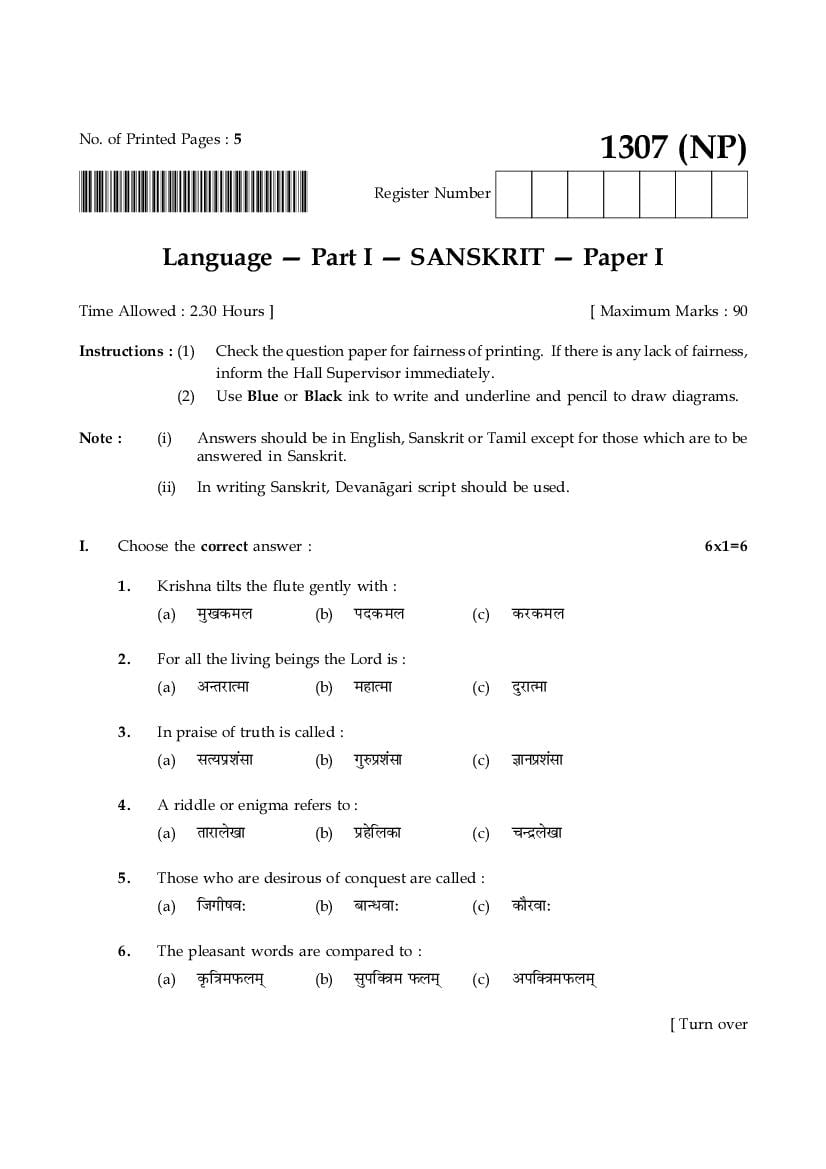
TN 12th Model Question Paper Sanskrit Paper I is available here for free download. Published by Tamil Nadu Board for Class 12, this sample paper can be viewed online or downloaded as a PDF (5 pages). Candidates preparing for Class 12 can use TN 12th Model Question Paper Sanskrit Paper I to understand the exam pattern, the type of questions asked, and the overall difficulty level.
Frequently Asked Questions
How can I download TN 12th Model Question Paper Sanskrit Paper I?
Open this page and click the Download button to save TN 12th Model Question Paper Sanskrit Paper I as a PDF. It is completely free on AglaSem Docs.
Is TN 12th Model Question Paper Sanskrit Paper I free to download?
Yes. TN 12th Model Question Paper Sanskrit Paper I can be viewed online and downloaded as a PDF free of cost on AglaSem Docs.
How many pages does TN 12th Model Question Paper Sanskrit Paper I have?
TN 12th Model Question Paper Sanskrit Paper I contains 5 pages, which you can read online or download together as a single PDF.
Where can I find more Class 12 study material?
You can find more Class 12 question papers, sample papers, syllabus, and answer keys on AglaSem Docs.
TN 12th Model Question Paper Sanskrit Paper I – Text
Read the full text of this sample paper below — useful to quickly search, copy and reference the content online without downloading the PDF.
📄 View text version (5 pages)
Page 1
1307 (NP)
!1307NPSanskritPaperI! Register Number
Language — Part I — SANSKRIT — Paper I
Time Allowed : 2.30 Hours ] [ Maximum Marks : 90
Instructions : (1) Check the question paper for fairness of printing. If there is any lack of fairness,
inform the Hall Supervisor immediately.
(2) Use Blue or Black ink to write and underline and pencil to draw diagrams.
Note : (i) Answers should be in English, Sanskrit or Tamil except for those which are to be
answered in Sanskrit.
(ii) In writing Sanskrit, Devana-gari script should be used.
I. Choose the correct answer : 6x1=6
1. Krishna tilts the flute gently with :
(a) ◊Èπ∑§◊‹ (b) ¬Œ∑§◊‹ (c) ∑§⁄U∑§◊‹
2. For all the living beings the Lord is :
(a) •ãÃ⁄UÊà◊Ê (b) ◊„Êà◊Ê (c) ŒÈ⁄UÊà◊Ê
3. In praise of truth is called :
(a) ‚àÿ¬˝‡Ê¥‚Ê (b) ªÈL§¬˝‡Ê¥‚Ê (c) ôÊÊŸ¬˝‡Ê¥‚Ê
4. A riddle or enigma refers to :
(a) ÃÊ⁄UÊ‹πÊ (b) ¬˝„Á‹∑§Ê (c) øãŒ˝‹πÊ
5. Those who are desirous of conquest are called :
(a) Á¡ªË·fl— (b) ’ÊãœflÊ— (c) ∑§ÊÒ⁄UflÊ—
6. The pleasant words are compared to :
(a) ∑ΧÁòÊ◊»§‹◊˜ (b) ‚ȬÁÄòÊ◊ »§‹◊˜ (c) •¬ÁÄòÊ◊»§‹◊˜
[ Turn over
Page 2
II. Choose the correct answer : 8x1=8
7. In the garden Nala caught hold of a bird :
(a) Á¬∑§— (b) ∑§Ê∑§— (c) „¥‚—
8. Lord Indra is also called as :
(a) ø∑˝§Ë (b) ‡Ê∑˝§— (c) ø∑˝§—
9. Daughter of ⁄UÊ¡◊ÊÃÊ is :
(a) ‚ÈŸãŒÊ (b) fl‚ãÃÊ (c) ‚ȪãœÊ
10. The Gods asked Nala to act as a :
(a) ŒÍ× (b) ‚fl∑§— (c) ‚Ê⁄UÁÕ—
11. After the incident with Karkotaka serpent, Nala changed his name as :
(a) OSfl— (b) ÁøòÊ∑§— (c) ’Ê„È∑§—
12. The Parvan where the story of Nala and Damayanti occurs is :
(a) ‚÷ʬfl¸Ÿ˜ (b) ’Ÿ¬fl¸Ÿ˜ (c) •ÊÁŒ¬fl¸Ÿ˜
13. Sage Veda Vyasa is originally called as :
(a) ¬⁄UʇÊ⁄U— (b) ‡ÊÁÄ× (c) ∑ΧcáÊmÒ¬ÊÿŸ—
14. The word Vaakdevi refers to Goddess :
(a) ¬Êfl¸ÃË (b) ‹ˇ◊Ë (c) ‚⁄USflÃË
III. (A) Short questions. Answer any three. 3x2=6
15. Ÿ ÁœÿÊ¥ ¬ÁÕ flø‚– How ?
16. Explain ⁄UÊ‚∑˝§Ë«UÊ–
17. What is the nature of divine and demoniac qualities ?
18. Why should one control his senses ?
Page 3
(B) Short answer. Answer any two. 2x2=4
19. What was the request of Damayanti to the Swan ?
20. Who was Ÿ‹—? Which country was ruled by him ?
21. What was the curse given by Narada to ∑§∑§Ê¸≈U∑§—?
IV. Short questions. Answer any seven. 7x2=14
22. Write meanings for :
(i) ∑§ÊÃ⁄U— (ii) fláÊÈ—
(iii) •ÊŒ⁄U— (iv) ∑ͧ◊¸—
23. Write any two grammatical peculiarities.
(i) Áfl¡ÿà (ii) •äÿÊS◊„¬Œ◊˜ (iii) ª⁄UËÿ‚Ë
24. Identify any two grammatical forms.
(i) π‹È (ii) ‚ΡÁà (iii) Œfl
25. Combine any two.
(i) ÿØ + ø (ii) Ÿ + •¥‡ÊÈ◊ÃÊ (iii) ÿ— + Ãfl
26. Split any two.
(i) ∑§Ê˘÷ÍØ (ii) ŸÊ¬⁄U◊˜ (iii) ÿŒÇŸÊÒ
27. Dissolve any two.
(i) ¡ªŒ˜ªÈL§◊˜ (ii) œ⁄UáÊËœ⁄U— (iii) ⁄UÊ·◊ÿ◊˜
28. Compound any two.
(i) ¬‡ÊÍŸÊ¥ ¬Á× (ii) ÁŸ‡ÊÿÊ ∑ΧÃ◊˜ (iii) •Êà◊Ÿ— •ã×
29. Antonyms (any two) :
(i) •œ◊¸— (ii) „ãÃÊ (iii) ∑˝§Êœ—
30. What are the two dictions of poet Bharathi ?
[ Turn over
Page 4
V. (A) Answer briefly any two. 2x4=8
31. Which is a real ornament ?
32. How should the tongue praise Krishna ?
33. Give the puzzle for ŸÊÁ⁄U∑§‹—
(B) Answer briefly any two. 2x4=8
34. Describe the conversation between Narada and Indra.
35. What are the Eight boons granted by Gods to Nala ?
36. Describe the conversation between Kali and Indra ?
VI. Answer the following : 3x4=12
37. Decline any one :
(i) Œ∑§Ê⁄UÊã× ÿÈc◊Œ˜ ‡Ê錗
(ii) Ã∑§Ê⁄UÊã× ◊L§Ã˜ ‡Ê錗
Conjugate any two :
38. ÷Í (÷fl˜) in ÁflÁœÁ‹æ˜§ (Potential Mood)
39. ª◊˜ (ªë¿˜U) in Á‹≈˜U (Past Perfect)
40. ‹÷˜ in ‹Ê≈˜U (Imperative Mood)
VII. (A) Answer in detail. 2x6=12
41. Quote and explain any three riddles from the lesson ¬˝„Á‹∑§Ê–
OR
Summarize the greatness of ÁflÁœ—, ‹Ê÷—, áSflË–
42. Describe the conversation between Merchants and Damayanti.
OR
Describe the conversation between Gods and Nala.
Page 5
(B) 43. Translate into Tamil or English any two. 1x6=6
(i) ‚àÿ◊∑§Ê¸ìÊ ‚Ê◊ÊìÊ ¬⁄U◊äÿÊS◊„ ¬Œ◊˜–
•l ÃÍìÊÒSÃ⁄¥U ÃÊèÿÊ¥ S◊⁄UáÊʟȪ˝„ÊãÃflH
(ii) •ôÊÊŸÁÃÁ◊⁄UÊãœSÿ ôÊÊŸÊÜ¡Ÿ‡Ê‹Ê∑§ÿÊ–
øˇÊÈL§ã◊ËÁ‹Ã¥ ÿŸ ÃS◊Ò üÊË ªÈ⁄Ufl Ÿ◊—H
(iii) ◊Ÿ‚Ê ÁøÁãÃÃ¥ ∑§ÊÿZ flø‚Ê Ÿ ¬˝∑§Ê‡ÊÿØ–
◊ãòÊ⁄UˇÊáʪͅUÊà◊Ê ∑§Êÿ¸Á‚Áh¥ ¬˝∑§Ê‡ÊÿØH
OR
Translate :
ªÊŒÊfl⁄UË ŸlÊ— ÃË⁄U ◊„ÊŸ˜ fl≈UflÎˇÊ— •Ê‚ËØ– ÃSÿ ‡ÊÊπÊ‚È ∑ȧ‹ÊÿÊŸ˜ Áfl⁄Uëÿ ’„fl— ¬ÁˇÊáÊ— ÃòÊ
‚ÈπŸ ÁŸfl‚Ÿ˜– ∞∑§ŒÊ fl·Ê¸∑§Ê‹ ∑§‡øŸ flÊŸ⁄UÊáÊÊ¥ ‚◊Í„— ÃòÊ •Êªàÿ ÁŸflÊ‚ÊÕZ flΡÊSÿ ◊Í‹¥
‚◊ȬÊüÊÿØ– ¬¡¸ãÿ— ◊„àÿÊ œÊ⁄UÿÊ •fl·¸Ã˜– ∑§¬ÿ— ø‡ÊÒàÿŸ ∑§ê¬◊ÊŸÊ— ’÷ÍflÈ—– flÎˇÊ·È ÁŸfl‚à‚È
πª·È ∑§‡øŸ flÊŸ⁄U·È ŒÿÊ¥ ∑ΧàflÊ ÃÊŸ˜ •’˝flËØ „ ÷˝ÊÃ⁄U— flÿ◊˜ •S◊Ê∑¥§ ŸË«U·È ‚Èπ¥ fl‚Ê◊—– fl—
Ÿ⁄UÊáÊÊ◊˜ ßfl „SÃÊҬʌÊÒ ø ‚ÁãÖ Ã× ÿÍÿ¥ •S◊ŒËÿèÿ— •Á¬ ŒÎ…UÃ⁄UÊŸ˜ ªÎ„ÊŸ˜ Sflÿ◊fl ÁŸ◊ʸÃÈ¥
‡ÊÄŸÈÕ– ∞fl¥ ‚Áà Á∑§◊ÕZ ÁŸflÊ‚⁄UÁ„ÃÊ— ∑§c≈¥U •ŸÈ÷fl Õ? ßÁÖ ÷ʥ ©¬Œ‡Ê¥ üÊÈàflÊ flÊŸ⁄UÊ—
Áfl„ªèÿ— •ÃËfl ∑§Ê¬ÊÁflc≈UÊ— •÷flŸ˜– à flÎˇÊ¥ •ÊL§s Áfl„ªÊŸÊ¥ ∑ȧ‹ÊÿÊŸ˜ ŸÊ‡ÊÿÊ◊Ê‚È—H
H ŒÈ¡¸ŸÊŸÊ¥ ∑ΧÃÊ— ‚ŒÈ¬Œ‡ÊÊ— ¬˝∑§Ê¬Êÿ ∞fl ∑§À¬ãÃH
VIII. 44. Explain any two with reference to the context. 2x3=6
(a) ¬˝ˇÊËáÊ¥ à ŒÈ—π◊˜–
(b) ÿÕÊ Ã ◊Ã¥ ÃÕÊ ∑§⁄UÊÁ◊–
(c) •ŸŸ ¡cÿÊÁ◊ •l ¡cÿÊÁ◊–
-o0o-
Document Details
| Board / Org | Tamil Nadu Board |
| Exam | Class 12 |
| Type | Sample Paper |
| Pages | 5 |
| Updated | 22 Jul 2026 |