NCERT Book Class 9 Social Science (Economics) Chapter 1 The Story of Village Palampur
Finished viewing? Save it for later —
Download NCERT Book Class 9 Social Science (Economics) Chapter 1 The Story of Village Palampur (PDF · 15 pages)About NCERT Book Class 9 Social Science (Economics) Chapter 1 The Story of Village Palampur
NCERT Book Class 9 Social Science (Economics) Chapter 1 The Story of Village Palampur is available here for free download. Published by NCERT for Class 9, this books can be viewed online or downloaded as a PDF (15 pages). Candidates preparing for Class 9 can use NCERT Book Class 9 Social Science (Economics) Chapter 1 The Story of Village Palampur to understand the exam pattern, the type of questions asked, and the overall difficulty level.
Frequently Asked Questions
How can I download NCERT Book Class 9 Social Science (Economics) Chapter 1 The Story of Village Palampur?
Open this page and click the Download button to save NCERT Book Class 9 Social Science (Economics) Chapter 1 The Story of Village Palampur as a PDF. It is completely free on AglaSem Docs.
Is NCERT Book Class 9 Social Science (Economics) Chapter 1 The Story of Village Palampur free to download?
Yes. NCERT Book Class 9 Social Science (Economics) Chapter 1 The Story of Village Palampur can be viewed online and downloaded as a PDF free of cost on AglaSem Docs.
How many pages does NCERT Book Class 9 Social Science (Economics) Chapter 1 The Story of Village Palampur have?
NCERT Book Class 9 Social Science (Economics) Chapter 1 The Story of Village Palampur contains 15 pages, which you can read online or download together as a single PDF.
Where can I find more Class 9 study material?
You can find more Class 9 question papers, sample papers, syllabus, and answer keys on AglaSem Docs.
NCERT Book Class 9 Social Science (Economics) Chapter 1 The Story of Village Palampur – Text
Read the full text of this books below — useful to quickly search, copy and reference the content online without downloading the PDF.
📄 View text version (1 page)
Page 1
Chapter The Story of Village Palampur
Overview
The purpose of the story is to introduce
some basic concepts relating to production
and this we do through a story of a
hypothetical village called Palampur.*
Farming is the main activity in
Palampur, whereas several other
activities such as small scale
manufacturing, dairy, transport, etc. are
carried out on a limited scale. These
production activities need various types
of resources — natural resources, man-
made items, human effort, money, etc. As
we read through the story of Palampur,
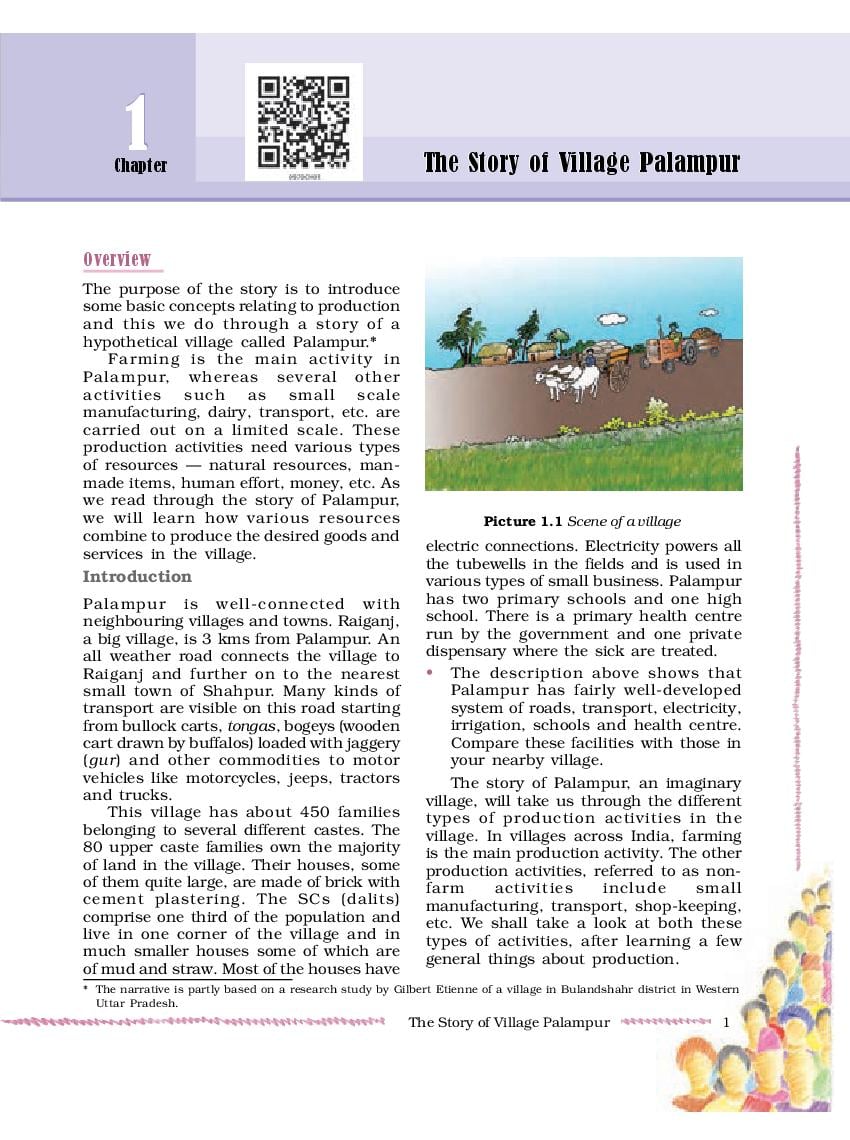
we will learn how various resources Picture 1.1 Scene of a village
combine to produce the desired goods and
electric connections. Electricity powers all
services in the village.
the tubewells in the fields and is used in
Introduction various types of small business. Palampur
Palampur is well-connected with has two primary schools and one high
neighbouring villages and towns. Raiganj, school. There is a primary health centre
a big village, is 3 kms from Palampur. An run by the government and one private
all weather road connects the village to dispensary where the sick are treated.
Raiganj and further on to the nearest • The description above shows that
small town of Shahpur. Many kinds of Palampur has fairly well-developed
transport are visible on this road starting system of roads, transport, electricity,
from bullock carts, tongas, bogeys (wooden irrigation, schools and health centre.
cart drawn by buffalos) loaded with jaggery Compare these facilities with those in
(gur) and other commodities to motor your nearby village.
vehicles like motorcycles, jeeps, tractors The story of Palampur, an imaginary
and trucks. village, will take us through the different
This village has about 450 families types of production activities in the
belonging to several different castes. The village. In villages across India, farming
80 upper caste families own the majority is the main production activity. The other
of land in the village. Their houses, some production activities, referred to as non-
of them quite large, are made of brick with farm activities include small
cement plastering. The SCs (dalits) manufacturing, transport, shop-keeping,
comprise one third of the population and etc. We shall take a look at both these
live in one corner of the village and in types of activities, after learning a few
much smaller houses some of which are general things about production.
of mud and straw. Most of the houses have
* The narrative is partly based on a research study by Gilbert Etienne of a village in Bulandshahr district in Western
Uttar Pradesh.
The Story of Village Palampur 1
Showing the first page only. Download the PDF above for the complete document.
Document Details
| Board / Org | NCERT |
| Exam | Class 9 |
| Type | Books |
| Pages | 15 |
| Updated | 30 Apr 2026 |