Odisha CPET 2021 Question Paper Social Work
Finished viewing? Save it for later —
Download Odisha CPET 2021 Question Paper Social Work (PDF · 12 pages)About Odisha CPET 2021 Question Paper Social Work
Odisha CPET 2021 Question Paper Social Work is available here for free download. Published by Odisha Exams for Odisha CPET, this question paper can be viewed online or downloaded as a PDF (12 pages). Candidates preparing for Odisha CPET can use Odisha CPET 2021 Question Paper Social Work to understand the exam pattern, the type of questions asked, and the overall difficulty level.
Frequently Asked Questions
How can I download Odisha CPET 2021 Question Paper Social Work?
Open this page and click the Download button to save Odisha CPET 2021 Question Paper Social Work as a PDF. It is completely free on AglaSem Docs.
Is Odisha CPET 2021 Question Paper Social Work free to download?
Yes. Odisha CPET 2021 Question Paper Social Work can be viewed online and downloaded as a PDF free of cost on AglaSem Docs.
How many pages does Odisha CPET 2021 Question Paper Social Work have?
Odisha CPET 2021 Question Paper Social Work contains 12 pages, which you can read online or download together as a single PDF.
Where can I find more Odisha CPET study material?
You can find more Odisha CPET question papers, sample papers, syllabus, and answer keys on AglaSem Docs.
Odisha CPET 2021 Question Paper Social Work – Text
Read the full text of this question paper below — useful to quickly search, copy and reference the content online without downloading the PDF.
📄 View text version (10 pages)
Page 1
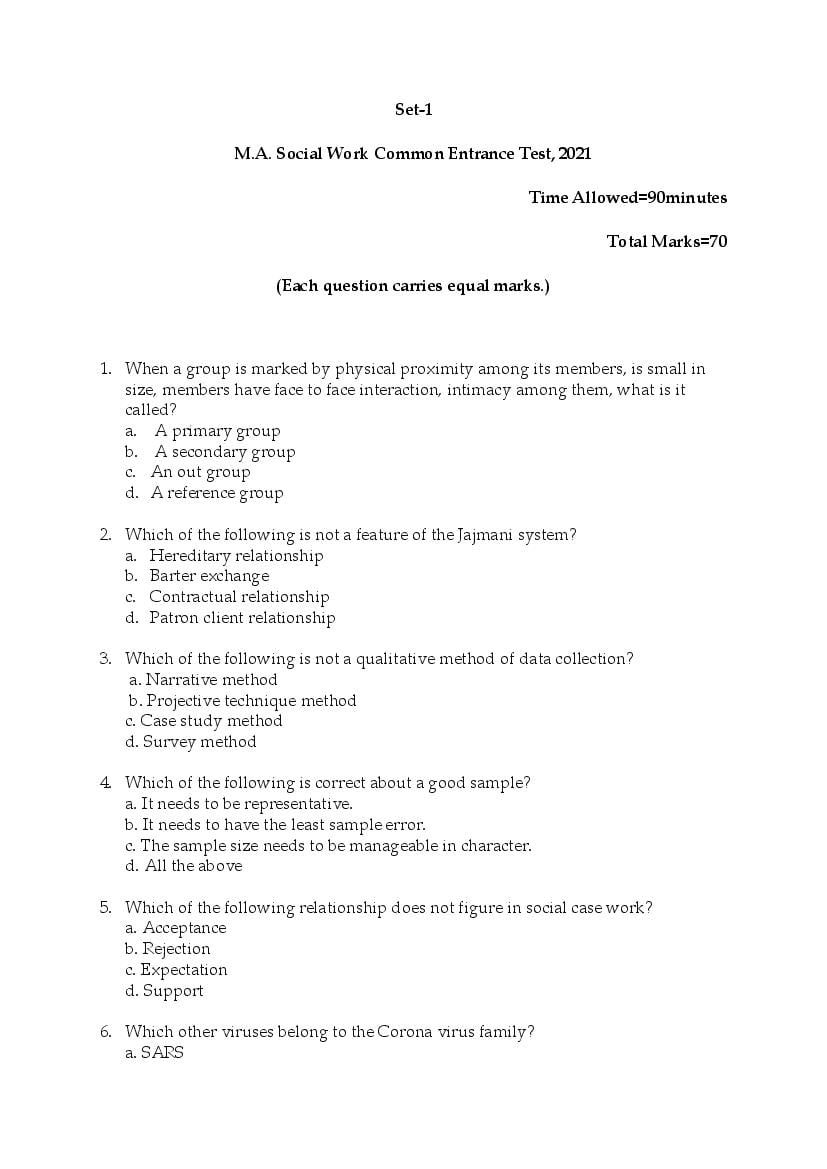
M.A. Social Work Common Entrance Test, 2021
Time Allowed=90minutes
Total Marks=70
(Each question carries equal marks.)
1. When a group is marked by physical proximity among its members, is small in
size, members have face to face interaction, intimacy among them, what is it
called?
a. A primary group
b. A secondary group
c. An out group
d. A reference group
2. Which of the following is not a feature of the Jajmani system?
a. Hereditary relationship
b. Barter exchange
c. Contractual relationship
d. Patron client relationship
3. Which of the following is not a qualitative method of data collection?
a. Narrative method
b. Projective technique method
c. Case study method
d. Survey method
4. Which of the following is correct about a good sample?
a. It needs to be representative.
b. It needs to have the least sample error.
c. The sample size needs to be manageable in character.
d. All the above
5. Which of the following relationship does not figure in social case work?
a. Acceptance
b. Rejection
c. Expectation
d. Support
6. Which other viruses belong to the Corona virus family?
a. SARS
Page 2
c. Both a and b
d. None
7. Panchayati Raj institutes in India have brought about which one of the following?
a. Eradication of untouchability
b. Spread of land ownership to depressed classes
c. Spread of education to the masses
d. Formal representation of the weaker sections in village governance
8. Which of the following pairs does not match correctly ?
a. Thomas Hobbes Social Contract Theory
b. Max Weber Cyclical Theory of Social Change
c. Sigmund Freud Psychoanalysis
d. Adam Smith Laissez faire
9. In which year the “Protection of Women from Domestic Violence Act” came into
force?
a. 2005
b.2006
c.2007
d.2008
10. Which of the following Acts is exclusively child related in nature?
a. Domestic violence Act
b. Equal remuneration Act
c. Maternity benefit Act
d. Juvenile Justice Act
11. From which of the following Constitutions, India borrowed the Directive
Principles of State Policy?
a. Irish Constitution
b. Australian Constitution
c. British Constitution
d. American Constitution
12. Which amendment Act added the three words” Socialist, Secular and Integrity´
into the Preamble of the Indian Constitution?
a. 37th Amendment act
b. 40th Amendment act
c. 42nd Amendment act
d. 44th Amendment act
13. Who allocates the election symbols to political parties for an election in India?
a. The Political Party
b. The Election Commission
Page 3
d. The President
14. Which is the first country to give voting right to women?
a. India
b. England
c. New Zealand
d. America
15. What happens to the Fundamental Rights of the citizens in India during an
emergency arising out of any external aggression?
a. They are suspended
b. They are terminated
c. They are not touched
d. They are given additional importance
16. The Human Development Report is brought out every year by :
a. The World Bank
b. The UNDP
c. The Oxfam
d. The Harvard University
17. Vandana Shiva, an Indian activist and environmentalist, is best known for:
a. Protecting seed diversity and preserving India’s agricultural heritage
b. Placing women and ecology at the heart of the debate on modern development
c. Her book Biopiracy: The Plunder of Nature and Knowledge
d. All of the above
18. Government can make Globalization more “fair” by :
a. Increasing market competition
b. Implementing the Goods and Services Tax
c. Implementing Labour Laws
d. Attracting Foreign Direct Investment
19. The term “Islam” means
a. Submission
b. Forgiveness
c. Thankfulness
d. Salvation
20. Which of the following pairs does not match correctly?
a. The Hindu Widows’ Remarriage Act, 1856 Ishwar Chandra
Vidyasagar
b. Amitate Father’s sister is given greater importance than the mother
c. The Central Waqf Council in India Administration of Auqaf
d. Quantitave Research Case Study
Page 4
a. Primitive and Vulnerable Tribal Group
b. Protection for Vulnerable Tribal Group
c. Particularly Vulnerable Tribal Group
d. Politically Vulnerable Tribal Group
22. Which of the following statements is not correct relating to the difference
between a caste and a tribe?
a. A caste has its own language while tribes follow a common language.
b. Occupational mobility is restricted in the caste system, but occupational
mobility is unrestricted in a tribal group.
c. Caste is a social and cultural group while a tribe is a territorial group.
d. A caste society is hierarchical while a tribal group is egalitarian.
23. How many tribal communities are there in Odisha?
a.58
b.59
c.61
d.62
24. Science aims to be both:
a. Philosophical and Progressive
b. Complex and Against Common Sense
c. Valid and Reliable
d. Experimental and Statistical
25. The Digital India Programme seeks to:
a. Transform India into a digitally empowered society and knowledge economy
b. Transform governance and Services and provide integrated government
services online and mobile platforms
c. Strengthen the Digital Infrastructure as a Utility to Every Citizen and promote
digital empowerment of citizens
d. All of the above
26. What are Mean, Median and Mode called?
a. Measures of control tendencies
b. Measures of deviation
c. Measures of central tendency
d. Sampling techniques
27. What does Action research imply?
a. Research intended to develop theories.
b. Research conducted to get statistical information.
c. An impact assessment research.
Page 5
28. Which of the following is not a research design?
a. Cohort
b. Experimental
c. Diagnostic
d. Exploratory
29. Which of the following is not a characteristic of scientific research?
a. Predictability
b. Objectivity
c. Subjectivity
d. Validity
30. Which of the following is the role of hypothesis in social research?
a. It gives direction to a research.
b. It biases a research.
c. It makes the research complicated.
d. None of the above
31. Which among the following is not a probability sampling?
a. Simple random sampling
b. Convenience sampling
c. Stratified random sampling
d. Cluster sampling
32. Which of the following pairs do not match ?
a. Ijab-e-Qubul The groom’s proposal and bride’s acceptance in a Muslim
marriage
b. Nikā-nāmah The document of the Muslim marriage contract
c. Tafweedh-e-Talaq Divorce by Wife
d. Talaq-e-Mughallazah Revocable Divorce
33. Which of the following is a skill required for Group work?
a. Skill in analysing group situation
b. Skill in dealing with group feeling
c. Skill in establishing a relationship
d. All of the above
34. “Controlled Group” is a term used in:
a. Survey research
b. Historical research
c. Experimental research
d. Descriptive research
35. What does NACO stand for?
A. National Authority of Counselling Organisations
b. National AIDS Control Organization
c. National AIDS Collaboration Organization
Page 6
36. In which year the Universal Declaration of Human Rights was adopted by the
U.N. General Assembly?
a.1945
b.1946
c.1948
d.1950
37. In which year, the United Nations Convention on the Rights of the Child was
adopted?
a.1979
b.1989
c.1999
d.2009
38. In which year Odisha became a Separate Province on the basis of language?
a.1932
b.1934
c.1936
d.1938
39. “Home Visit” is a tool used in:
a. Social Group work
b. Social Case Work
c. Social Work Research
d. Social Welfare Administration
40. Which of the following key concept was introduced by Paulo Freire?
a. Ladder of Participation
b. Eyes on the Street
c. Conscintization
d. both a and b
41. Who could be named as the father of Client centered therapy?
a. Carl Rogers
b. William Beverigde
b. Jane Jacobs
d. Mary Richmond
42. What did the First five Year Plan of India stress on?
a. Industry
b. Creation of services
c. Agriculture
d. Development of science and Technology
43. The motto “Help without alms” is associated with :
a. Thomas Chalmers
b. Octavia Hill`
Page 7
d. None of the above
44. What is the basic ethical principle of Social Work ?
a. Dignity of the Person
b. Social Justice
c. Service with integrity, and competence
d. All of the above
45. Which type of authority did Gandhiji possess?
a. Rational legal
b. Traditional
c. Charismatic
d. All the above
46. Who commented that “The history of all hitherto existing societies is the history
of class struggle”?
a. Marx Weber
b. Karl Marx
c. Newman
d. Dahrendorf
47. In which year the Protection of Women from Domestic Violence Act was enacted
in India?
a. 2001
b.2003
c.2005
d.2007
48. The historical origins of the Red Cross can be traced back to:
a. Jean Henri Dunant
b. Carl Rogers
c. William Henry Beveridge
d. Jane Addams
49. Who of the following is known for his theory of Social capital as an active
ingredient of social welfare ?
a. Jane Jacobs
b. Ann Hartmann
c. Erving Goffman
d. Robert Putnam
50. In which year the Champaran Satyagraha was launched?
a.1917
b.1920
c.1927
d.1930
51. The goal of social work is:
Page 8
b. To provide services to all
c. To motivate the donors
d. To promote social justice
52. When a number appears maximum time in a series, it is called?
a. Mean
b. Mode
c. Median
d. Correlation
53. Which of the following observation methods is more likely to bring out more in-
depth data and information?
a. Participant observation method
b. Non participant observation method
c. Controlled observation
d. All the above
54. One is not born but rather becomes a woman. Who said this?
a. John Stuart Mill
b. Betty Friedan
c. Simone de Beauvoir
d. Sarojini Naidu
55. Who among the following suggested the theory of cultural lag?
a. C.H. Cooley
b. William Ogburn
c. G.H. Mead
d. George Homans
56. Theories must be ________ :
a. Formulated prior to research
b. Issue-Driven
c. Testable
d. Macro-sociological
57. Which among the following is a child centric programme?
a. ICDS
b. IAY
c. MGNREGA
d. All the above
58. Who among the followings is associated with “green revolution”?
a. VerghesKurien
b. M.S. Swaminathan
c. Norman Borlaug
d. None of the above
Page 9
a. Mahatma Gandhi
b. DadabhaiNaoroji
c. Acharya Binova Bhave
d. Maulana Abdul Kalam
60. In which year the Community Development Programme was launched in India?
a.1950
b.1952
c.1955
d. 1957
61. Who among the following was a pioneer and an ardent advocate of women’s
education in India?
a. Rabindranath Tagore
b. Jyotiba Phule
c. Jaya Prakash Narayan
d. Atal Bihari Bajpai
62. The three-tier system of Panchayati Raj was recommended by
a. Kaka Kalekar Committee
b. Simon Commission
c. Balwant Rai Mehta Committee
d. Jai Prakash Narain Committee
63. What is meant by sex-ratio?
a. The relation between male and female
b. The ratio between the number of adult male and adult females in a population
c. The number of females per 1000 males in a population
d. The ratio between number of female and number of male in a population
64. Group members can help minimize conflict by
a. creating harmony in the group by agreeing with other group members
b. being aware of what stage of group formation the group is passing through
c. aiming for cultural consensus
d. being respectful of other’s ideas and culture and aiming for consensus
65. The whole from which a sample is drawn is called as
a. Base
b. Whole
c. Universe
d. None of the above
66. The descendants of common male ancestor are called_______.
a. agnates
b. cognates
c. lineal kins
d. collateral kins
Page 10
atrocious?
a. Asura marriage
b. Gandharva marriage
c. Paishacha marriage
d. Raksasha marriage
68. Primitive societies are characterised more by _______ terms in kinship.
a. Classificatory
b. Ambiguous
c. Descriptive
d. Deceptive
69. Under which article of the Indian Constitution, a National Commission for
Scheduled Tribes is established?
a. Art.330
b. Art.338(A)
c. Art.334
d. Art.335
70. The Theory of Demographic transition includes:
a. High birthrate and high death rate
b. Rapidly falling death rate and high birthrate
c. Low birthrate and low death rate
d. All the above
*******
Document Details
| Board / Org | Odisha Exams |
| Exam | Odisha CPET |
| Type | Question Paper |
| Pages | 12 |
| Updated | 22 Jul 2026 |