Karnataka 1st PUC Model Question Paper 2022 for Physics
Finished viewing? Save it for later —
Download Karnataka 1st PUC Model Question Paper 2022 for Physics (PDF · 6 pages)About Karnataka 1st PUC Model Question Paper 2022 for Physics
Karnataka 1st PUC Model Question Paper 2022 for Physics is available here for free download. Published by Karnataka Board for Class 11, this sample paper can be viewed online or downloaded as a PDF (6 pages). Candidates preparing for Class 11 can use Karnataka 1st PUC Model Question Paper 2022 for Physics to understand the exam pattern, the type of questions asked, and the overall difficulty level.
Frequently Asked Questions
How can I download Karnataka 1st PUC Model Question Paper 2022 for Physics?
Open this page and click the Download button to save Karnataka 1st PUC Model Question Paper 2022 for Physics as a PDF. It is completely free on AglaSem Docs.
Is Karnataka 1st PUC Model Question Paper 2022 for Physics free to download?
Yes. Karnataka 1st PUC Model Question Paper 2022 for Physics can be viewed online and downloaded as a PDF free of cost on AglaSem Docs.
How many pages does Karnataka 1st PUC Model Question Paper 2022 for Physics have?
Karnataka 1st PUC Model Question Paper 2022 for Physics contains 6 pages, which you can read online or download together as a single PDF.
Where can I find more Class 11 study material?
You can find more Class 11 question papers, sample papers, syllabus, and answer keys on AglaSem Docs.
Karnataka 1st PUC Model Question Paper 2022 for Physics – Text
Read the full text of this sample paper below — useful to quickly search, copy and reference the content online without downloading the PDF.
📄 View text version (6 pages)
Page 1
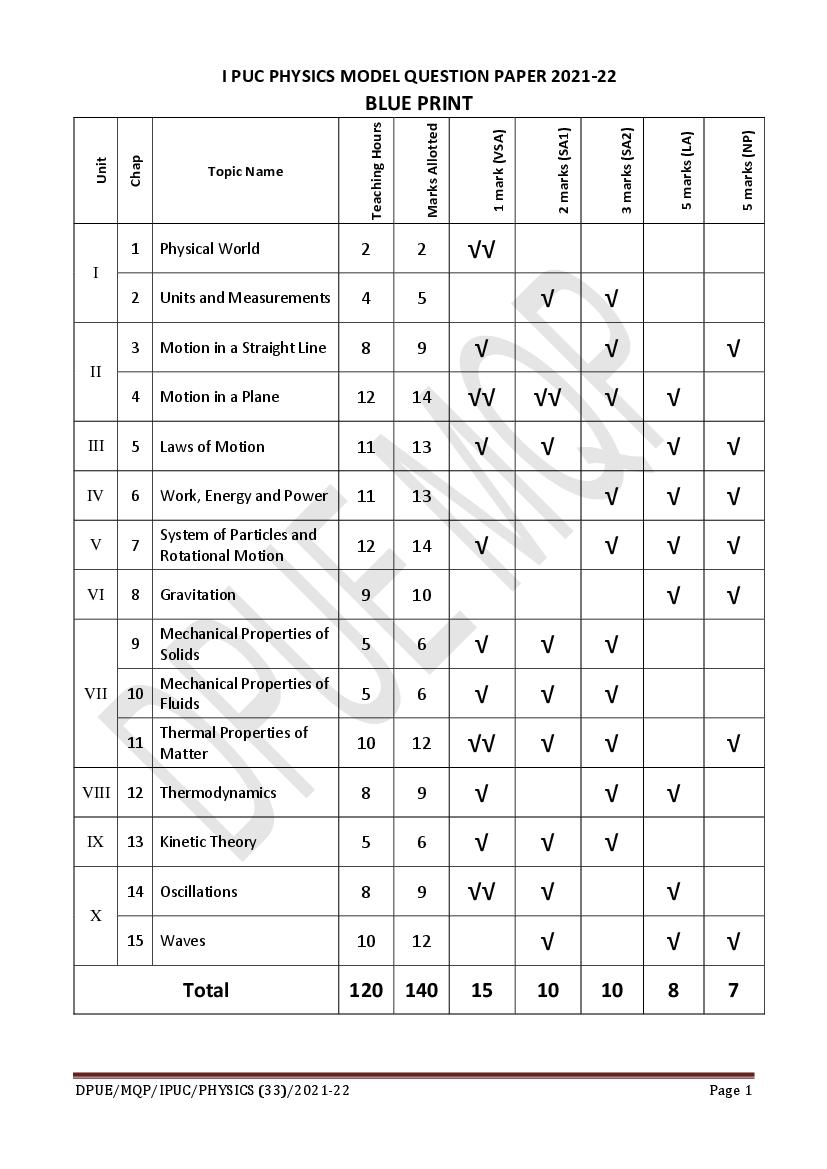
BLUE PRINT
Teaching Hours
Marks Allotted
2 marks (SA1)
3 marks (SA2)
1 mark (VSA)
5 marks (NP)
5 marks (LA)
Chap
Unit
Topic Name
1 Physical World 2 2 √√
I
2 Units and Measurements 4 5 √ √
3 Motion in a Straight Line 8 9 √ √ √
II
4 Motion in a Plane 12 14 √√ √√ √ √
III 5 Laws of Motion 11 13 √ √ √ √
IV 6 Work, Energy and Power 11 13 √ √ √
System of Particles and
V 7
Rotational Motion
12 14 √ √ √ √
VI 8 Gravitation 9 10 √ √
Mechanical Properties of
9
Solids
5 6 √ √ √
Mechanical Properties of
VII 10
Fluids
5 6 √ √ √
Thermal Properties of
11
Matter
10 12 √√ √ √ √
VIII 12 Thermodynamics 8 9 √ √ √
IX 13 Kinetic Theory 5 6 √ √ √
14 Oscillations 8 9 √√ √ √
X
15 Waves 10 12 √ √ √
Total 120 140 15 10 10 8 7
DPUE/MQP/IPUC/PHYSICS (33)/2021-22 Page 1
Page 2
MODEL QUESTION PAPER - 2022
I PUC PHYSICS (33)
Time Duration: 3 Hrs 15 Minutes Max. Marks: 70
Instructions:
1. All parts are compulsory.
2. Answers without relevant diagram/figure/circuit wherever necessary will not carry any
marks.
3. Direct answers to the numerical problems without writing the relevant formula and detailed
solutions will not carry any marks.
PART- A
I. Answer any TEN of the following questions: 10 × 1 = 10
1. Name the domain of Physics which includes phenomena at the laboratory and astronomical
scales.
2. Which is the strongest fundamental force in nature?
3. Define displacement of a particle.
4. Write the magnitude of ̂ .
5. For what angle of projection, range of a projectile is maximum?
6. State Aristotelian law of motion.
7. Mention the expression for centre of mass of a system of two particles lying in a straight line.
8. In given materials steel, brass and copper, which is more elastic?
9. What is Magnus effect?
10. Give the meaning of sublimation.
11. Mention the SI unit of thermal conductivity.
12. Write the statement of Zeroth law of thermodynamics.
13. On what factor does the mean free path of a gas molecule depend?
14. Give an example for periodic motion.
15. What are free oscillations?
PART- B
II. Answer any FIVE of the following questions: 5 × 2 = 10
16. Write the number of significant figures in 2.386 and 0.0340
17. Distinguish between scalars and vectors.
18. What is centripetal acceleration? Give the expression for it.
19. Mention any two advantages of friction.
20. State and explain Hooke’s law.
21. Write the expression for capillary rise of liquid and explain the terms.
22. Convert 1000 C into Fahrenheit and Kelvin scale of temperature.
23. Mention the degrees of freedom for (i) monatomic molecule and (ii) diatomic molecule.
24. Draw the graphs to represent the (i) variation of displacement and (ii) variation of velocity
with time for a particle undergoing SHM.
25. What are nodes and antinodes in standing waves?
DPUE/MQP/IPUC/PHYSICS (33)/2021-22 Page 2
Page 3
III. Answer any FIVE of the following questions: 5 × 3 = 15
26. Write two applications and one limitation of dimensional analysis.
27. a) Define relative velocity of an object with respect to another and
b) Draw position-time graphs of two objects moving along a straight line when their relative
velocity is (i) zero and (ii) non-zero.
28. Obtain the expression for the time of flight of a projectile.
29. Derive the expression ⃗ ⃗ , where the symbols have usual meaning.
30. Show that torque is equal to rate of change of angular momentum of a particle.
31. Define i) Young’s modulus ii) Shear modulus and iii) Bulk modulus of elasticity.
32. State Pascal’s law. Mention any two applications of Pascal’s law.
33. Obtain for ideal gas, where symbols have usual meaning.
34. Derive an expression for the work done in an isothermal process.
35. State any three assumptions of kinetic theory of gases.
PART- D
IV. Answer any TWO of the following questions: 2 × 5 = 10
36. Derive the expression for magnitude and direction of the resultant of two concurrent vectors
making an angle of θ between them.
37. State and prove the law of conservation of linear momentum using Newton’s laws of motion.
38. What is meant by inelastic collision? Obtain the expression for loss in kinetic energy in case
of completely inelastic collision in one dimension.
39. Define moment of inertia. State and explain (i) theorem of perpendicular axes and (ii)
theorem of parallel axes.
V. Answer any TWO of the following questions: 2 × 5 = 10
40. Derive the expression for acceleration due to gravity at a point below the surface (depth) of
the earth.
41. Explain Carnot’s cycle with a P-V diagram.
42. Arrive at the expression for the time period of oscillation of a simple pendulum.
43. Write Newton’s formula for speed of sound in a gas medium. Discuss Laplace’s correction
to it.
VI. Answer any THREE of the following questions: 3 × 5 = 15
44. A car moving along a straight highway with a speed of 126 is brought to a stop within
a distance of 200 m. Calculate the,
(i) retardation of the car by assuming it to be uniform and
(ii) time taken by the car to stop.
45. A circular racetrack of radius 300 m is banked at an angle of . If the coefficient of friction
between the wheels of a race car and the road is 0.2, find the,
(i) optimum speed of the race car to avoid wear and tear on its tyres, and
(ii) maximum permissible speed to avoid slipping.
46. A body of mass 0.1 kg falling freely under gravity takes 10 s to reach the ground. Calculate
the kinetic energy and potential energy of the body when it has travelled for first 6 s.
Given,
DPUE/MQP/IPUC/PHYSICS (33)/2021-22 Page 3
Page 4
5 gram are put one on top of the other at the 12.0 cm mark, the stick is found to be balanced
at 45.0 cm mark. Calculate the mass of the metre stick.
48. An artificial satellite is going round the earth, close to its surface. Find the,
(i) orbital velocity of the satellite and
(ii) time taken by it to complete one round.
Given, the radius of the earth is 6400 km and
49. A pan filled with hot food cools from in 2 minutes, when the room
temperature is at How long will it take to cool from
50. For travelling harmonic wave ( ) ( ); where x and y are in
cm and t is in second. Calculate the frequency and the speed of the wave. Also calculate the
distance between two successive crests in the wave.
*****
DPUE/MQP/IPUC/PHYSICS (33)/2021-22 Page 4
Page 5
I PUC PHYSICS (33)
Time: 3 Hours 15 Minutes (of which 15 minutes is for reading the question paper)
The weightage of the distribution of marks over different dimensions of the question paper is as
follows:
A. Weightage to Objectives:
Objective Weightage Marks
Knowledge 40% 56/140
Understanding 30% 42/140
Application 20% 28/140
Skill 10% 14/140
B. Weightage to Content/Subject Units:
Teaching Marks
Unit Chap Topic Name
Hours Allotted
1 Physical World 2 2
I
2 Units and Measurements 4 5
3 Motion in a Straight Line 8 9
II
4 Motion in a Plane 12 14
III 5 Laws of Motion 11 13
IV 6 Work, Energy and Power 11 13
V 7 System of Particles and Rotational Motion 12 14
VI 8 Gravitation 9 10
9 Mechanical Properties of Solids 5 6
VII 10 Mechanical Properties of Fluids 5 6
11 Thermal Properties of Matter 10 12
VIII 12 Thermodynamics 8 9
IX 13 Kinetic Theory 5 6
14 Oscillations 8 9
X
15 Waves 10 12
Total 120 140
Note:
Variation of 1 mark per chapter is allowed, however the total marks should not exceed 140.
DPUE/MQP/IPUC/PHYSICS (33)/2021-22 Page 5
Page 6
No of No of
Main
Part Type of question Marks questions to questions to be
Question
be set answer
A I Very Short Answer (VSA) 1 15 10
B II Short Answer (SA-1) 2 10 5
C III Short Answer (SA-2) 3 10 5
IV Long Answer (LA) 5 4 2
D V Long Answer (LA) 5 4 2
VI Numerical Problems (NP) 5 7 3
Total 50 37
Note:
1. Questions from 36 to 39 (Part-D, Main Question-IV) must be set from Unit I to V
2. Questions from 40 to 43 (Part-D, Main Question-V) must be set from Unit VI to X
3. Questions from 44 to 47 (Part-D, Main Question-VI) must be set from Unit I to V
4. Questions from 48 to 50 (Part-D, Main Question-VI) must be set from Unit VI to X
D. Weightage to level of difficulty:
Level Weightage Marks
Easy 40% 56/140
Average 40% 56/140
Difficult 20% 28/140
General Instructions:
1. Questions should be clear, unambiguous, understandable and free from grammatical errors.
2. Questions which are based on same concept, law, fact etc., and which generate the same
answer should not be repeated under different forms (VSA, SA, LA and NP).
*****
DPUE/MQP/IPUC/PHYSICS (33)/2021-22 Page 6
Document Details
| Board / Org | Karnataka Board |
| Exam | Class 11 |
| Type | Sample Paper |
| Pages | 6 |
| Updated | 22 Jul 2026 |