Odisha CPET 2021 Question Paper Wild Life and Biodiversity Conservation
Finished viewing? Save it for later —
Download Odisha CPET 2021 Question Paper Wild Life and Biodiversity Conservation (PDF · 10 pages)About Odisha CPET 2021 Question Paper Wild Life and Biodiversity Conservation
Odisha CPET 2021 Question Paper Wild Life and Biodiversity Conservation is available here for free download. Published by Odisha Exams for Odisha CPET, this question paper can be viewed online or downloaded as a PDF (10 pages). Candidates preparing for Odisha CPET can use Odisha CPET 2021 Question Paper Wild Life and Biodiversity Conservation to understand the exam pattern, the type of questions asked, and the overall difficulty level.
Frequently Asked Questions
How can I download Odisha CPET 2021 Question Paper Wild Life and Biodiversity Conservation?
Open this page and click the Download button to save Odisha CPET 2021 Question Paper Wild Life and Biodiversity Conservation as a PDF. It is completely free on AglaSem Docs.
Is Odisha CPET 2021 Question Paper Wild Life and Biodiversity Conservation free to download?
Yes. Odisha CPET 2021 Question Paper Wild Life and Biodiversity Conservation can be viewed online and downloaded as a PDF free of cost on AglaSem Docs.
How many pages does Odisha CPET 2021 Question Paper Wild Life and Biodiversity Conservation have?
Odisha CPET 2021 Question Paper Wild Life and Biodiversity Conservation contains 10 pages, which you can read online or download together as a single PDF.
Where can I find more Odisha CPET study material?
You can find more Odisha CPET question papers, sample papers, syllabus, and answer keys on AglaSem Docs.
Odisha CPET 2021 Question Paper Wild Life and Biodiversity Conservation – Text
Read the full text of this question paper below — useful to quickly search, copy and reference the content online without downloading the PDF.
📄 View text version (9 pages)
Page 1
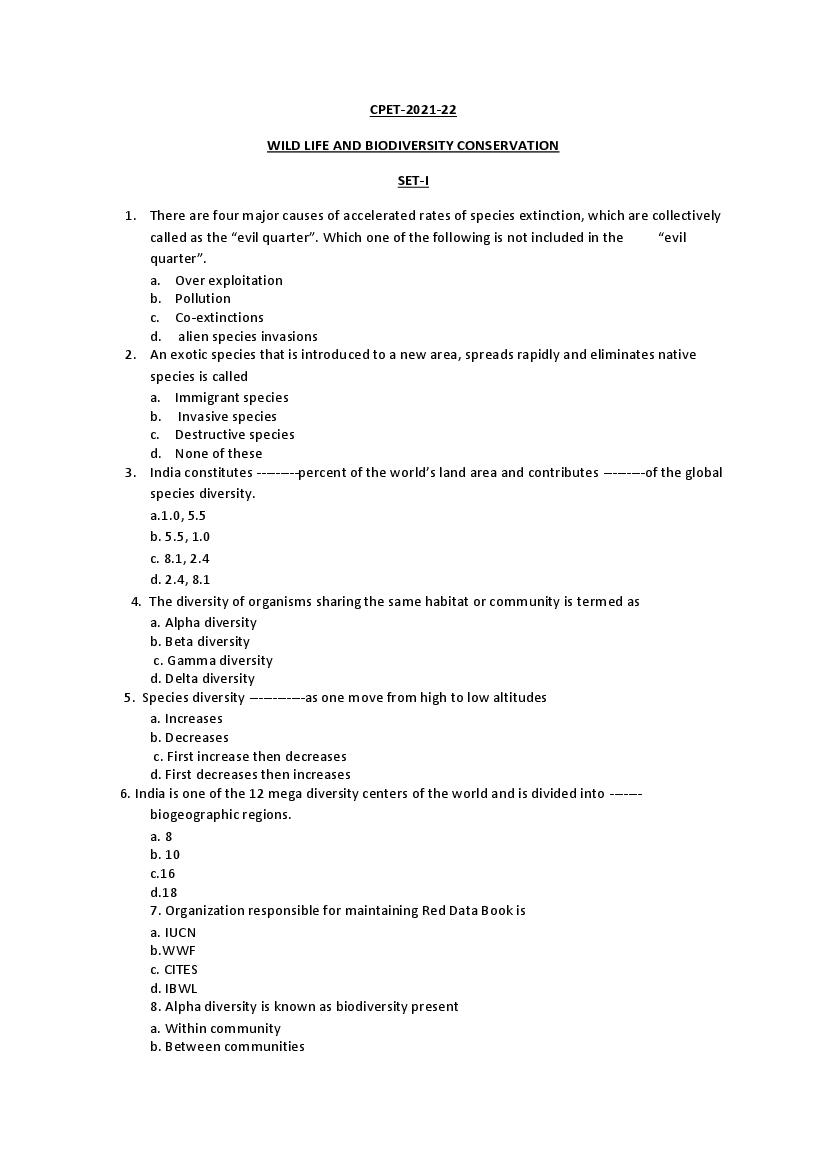
WILD LIFE AND BIODIVERSITY CONSERVATION
SET-I
1. There are four major causes of accelerated rates of species extinction, which are collectively
called as the “evil quarter”. Which one of the following is not included in the “evil
quarter”.
a. Over exploitation
b. Pollution
c. Co-extinctions
d. alien species invasions
2. An exotic species that is introduced to a new area, spreads rapidly and eliminates native
species is called
a. Immigrant species
b. Invasive species
c. Destructive species
d. None of these
3. India constitutes ---------percent of the world’s land area and contributes ---------of the global
species diversity.
a.1.0, 5.5
b. 5.5, 1.0
c. 8.1, 2.4
d. 2.4, 8.1
4. The diversity of organisms sharing the same habitat or community is termed as
a. Alpha diversity
b. Beta diversity
c. Gamma diversity
d. Delta diversity
5. Species diversity ------------as one move from high to low altitudes
a. Increases
b. Decreases
c. First increase then decreases
d. First decreases then increases
6. India is one of the 12 mega diversity centers of the world and is divided into -------
biogeographic regions.
a. 8
b. 10
c.16
d.18
7. Organization responsible for maintaining Red Data Book is
a. IUCN
b.WWF
c. CITES
d. IBWL
8. Alpha diversity is known as biodiversity present
a. Within community
b. Between communities
Page 2
d. None of these
9. Western Ghats have greater number of amphibian species than the Eastern Ghats. What
kind of diversity does it represent?
a. Species diversity
b. Genetic diversity
c. Ecological diversity
d. None of these
10. --------- National Park is the first National Park of India.
a. Jim Corbet
b. Nanda Devi
c. Kaziranga
d. Jaldapara
11. Which of these is not included in the biodiversity hot spots of India
a. Western Ghats
b. Himalayas
c. Indo-Burma
d. North Indian Plants
12. Select the incorrectly matched pair
a. UNESCO = United Nations Educational Scientific and Cultural Organization
b. CITES = Convention in International Trade in Elite Species
c. IUCN= International Union of Conservation for Nature and Natural Resources
d. WWF = World Wide Fund for Nature
13. First Biosphere Reserve in India was established in 1986 at
a. Nilgiri
b. Nanda Devi
c. Rann of Kutch
d. Sunderbans
14. Nandadevi biosphere reserve is found in
a. Uttaranchal
b. Assam
c. Himachal Pradesh
d. Andhra Pradesh
15. Cryopreservation is the preservation of germplasm at very low temperature of around
a. -1210C
b. -1960C
c. 00C
d. -1010C
16. Biodiversity Act of India was passed by the parliament in the year
a. 1992
b. 1996
c. 2000
d. 2002
17. Biosphere reserves differ from National Parks and Wildlife Sanctuaries because in the
former
a. Human beings are not allowed to enter
b. People are an integral part of the system
c. Plants are paid greater attention than the animals
d. Living organisms are brought from all over the world and preserved for posterity.
Page 3
but was amended in the year ---------- to include ------- as an air pollutant.
a. 1990, noise
b. 1984, particulate matter
c. 1987, PAN
d. 1987, noise
19. Which of the following is the most dangerous metal pollutant of automobile exhaust?
a. Cadmium
b. Copper
c. Mercury
d. Lead
20. Acid rains are produced by
a. Excess NO2 and SO2 from burning fossil fuels
b. Excess production of NH3 by industries and power plants
c. Excess release of carbon monoxide by incomplete combustion of fossil fuels
d. Excess release of CO2 by combustion and animal respiration
21. Lichens are the indicators of
a. Water pollution
b. Air pollution
c. Soil pollution
d. All of these
22. Chloroflurocarbons are air polluting agents which are produced by
a. Diesel trucks
b. Jet planes
c. Rice fields
d. Cellphones
23. Peroxyacyl nitrates (PAN) are formed through photochemical reactions between
a. Sulphur oxides and hydrocarbons
b. Nitrogen oxides and hydrocarbons
c. Nitrogen oxides and O3
d. CFCL3 and O3
24. Greenhouse effect is due to
a. Accumulation of O3 and depletion of CO2
b. Accumulation of both O3 and CO2
c. Accumulation of CO2 and depletion of O3
d. Presence of green plants on the earth
25. The major ozone depleting substance out of the following is
a. CFCs
b. O2
c. Nitrogen
d. All of these
26. Montreal Protocol is associated with
a. Control of emission of ozone depleting substances
b. Control of radioactive wastes
c. Control of desertification
Page 4
27. Ozone layer of upper atmosphere is being destroyed by
a. Chloroflurocarbons
b. SO2
c. O2 and CO2
d. Smog
28. Which one of the following is the most productive ecosystem?
a. Temperate forest
b. Grassland
c. Desert
d. Tropical rain forest
29. Which one of the following aspects is not a component of functional unit of ecosystem?
a. Productivity
b. Decomposition
c. Energy flow
d. Ecological pyramids
30. ------- is the rate of production of organic matter by consumers.
a. Primary productivity
b. Secondary productivity
c. Net primary productivity
d. Gross primary productivity
31. The biomass available for consumption by the herbivores and decomposers is called
a. Net primary productivity
b. Secondary productivity
c. Standing crop
d. Gross primary productivity
32. Which one of the following exhibits least productivity?
a. Salty marshes
b. Grasslands
c. Open oceans
d. Coral reefs
33. Rate of decomposition depends upon
a. Chemical composition of detritus
b. Temperature
c. Soil moisture and soil pH
d.All of these
34. Decomposers are also called as
a. Transducers
b. Reducers
c. Micro-consumers
d. Both reducers and micro-consumers
35. Organisms which are associated with first as well as third trophic level are
a. Macrophytes
b. Phytoplanktons
c. Chemoautotrophs
Page 5
36. Artificial systems of classification were based upon
a. Vegetative characters
b. Androecium structure
c. Habit and habitat
d. All of these
37. --------- systems of classification were based on natural affinities among the organisms
a. Artificial
b. Natural
c. Phylogenetic
d. Sexual
38. Which out of the following are included under tracheophyta i.e. vascular plants?
a. Pteridophytes
b. Gymnosperms
c. Angiosperms
d. All of these
39. System of classification that employs numerical data to evaluate similarities and differences
is known as
a. Cytotaxonomy
b. Biosystematics
c. Phenetics
d. Chemotaxonomy
40. A system of classification in which a large number of traits are considered is
a. Artificial system
b. Phylogenetic system
c. Synthetic system
d. Natural system
41. Each character is given equal importance and at the same time hundreds of characters can
be considered in
a. Cytotaxonomy
b. Morphotaxonomy
c. Chemotaxonomy
d. Numerical taxonomy
42. At least a half of the total CO2 fixation on earth is carried out through photosynthesis by
a. Angiosperms
b. Gymnosperms
c. Algae
d. Bryophytes
43. In most green algae, pyrenoids represent the storage bodies located in
a. Chloroplast
b. Mitochondria
c. Cytoplasm
d. Nucleus
44. Fusion of two gametes which are dissimilar in size is termed as
a. Oogamy
Page 6
c. Anisogamy
d. Both ‘a’ and ‘c’
45. Phycoerythrin is present in
a. Euglena
b. Polysiphonia
c. Chlamydomonas
d. Fucus
46. Agar-agar is commercially obtained from
a. Green algae
b. Blue green algae
c. Brown algae
d. Red algae
47. Unbranched, erect, cylindrical stout axis with distinct nodes and internodes, and with jointed
appearance is called as
a. Runner
b. Sucker
c. Culm
d. Caudex
48. ------- are the green stems of limited growth which have taken over the function of
photosynthesis from leaves.
a. Phylloclades
b. Cladodes
c. Phyllodes
d. Stem thorns
49. In Bouginvillea, weak stems rise up a support by clinging to it with the help of curved thorns,
such plants are called as
a. Tendrils
b. Hooks
c. Offsets
d. Scramblers
50. In Opuntia the function of photosynthesis is carried out by
a. Cladode
b. Phyllode
c. Phylloclade
d. Stipules
51. Which plant part is modified into pitcher in pitcher plants?
a. Root
b. Stem
c. Leaf
d. Flower
52. Spines present on the areoles of Opuntia represent
a. Stem
b. Leaves
c. Buds
Page 7
53. Which of the following kinds of venation is present in banana?
a. Reticulate unicostate
b. Reticulate multicostate
c. Parallel unicostate
d. Parallel multicostate
54. If the gynoecium is present in the top most position of the thalamus, the flower is referred
to as
a. Hypogynous
b. Perigynous
c. Epigynous
d. None of these
55. In ------ placentation, a monocarpellary ovary bears a single longitudinal ovule along the
junction of two fused margins.
a. Axile
b. Parietal
c. Free central
d. Marginal
56. Ovary is said to be half inferior in which of the following conditions?
a. Hypogynous
b. Perigynous
c. Epigynous
d. Both ‘b’ and ‘c’
57. Edible part of apple and pear is
a. Epicarp
b. Mesocarp
c. Endocarp
d. Thalamus
58. Monocotyledonous seeds possess a single cotyledon which is represented by
a. Tegmen
b. Endosperm
c. Scutellum
d. Aleurone
59. Root cap in monocots is formed by
a. Dermatogen
b. Calyptrogen
c. Vascular cambium
d. Wound cambium
60. ---------- is a living mechanical tissue
a. Parenchyma
b. Collenchyma
c. Sclerenchyma
d. Both ‘a’ and ‘b’
61. Which of the following have porous body and are diplobastic?
a. Aurelia and Obelia
Page 8
c. Leucosolenia and Spongilla
d. Sycon and Hydra
62. Which of the following is not a characteristic feature of sponges?
a. Cellular level of organization
b. Presence of ostia
c. Intracellular digestion
d. Body supported by chitin
63. What is true about Nereis, scorpion, cockroach and silver fish?
a. They all possess dorsal heart
b. None of them is aquatic
c. They all belong to the same phylum
d. They all have jointed pair appendages
64. Bilateral symmetry, metameric segmentation, coelom and open circulatory system
characterizes which of the following phylum?
a. Annelida
b. Mollusca
c. Arthropoda
d. Echinodermata
65. In which of the following, segmentation in the body is first observed?
a. Aschelminthes
b. Arthropoda
c. Annelida
d. Platyhelminthes
66. Among the following organisms which is a completely non parasitic form?
a. Sea anemone
b. Tapeworm
c. Leech
d. Mosquito
67. The limbless amphibian is
a. Ichthyophis
b. Hyla
c. Rana
d. Salamandra
68. Which of the following is a transparent tissue
a. Tendon
b. Fibrous cartilage
c. Hyaline cartilage
d. All of these
69. Which of the following cells do not form layer and remain structurally separate?
a. Epithelial cells
b. Muscle cells
c. Nerve cells
d. Gland cells
70. Which one of the following contains the largest quantity of extracellular material?
Page 9
b. Areolar tissue
c. Stratified epithelium
d. Myelinated nerve fibres
Document Details
| Board / Org | Odisha Exams |
| Exam | Odisha CPET |
| Type | Question Paper |
| Pages | 10 |
| Updated | 30 Apr 2026 |