Finished viewing? Save it for later —
Download CBSE Class 10 Question Paper 2024 Solution English Language & Literature (PDF · 9 pages)About CBSE Class 10 Question Paper 2024 Solution English Language & Literature
CBSE Class 10 Question Paper 2024 Solution English Language & Literature is available here for free download. Published by CBSE for Class 10, this solution can be viewed online or downloaded as a PDF (9 pages). Candidates preparing for Class 10 can use CBSE Class 10 Question Paper 2024 Solution English Language & Literature to understand the exam pattern, the type of questions asked, and the overall difficulty level.
Frequently Asked Questions
How can I download CBSE Class 10 Question Paper 2024 Solution English Language & Literature?
Open this page and click the Download button to save CBSE Class 10 Question Paper 2024 Solution English Language & Literature as a PDF. It is completely free on AglaSem Docs.
Is CBSE Class 10 Question Paper 2024 Solution English Language & Literature free to download?
Yes. CBSE Class 10 Question Paper 2024 Solution English Language & Literature can be viewed online and downloaded as a PDF free of cost on AglaSem Docs.
How many pages does CBSE Class 10 Question Paper 2024 Solution English Language & Literature have?
CBSE Class 10 Question Paper 2024 Solution English Language & Literature contains 9 pages, which you can read online or download together as a single PDF.
Where can I find more Class 10 study material?
You can find more Class 10 question papers, sample papers, syllabus, and answer keys on AglaSem Docs.
CBSE Class 10 Question Paper 2024 Solution English Language & Literature – Text
Read the full text of this solution below — useful to quickly search, copy and reference the content online without downloading the PDF.
📄 View text version (9 pages)
Page 1
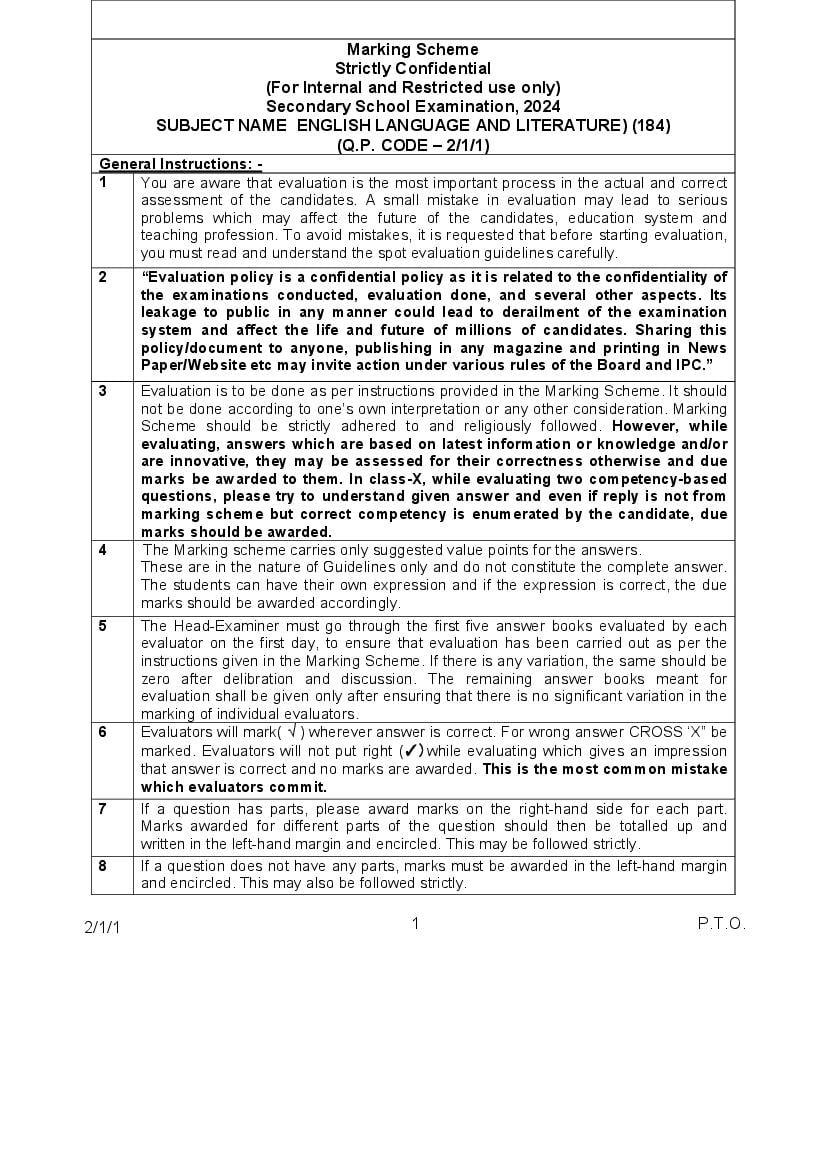
Strictly Confidential
(For Internal and Restricted use only)
Secondary School Examination, 2024
SUBJECT NAME ENGLISH LANGUAGE AND LITERATURE) (184)
(Q.P. CODE – 2/1/1)
General Instructions: -
1 You are aware that evaluation is the most important process in the actual and correct
assessment of the candidates. A small mistake in evaluation may lead to serious
problems which may affect the future of the candidates, education system and
teaching profession. To avoid mistakes, it is requested that before starting evaluation,
you must read and understand the spot evaluation guidelines carefully.
2 “Evaluation policy is a confidential policy as it is related to the confidentiality of
the examinations conducted, evaluation done, and several other aspects. Its
leakage to public in any manner could lead to derailment of the examination
system and affect the life and future of millions of candidates. Sharing this
policy/document to anyone, publishing in any magazine and printing in News
Paper/Website etc may invite action under various rules of the Board and IPC.”
3 Evaluation is to be done as per instructions provided in the Marking Scheme. It should
not be done according to one’s own interpretation or any other consideration. Marking
Scheme should be strictly adhered to and religiously followed. However, while
evaluating, answers which are based on latest information or knowledge and/or
are innovative, they may be assessed for their correctness otherwise and due
marks be awarded to them. In class-X, while evaluating two competency-based
questions, please try to understand given answer and even if reply is not from
marking scheme but correct competency is enumerated by the candidate, due
marks should be awarded.
4 The Marking scheme carries only suggested value points for the answers.
These are in the nature of Guidelines only and do not constitute the complete answer.
The students can have their own expression and if the expression is correct, the due
marks should be awarded accordingly.
5 The Head-Examiner must go through the first five answer books evaluated by each
evaluator on the first day, to ensure that evaluation has been carried out as per the
instructions given in the Marking Scheme. If there is any variation, the same should be
zero after delibration and discussion. The remaining answer books meant for
evaluation shall be given only after ensuring that there is no significant variation in the
marking of individual evaluators.
6 Evaluators will mark( √ ) wherever answer is correct. For wrong answer CROSS ‘X” be
marked. Evaluators will not put right (✓)while evaluating which gives an impression
that answer is correct and no marks are awarded. This is the most common mistake
which evaluators commit.
7 If a question has parts, please award marks on the right-hand side for each part.
Marks awarded for different parts of the question should then be totalled up and
written in the left-hand margin and encircled. This may be followed strictly.
8 If a question does not have any parts, marks must be awarded in the left-hand margin
and encircled. This may also be followed strictly.
2/1/1 1 P.T.O.
Page 2
marks should be retained and the other answer scored out with a note “Extra
Question”.
10 No marks to be deducted for the cumulative effect of an error. It should be penalized
only once.
11 A full scale of marks __________(example 0 to 80/70/60/50/40/30 marks as given in
Question Paper) has to be used. Please do not hesitate to award full marks if the
answer deserves it.
12 Every examiner has to necessarily do evaluation work for full working hours i.e., 8
hours every day and evaluate 20 answer books per day in main subjects and 25
answer books per day in other subjects (Details are given in Spot Guidelines).This is in
view of the reduced syllabus and number of questions in question paper.
13 Ensure that you do not make the following common types of errors committed by the
Examiners in the past:-
● Leaving answer or part thereof unassessed in an answer book.
● Giving more marks for an answer than assigned to it.
● Wrong totalling of marks awarded on an answer.
● Wrong transfer of marks from the inside pages of the answer book to the title
page.
● Wrong question wise totalling on the title page.
● Wrong totaling of marks of the two columns on the title page.
● Wrong grand total.
● Marks in words and figures not tallying/not same.
● Wrong transfer of marks from the answer book to online award list.
● Answers marked as correct, but marks not awarded. (Ensure that the right tick
mark is correctly and clearly indicated. Same is with the X for incorrect answer.)
● Half or a part of answer marked correct and the rest as wrong, but no marks
awarded.
14 While evaluating the answer books if the answer is found to be totally incorrect, it
should be marked as cross (X) and awarded zero (0)Marks.
15 Any unassessed portion, non-carrying over of marks to the title page, or totalling error
detected by the candidate shall damage the prestige of all the personnel engaged in
the evaluation work as also of the Board. Hence, in order to uphold the prestige of all
concerned, it is again reiterated that the instructions be followed meticulously and
judiciously.
16 The Examiners should acquaint themselves with the guidelines given in the
“Guidelines for spot Evaluation” before starting the actual evaluation.
17 Every Examiner shall also ensure that all the answers are evaluated, marks carried
over to the title page, correctly totalled and written in figures and words.
18 The candidates are entitled to obtain photocopy of the Answer Book on request on
payment of the prescribed processing fee. All Examiners/Additional Head
Examiners/Head Examiners are once again reminded that they must ensure that
evaluation is carried out strictly as per value points for each answer as given in the
Marking Scheme.
2/1/1 2
Page 3
MARKING SCHEME
ENGLISH LANGUAGE AND LITERATURE
SECTION A (Reading)
(20 Marks)
1 Discursive passage 10
i To highlight richness of world’s cultures. (1)
To play essential role of inter-cultural dialogue for achieving peace and
sustainable development.
ii (D) – highlighting the real world of cultural and creative sector at (1)
generating
social cohesion and educational resource during an international
emergency.
iii Draw upon creative potential of world’s diverse cultures, engage in (2)
continuous dialogue to ensure that all members of society benefit from
sustainable development.
iv A positive/appreciative/optimistic statement that (2)
highlights/emphasizes on the advantages of a cultural diversity rather
than viewing it as a cause of undermining the situation/cultural
diversity is dispensable for poverty reduction/cultural diversity
important for sustainable development
(any other relevant response for tone must be accepted)
v (B) – 1 mark to be awarded to each child. There is error in the spelling (1)
of the word ‘disparate’ which changes the meaning of the word
completely.
vi (C) – (d & e) essential and intrinsic (1)
Urgent and crucial
vii The resolution on cultural and sustainable development, affirming (1)
culture’s contribution to the three dimensions of sustainable
development.
viii Bridging the gap between culture (1)
2. Case-based factual passage 10
i. - Overcome social status hierarchy associated with vocational (2)
education.
- integration into mainstream education
- revision and revamping of all aspects of education
- aligning aspirational goals of 21st century with education system
(Any two points)
2/1/1 3 P.T.O.
Page 4
correct.) (1)
(No partial credit)
iii. (C) – minimum 50% learners shall have exposure to vocational (1)
education
iv. It will allow other schools to use the facility of skill labs (1)
v. Dignity of labour/labour/artisanship (1)
vi. South Korea – any appropriate reason related to South Korea (2)
vii. (A) – middle and secondary school (1)
viii. any one relevant point from below - (1)
- child will learn at least one skill
- understand dignity of labour
- appreciate Indian Arts & Artisanship
SECTION B (Grammar)
(10 Marks)
3 Any ten out of twelve questions to be attempted / marked 10x1=10
(full credit for correct answer. No partial credit of ½ for any
questions in this section)
i. explains (1)
ii. Error Correction (1)
interestingly interesting
iii. Raashi asked Ratul what challenges he had faced while volunteering (1)
iv. (A) – he had been overloaded with assignments (1)
v. it (1)
vi. offer (1)
vii. (C) – youth (1)
viii. (A) – feeling (1)
ix. he had recently/just got a haircut (1)
x. (D) – has been awarded (1)
xi. (A) – reflect (1)
xii. in to (1)
SECTION B (Writing Skills)
(10 Marks)
4 Any one from (A) or (B) to be attempted 5
Format – 1 [full credit if all aspects included. Partial credit (½ mark) if
one-two aspects are missing. No credit if more than two aspects are
missing]
Organisation of ideas – 1 (effective style, orderly sequence,
paragraphed structure and formal tone and vocabulary) and
Accuracy -1 (spelling, punctuation and grammar)
Content -2
2/1/1 4
Page 5
relevant point must be accepted]
Drawing the attention of the Commissioner of Traffic Police:
Fatal accidents due to reckless driving and road rage
Need for stricter action against offenders
Need for use of social media to raise awareness
Implications of irresponsible driving
B Suggested Value Points [these value points are a suggestion. Any other
relevant point must be accepted]
Drawing the attention of the editor
Half marathon to raise funds for an orphanage (Koshish)
Need to sensitise school children
Emphasis on participation of school children in such programs
Benefits of community service/participation
5 Any one from (A) or (B) to be attempted 5
Organisation of ideas -2 [effective style, orderly sequence, single
paragraph structure, formal tone and functional vocabulary]
Accuracy 1 [Spelling, punctuation and grammar]
Content -2 (Four trends/ points included & well-developed with
sustained clarity)
A Suggested Value Points [these value points are a suggestion. Any other
relevant point must be accepted]
• Comparisons between the different stages of a butterfly
• Drawing conclusions wherever required
Same for the Visually challenged students
B Suggested Value Points [these value points are a suggestion. Any other
relevant point must be accepted]
• Analysis of hobbies taken up by boys vs. those taken up by girls
• Drawing inferences wherever required.
SECTION – C: (Literature Textbook and Supplementary Reading Text) (40 Marks)
6 Answer the questions of any one of the given two, (A) or (B) : 5
A i) Mandela felt happy because of his role in ending Apartheid in (1)
South Africa.
He was overwhelmed remembering all the past events.
ii) B) recognises the rights and freedom of all people (1)
2/1/1 5 P.T.O.
Page 6
skinned people in their own land.
One of the harshest and most inhuman societies of the world.
iv. Appeased/repaired/mended (1)
(Or any other appropriate word/phrase should be accepted)
B (i) Anne- sensitive girl/emotionally attached to grandmother. (1)
(Or any other appropriate word/phrase should be accepted)
ii) (C) – Montessori Nursery School (1)
iii) Anne’s teacher in sixth form and Headmistress. (2)
Both had relationship based on love and respect.
iv) Emotional/poignant/painful (1)
(Or any other appropriate word/phrase should be accepted)
7 Answer the questions of any one of the given two, (A) or (B) : (5)
A i) Zoo- stalks in his cage/forced to be quiet (1)
Forest- moves majestically wherever he wants/snarls and
terrorises the village.
(Any one point from the above)
ii) Tiger- naturally powerful, free and ferocious (Any one (1)
point/ any other suitable word/phrase is acceptable)
iii) In his vivid stripes, pads of velvet quiet, in his quiet rage (2)
(Any two of these images with elaboration to be accepted)
iv) Suppressed anger (1)
B i) (B) – sympathetic, understanding the depth of the boy’s loss (1)
ii) Ball is a metaphor for possessions/childhood innocence (1)
iii) loss of the ball- moment of transition from childhood to (1)
maturity/ memories of childhood flashed in front of his
eyes. (Reference- ‘senses his first responsibility’, ‘he is
learning’)
iv) Journey from innocence to maturity/ youth to adulthood (2)
Realisation/learning- loss is inevitable, he will lose things,
replace them but never be able to buy back the thing he has
lost.
2/1/1 6
Page 7
each :
Content-2;(Any two-three relevant points to be accepted)
Organisation -1 ; (½ mark to be deducted for Accuracy from the overall
credit of a response, if error density is high -more than a total of 2
spellings and/or grammatical errors.)
i) Mood- depressed/ hopeless. (Any other appropriate word can be (1+1) +1=3
accepted)
Images- ‘hemlock tree’ and ‘crow’.
ii) Positive attitude can help individuals see opportunities where (2+1=3)
others see problems.
(Students can answer this question with/ without reference to any
chapter(s)/character(s)
(any two points)
iii) sharp teeth, spikes on top of him and scales underneath. (2+1=3)
mouth was similar to a fireplace and nose was like a chimney.
daggers on his toes.
(any two points)
iv) Human beings incapable of seeing inner beauty. (2+1=3)
Only God sees beyond external beauty.
v) Death brings grief and suffering (2+1=3)
It treats everyone equally
Death takes away material possessions, power and privilege
One should not be controlled by desires and material
possessions.
(any two points)
9 Answer any two of the following three questions in 40-50 2x3 = 6
Words each :
Content-2 (Any two-three relevant points to be accepted.)
Organisation -1 ; (½ mark to be deducted for Accuracy from the overall
credit of a response, if error density is high -more than a total of 2
spellings and/or grammatical errors.
2/1/1 7 P.T.O.
Page 8
committed many crimes.
misused his discovery
(any two points)
ii) Bholi refused to marry the man demanding dowry (2+1=3)
proud to see Bholi take a stand for herself/transform into a
confident person.
iii) The diamond necklace borrowed was fake (2+1=3)
Lost her beauty / wasted her youth and money
suffered
(any two points)
10 Answer any one of the following two questions in 100-120 6
words :
Content= 3,
Expression= 2,
Accuracy= 1
i) Differences- (3+2+1)
A Baker from Goa- freedom is a reality,
Nelson Mandela- freedom is an illusion.
Commonalities-
both talk about freedom of childhood
carefree existence
innocence of childhood.
(any three points)
ii) Anne to Amanda: (3+2+1)
stop fantasising
do what you want
face situations head on
Amanda to Anne:
strive for freedom
live your life
create your own space
keep dreaming (be optimistic)
(any three points, at least one from each side)
2/1/1 8
Page 9
words :
Content =3, Expression= 2, Accuracy= 1
i) woman in red pretends to be lady of the house (mannerisms, (3+2+1)
gestures, language were sophisticated)
Horace trusted, opened safe (didn’t inform police)
She took away all jewels.
ii) Hari Singh returns after regretting stealing money from Anil. (3+2+1)
Anil knew Hari was a thief
Next Morning, Hari offers tea
Anil didn’t refer to the incident/ doesn’t show any signs of
anger
2/1/1 9 P.T.O.
Document Details
| Board / Org | CBSE |
| Exam | Class 10 |
| Type | Solution |
| Pages | 9 |
| Updated | 30 Apr 2026 |