Telangana Class 8 Syllabus Science (Physical)
Finished viewing? Save it for later —
Download Telangana Class 8 Syllabus Science (Physical) (PDF · 5 pages)About Telangana Class 8 Syllabus Science (Physical)
Telangana Class 8 Syllabus Science (Physical) is available here for free download. Published by Telangana Board for Class 8, this syllabus can be viewed online or downloaded as a PDF (5 pages). Candidates preparing for Class 8 can use Telangana Class 8 Syllabus Science (Physical) to understand the exam pattern, the type of questions asked, and the overall difficulty level.
Frequently Asked Questions
How can I download Telangana Class 8 Syllabus Science (Physical)?
Open this page and click the Download button to save Telangana Class 8 Syllabus Science (Physical) as a PDF. It is completely free on AglaSem Docs.
Is Telangana Class 8 Syllabus Science (Physical) free to download?
Yes. Telangana Class 8 Syllabus Science (Physical) can be viewed online and downloaded as a PDF free of cost on AglaSem Docs.
How many pages does Telangana Class 8 Syllabus Science (Physical) have?
Telangana Class 8 Syllabus Science (Physical) contains 5 pages, which you can read online or download together as a single PDF.
Where can I find more Class 8 study material?
You can find more Class 8 question papers, sample papers, syllabus, and answer keys on AglaSem Docs.
Telangana Class 8 Syllabus Science (Physical) – Text
Read the full text of this syllabus below — useful to quickly search, copy and reference the content online without downloading the PDF.
📄 View text version (5 pages)
Page 1
8th CLASS
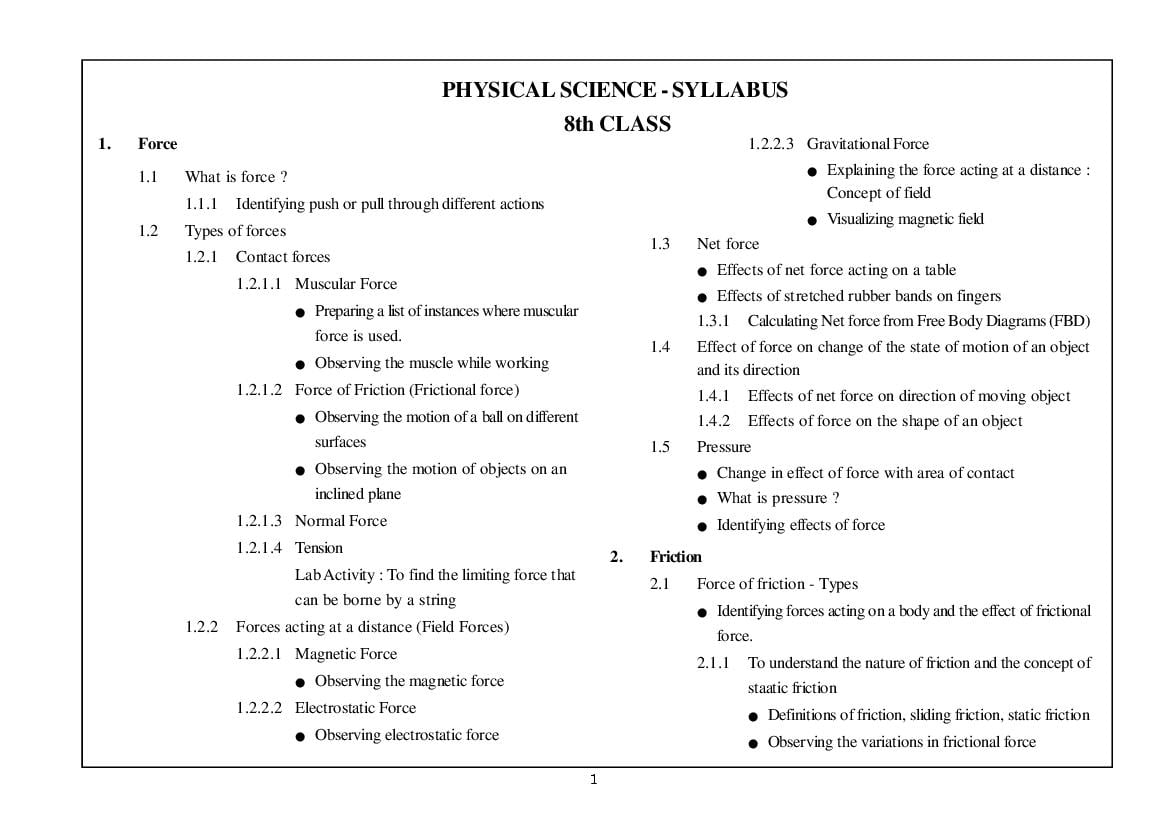
1. Force 1.2.2.3 Gravitational Force
1.1 What is force ? Explaining the force acting at a distance :
Concept of field
1.1.1 Identifying push or pull through different actions
Visualizing magnetic field
1.2 Types of forces
1.3 Net force
1.2.1 Contact forces
Effects of net force acting on a table
1.2.1.1 Muscular Force
Effects of stretched rubber bands on fingers
Preparing a list of instances where muscular
1.3.1 Calculating Net force from Free Body Diagrams (FBD)
force is used.
1.4 Effect of force on change of the state of motion of an object
Observing the muscle while working and its direction
1.2.1.2 Force of Friction (Frictional force) 1.4.1 Effects of net force on direction of moving object
Observing the motion of a ball on different 1.4.2 Effects of force on the shape of an object
surfaces 1.5 Pressure
Observing the motion of objects on an Change in effect of force with area of contact
inclined plane What is pressure ?
1.2.1.3 Normal Force Identifying effects of force
1.2.1.4 Tension
2. Friction
Lab Activity : To find the limiting force that
2.1 Force of friction - Types
can be borne by a string
Identifying forces acting on a body and the effect of frictional
1.2.2 Forces acting at a distance (Field Forces)
force.
1.2.2.1 Magnetic Force
2.1.1 To understand the nature of friction and the concept of
Observing the magnetic force staatic friction
1.2.2.2 Electrostatic Force Definitions of friction, sliding friction, static friction
Observing electrostatic force Observing the variations in frictional force
Page 2
2.2.1 Effect of rough surface on frictional force 3.4.4 Why synthetic fibres ?
2.2.2 Effect of area of contact on frictional force 3.4.5 Polysters
2.2.3 Effect of Normal force on friction
How can you say a bottle is PET bottle ?
2.3 Is friction necessary ?
Identification of various articles with recycling codes
2.3.1 Friction produces heat
3.5 Plastics around us
2.4 Increasing the drecreasing friction
3.5.1 What is a plastic ?
2.4.1 How to reduce friction ?
2.4.2 Effect of rollers on friction 3.5.2 Types of plastics
2.4.3 Understanding the princle of ball bearings Identifying thermoplastic and thermo setting plastic
2.5 Fluid friction by flame test.
Observing fluid friction 3.5.2.1 Thermoplastics
2.5.1 Identifying factors influencing the fluid friction 3.5.2.2 Thermo setting plastics
3. Synthetic Fibres and Plastics 3.5.3 Why do we prefer plastics ?
3.1 Clothes made from Natural fibres 3.5.4 Plastics and Environment
3.2 What is synthetic fibre ? 3.6 Bio degradable and non-bio degradable substances
3.2.1 Concepts of monomer and polymer
3.7 Principle of 4R (Reduce, Recyle, Reuse and Recover)
3.3 Identifying synthetic fibres
3.7.1 Reduce
3.3.1 identifying synthetic fibres by burning test
3.7.2 Reuse
3.4 Some of the synthetic fibres / examples for synthetic fibres
3.7.3 Recycle
3.4.1 Nylon
How is nylon made ? Recycling code
How strong is nylon ? Role of codes in Recycling process
3.4.2 Rayon Uncoded plastics
How is rayon prepared ? 3.7.4 Recover
Why are different synthetic fibres mixed ?
Page 3
4.1 Metals and non metals - an introduction Observing sound produced by a vibrating body
4.2 Physical properties of metals and non metals 5.2 Sound has energy
4.2.1 Appearance - Lustrous nature 5.3 Musical instruments
Observing appearance and colour of materials producing sounds that resembles sound of rainfall
4.2.2 Sonarity observing changes in sound
Listening sound produced by some materials 5.4 Sounds produced by human
4.2.3 Mallcability
5.4.1 Structure of voice box
Identifying mallcability of material
Observing movements of vocal cords during speech
4.2.4 Ductility
5.5 Sound propogation
4.2.5 Electrical conductivity
5.5.1 Sound needs medium to propogate
Identifying electrical conductivity of a material
5.5.2 Propogation of sound in different media
4.2.6 Conductivity of Heat
Observing sound propogation in Solids
Observing conductivity of heat of metals
4.3 Chemical properties of metals and non metals Observing sound propogation in liquids
4.3.1 Reaction with oxygen 5.5.3 Is sound propogate without medium
Rusting of metals 5.6 How do we hear sound
4.3.2 Reaction with water 5.6.1 Structure and function of eardrum
4.3.3 Reaction with acids 5.7 Characteristics of sound
4.4 Reactivity of metals 5.7.1 Loudness - Feebleness
4.5 Some uses of non metals Observing relationship between the intensity of
4.6 Some uses of metals sound produced and vibrations of a body
5. Sound 5.7.2 Pitch
Identifying pitch or shrillness of a sound
5.1 Production of sound
5.8 Normal sound consists of mixed frequencies
listening sound and predicting source
5.9 Noice and music
identifying different sounds
5.10 Audible range
Page 4
5.11.1 Effects of sound pollution 7.9 Misuse of energy resources
5.11.2 Controlling measures 7.9.1 Harmful effects of fuels
6. Reflection of Light at plane surfaces 8. Combustion, Fuels and flame
6.1 Formation of image by a Pin hole camera
8.1 Do all materials burn ?
6.2 Fermat principle
8.2 What is required for the process of combustion ?
6.3 Plane mirror
6.4 Reflection – its laws 8.2.1 Testing of necessity of air for burning
6.4.1 Plane of reflection 8.2.2 Oxygen helps in burning
6.5 Plane mirrors – image formation 8.3 Ignition temperature
6.5.1 Characteristics of an image formed by a plane mirror 8.3.1 Burning paper with sun rays
7. Coal and Petroleum 8.3.2 Understanding ignition temperature
7.1 Sources of materials 8.4 Types of Combustion
7.2 Exhaustible and inexhaustable resources 8.5 Fuels
7.3 Fuels - Coal, Petroleum, Natural Gas 8.6 Fire controll
7.3.1 Production of petroleum 8.7 Flame
7.3.2 Natural gas is an important source 8.7.1 Observing behavour of different solid fuels
7.3.3 Uses of coal, petroleum, natural gas 8.7.2 Structure of flame
7.3.4 various uses of petroleum 8.7.3 Observing situations, happens in different zones of
7.3.5 Coal and its products candle flame
Coke 9. Electrical Conductivity of Liquids
Coal gas 9.1 Testing the material to know which allows electric current to
Coaltar pass through it.
7.3.6 Uses of coal products 9.2 Electrical conductivity of liquids
Observing gases evolved in burning of coal 9.2.1 Testing the electrical conductivity of liquids
7.4 Some petrochemical products 9.2.2 When do liquids conduct electricity - electric
7.5 Natural gas and petrochemicals conductivity of electrolyte.
7.6 Formation of coal, petroleum 9.3 Chemical effects of electric current
7.7 Versatile nature of coal and petroleum Testing the effect of electric current on potato.
Page 5
9.4.1 Making of an electric cell 11.4.2 Moon surface
9.5 Electroplating 11.5 Solar eclipse
9.5.1 Electroplating procedure 11.5.1 Types of Solar eclipse
9.5.2 Uses of electroplating 11.6 Lunar eclipse
10. Some natural phenomena 11.6.1 Types of lunar eclipse
10.1 Lightning 11.7 Know about stars
10.1.1 Sparks - that the greeks know about 11.7.1 Observing movements of constellation
10.2 Charging by rubbing 11.7.2 Why polar star appears fixed at a point
10.2.1 Effects of rubbing 11.8 The Solar System
10.2.2 Effects of charged bodies 11.8.1 Sun
10.3 Types of charges and their interaction 11.8.2 The Planets
10.3.1 Finding the presence of charge on a body 11.8.3 Some other members of Solar system
10.3.2 Transfer of charge Asteroids
10.4 Story of Lightning - Safety measures Comets
10.4.1 Lightning conducter Meteors and Meteorites
10.5 Earthquakes 11.9 Artificial Satellites
10.5.1 Collecting information about earthquake damages 11.10 How people know earth is spherical
10.5.2 What is earthquake 11.10.1 How people know earth rotates on its own axis
10.5.3 Causes of earthquake 12. Graphs of Motion
10.5.4 Earthquakes - safety measures 12.1 Motion, Graphs - Introduction
10.5.5 Earthquakes in Telangana
12.2 Graph is not a map
11. Stars and the Solar system 12.3 Graphs of uniform motion
11.1 Observing changes in length of shadow 12.3.1 Slope of Graph - Velocity
11.2 Understanding the North - South movement of Sun 12.3.2 Graphs of Stationary Objects
11.3 Sun-dail 12.4 Graphs of non-uniform motion
11.4 Phases of moon