MBOSE Class 11 Syllabus
Finished viewing? Save it for later —
Download MBOSE Class 11 Syllabus (PDF · 51 pages)About MBOSE Class 11 Syllabus
MBOSE Class 11 Syllabus is available here for free download. Published by Meghalaya Board for Class 11, this syllabus can be viewed online or downloaded as a PDF (51 pages). Candidates preparing for Class 11 can use MBOSE Class 11 Syllabus to understand the exam pattern, the type of questions asked, and the overall difficulty level.
Frequently Asked Questions
How can I download MBOSE Class 11 Syllabus?
Open this page and click the Download button to save MBOSE Class 11 Syllabus as a PDF. It is completely free on AglaSem Docs.
Is MBOSE Class 11 Syllabus free to download?
Yes. MBOSE Class 11 Syllabus can be viewed online and downloaded as a PDF free of cost on AglaSem Docs.
How many pages does MBOSE Class 11 Syllabus have?
MBOSE Class 11 Syllabus contains 51 pages, which you can read online or download together as a single PDF.
Where can I find more Class 11 study material?
You can find more Class 11 question papers, sample papers, syllabus, and answer keys on AglaSem Docs.
MBOSE Class 11 Syllabus – Text
Read the full text of this syllabus below — useful to quickly search, copy and reference the content online without downloading the PDF.
📄 View text version (51 pages)
Page 1
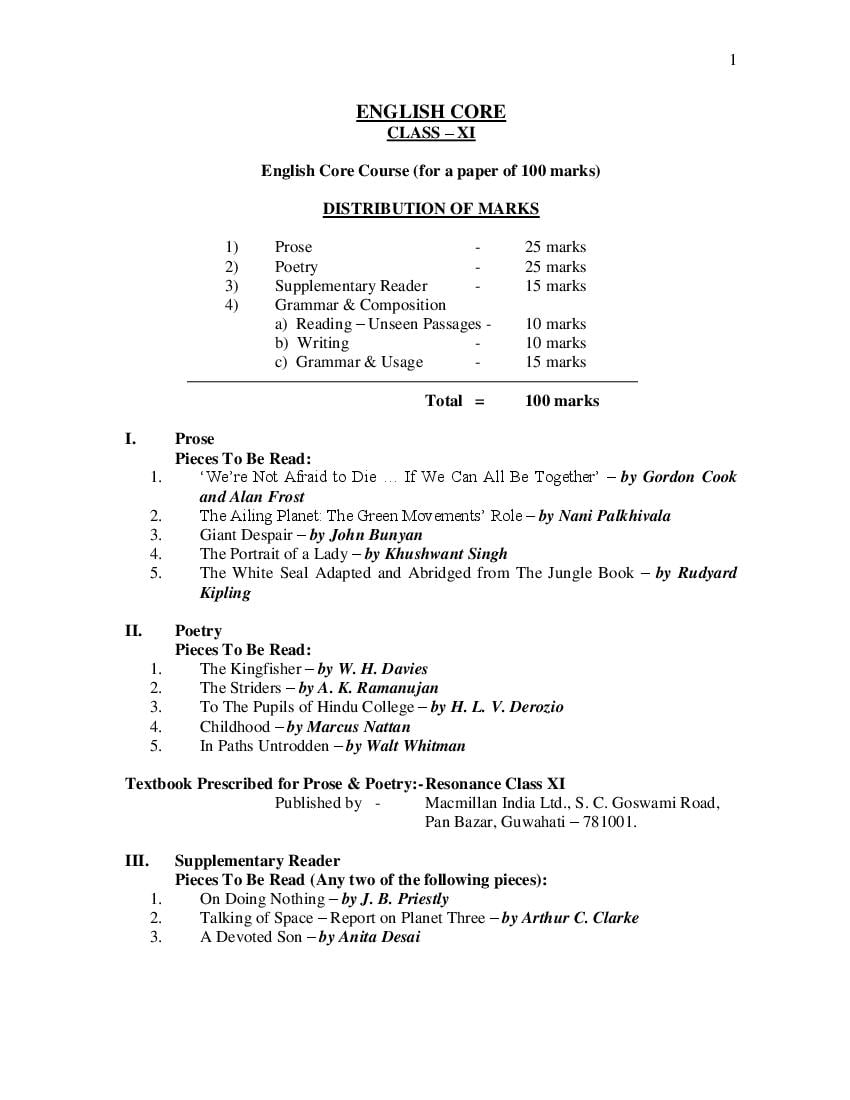
ENGLISH CORE
CLASS – XI
English Core Course (for a paper of 100 marks)
DISTRIBUTION OF MARKS
1) Prose - 25 marks
2) Poetry - 25 marks
3) Supplementary Reader - 15 marks
4) Grammar & Composition
a) Reading – Unseen Passages - 10 marks
b) Writing - 10 marks
c) Grammar & Usage - 15 marks
Total = 100 marks
I. Prose
Pieces To Be Read:
1. ‗We‘re Not Afraid to Die … If We Can All Be Together‘ – by Gordon Cook
and Alan Frost
2. The Ailing Planet: The Green Movements‘ Role – by Nani Palkhivala
3. Giant Despair – by John Bunyan
4. The Portrait of a Lady – by Khushwant Singh
5. The White Seal Adapted and Abridged from The Jungle Book – by Rudyard
Kipling
II. Poetry
Pieces To Be Read:
1. The Kingfisher – by W. H. Davies
2. The Striders – by A. K. Ramanujan
3. To The Pupils of Hindu College – by H. L. V. Derozio
4. Childhood – by Marcus Nattan
5. In Paths Untrodden – by Walt Whitman
Textbook Prescribed for Prose & Poetry:- Resonance Class XI
Published by - Macmillan India Ltd., S. C. Goswami Road,
Pan Bazar, Guwahati – 781001.
III. Supplementary Reader
Pieces To Be Read (Any two of the following pieces):
1. On Doing Nothing – by J. B. Priestly
2. Talking of Space – Report on Planet Three – by Arthur C. Clarke
3. A Devoted Son – by Anita Desai
Page 2
Textbook Prescribed: Voices Classes XI & XII
Published by - Macmillan India Ltd., S. C. Goswami Road,
Pan Bazar, Guwahati – 781001.
IV. Grammar & Composition
The Prescribed Portions are:
1. Reading: Unseen Passages for (Comprehension and note taking in various
topics and situations)
2. Writing: Reports/Essays/Letters
3. Grammar & Usage (To be put in objective format only)
a) Determiners
b) Tenses
c) Active & Passive Constructions
d) Use of Idioms and Phrases
e) Transformation of Sentences
Textbook Prescribed: English Grammar & Composition
Published by - Pearson Education, 482 F. I. E. Patparganj,
New Delhi – 110092, India.
******
Page 3
ALTERNATIVE ENGLISH
CLASS – XI
Alternative English (For a paper of 100 marks)
DISTRIBUTION OF MARKS
1. Prose - 25 marks
2. Poetry - 25 marks
3. Short Plays - 20 marks
4. Grammar & Composition
a) Reading Unseen Passages (Comprehension) - 10 marks
b) Precis Writing - 10 marks
c) Grammar & Usage - 10 marks
Total = 100 marks
I. Prose
Pieces To Be Read:
1. The Face on the Wall – by E. V. Lucas
2. Sparrows – by K. A. Abbas
3. Love Across The Desert – by K. N. Dharuwala
4. The Redemption – by Victor Hugo
5. The Castaway – by Rabindranath Tagore
II. Poetry
Pieces To Be Read:
1. Ode on a Grecian Urn – by John Keats
2. Laugh and Be Merry – by John Masefield
3. A Baby Running Barefoot – by D. H. Lawrence
4. Light Shining Out of Darkness – by William Cowper
5. To India – My Native Land – by H. L. V. Derozio
III. Short Plays
The Prescribed Plays are:
1. Abraham Lincoln – by K. N. Devidas
Or
2. Julius Caesar – by William Shakespeare
Textbook Prescribed for Prose/Poetry/Short Plays: Imprints Class XI
Published by - Macmillan India Ltd.,
S. C. Goswami Road, Pan Bazar,
Guwahati – 781001.
Page 4
IV. Grammar & Composition
The Prescribed Portions are:
1. Reading – (Comprehension) Passages with a variety of questions based on
Vocabulary and Comprehension
2. Writing – Precis Writing
3. Grammar & Usage:
a) Correction of grammatical errors in the given sentences
b) Agreement between subject and verb
c) Direct/Indirect Speech
d) Use of Prepositions
e) Use of Articles
Textbook Prescribed: English Grammar & Composition
Published by - Pearson Education, 482 F. I. E. Patparganj,
New Delhi – 110092, India.
*****
Page 5
ENVIRONMENTAL EDUCATION
CLASS – XI
(TO BE ASSESSED INTERNALLY BY AWARDING GRADES)
Topics To Be Read:
Unit I: Man and Environment (20 Marks)
Chapter 1: Dimensions of Environment
Physical, biological and social dimensions; Environment dimensions;
Exchange of heat between the earth and its atmosphere; Physical realms of the
earth; The realm of the land; The biological environment; Social Environment.
Chapter 4: Population and Environment
Meaning and importance of population study; Population theories; World
population growth; Population and environmental issues.
Chapter 5: Impact of Human Activities on the Environment
Environmental problems of urban and rural areas; Natural Resources and
their depletion; Classification of Natural Resources; Depletion of soil; Depletion of
plant resources; Stress on Civic Amenities and Supply of Water; Waste Disposal;
Transport; Health Services; Vehicular Emission; Urbanization; The Housing Crisis;
Migration; Floating Population.
Unit II: Environment and Development (10 Marks)
Chapter 7: Agriculture and Industrialization
Historical background of the role of agriculture and industry in
development; Localisation of Industrial Plants; Impact of industrialization on
agricultural development.
Chapter 9: Impact of Development on Environment
Changing pattern of land use; Reclamation of land; Deforestation; Resource
depletion; Pollution; Industrial pollution; Environment degradation.
Unit III: Environmental Pollution and Global Issues (30 Marks)
Chapter 12: Air, Water and Soil Pollution
Air Pollution; Water Pollution; Soil Pollution.
Chapter 20: Strategies of Reducing Pollution
Air pollution control strategies; Strategies to reduce soil pollution; Strategies
to reduce water pollution. (Chapters 12 and 20 to be studied together)
Page 6
Chapter 17: Green House Effect
Green House Effect; Effects of global warming and climatic changes on
human society; Biological impacts of global warming.
Chapter 18: Pollution Related Diseases
Diseases caused by air and water pollution; Disease of the modern age.
Unit IV: Energy (10 Marks)
Chapter 22: Conventional Sources of Energy
Conventional energy sources; Fossil fuels; Coal; Petroleum; Firewood;
Energy situation in India.
Chapter 23: Non – Conventional Sources of Energy
Biomass energy; Solar energy; Wind energy; Ocean power (Tidal waves and
thermal); Wave energy; Ocean thermal energy conversion; Nuclear energy; Hydel
power; Geothermal energy.
Chapter 24: Conservation of Energy Resources
Effects to conserve energy resources; Conserving energy resources in
industries; Conserving energy resources in agriculture; Conserving energy
resources in the transport sector.
One Exemplar Project/Activity may be completed in a year from the
suggested list in the textbook. (30 Marks)
Book Recommended: Frank Environmental Education Class XI
Published by - Frank Brothers & Co. Publishers Ltd.,
136 Moti Lal Nehru Road,
Opp. Pan Bazar Girls‘ Higher Secondary School,
Guwahati – 781001.
******
Page 7
ASSAMESE (MIL)
CLASS – XI
DISTRIBUTION OF MARKS
1. Prose - 30 marks
2. Poetry - 25 marks
3. Rapid Reader - 15 marks
4. Grammar & Composition - 30 marks
Total = 100 marks
I. Prose
Pieces To Be Read:
1. Bor Boruahar Kobita Bedona – Lakhinath Bezbarua
2. Jibonor Santiparba – Satyanath Bora
3. Badha Kavya – Dr. Birinchi Kr. Boruah
4. Asomor Khel Dhemali – Narayan Sharma
II. Poetry
Pieces To Be Read:
1. Borgeet – Madhab Dev
2. Bon Kunwari – Chandra Kr. Agarwala
3. Lachit Phukan – Debakanta Baruah
4. Ekhon Chithi – Hem Barua
Book Recommended for Prose & Poetry: Sahitya Saurav
Published by - Jyoti Prakashan, Jasowanta Road,
Pan Bazar, Guwahati – 781001.
III. Rapid Reader: Drama
Book Recommended: Chiraj: Phani Sarma – Pratham Anka (Page 01 to 25)
IV. Grammar & Composition
Pieces To Be Read:
1. Pada Prakaran, Karak & Samash
2. Amplification & Sentence Making
3. Substance Writing
4. Sentence Making with Phrases and Idioms
Book Recommended:
1. Pravesika Rachana Sikkha: Giridhar Sarma
2. Rachana Bichitra: Dharma Singha Deka
3. Bahal Byakaran: Satyanath Bora
******
Page 8
BENGALI (MIL)
CLASS – XI
DISTRIBUTION OF MARKS
1. Prose - 25 marks
2. Poetry - 20 marks
3. Drama - 15 marks
4. Composition
a) Potro Likhon - 6 marks
b) Bhab Somprasaran - 7 marks
c) Prabandha Rachana - 7 marks
5. Grammar
a) Bakya Paribartan - 5 marks
b) Sadhu – O – Chalit Bhasha - 5 marks
c) Prabad – Pracharan - 5 marks
d) Bagdhara - 5 marks
Total = 100 marks
I. Prose
Pieces To Be Read:
1. Sitar Banobas – by Iswar Chandra Bidyasagar
2. Bhanu Singher Patro – by Rabindranath Tagore
3. Mahesh – by Sharat Chandra Chattopaddhay
II. Poetry
Pieces To Be Read:
1. Purborag – by Chandi Das
2. Jiban Bandana – by Nazrul Islam
3. Abar Asibo Phire – by Jibanananda Dash
III. Drama: Udbastu (Selected Part from „Natun Ihudi‟) by Salil Sen
Textbook Recommended: Uchcho Madhyamik Path Sankalan (MBOSE Publications)
Printed & Distributed by - C & P Enterprises, Educational Publishers,
M. C. Road, Guwahati – 781003.
IV. Grammar & Composition (No textbook has been recommended)
The Recommended Portions are:
1. Patro Likhon 5. Sadhu – O – Chalit Bhasu
2. Bhab Samprasaron 6. Prabad - Prabachan
3. Prabandha Rachana 7. Bagdhara
4. Bakya Paribartan
******
Page 9
GARO (MIL)
CLASS – XI
DISTRIBUTION OF MARKS
1. Prose - 35 marks
2. Poetry - 35 marks
3. Essay - 15 marks
4. Agan Me·apa/Ku·jikse - 15 marks
Total = 100 marks
I. Prose
The Prescribed Pieces are:
1. Nikgijagipa Gam – Fridina K. Marak
2. A·chik Jatni Ku·riting Agananirango Jajong aro Askirangni Gimin Aganani –
Dewansing S. Rongmuthu
3. Japan Nokdang – Rev. Gilbert K. Marak
Recommended Textbook: A·chikni Chanchibewale Seanirang
Compiled and edited by – K. M. Momin,
Tura Book Room, Tura.
II. Poetry
The Prescribed Pieces are: Salingni Agana
Recommended Textbook: Seokgimin Poetryrang – by D. S. Nengminza
Tura Book Room
III. Essay Writing (Unseen)
IV. Agan Me·apa/Ku·jikse
Recommended Textbook: A·chik Composition by Keneth M. Momin,
Tura Book Room, Tura.
******
Page 10
HINDI (MIL)
CLASS – XI
DISTRIBUTION OF MARKS
1. Prose - 25 marks
2. Poetry - 25 marks
3. Rapid Reader - 20 marks
4. Grammar & Composition
a) Essay Writing - 10 marks
b) Letter Writing - 10 marks
c) Unseen Passage - 10 marks
Total = 100 marks
I. Prose
Pieces To Be Read:
1. Namak Ka Daroga – by Premchand
2. Apu Ke Saath Dhai Saal – by Satyajit Ray
3. Galta Loha – by Shekhar Joshi
4. Jamun Ka Per – by Krishnachander
5. Bharat Mata – by Jawaharlal Nehru
6. Atma Ka Taap – by Sayyad Haider Raza
II. Poetry
Pieces To Be Read:
1. Hum Nau Ek Ek Kari Jana – by Kabir
2. Mere To Giridhar Gopal, Dusro Na Koi – by Meera
3. Wah Aankhe – by Sumitranandan Pant
4. Ghar Ki Yaad – by Bhawani Prasad Mishra
5. Hai Bhukh! Mat Machal – by Akkak Mahadevi
6. Aao Milkar Bachae – by Nirmala Putul
Textbook Prescribed for Prose & Poetry: Aroh – Hindi Core (NCERT)
III. Rapid Reader
Pieces To Be Read:
1. Bhartiya Gayiko Mei Bejor: Lata Mangeshkar – by Kumar Gandharu
2. Rajasthan Ki Rajat Bunde – by Anupam Mishra
3. Aalo – Aandhari – by Baby Haldar
Textbook Prescribed: Vittan Hindi Suppo I (Core) (NCERT)
IV. Grammar & Composition
a) Composition
The Prescribed Portions are:
Page 11
1. Essay Writing
2. Letter Writing
3. Unseen Passage
b) Grammar
1. Shrutisan Bhinnarthak Shabd
2. Anekarthi Shabd
3. Anek Shabdo Badle Ek Shabd
4. Paryawachi
5. Velomi
6. Muhaovre
7. Lokoktiyan
Textbook Prescribed: Hindi Vyakaran Aur Vyavahar, NCERT
******
Page 12
KHASI (MIL)
CLASS – XI
DISTRIBUTION OF MARKS
1) Prose - 40 marks
2) Poetry - 45 marks
3) Essay (Unseen) - 15 marks
Total marks = 100 marks
1. Prose
Textbooks Recommended Pieces To Be Read
i) Ki Syntiew Ha Ranab by W. Kharkrang - Chapter 4: U Blei U Iohi Ia
Kiei Kiei Baroh
Chapter 5: Ban Aiti Namar
Kiwei
ii) Na Sla Ka Sohmyndur by Sweety Mon Rynjah - Chapter 3: Ki Matti U
Longshwa
Chapter 14: Ban Ieng Ha La
Ki Kjat
2. Poetry
Textbooks Recommended Pieces To Be Read
i) Ka Samoi Jong Ka Lyer by K. S. Nongkynrih - i) Tang Ki tiew Pher Ki La
Wan Sei Kynthong
ii) Ka Prem Miet Harud Ka
Tyllong Wah Umkhrah
ii) Ka Jingsneng Tymmen (Part I) by R. S. Berry - Chapters I to X
iii) Ki Poetry Khasi by V. G. Bareh - Chapter 4: Tiewdohmaw Ha
Shiteng Riat
Chapter 5: Pyrem
iv) Na Nengpei Ki Sur Myllung by B.C. Jyrwa - Chapter 3: Ka Por Samla
Chapter 11: U Nongshnadur
3. Essay – Unseen
********
Page 13
MIZO (MIL)
CLASS – XI
DISTRIBUTION OF MARKS
A. Hla (Poetry) - 20 marks
B. Thu (Prose) - 20 marks
C. Thawnthu leh lemchan - 15 marks
D. Grammar - 15 marks
E. Chhiar (Pakhat, text bu pawn)- 10 marks
F. Ziak - 20 marks
Total = 100 marks
A. Hla (Poetry)
Pieces To Be Read:
1. Ka Va Ngai Em Lalram Ropui - Hleia
2. Awmhar Huiva - Liangkhaia
3. Kawltuchawia - Chhuana
4. Khawngai Hnuchham - Vankhama
5. Hraite Khawnge I Chûn Ve Kha - Rokunga
6. Chhingkhual Tha Lengheri - Laltanpuia
7. Zofa Kan Dinhmun Hi - L. Z. Sailo
8. An Dang Chuang Lo Ve - Suakliana
9. Phu Loh Thahmingliani - F. Rokima
10. Duhaisâm - T. Zorampela
B. Thu (Prose)
Pieces To Be Read:
1. Buaina - Darchhawna
2. Anni Leh Keini - Siamkima Khawlhring
3. Intodelh - Lalzuia Colney
4. Hmanlai Nula Leh Tlangval Nun - B.Lalthangliana
5 Leilung Hi Pathain Siam A Ni - P. L. Liandinga (Lehlin)
6. Zoram Par Mawi - C. Rokhuma
7. Chanchin Tha Malsawmna - Z. T. Sangkhuma
8. Music - Sangzuala
C. Thawnthu leh lemchan
Pieces To Be Read:
1. Rauthla Leng (Thamnthu)
2. Kalkhama Leh Lianphunga (Lemchan)
Page 14
D. Grammar
Pieces To Be Read:
1. Mood
2. Synonym & Antonym
3. Tawng upa (Class X - a zir loh 100)
E. Chhiar
Pieces To Be Read:
Text Bu Pawn Lam Thuziak Naupangin An Hritthiam Dan Enna Tur
Zirlaibu pawn (unseen passage) a mi thuziak pakhat, word 1000 vel,
lakchhuah a, chumi atang chuan zawhna eng emaw zat siam tur a ni. Thumal
awmzia an hriat loh zawhna mark 2 pu tel se.
Thuziak chu hetiang atanga lak tur a ni:
(a) Factual passage
(b) Discussion passage
F. Ziak
Pieces To Be Read:
1. Essay ziak
2. Report leh minute ziah. Thil thleng chanchin ziah
(Thil ziah te hi ni tin chanchinbu leh School magazine a chhuah tlak tur ni se)
3. Lehkhathawn: Lehkhathawn ziah ngai chi hrang hrang ziah thiam. Hengte hi zirtir
tel ngei ni se
(i) Sawrkara lehkha thehluh tur ziah (lehkha pangngai bakah complaint, enquiries
etc. leh a chhan letna thlengin)
(ii) Kohhran leh tlawmngai pawl te hnena lehkhathawn
(iii) Chanchinbu mite hnena lehkhathawn
(iv) Hna dilna
Books Recommended :
a) Prose & Poetry
Mizo – XI (Core) – by MBSE
- R. D. Print Tech, Near Vanapa Hall, Treasury Square,
Aizawl - 796001.
b) Grammar & Composition
Mizo Grammar & Composition for Class XI & XII by MBSE
- Milan Press, Zodin Square, Aizawl - 796001.
*******
Page 15
NEPALI (MIL)
CLASS – XI
DISTRIBUTION OF MARKS
Section A Literature
(a) Short Story - 20 marks
(b) Essay - 20 marks
(c) Poetry - 20 marks
Section B Grammar - 15 marks
Section C Reading Unseen - 10 marks
Section D Composition and Writing - 15 marks
Total = 100 marks
Section A: Literature
(a) Story – The following stories are to be read: (20 marks)
(i) Madhu - Indra Sundas
(ii) Mero Auta Nagahuki - Hari Prasad Gorkha Rai
(iii) Chimeki - Guru Prasad Mainali
(iv) Aama - Bikram Bir Thapa
(b) Essay – The following stories are to be read: (20 marks)
(i) Virharu - Laximi Prasad Devkota
(ii) Nepali Sanskritima Madal Ko Sthan - Lil Bahadur Chettri
(iii) Hamro Sanskriti - Krishna Prasad Gewali
(iv) Nakal - Rubi Neupane
(c) Poetry – The following poems are to be read : (20 marks)
(i) Nav Yuvak - Madhav Ghimire
(ii) Bhikari - Laximi Prasad Devkota
(iii) Hami Bahadur - Agam Singh Giri
(iv) Barsha Wichar - Lekhnath Paudyal
(v) Vidyarthi Sita - Mani Singh Thapa
(vi) Shillong - Krishana Prasad Gewali
Section B: Grammar: The following chapters are to be read: (15 marks)
(i) Swar Varna
(ii) Vanjan Varna
(iii) Matra Parichaya
(iv) Wakya Parichaya
(v) Samas
(vi) Ukhan Ra Tukka
Section C: Reading (Unseen) (10 marks)
Page 16
Section D: Composition and Writing (15 marks)
(i) Comprehension Writing
(ii) Essay Writing
(iii) Letter Writing
Textbook Prescribed:
1. Uchha Madhyamik Nepali Sahitya
- by Textbook Committee (Nepali) Shillong – 2.
2. Madhyamik Nepali Vyakaran Ra Rachana
- by Shree Raj Prakashan, Darjeeling
3. Ramro Rachana Mitho Nepali
- by Krishna Prasad Parajuli Sahayogi Press, Kathmandu
*********
Page 17
POLITICAL SCIENCE
CLASS – XI
DISTRIBUTION OF MARKS
1) Course I - Political Theory - 50 marks
2) Course II - The Indian Constitution and
Political System - 50 marks
Total = 100 marks
Course I – Political Theory Periods Marks
Unit I Definition, nature, scope and importance of Political Science 18 8
State
Nation
Unit II The Process of Mobilization: Public Opinion, Political Party, 18 14
Pressure Groups and Interest Groups.
Unit III The Organs of the Government: 20 14
The Executive
The Legislature
The Judiciary
Unit IV Forms of Government and Structure of Government 18 14
Course II – The Indian Constitution and Political System in Operation
Unit V Framing of the Indian Constitution 20 14
Unit VI Indian Federalism 15 14
Unit VII Government in the States: 25 14
The Governor
The Chief Minister
The State Legislature
The State Judiciary
Unit VIII Local Self – Government 16 8
Total 150 100
Course I: Political Theory (I) Periods: 74
Unit I – Definition, nature, scope and importance of Political Science
Political Science as a science; the Normative and the Empirical approaches
The State – Definition and elements; state and society, state and association, state
and government.
Nation – Meaning, characteristics; distinction between state and nation.
(8 marks) (18 periods)
Page 18
Unit II – The Process of Mobilization: Public Opinion – meaning, agencies and its
importance in democracy.
The Political Party – Definition, characteristics and functions. Kinds of party
system – Single party system, Bi-party system and Multi-party system, their merits
and demerits; the role of the Opposition in a democracy.
Pressure groups and Interest groups – Meaning, general characteristics, their role
and functions; differences between pressure groups and interest groups; differences
between political parties and pressure groups. (14 marks) (18 periods)
Unit III – The Organs of the Government:
The Executive – Meaning of Executive, kinds of Executive and functions of the
Executive. Importance of the Executive.
The Legislature – Meaning, functions of the Legislature and the types of
legislatures. The Judiciary – Meaning of Judiciary, functions of the Judiciary,
conditions for the independence of the Judiciary. (14 marks) (20 periods)
Unit IV – Forms of Government: Democracy – Direct and Indirect or Representative
Democracy; the Devices of Direct Democracy – Referendum, plebiscite, recall and
initiative. Merits and demerits of direct and indirect democracy.
Dictatorship – Meaning, characteristics, merits and demerits.
The Structure of Government: Unitary and Federal government – Characteristics,
merits and demerits; Parliamentary and Presidential government – characteristics,
merits and demerits. (14 marks) (18 periods)
Course II: The Indian Constitution and Political System in operation Periods: 76
Unit V – Framing of the Indian Constitution; Sources of the Indian Constitution;
Philosophy of the Indian Constitution – the Preamble; Salient features of the Indian
Constitution; (14 marks) (20 periods)
Unit VI – Indian Federalism: Meaning, need for federalism in India; Nature and features of
Indian federalism.
Amendments – Need for amendment and procedure for amendment.
(14 marks) (15 periods)
Unit VII – Government in the States: The Governor – Appointment, powers and functions.
The Chief Minister and the Council of Ministers.
The State Legislature: The Legislative Assembly – composition, qualifications of
members, term of office, resignation and removal, quorum, privileges, powers and
functions.
The Speaker – election, removal, functions.
The Legislative Council – composition, qualifications of members, term of office,
privileges, quorum, presiding officers, powers and functions.
The State Judiciary: The High Court – composition, qualifications of Judges,
appointment, term of office and removal. Powers and functions of the High Court.
Subordinate Courts in the states. (14 marks) (25 periods)
Page 19
Unit VIII – Local Self-Government: meaning, importance, Local Self-Government and
Democracy.
The District Council (with reference to Meghalaya) – constitutional provisions,
composition, tenure, powers and functions, workings, importance.
Rural Local Self-Government: Panchayati Raj System – essence and need,
composition, functions relating to agriculture, public works, sanitation, education,
village defence, welfare, forests and environment etc,
Traditional Institutions in Meghalaya: Nokmaship, Doloiship, Syiemship.
(8 marks) (16 periods)
Recommended Textbook: Political Science for Class XI
Published by - Pearson Education, Dorling Kindersley (P) Ltd.
482 F.I.E. Patparganj, Delhi - 110092.
Suggested reading materials:-
1. Political Science (for +2 stage)
Theory and Constitution
Volume I & II
Author: Durga Kant Sarmah (Wiley Eastern Limited)
2. Political Science - An Introduction
Textbook for Class XI
Author: S.N. Jha
Editor: Nalini Pant (NCERT – 2002)
3. Indian Constitution and Administration
Textbook for Class XI
Author: B.L. Garg
Editor: Nalini Pant (NCERT – 2002)
********
Page 20
HISTORY
CLASS – XI
DISTRIBUTION OF MARKS
Question Type Section No. of Marks for each Total Grand
Questions Questions Marks Total
A. Objective Type
i) Multiple Choice I 10 × 01 10 30
ii) Fill up the blanks 10 × 01 10
iii) Very Short Answer II 10 × 01 10 20
iv) Short Answer 10 × 02 10
Total 50
48 (+) 02
B. Descriptive Type - 04 × 12 for
Cleanliness 50
(is a must)
Total 100
Themes Objectives
I. EARLY SOCIETIES Familiarise the learner with ways of
1. From the Beginning of Time reconstructing human evolution.
Focus: Africa, Europe till 15000 BC
(a) Views on the origin of human beings Discuss whether the experience of present – day
(b) Early societies hunting – gathering people can be used to
Debate on present – day hunter – gatherer understand early societies.
societies.
2. Early Cities Familiarise the learner with the nature of early
Focus: Iraq, 3rd millennium BC urban centres.
(a) Growth of towns
(b) Nature of early urban societies Discuss whether writing is significant as a
Debate on the uses of writing marker of civilization.
II. EMPIRES
3. An Empire across Three Continents Familiarize the learner with the history of a
Focus: Roman Empire, 27 BC to AD 600. major world empire.
(a) Political Evolution
(b) Economic expansion
(c) Religion Discuss whether slavery was a significant
(d) Late Antiquity element in the economy.
Debate on the institution of slavery.
Page 21
4. Central Islamic Lands Familiarize the learner with the rise of Islamic
Focus: 7th to 12th centuries empires in the Afro – Asian territories and its
(a) Polity implications for economy and society.
(b) Economy
(c) Culture Understand what the crusades meant in these
Debate on the nature of the Crusades. regions and how they were experienced.
5. Nomadic Empires
Focus: The Mongol, 13th to 14th century Familiarize the learner with the varieties of
(a) The nature of nomadism nomadic society and their institutions.
(b) Formation of empires
(c) Conquests and relations with other Discuss whether state formation is possible in
states nomadic societies.
Debate on nomadic societies and state
formation.
III. CHANGING TRADITIONS Familiarize the learner with the nature of the
6. Three Orders economy and society of this period and the
Focus: Western Europe, 9th – 16th century. changes within them.
(a) Feudal society and economy
(b) Formation of states Show how the debate on the decline of feudalism
(c) Church and society helps in understanding processes of transition.
Debate on decline of feudalism.
7. Changing Cultural Traditions
Focus on Europe, 14th to 17th century. Explore the intellectual trends in the period.
(a) New ideas and new trends in
literature and arts
(b) Relationship with earlier ideas Familiarize students with the paintings and
(c) The contribution of West Asia buildings of the period.
Debate: Is the notion ‗European Renaissance‘
valid?
8. Confrontation of Cultures Discuss changes in European economy that led
Focus on the Americas, 15th to 18th century. to the voyages.
(a) European voyages of exploration Discuss the implications of the conquests for the
(b) Search for gold; enslavement, raids, indigenous people.
extermination
Explore the debate on the nature of the slave
(c) Indigenous people and cultures – the trade and see what this debate tells us about the
Arawaks, the Aztecs, the Incas. meaning of these ―discoveries‖.
(d) The history of displacements.
Debate on the slave trade.
Page 22
IV. PATHS TO MODERNIZATIONS
9. Displacing Indigenous People
Focus on North America and Australia, 18th – Sensitize students to the processes of
20th century. displacements that accompanied the
(a) European colonists in North America development of America and Australia.
and Australia.
(b) Formation of White settler societies. Understand the implications of such processes
(c) Displacement and repression of local for the displaced populations.
people.
Debate on the impact of European settlement
on indigenous populations.
10. The Industrial Revolution Understand the nature of growth in the period
Focus on England, 18th and 19th century. and its limits.
(a) Innovations and technological change.
(b) Patterns of growth. Initiate students to the debate on the idea of
(c) Emergence of a working class. industrial revolution.
Debate: Was there an Industrial Revolution?
11. Paths to Modernization
Focus on East Asia. Late 19th and 20th Make students aware that transformation in the
century. modern world takes many different forms.
(a) Militarization and economic growth
in Japan. Show how notions like, ‗modernization‘ need to
(b) China and the Communist be critically assessed.
alternative.
Debate on the meaning of Modernization.
Recommended Textbook: A Textbook of History Class XI
Published by - Sunflower Publications (P) Ltd., 542/16 Joshi Road,
Karol Bagh, New Delhi – 110005.
*******
Page 23
PHILOSOPHY
CLASS – XI
DISTRIBUTION OF MARKS
Full Marks- 100
UNIT 1: (Marks: 15) (No. of Lectures: 20)
LOGIC – Definition, Scope of Logic, Logic as Science or Arts, Word – Meaning,
Kinds, TERMS – Meaning, Division of Terms, DENOTATION AND CONNOTATION
of Terms, LOGICAL CHARACTER of Terms, FORMAL TRUTH and MATERIAL
TRUTH.
UNIT 2: (Marks: 20) (No. of Lectures: 25)
PROPOSITION – Meaning, Division of Proposition, Distinction between Grammatical
Sentence and Logical Proposition, SIMPLIFICATION of Proposition, DISTRIBUTION
of term, REDUCTION of Sentences into their Strict Logical form of Propositions,
OPPOSITION of Proposition – Meaning and Kind.
UNIT 3: (Marks: 25) (No. of Lectures: 40)
INFERENCE – Meaning, Kinds – IMMEDIATE INFERENCE – Conversion,
Obversion, Inversion and Contraposition. SYLLOGISM – Meaning, Characteristics,
Structure, Kinds, GENERAL RULES of Syllogism and its Fallacies, FIGURE of
Syllogism, MOODS of Syllogism, SPECIAL RULES of Valids Moods of First, Second,
Third and Fourth Figures, REDUCTION – Direct and Indirect.
UNIT 4: (Marks: 20) (No. of Lectures: 25)
SYMBOLIC LOGIC – Meaning, Simple and Compound Statement, Conjunction,
Disjunction, Material Equivalence and Negation, Using of Symbols and Simple
Symbolization.
UNIT 5: (Marks: 20) (No. of Lectures: 25)
PHILOSOPHY – Meaning, of Philosophy with Reference to Western Philosophy, Scope
of Philosophy, Branches of Philosophy, Relation of Philosophy to Logic.
REFERENCE BOOKS:
1. Textbook of Deductive Logic : B. N. Roy
2. Symbolic Logic : I. M. Copi
3. A Manual of Ethics : J. N. Sinha
Page 24
4. Gandhi His Life and Thoughts : J. B. Kripalini
5. Introduction To Philosophy : John Patrick
************
Page 25
GEOGRAPHY
CLASS – XI
One Paper Time: 3 hours Theory – 70 marks
Practicals – 30 marks
DISTRIBUTION OF MARKS
A. Fundamental of Physical Geography
Unit I Geography as a Discipline - 3 marks
Unit II The Earth - 6 marks
Unit III Landforms - 6 marks
Unit IV Climate - 10 marks
Unit V Water (Oceans) - 4 marks
Unit VI Life On Earth - 6 marks
B. India - Physical Environment
Unit I Introduction - 4 marks
Unit II Physiography - 10 marks
Unit III Climate, Vegetation and Soil - 14 marks
Unit IV Natural Hazards and Disaster; Causes,
Consequences and Management - 7 marks
Total = 70 marks
A. FUNDAMENTALS OF PHYSICAL GEOGRAPHY (35 MARKS)
Unit I: Geography as a Discipline (3 marks) (6 Periods)
Geography as an integrating Subject, as a science of spatial attributes.
Branches of Geography: Importance of Physical Geography.
Unit II: The Earth (6 marks) (13 Periods)
Origin and Evolution of the Earth; Interior of the Earth; Wagener‘s Continental
Drift Theory and Plate Tectonics; Earthquakes and volcanoes.
Unit III: Landforms (6 marks) (13 Periods)
Rocks and minerals – Major types of rocks and their basics characteristics
Geomorphic processes – Weathering, Mass wasting, Erosional and Depositional
work of running water and wind.
Unit IV: Climate (10 marks) (20 Periods)
Atmosphere – Composition and structure; elements of weather and climate.
Insolation – Angle of incidence and distribution; Heating and cooling of the
atmosphere (conduction, convection, terrestrial radiation and advection);
temperature – horizontal and vertical.
Page 26
Pressure-Pressure belts; wind planetary, seasonal and local; tropical and extra
tropical (temperature) cyclones.
Precipitation – evaporation, condensation – rainfall types
World Climate – greenhouse effect, global warming and climatic changes
Unit V: Water (Oceans) (4 marks) (10 Periods)
Hydrological Cycle
Oceans – Submarines relief, distribution of temperature and salinity.
Unit VI: Life on Earth (6 marks) (13 Periods)
Biosphere – Importance of plants and other organisms; ecosystems, energy flow;
biodiversity and conservation; ecological balance.
B. INDIA – PHYSICAL ENVIRONMENT (35 MARKS)
Unit I: Introduction (4 marks) (5 Periods)
Location – space relation and India‘s place in the world
Unit II: Physiography (10 marks) (20 Periods)
Brief geological history of India
Physiographic Divisions
Drainage systems: concept of water sheds: the Himalayan and the Peninsular
Unit III: Climate, Vegetation and Soil (14 marks) (25 Periods)
Weather and Climate – spatial and temporal; distribution of temperature; pressure;
winds and rainfall; Indian monsoons – mechanism, onset and variability; Climatic
types (Koeppen‘s)
Natural vegetation (ICAR‘s classification) and their distribution; soil degradation
and conservation.
Unit IV: Natural Hazards and Disasters: (7 marks) (10 Periods)
Causes, Consequences and Management
Floods and Droughts
Earthquakes, Tsunami
Cyclones
Landslides
PRACTICAL SYLLABUS
FULL MARKS: 30
PASS MARKS: 9
Unit I: Fundamental of Maps (8 marks) (10 periods)
Scales – types; construction of linear scales, measuring distance, finding direction
and use of symbols.
Page 27
Contours and cross profiles of gentle slope and steep slope, convex and concave
slope, conical hill, v – shaped valley.
Representation of Data – construction of diagrams: bars, circles and flow charts.
Unit II : Topographic and Weather Maps (8 marks) (8 periods)
Study of Topographic maps under the heads – relief, drainage, natural vegetation,
distribution of settlement, contour and cross profile of the landform in the specific
map provided to the students.
Use of weather charts: describing pressure, wind and rainfall distribution
Unit III: Aerial Photographs and Satellite images (6 marks) (7 periods)
Aerial photographs: types and geometry – vertical aerial photographs, difference
between maps and aerial photographs; photo scale determination
Satellite images: stages in remote sensing data acquisition, platform & sensors and
data products (photographic and digital)
Practical Record Book (5 marks)
Viva Voce (3 marks)
Textbook Recommended: Geography for Class XI
Published by - Sunflower Publications (P) Ltd., 542/16 Joshi Road,
Karol Bagh, New Delhi - 110005.
PRACTICAL
Book Recommended: Pratical Work in Geography
Published by - Sunflower Publications (P) Ltd., 542/16 Joshi Road,
Karol Bagh, New Delhi - 110005.
********
Page 28
EDUCATION
CLASS – XI
DISTRIBUTION OF MARKS
Section – I: Education = 60 marks
Section – II: Psychology of Education = 40 marks
Total = 100 marks
SECTION I – EDUCATION (52 Periods)
Introduction (18 Periods)
1. Education – Broad & Narrow Meaning
- Definitions on Education
- Aims of Education
- Individual aims
- Social aims
- Aims for National Development
2. Agencies of Education
- Formal
- Informal
- Non-formal
3. Levels of Education (10 Periods)
a. Educational ladder — Elementary, Secondary, Higher Education (Basic concepts,
meaning and objectives)
4. Constitutional Provisions Relating to Education (10 Periods)
a. Free and Compulsory Education
b. Religious Instruction
c. Language Safe Guards
d. Equality of Educational Opportunities
e. Education of Minorities
f. Education of Weaker Sections & Scheduled Castes
g. Instruction in Mother Tongue
h. Development of Hindi
i. Higher Education & Research
5. Sociology and Education (14 Periods)
a. Meaning and definition of Educational Sociology
b. Relationship between Sociology and Education
c. Sociological bases of Education
d. Importance of Educational Sociology
Page 29
SECTION II – PSYCHOLOGY OF EDUCATION (46 Periods)
6. Introduction (14 Periods)
a. What is Psychology?
b. Branches of Psychology
c. Relationship between Psychology and Education
d. Nature and Scope of Educational Psychology
7. Growth and Development (16 Periods)
a. Meaning of Growth and Development
b. Factors influencing growth and development
8. Developmental stages – Infancy, Childhood and Adolescence
9. Learning and Motivation (16 Periods)
a. Concept of Learning
b. Theories and Laws of Learning. Trial & Error Theory (Thorndike), Gestalt
(Insightful learning), Conditioning (Pavlov‘s)
c. Factors facilitating Classroom learning
d. Motivation in Learning
- What is motivation?
- Role of Motivation in learning – classroom incentives, competition, co-
operation and interest.
Reference Books: Class XI
1. Aggarwal, J. C.: Theory and Principles of Education – Vani Educational Books,
Vikas Publishing House Pvt. Ltd.
2. Bhatia and Bhatia: A Text Book of Education for Beginners – Kalyani Publishers,
New Delhi.
3. Bhatia, Hans Raj: Elements of Educational Psychology – Orient Longman.
4. Chaube: Educational Psychology – Vinod Pustak Mandir, Agra – 2.
5. Kaushik, Vijaya Kumari: Education Theory & Practice; 1997.
6. Kaushik, Vijaya Kumari: Principles of Education; 1997.
7. Kundu, C. L.: Sterling Publishers Pvt. Ltd.
8. Mangal, S. K.: Psychological Foundations of Education – Prentice Hall of India,
New Delhi.
9. Rai, B. C.: Sociological Foundations of Education – Prakashan Kendra, Lucknow.
Page 30
10. Safaya, R. N.: Development of Educational Theory and Practice – Bani Mandir,
Pan Bazar, Guwahati.
11. Sahu, Binod Kumar: Education of the Exceptional Children – Kalyani Publishers,
New Delhi.
12. Saxena, N. R. Swaroop: Philosophical and Sociological Foundations of Education
– R. Lall Book Depot Meerut.
13. Skinner, B. F.: Educational Psychology.
14. Taneja, V. R.: Educational Thought and Practice – Sterling Publishers Pvt. Ltd.
Recommended Textbook: Intermediate Education Class XI
Published by - Pearson Education,
Dorling Kindersley (P) Ltd.,
482 FIE Patparganj, Delhi – 110092.
********
Page 31
HOME SCIENCE
CLASS – XI
COURSE STRUCTURE
(THEORY)
ONE PAPER TIME : 3 HOURS 70 MARKS
UNIT TITLE MARKS
I Chemistry 20
II Human Development 25
III Family Resource Management 25
Total = 70
UNIT I – CHEMISTRY
Basic concepts of Chemistry: Atom, Molecule, Symbol, Valency.
Structure of Atom: Rutherford‘s model, Bohr‘s Model.
Concept of Energy levels (orbits): Concept of shells, subshells, and orbitals.
Quantum Theory, electronic configuration of elements.
Chemicals Bonding: Kossel – Lewis approach to bonding – ionic bonding,
covalest bonding, Resonance structures, Electronegativity, Hybridisation
(quantitative treatment of sp, sp2, sp3)
Hydrogen ion concentration, Law of Mass action, Dissociation of water pH
scale.
Organic Chemistry: Tetravalency of carbon, structure of carbon atom.
Hydrocarbons – elementary idea of alkanes, alkenes, alkynes, their general
formulae. Functional groups and Homologous series.
Biomolecular Chemistry: Carbohydrates – classification, structures of pentoses
and hexoses. Amino acids – Structures, peptide bond. Proteins – Simple idea of
primary, secondary, tertiary and quaternary structures. Fatty acids: Saturated and
unsaturated fatty acids.
Page 32
UNIT II – HUMAN DEVELOPMENT
Meaning and Principles of Growth and Development.
Infancy (0 – 1 years): Meaning and development Tasks of infancy. Physical care:
Feeding: (breast feeding, artificial feeding, supplementary feeding and weaning)
Bathing, Toilet training and clothing. Emotional Development: (fear, anger, joy,
pleasure, tempers tantrums). Physical and Motor development. Immunisation.
Early childhood (1 – 4 yrs) Meaning and development tasks of early childhood.
Emotional development: (fear, anxiety, anger, jealousy, joy, pleasure, delight).
Physical development. Language development. Social development. Intellectual
development. Personality and Moral development. Common ailments: (fever,
common cold, allergy, diarrhoea, whooping cough, worm infestation).
Late Childhood (4 – 12 years) Meaning and development tasks of Late childhood.
Emotional development (fear, anxiety, anger, curiosity, joy, pleasure). Physical
development. Social development. Intellectual development. Development of
creativity Personality and Moral development.
Adolescence (12 – 18 years) Meaning and tasks of adolescence. Physical
development. Emotional development: (Grief, affection, love, anger). Social
development. Personality development. Moral development.
UNIT III – FAMILY RESOURCE MANAGEMENT
My house and Its Care: Meaning and characteristics of a house. Planning and
layout of a house. Importance of cleaning. Care of the house (daily, weekly,
monthly, seasonal cleaning) Cleaning equipments. Household pests and their
prevention. Principles and types of flower arrangement
Resources and their Management Meaning, characteristics and classification of
resources. Family resources and their management. Budgeting, Meaning and need
for management. Steps in Management (planning, organizing, controlling,
implementing and evaluating)
Household Equipments: Care, maintenance and use of household equipments: Gas
stove, kerosene stove, immersion rod, pressure cooker, heaters, cutting devices
(peelers, cutters and graters)
Page 33
PRACTICALS SYLLABUS
FULL MARKS: 30
PASS MARKS: 9
Evaluation Scheme for Examination Marks
1. Chemistry 7
2. Human Development 8
3. Family Resource Management 8
4. Practical Journal 5
5. Viva Voce 2
Total - 30
1. CHEMISTRY :- Determination of pH using pH meter of
a. Water
b. Given Solution
2. HUMAN DEVELOPMENT :-
a. Prepare a feeding schedule for an infant of 8 months old.
b. Interview two working mothers in your neighbourhood to find out their
arrangements for children in their absence for the children below 4 years
and evaluate.
3. FAMILY RESOURCE MANAGEMENT :-
a. Plan a monthly budget with your pocket money.
b. Cleaning of Gas Stove and Pressure Cooker.
Reference Books :
1. Chemistry Textbook for Class XI and Class XII – MBOSE
2. A Textbook of Practical Biochemistry, 3rd Edition, by T. Plummer – Orient
Longman Pvt. Ltd.
3. Elements of Home Science (1997) by Mullick Premlata – Kalyani Publishers,
4863/2B, Bharat Ram Road, 24, Daryaganj, New Delhi – 110002.
Page 34
4. Elements of Child Development (1997) by K. C. Panda – Kalyani Publishers,
1/1 Rajendra Nager, Ludhiana – 141008.
5. Child Psychology (1984) by E. B. Hurlock – McGraw Hill (P) Ltd.
6. Developmental Psychology: A Life Span Approach (1985) by E. B. Hurlock –
McGraw Hill (P) Ltd.
7. Home Management for Indian Families (1985) by M. K. Mann – Orient
Longman (P) Ltd.
8. Home Management, Educational Planning Group (1993) – Arya Publishing
House, New Delhi.
9. Management of Modern Families (1980) by Gross, Granall and Kholi –
Prentice Hall Inc., New Delhi.
*******
Page 35
Unit II: Crystallography and Mineralogy (17 Periods/13 Marks)
Crystal: its definition, external form, symmetry elements, axial elements and classification
into 6 systems.
Study of the Normal class of the following systems: Isometric, Tetragonal and Hexagonal.
Minerals: definition, physical properties and chemical composition.
Elementary knowledge of optical mineralogy: Definition – polarization of light, Nicol
Prism, double refraction, pleochroism, refractive index, birefringence, isotropism and
anisotropism, extinction, interference color, twinning.
Unit III: Structural Geology and Geotectonic (23 Periods/14 Marks)
Rock deformation: definition, types-elastic, plastic, brittle deformation; rigid and non-rigid
body deformation;
Basic structural elements: line and plane (linear and planar structures) and their
measurement – trend, plunge, rake/pitch, strike, dip.
Folds: definition, elements of folds – limbs, hinge, fold axis, axial surface, inflection point,
median surface. Types of folds – antiform, synform, syncline, anticline, open folds, tight
folds, isoclinal folds, recumbent folds, plunging and non plunging folds, symmetrical folds,
asymmetrical folds, overturned folds, concentric folds, similar folds.
Faults: definition, fault zone and shear zone; elements of a fault – fault plane, hanging wall,
footwall, fault angle, hade, heave, throw, slip. Types of faults – Dip Slip faults (Normal
Slip fault, Reverse Slip fault, and Thrust Slip fault), Strike Slip fault, Oblique Slip fault.
Joints: definition; joint set, joint system; master joints, systematic and non – systematic
joints; extensional joints and shear joints.
Concept of Plate Tectonics: lithosphere, asthenosphere, plates, plate motion and plate
boundaries.
Unit IV: Igneous Petrology (23Periods/15 Marks)
Magma: definition and composition; crystallization of magma – unicomponent and binary
system.
Bowen‘s Reaction Series.
Magmatic differentiation and assimilation.
Igneous Rocks: Mode of occurrence – intrusive and extrusive rocks. Forms, structures and
textures of igneous rocks.
Simple classification of igneous rocks based on mineral constituents.
Page 36
Unit V: Metamorphic Petrology (15Periods/13 Marks)
Metamorphism: definition and concept.
Factors and types of metamorphism; Riecke‘s principle.
Preliminary idea of metamorphic grades and metamorphic facies.
Structures and textures of metamorphic rocks.
Books Recommended:
1. A Textbook of Geology – P. K. Mukerjee (World Press, 1997)
2. Introduction to Geology, Volume I: Principles – H. H. Read and J. Watson
(ELBS,1988)
3. Physical Geology – R. F. Flint and B. J. Skinner (John Wiley, 1974)
4. Understanding Earth – F. Press and R. Siever (W. H. Freeman and Co. New York,
2nd Edition, 2001)
5. Physical Geology – D. Leet and S. Judson (Prentice Hall, 1974)
6. The Changing Earth – J. S. Monroe and R. Wiecarder (Brooks/Cole, 3rd Edition,
2001)
7. Geology – W. C. Putnam (OUP, 1971)
8. Rutley‘s Element of Mineralogy – H. H. Read (CBS, 1984)
9. Textbook of Mineralogy – E. S. Dana and W. Ford (John Wiley,1986)
10. Structural Geology – M. P. Billings (Prentice Hall, 1986)
11. Structure of Rocks and Regions – G. H. Davis (John Wiley,1984)
12. Principles of Petrology – G. W. Tyrrell (B. I. Publications Pvt. Ltd,1998)
13. Petrology – E. G. Ehlers and H. Blatt (CBS, 1986)
14. Igneous and Metamorphic Petrology – M. G. Best (CBS, 1986)
**********
PRACTICALS: 30 Marks 45 periods 3 (Three) Hours
Study of crystals belonging to the Isometric, Tetragonal and Hexagonal systems:
clinographic sketch; identification of crystals and determination of general symbol (Miller
indices). 1+2=3
Identification of the following minerals in hand specimens on the basis of physical
characters and chemical composition:
Quartz, orthoclase, plagioclase, calcite, augite, hornblende, olivine, garnet, tourmaline,
muscovite, biotite, sillimanite, kyanite, gypsum. 1½ x 4 = 6
Page 37
Identification of the following minerals on the basis of optical characters under the
microscope with drawings: quartz, orthoclase, microcline, plagioclase, augite, hornblende,
biotite, olivine. 4
Identification of the following igneous and metamorphic rocks in hand specimens on the
basis of their physical characters, mineralogy, texture and structure:
Granite, diorite, pegmatite, rhyolite, gabbro, dolerite, basalt, slate, schist, gneiss, marble,
phyllite. 1½ x 4 = 6
Measurement of orientation of lines and planes with the help of the clinometer compass
and protractor. 2
Description of geological maps and drawing of cross sections. 5
Field work of 4 (Four) days duration as per the requirement of the syllabus and Viva voce
3+1=4
Books Recommended:
1. Laboratory Manual of Geology – A. K. Sen (Modern Book Agency, Calcutta,1995)
2. Manual of Geological Maps – N. Gokhale (CBS, 1987)
3. Field Geology – F. H. Lahee (McGraw Hill)
4. Field Geology – R. Compton (McGraw Hill, 1987)
*********
Page 38
ANTHROPOLOGY
CLASS – XI
DISTRIBUTION OF MARKS
Theory – 70 Marks
Practical – 30 Marks
Total – 100 Marks
PART I = THEORY
(Total 48 Lectures)
1. Anthropology: The Study of Human (12 Periods)
i. Meaning, aim and scope
ii. Core branches
iii. Relationships to other Science: Sociology, History, Biology, Geology and
Geography.
2. Man‟s Place In The Animal Kingdom (12 Periods)
i. Classification of the order of primate.
ii. Characteristic of primate order – great apes and man.
iii. Evolutionary Changes in Primate (upright posture and bipedalism)
3. Human Evolution (12 Periods)
i. Evidences of Evolution (Embryological, Morphological and
Palaeontological).
ii. Principles of Evolution (Natural-Selection, Mutation, Genetic Drift &
Migration).
iii. Stages of evolution (Prosimii to Hominoid, Hominoid to hominid)
4. Theories of Evolution (12 Periods)
i. Theory of Lamark (Lamarkism.)
ii. Theory of Darwin (Darwinism).
iii. Mutation Theory (Hugo De Vries).
PART II =THEORY
(Total 72 Lectures)
1. Culture and society: (12 Periods)
i. Culture and its characteristics, Ethnocentricism, Cultural-Relativism and
Xenophobia.
ii. The concept of Society and Socialization.
iii. Relation between Society and Culture.
Page 39
2. Social Institutions: (12 Periods)
i. Family – function and types.
ii. Marriage – types, regulations of marriage, marriage payment.
iii. Kinship – Descent and residence, Kinship Terminology (Morgan).
3. Social Groups: (12 Periods)
i. Primary and Secondary groups.
ii. Kin-groups (Lineage, Clan, Phantry and Moiety)
iii. Fission and Segmentation of social groups.
4. Religious Aspect of Culture: (12 Periods)
i. Religion – definition, function and types. (Animism, Animatism, Manaism
and Naturism).
ii. Magic – definition, function and types (Frazer‘s)
iii. Relationship between Magic and Religion.
5. Economic Aspect of Culture: (12 Periods)
i. Foraging, Hunting and Fishing.
ii. Domestication of animals and plants (food production).
iii. System of Exchange: Reciprocity, Redistribution and Market
6. Fieldwork in Anthropology: (12 Periods)
i. Development and significance of fieldwork.
ii. Stages of fieldwork
iii. Data collection – Interview, observation and genealogy.
PART – III = PRACTICAL
(Total 30 Classes)
1. Somatometry: (15 Classes)
Measurements of the following somatometric indices should be taken from at least
five subjects:
i. Cephalic-Index: Head-length, breadth and circumference;
ii. Nasal & Facial Index - Nasal length and breadth, Facial height and
Bizogamatic breadth.
iii. Height vertex and sitting height.
2. Somatoscopy: (15 Classes)
Observation and classification of the following samatoscopic characteristics should
be taken from at least five subjects:
i. Skin colour, Hair-colour, hair-form and texture.
ii. Eye-colour, slit and epicanthic fold.
iii. Nose form, Chin form and Lips form.
Page 40
Reference Books:
1. Bhattacharya D. K. 1997 (1st published 1973) Prehistoric Archaeology (A
Comparative Study of Human Succession) Delhi, Hindustan Publishing Corporation
(India).
2. Basu Roy, Indrani 2003, Anthropology: The Study of Man New Delhi, S. Chand &
Co. Ltd.
3. Das, B. M. Outlines of Physical Anthropology, Allahabad 1997 (1st published 1961,
Kitab Mahal).
4. Das, B. M. & Deka, R. 1992, Practical in Physical Anthropology, Allahabad, Kitab
Mahal.
5. Doshi S. L. and Jain, P. C. 2001, Social Anthropology, New Delhi, Rawat
Publications.
6. Hasnain Nadeem, 1992, General Anthropology, New Delhi, Jawahar Publishers and
Distributors.
7. Mair Lucy, 1984 (1st published 1965) An Introduction to Social Anthropology, New
Delhi, Oxford University Press.
8. Jha Makhan, 1994, An Introduction to Social Anthropology Vikas Publishing House
Pvt. Ltd., Sarkar, R. M. 1994, Fundamentals of Physical Anthropology, Calcutta,
Book World Publishers.
9. Scupin, Raymond and Decorse, Christopher R. 2005, Anthropology: A Global
Perspective, New Delhi, Prentice Hall of India.
10. Srivastava, A. R. N. 2005, Essentials of Cultural Anthropology, New Delhi,
Prentice Hall of India.
*******
Page 41
STATISTICS
CLASS – XI
100 marks
3 (three) hours
GROUP – A
1. Algebra: Permutation and combination (Theorems with proofs and simple
examples): Binomial theorem for a positive integral index (without proof):
simple examples on Binomial co-efficients, logarithms. Exponential and
logarithmic series with simple examples (without proof).
2. Finite Differences: ∆ and E operators, construction of difference table.
Newton‘s forward and backward interpolation formulae, Lagrange‘s formula
(Numerical application of Lagrange‘s formula not required).
GROUP – B
Probability:
Random experiments, sample point and sample space (finite, simple and
compound events, relation among events. Basic assumptions and definition of
probability. Theorem on total probability (two events only). Definition of
conditional probability, compound probability (Elementary problems only).
GROUP – C
1. Descriptive Statistics: Definition, scope and limitations of Statistics;
collection of data; classification and tabulation; diagrammatic representation of
statistical data. Frequency distributions; Histograms, Frequency Polygon and
Ogive. Measures of location and dispersion.
2. Vital Statistics: Sources of vital statistics. Death rates and mortality rates.
*********
Page 42
ELECTIVE ENGLISH
CLASS – XI
DISTRIBUTION OF MARKS
1) Short Stories - 45
2) Short Modern Plays - 40
3) Writing - 15
Total marks = 100
I. Short Stories 45 Marks
The Prescribed Pieces are:
1. The Gift of the Magi – by O. Henry
2. The Gold Watch – by Mulk Raj Anand
3. The Night the Ghost Got in – by James Thurber
4. Dr. Heidegger‘s Experiment – by Nathaniel Hawthorne
Name of the textbook: Short Stories of Yesterday And Today
Edited by Shiv K. Kumar
Published by - Oxford University Press, Danish Road,
Pan Bazar, Guwahati – 781001.
II. Short Plays 40 Marks
The Prescribed Plays are:
1. The Carrier Pigeon – by Eden Phillpoots
2. The Three Wayfarers – by Thomas Hardy
3. The Conspiracy – by Robert Barr and Sydney Ransom
4. Comedy and Tragedy – by W. S. Gilbert
Name of the textbook: Short Modern Plays – Second Series
Selected by – S. R. Littlewood.
Published by - Macmillan India Ltd., S. C. Goswami Road,
Pan Bazar, Guwahati – 781001.
III. Writing (Unseen) 15 Marks
a) To write an essay on an argumentative/discursive/descriptive topic (200-250 words)
- 08 marks
b) To write a shorter composition such as an article/report (100-125 words)
- 07 marks
********
Page 43
ASSAMESE (ELECTIVE)
CLASS – XI
DISTRIBUTION OF MARKS
1) Prose - 30
2) Poetry - 30
3) Novel - 15
4) Rhetoric and Prosody - 15
5) Essay - 10
Total marks - 100
A. Prose
Pieces To Be Read:
1. Sahityar Mulkatha – by S. K. Bhuyan
2. Adhunik Galpa Sahitya – by H. Baruah
Name of the Textbook: Prabandhawali
Guwahati University, Guwahati – 781001.
B. Poetry
Pieces To Be Read:
1. Bhiksha Bahagir Biya Keteki
2. Charai; Golpo; Basisthasram; Sankardev; Gowa be Eber Mar Priya
3. Bihangini (7 poems)
Name of the Textbook: Sadari – by Raghunath Chaudhary
C. Novel: Bhanumati – by Padmanath Gohain Borah
D. Rhetoric and Prosody and Unseen
E. Essay:
For Rhetoric and Prosody:
(Students are expected to have some general idea of the topics along with
definitions and examples)
1. Alankara – Sabdalam Kara and Arthalam Kara Anuprasa, Upama; Rupaka; Tamaka
2. Chanda – Yati; Parba Carama; Stavaka; Mitakshara and Mitalshara Pada; Chavi;
Dulari; Lechari
Book Recommended: Sahitya Say – by Senapati Dev Sharmah
Book Recommended as Reference: Sahitya Vidya Parikrama: Tirtha Nath Sarmah
(
********
Page 44
BENGALI (ELECTIVE)
CLASS – XI
DISTRIBUTION OF MARKS
1) Novel - 20
2) Poetry - 15
3) Short Stories - 15
4. Grammar & Composition
a) Metre (Chanda) - 10
b) Rhetoric (Alankar) - 10
c) Essay - 15
d) Unseen - 15
Total marks = 100
I. Novel
Name of the Novel: Datta – by Sarat Chandra Chatterjee
II. Poetry
The Prescribed Poems are:
1. Bangla Bhasha
2. Kashiramdas
3. Yaser Mandir
4. Aswin Mas
5. Sita Devi
6. Kapolaksanad
7. Bijoya Dasami
8. Samapta
Name of the textbook: Chaturdaspadi Kabitabali – by M. S. Dutta
III. Short Stories
The Prescribed Pieces are:
1. Ichchapuran
2. Anadhikar Prabes
3. Sadar O Andar
4. Megh O Roudra
Name of the textbook: Galpaguccha (Short Story) – by Rabindranath Tagore
Note: Any standard Publication of the Prescribed Books may be followed.
*******
Page 45
GARO (ELECTIVE)
CLASS – XI
DISTRIBUTION OF MARKS
1. Prose - 45 marks
2. Poetry - 35 marks
3. Grammar - 20 marks
Total = 100 marks
I. Prose
Recommended Textbook: Maniani Bidik – by Mihir N. Sangma
Tura Book Room, Tura.
The prescribed pieces are:
“Gamma Ge·ani Bidingo A·chikrangni Manianirang”
a) A·a o·pata ba jumang sia
b) Rama krita ba a·a bakchata ba den·bilsia ba wa·cheng balroroa
c) A·galmaka ba a·galmak doa
d) A·krita ba me·jak sim·a
e) Rongchu gala ba wanna stita guri janggia
f) Me·gap ra·ona ba ja·pang ra·a ba ja·megapa
g) Wangala ba wanma rongchua ba dru wanbola
II. Poetry
Recommended Textbook: Chasong Gital A·chik Poedorang
Compiled and Edited – by Keneth M. Momin,
Published by – Tura Book Room, Tura
The prescribed pieces are:
a) Pring - S. S. Marak
b) Nokgipani Pattia - Phoebe W. Momin
c) Ka·saa - Keneth Momin
d) Rasongni Kimbriona - Rev. Gilbert Marak
e) A·chik A·song - Perkins K. Sangma
III. Grammar
Pieces To Be Read: Bak I and II
Recommended Textbook: A·chik Grammar – by E. G. Phillips
Published by – Tura Book Room, Tura
********
Page 46
HINDI (ELECTIVE)
CLASS – XI
DISTRIBUTION OF MARKS
1) Nibandh - 35
2) Natak - 35
3) Upanyas - 30
Total = 100
1. Nibandh
Prescribed Pieces
1. Ruchi – Balakrishna Bhatt
2. Utsaha – Acharya Ramachandra Shukla
3. Dakshin Ganga Godavari – Kaka Kalelkar
4. Gehun Banam Gulab – Ramvriksha Banipuri
5. Ninda Rasa – Harishankar Parasai
Book Prescribed: Parijat – Harbans Lal Sharma and Brijbhusan Sharma,
NCERT, New Delhi
2. Natak
Book Prescribed: Ashadh Ka Ek Din – Mohan Rakesh
- Published by Rajpal and Sons, Delhi
Book for reference: Mohan Rakesh Aur Unke Natak – Dr.Girish Rastogi
- Published by Lok Bharati Prakashan, Allahabad.
3. Upanyas
Book Prescribed: Nirmala – Premchand
- Published by Saraswati Prakashan, Allahabad
Book for Reference: Premchand Ke Upanyasa Ka Silp Vidhan
– Dr. Kamal Kishore Goenka.
********
Page 47
KHASI (ELECTIVE)
CLASS – XI
DISTRIBUTION OF MARKS
i) Elementary Theory and Criticism - 20
ii) History of Khasi Literature - 30
iii) Poetry - 30
iv) Short Story - 20
Total marks = 100
1. Elementary Theory and Criticism:
Textbook prescribed - Ki Snap Ka Bishar Bniah
- by H. W. Sten, B. L. Swer and B. War
Pieces to be read – All
2. History of Khasi Literature
Textbook prescribed - Ka History Ka Thoh Ka Tar (Bynta I)
- by R. S. Lyngdoh
Pieces To Be Read – All
3. Poetry:
Textbooks Prescribed -
a) Ka Snap U Longshuwa – by Pascal Malngiang
Pieces To Be Read - Chapter 17: Shong Ruh Jhieh
Chapter 18: U Lok Bashisha
b) Ka Marynthing Rupa – by L. G. Shullai
Pieces To Be Read -
i. Pumpum Tdem Dewiong, Diesel & Bad Duma
ii. Talawiar U Sohpetbneng
4. Short Story:
Textbooks Prescribed - Shithiar Ki Khana Lyngkot – by Paul Lyngdoh
Pieces To Be Read -
i) Mab Bad Klet
ii) U Nongialam
iii) U Thlen
**********
Page 48
MIZO (ELECTIVE)
CLASS – XI
DISTRIBUTION OF MARKS
I. Hla (Poetry) - 25 marks
II. Thu (Prose) - 25 marks
III. Thawnthu (Short Story) - 25 marks
IV. Lemchan (Plays) - 25 marks
Total = 100 marks
I. Hla (Poetry)
Pieces To Be Read:
1. Zo Hnam Hla - Thanga
2. Damlai Tuipui Fawn - C. Z. Huala
3. Awmkhawmna In Hlui - Hrawva
4. Kawmu - Chhuana
5. Pathian Ralthuam Hmangtute Chu - Saihnuna
6. Fur - Lalthangfala Sailo
7. German Run Zai
8. Abor Run Zai
9. Japan Ral Len Hla
10. Kumsul Liam Hnu - C. Lalkhawliana
11. Tan Hla - R. L. Kamlala
12. Lenna Khua Hmun Lo - Lalzova
13. Mi Zawn Inchuh - James Dokhuma
14. Ziak Loh Zirlai - Laltluangliana Khiangte
15. Thlawhhma Hla - Romani
II. Thu (Prose)
Pieces To Be Read:
1. Hmangaihna - Lalhmingliana Saiawi
2. Mizo Thu Leh Hla Mawi - C. Chhuanvawra
3. Hri Dai Theu - C. Vanlallawma
4. Thalaite Intodelhna - P. C. Biaksiama
5. Nghah - Darchhawna
6. Mizo Thangval Rual Leh Japan Ral - Zokima
7. Mizo Tawng Khawvel - C. Sangzuala
8. Zin Kawng Thim - R. L. Thanmawia
9. Fam Ta Lo Chu - James Dokhuma
10. Mizo Thu Leh Hla Tobul - B. Lalthangliana
Page 49
III. Thawnthu (Short Story)
Pieces To Be Read:
1. Eng nge Pawi? - Lalzuithanga
2. Leitlang Dingdi - C. Thuamluaia
IV. Lemchan (Plays)
Pieces To Be Read:
1. Hausakna Nun Dik Tak - Chawngzika
2. Diktea Vahvaihna - C. Lalsiamthanga
Textbook Prescribed:
Mizo – XI (Elective) – by MBSE
- Printed by Milan Press,
Zodin Square, Aizawl – 796001.
*********
Page 50
NEPALI (ELECTIVE)
CLASS – XI
DISTRIBUTION OF MARKS
Literature - 60 marks
Grammar - 15 marks
Reading Unseen - 10 marks
Composition & Writing - 15 marks
Total = 100 marks
A. Poetry (20 marks)
Pieces To Be Read: Writer
1. Pinjara Ko Suga - Lekh Nath Paudel
2. Udbodhan - Dharndhar Koirala
3. Jabiko Chara - Uddha Prasad Mishra
4. Manish Chainan - Siddhicharan Shrestha
5. Nirjhar - Narendra Kumai
6. Bhikhari - Laxmi Prasad Deokota
B. Prose (Story) (20 marks)
Pieces To Be Read: Writer
1. Sahid - Guru Prasad Mainali
2. Machha Ko Mol - Shiv Kumar Rai
3. Tangan Ghoda - Balkrishna Sam
4. Pavitra - Biswessar Prasad Koirala
C. Prose (Essay) (20 marks)
Pieces To Be Read: Writer
1. Bhani Bisauni Thego - Dr. Jagat Chettri
2. Birsiyeko Sanskriti - M. M. Gurung
3. Hamro Rashtriya Chad Ra Sayapatri Phul - Bishnu Ram Rai
4. Lok Sahityama Sawai Ko Sthan - Shiv Kumar Rai
Textbook Prescribed:
1. Uchha Madhyamik Nepali Sahitya
by Textbook Committee (Nepali), Shillong – 2.
D. Grammar (15 marks)
Chapters: Paryayevachi Shabda, Viparitarthak Shabda, Anekarthak Shabda, Saar
Shabda, Shabda Suddhi Prakriya
Essay Writing: Atmaparak, Vastuparak
Letter Writing: Vyaktigat, Daftari, Smarak Patra
Page 51
Reading Unseen: (10 marks)
(i) Composition and Writing (15 marks)
Textbook Prescribed:
1. Madhyamik Nepali Vyakaran Ra Rachana
by Shree Raj Prakashan, Darjeeling
2. Ramro Rachana Mitho Nepali
by Krishna Prasad Parajuli
- Sahayogi Press, Kathmandu
********
Document Details
| Board / Org | Meghalaya Board |
| Exam | Class 11 |
| Type | Syllabus |
| Pages | 51 |
| Updated | 09 Jun 2026 |