PSEB 11th Class Syllabus 2027 Mathematics
Finished viewing? Save it for later —
Download PSEB 11th Class Syllabus 2027 Mathematics (PDF · 3 pages)About PSEB 11th Class Syllabus 2027 Mathematics
PSEB 11th Class Syllabus 2027 Mathematics is available here for free download. Published by Punjab Board for Class 11, this syllabus can be viewed online or downloaded as a PDF (3 pages). Candidates preparing for Class 11 can use PSEB 11th Class Syllabus 2027 Mathematics to understand the exam pattern, the type of questions asked, and the overall difficulty level.
Frequently Asked Questions
How can I download PSEB 11th Class Syllabus 2027 Mathematics?
Open this page and click the Download button to save PSEB 11th Class Syllabus 2027 Mathematics as a PDF. It is completely free on AglaSem Docs.
Is PSEB 11th Class Syllabus 2027 Mathematics free to download?
Yes. PSEB 11th Class Syllabus 2027 Mathematics can be viewed online and downloaded as a PDF free of cost on AglaSem Docs.
How many pages does PSEB 11th Class Syllabus 2027 Mathematics have?
PSEB 11th Class Syllabus 2027 Mathematics contains 3 pages, which you can read online or download together as a single PDF.
Where can I find more Class 11 study material?
You can find more Class 11 question papers, sample papers, syllabus, and answer keys on AglaSem Docs.
PSEB 11th Class Syllabus 2027 Mathematics – Text
Read the full text of this syllabus below — useful to quickly search, copy and reference the content online without downloading the PDF.
📄 View text version (4 pages)
Page 1
PSEB 11th Class
Syllabus 2027
Mathematics
EXAM YEAR TYPE SUBJECT
Punjab Class 11 2027 Syllabus Maths
Notes · Sample Papers · Previous Year Papers · Mock Tests
Page 2
m
m
c. oTime: 3:00 hrs
MATHEMATICS
.co
m s em
Theory : 80 Marks
s e l a INA : 20 Marks
a ag Total : 100 Marks
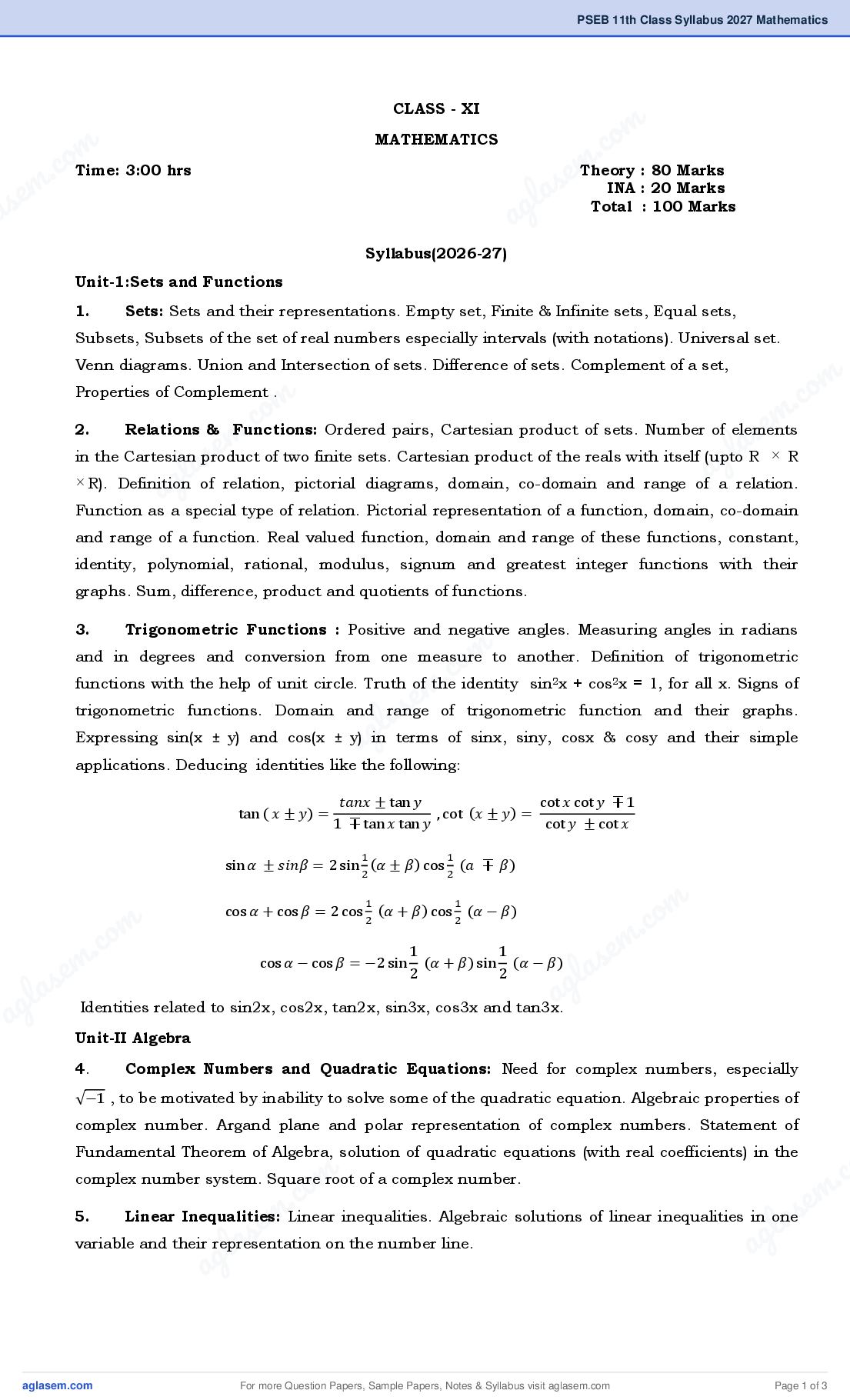
Syllabus(2026-27)
Unit-1:Sets and Functions
1. Sets: Sets and their representations. Empty set, Finite & Infinite sets, Equal sets,
Subsets, Subsets of the set of real numbers especially intervals (with notations). Universal set.
Venn diagrams. Union and Intersection of sets. Difference of sets. Complement of a set,
m
Properties of Complement .
om . co
. c e m
2.
m s
Relations & Functions: Ordered pairs, Cartesian product of sets. Number of elements
e of two finite sets. Cartesian product of the reals with itself (uptoa
lR R
a s
in the Cartesian product g
l of relation, pictorial diagrams, domain, co-domain and range ofaa relation.
a g
R). Definition
Function as a special type of relation. Pictorial representation of a function, domain, co-domain
and range of a function. Real valued function, domain and range of these functions, constant,
identity, polynomial, rational, modulus, signum and greatest integer functions with their
graphs. Sum, difference, product and quotients of functions.
3. Trigonometric Functions : Positive and negative angles. Measuring angles in radians
o m
and in degrees and conversion from one measure to another. Definition of trigonometric
c
. identity sin x + cos x = 1, for all x. Signs of
m
functions with the help of unit circle. Truth of the 2
e of trigonometric function and their graphs.
2
trigonometric functions. Domain and range
Expressing sin(x ± y) and cos(x ± y) g
a in terms of sinx, siny, cosx & cosy and their simple
applications. Deducing identities like the following:
𝑡𝑎𝑛𝑥 ± tan 𝑦 cot 𝑥 cot 𝑦 ∓ 1
tan ( 𝑥 ± 𝑦) = , cot (𝑥 ± 𝑦) =
1 ∓ tan 𝑥 tan 𝑦 cot 𝑦 ± cot 𝑥
sin 𝛼 ± 𝑠𝑖𝑛𝛽 = 2 sin (𝛼 ± 𝛽) cos (𝑎 ∓ 𝛽)
m
.co
cos 𝛼 + cos 𝛽 = 2 cos (𝛼 + 𝛽) cos (𝛼 − 𝛽)
m
m .co 1
s e 1 m
s e cos 𝛼 − cos 𝛽 = −2 sin
2
g l a
(𝛼 + 𝛽) sin (𝛼 − 𝛽)
2
g la Identities related to sin2x, cos2x, tan2x, sin3x, cos3x and tan3x.a
a
Unit-II Algebra
4. Complex Numbers and Quadratic Equations: Need for complex numbers, especially
√−1 , to be motivated by inability to solve some of the quadratic equation. Algebraic properties of
complex number. Argand plane and polar representation of complex numbers. Statement of
Fundamental Theorem of Algebra, solution of quadratic equations (with real coefficients) in the
m . c
c. o
complex number system. Square root of a complex number.
e m
5.
em
Linear Inequalities: Linear inequalities. Algebraic solutions of linear inequalities in one
variable and their representation on the number line. ag
ag
For more Question Papers, Sample Papers, Notes & Syllabus visit Page 1 of 3
Page 3
Permutations and combinations, derivation of formulae for 𝑛 and 𝑛 and their connections,
simple applications.
7. Binomial Theorem :History, statement and proof of the binomial theorem for positive
integral indices. Pascal’s triangle. Simple applications.
8. Sequence and Series: Sequence and Series. Arithmetic Mean (A.M.) , Geometric
Progression ( G.P.), general term of a G.P, sum of n terms of a G.P. Infinite G.P. and its sum,
geometric mean (G.M), relation between A.M. and G.M.
Unit-III: Coordinate Geometry
9. Straight Lines : Brief recall of two dimensional geometry from earlier classes. Slope of a
line and angle between two lines .Various forms of equations of a line: parallel to axis, point–
slope form, slop–intercept form, two–point form, intercept form. Distance of a point from a line.
10. Conic Sections: Sections of a cone: circles, ellipse, parabola, hyperbola, a point, a
straight line and a pair of intersecting lines as a degenerated case of a conic section. Standard
equations and simple properties of parabola, ellipse and hyperbola. Standard equations of a
circle.
11. Introduction to Three-dimensional Geometry :Coordinate axes and coordinate planes
in three dimensions .Coordinates of a point. Distance between two points.
Unit-IV: Calculus
12. Limits and Derivatives: Derivative introduced as rate of change both as that of distance
function and geometrically. intuitive idea of limit. Limits of polynomials and rational functions
trigonometric, exponential and logarithmic functions. Definition of derivative, relate it to slope
of tangent of the curve, derivative of sum, difference, product and quotient of functions.
Derivatives of polynomial and trigonometric functions.
Unit-V: Statistics and Probability
13. Statistics: Measure of Dispersion: Range, mean deviation, variance and standard
deviation of ungrouped/grouped data.
14. Probability : Events: Occurrence of events, ‘not’, ‘and’ & ‘or’ events, exhaustive events,
mutually exclusive events. Axiomatic (set theoretic) probability, connections with others theories
of earlier classes. Probability of an event , probability of ‘not’, ‘and’ & ‘or’ events.
INTERNAL ASSESSMENT 20 Marks
Mathematics Activities 10 Marks
Distribution of marks under CCE(Besides Mathematics Activities ) 10 Marks
Note: For activities NCERT Lab Manual may be referred.
Conduct of Periodic Tests
1. Periodic Test is a Pen and Paper assessment which is to be conducted by the subject
teacher.
2. In the entire Academic year, three periodic Tests in each subject may be conducted.
3. Once schools complete the conduct of all three periodic tests, they will convert the
weightage of each of the three tests into ten marks each for identifying best two
For more Question Papers, Sample Papers, Notes & Syllabus visit Page 2 of 3
Page 4
o m
m
taken as the final marks for PT.
. c
c. o4. The school will ensure simple documentation to keep a record
s e mof performance.
e m l a
as ag
Assessment of Activity work
Time : 2hrs 10 Marks
Throughout the year any 10 activities shall be performed be the student from the
activities given in the NCERT Laboratory Manual for the respective class (XI or XII) which is
available on the link: http//www.ncert.nic.in/exemplar/labmanuals.html. A record of the same
may be kept by the student. An year end test on the activity may be conducted at the School
Level. The weightage are as under:
o m
m . c
.
the year andco recordkeeping
The activities and one of the projects performed by the
: 5marks em
student throughout
s
e m of the activity performed during the year end test : 3 marks
l a
Assessment
Viva-voce g
: 2amarks
ag ACTIVITIES
1. To find the number of subsets of a given set and verify that if a set has n number
of elements, then the total number of subsets is 2 .
2. To verify that for two sets A and B, 𝑛 (𝐴 × 𝐵) = 𝑝𝑞 and the total number of
relations from A to B is 2 , where 𝑛 (𝐴) = 𝑝 and 𝑛 (𝐵) = 𝑞 .
3. To represent set theoretic operations using Venn diagrams.
4. To verify distributive law for three given non-empty sets A,B and C, that is,
𝐴 ∪ (𝐵 ∩ 𝐶) = (𝐴 ∪ 𝐵) ∩ (𝐴 ∪ 𝐶)
m
.co
5. To identify a relation and a function.
6. To distinguish between a Relation and a Function.
7.
e m
To verify the relation between the degree measure and the radian measure of an
angle.
8.
ag
To find the values of sine and cosine functions in second, third and fourth
quadrants using their given values in first quadrant.
9. To prepare a model to illustrate the values of sine functions and cosine
functions for different angles which are multiples of and 𝜋
10. To plot the graphs of sin 𝑥, sin 2𝑥, 2𝑠𝑖𝑛𝑥 𝑎𝑛𝑑 sin , using same coordinate axes.
11. To interpret geometrically the meaning of 𝑖 = √− 1 and its integral powers.
12. To find the number of ways in which three cards can be selected from given five
cards.
m
.co
13. To construct a Pascal’s Triangle and to write binomial expansion for a given
m
positive integral exponent.
14.
.co
To demonstrate that the Arithmetic mean of two different positive numbers is
s e m
s em always greater than the Geometric mean.
g la
a
l 16.
15. To construct different types of conic section.
a
ag 17.
To construct a parabola.
An alternative method of constructing a parabola.
18. To construct an ellipse using a rectangle.
19. To construct an ellipse with given major and minor axes.
20. To construct an ellipse when two fixed points are given.
21. To explain the concept of octants by three mutually perpendicular planes in
space.
22. To find analytically 𝑙𝑖𝑚 𝑓 (𝑥) =
23.
m
Verification of the geometrical significance of derivative.
. c
c. o s e m
s em g l a
l a a
ag
For more Question Papers, Sample Papers, Notes & Syllabus visit Page 3 of 3