Edudel Syllabus Class 12 Chemistry
Finished viewing? Save it for later —
Download Edudel Syllabus Class 12 Chemistry (PDF · 8 pages)About Edudel Syllabus Class 12 Chemistry
Edudel Syllabus Class 12 Chemistry is available here for free download. Published by Delhi School Education for Class 12, this syllabus can be viewed online or downloaded as a PDF (8 pages). Candidates preparing for Class 12 can use Edudel Syllabus Class 12 Chemistry to understand the exam pattern, the type of questions asked, and the overall difficulty level.
Frequently Asked Questions
How can I download Edudel Syllabus Class 12 Chemistry?
Open this page and click the Download button to save Edudel Syllabus Class 12 Chemistry as a PDF. It is completely free on AglaSem Docs.
Is Edudel Syllabus Class 12 Chemistry free to download?
Yes. Edudel Syllabus Class 12 Chemistry can be viewed online and downloaded as a PDF free of cost on AglaSem Docs.
How many pages does Edudel Syllabus Class 12 Chemistry have?
Edudel Syllabus Class 12 Chemistry contains 8 pages, which you can read online or download together as a single PDF.
Where can I find more Class 12 study material?
You can find more Class 12 question papers, sample papers, syllabus, and answer keys on AglaSem Docs.
Edudel Syllabus Class 12 Chemistry – Text
Read the full text of this syllabus below — useful to quickly search, copy and reference the content online without downloading the PDF.
📄 View text version (6 pages)
Page 1
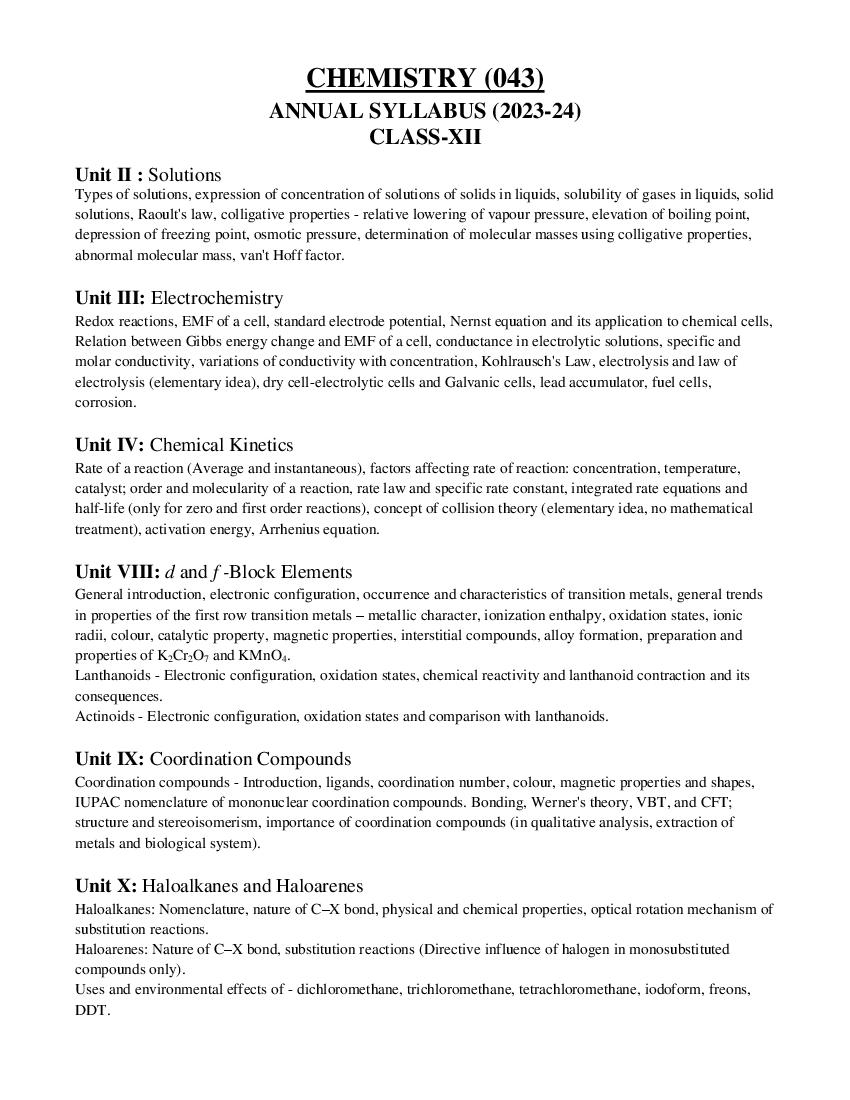
ANNUAL SYLLABUS (2023-24)
CLASS-XII
Unit II : Solutions
Types of solutions, expression of concentration of solutions of solids in liquids, solubility of gases in liquids, solid
solutions, Raoult's law, colligative properties - relative lowering of vapour pressure, elevation of boiling point,
depression of freezing point, osmotic pressure, determination of molecular masses using colligative properties,
abnormal molecular mass, van't Hoff factor.
Unit III: Electrochemistry
Redox reactions, EMF of a cell, standard electrode potential, Nernst equation and its application to chemical cells,
Relation between Gibbs energy change and EMF of a cell, conductance in electrolytic solutions, specific and
molar conductivity, variations of conductivity with concentration, Kohlrausch's Law, electrolysis and law of
electrolysis (elementary idea), dry cell-electrolytic cells and Galvanic cells, lead accumulator, fuel cells,
corrosion.
Unit IV: Chemical Kinetics
Rate of a reaction (Average and instantaneous), factors affecting rate of reaction: concentration, temperature,
catalyst; order and molecularity of a reaction, rate law and specific rate constant, integrated rate equations and
half-life (only for zero and first order reactions), concept of collision theory (elementary idea, no mathematical
treatment), activation energy, Arrhenius equation.
Unit VIII: d and f -Block Elements
General introduction, electronic configuration, occurrence and characteristics of transition metals, general trends
in properties of the first row transition metals – metallic character, ionization enthalpy, oxidation states, ionic
radii, colour, catalytic property, magnetic properties, interstitial compounds, alloy formation, preparation and
properties of K2Cr2O7 and KMnO4.
Lanthanoids - Electronic configuration, oxidation states, chemical reactivity and lanthanoid contraction and its
consequences.
Actinoids - Electronic configuration, oxidation states and comparison with lanthanoids.
Unit IX: Coordination Compounds
Coordination compounds - Introduction, ligands, coordination number, colour, magnetic properties and shapes,
IUPAC nomenclature of mononuclear coordination compounds. Bonding, Werner's theory, VBT, and CFT;
structure and stereoisomerism, importance of coordination compounds (in qualitative analysis, extraction of
metals and biological system).
Unit X: Haloalkanes and Haloarenes
Haloalkanes: Nomenclature, nature of C–X bond, physical and chemical properties, optical rotation mechanism of
substitution reactions.
Haloarenes: Nature of C–X bond, substitution reactions (Directive influence of halogen in monosubstituted
compounds only).
Uses and environmental effects of - dichloromethane, trichloromethane, tetrachloromethane, iodoform, freons,
DDT.
Page 2
Alcohols: Nomenclature, methods of preparation, physical and chemical properties (of primary alcohols only),
identification of primary, secondary and tertiary alcohols, mechanism of dehydration, uses with special reference
to methanol and ethanol.
Phenols: Nomenclature, methods of preparation, physical and chemical properties, acidic nature of phenol,
electrophillic substitution reactions, uses of phenols.
Ethers: Nomenclature, methods of preparation, physical and chemical properties, uses.
NOTE: Completion of syllabus of Mid-Term by 15 September 2023
____________________________________________________________________________________
MID-TERM EXAMINATION
____________________________________________________________________________________
Unit XII: Aldehydes, Ketones and Carboxylic Acids
Aldehydes and Ketones: Nomenclature, nature of carbonyl group, methods of preparation, physical and chemical
properties, mechanism of nucleophilic addition, reactivity of alpha hydrogen in aldehydes, uses.
Carboxylic Acids: Nomenclature, acidic nature, methods of preparation, physical and chemical properties; uses.
Unit XIII: Amines
Amines: Nomenclature, classification, structure, methods of preparation, physical and chemical properties, uses,
identification of primary, secondary and tertiary amines.
Diazonium salts: Preparation, chemical reactions and importance in synthetic organic chemistry.
Unit XIV: Biomolecules
Carbohydrates - Classification (aldoses and ketoses), monosaccahrides (glucose and fructose), D-L configuration
oligosaccharides (sucrose, lactose, maltose), polysaccharides (starch, cellulose, glycogen); Importance of
carbohydrates.
Proteins -Elementary idea of - amino acids, peptide bond, polypeptides, proteins, structure of proteins - primary,
secondary, tertiary structure and quaternary structures (qualitative idea only), denaturation of proteins; enzymes.
Hormones - Elementary idea excluding structure.
Vitamins - Classification and functions.
Nucleic Acids: DNA and RNA.
NOTE:
• Complete the annual syllabus by 15th December 2023.
• Whole syllabus will be covered in Common Pre-Board Examination.
• Chapter wise weightage and question paper design for Common Annual School Examination is
as follows:
Sr. No. Name of the Unit Marks
1. Solutions 7
2. Electrochemistry 9
3. Chemical Kinetics 7
4. The d- and f-block Elements 7
Page 3
6. Haloalkanes and Haloarenes 6
7. Alcohols, Phenols and Ethers 6
8. Aldehydes, Ketones and Carboxylic Acids 8
9. Amines 6
10. Biomolecules 7
Total 70
QUESTION PAPER DESIGN CLASS-XII (2023-24)
Section Type of Questions Marks
A Selected Response Type (Multiple Choice Questions) 16
12 MCQs and 4 Assertion-Reason type questions.
1 marks each
B Very Short Answer Type Questions 10
5 questions with internal choice in one question.
2 marks each.
C Short Answer Type Questions 21
7 questions with internal choice in one question.
3 marks each.
D Case -Based Questions 8
2 Questions, each question has an internal choice and carries
4 (1+1+2) marks each.
E Long Answer Type Questions 15
3 questions with internal choice in each question.
5 marks each.
Total 70
Sr. No. Domain Total Marks Percentage
1. Remembering and Understanding: Exhibit memory of 28 40
previously learned material by recalling facts, terms, basic concepts
and answers. Demonstrate understanding of facts and ideas by
organizing, comparing, translating, interpreting, giving descriptions
and stating main ideas.
2. Applying: Solve problems to new situations by applying acquired 21 30
knowledge, facts, techniques and rules in a different way.
Page 4
information into parts by identifying motives or causes. Make
inferences and find evidence to support generalizations. Present
and defend opinions by making judgments about information,
validity of ideas or quality of work based on a set of criteria.
Compile information together in a different way by combining
elements in a new pattern or proposing alternative solutions.
Link for CBSE Sample Paper (Chemistry Class-12th) :
https://cbseacademic.nic.in/web_material/SQP/ClassXII_2023_24/Chemistry-
SQP.pdf
PRACTICAL SYLLABUS (2023-24)
Micro-chemical methods are available for several of the practical experiments, wherever possible such techniques
should be used.
A. Surface Chemistry
(a) Preparation of one lyophilic and one lyophobic sol
Lyophilic sol - starch, egg albumin and gum
Lyophobic sol - aluminium hydroxide, ferric hydroxide, arsenous sulphide.
(b) Dialysis of sol-prepared in (a) above.
(c) Study of the role of emulsifying agents in stabilizing the emulsion of different oils.
B. Chemical Kinetics
(a) Effect of concentration and temperature on the rate of reaction between Sodium Thiosulphate and
Hydrochloric acid.
(b) Study of reaction rates of any one of the following:
(i) Reaction of Iodide ion with Hydrogen Peroxide at room temperature using different concentration of Iodide
ions.
(ii) Reaction between Potassium Iodate, (KIO3) and Sodium Sulphite: (Na2SO3) using starch solution as indicator
(clock reaction).
C. Thermochemistry
Any one of the following experiments
i) Enthalpy of dissolution of Copper Sulphate or Potassium Nitrate.
ii) Enthalpy of neutralization of strong acid (HCl) and strong base (NaOH).
iii) Determination of enthaply change during interaction (Hydrogen bond formation) between Acetone and
Chloroform.
D. Electrochemistry
Variation of cell potential in Zn | Zn2+|| Cu2+| Cu with change in concentration of electrolytes (CuSO4 or ZnSO4) at
room temperature.
E. Chromatography
i) Separation of pigments from extracts of leaves and flowers by paper chromatography and determination of Rf
values.
Page 5
large difference in Rf values to be provided).
F. Preparation of Inorganic Compounds
Preparation of double salt of Ferrous Ammonium Sulphate or Potash Alum. Preparation of Potassium Ferric
Oxalate.
J. Determination of concentration/ molarity of KMnO4 solution by titrating it against a standard
solution of:
i) Oxalic acid,
ii) Ferrous Ammonium Sulphate
(Students will be required to prepare standard solutions by weighing themselves)
NOTE: Completion of syllabus of Mid-Term by 15th September 2023
____________________________________________________________________________________
MID-TERM EXAMINATION
____________________________________________________________________________________
G. Preparation of Organic Compounds
Preparation of any one of the following compounds
i) Acetanilide ii) Di -benzalAcetone iii) p-Nitroacetanilide iv) Aniline yellow or 2 - Naphthol Anilinedye.
H. Tests for the functional groups present in organic compounds:
Unsaturation, alcoholic, phenolic, aldehydic, ketonic, carboxylic and amino (Primary) groups.
I. Characteristic tests of carbohydrates, fats and proteins in pure samples and their detection in
given foodstuffs.
K. Qualitative Analysis
a) Determination of one anion and one cation in a given salt
Cations- Pb2+, Cu2+, As3+, Al3+, Fe3+, Mn2+, Ni2+, Zn2+, Co2+ , Ca2+, Sr2+, Ba2+, Mg2+, NH4 +
Anions - CO32- , S2- , NO2- , SO32-, SO42-, NO3 - , Cl- , Br-, I-, PO43-, CH3COO-
(Note: Insoluble salts excluded)
b) Detection of -Nitrogen, Sulphur, Chlorine in organic compounds.
PROJECTS
Scientific investigations involving laboratory testing and collecting information from other sources. A few
suggested Projects
• Study of the presence of oxalate ions in guava fruit at different stages of ripening.
• Study of quantity of casein present in different samples of milk.
• Preparation of soybean milk and its comparison with the natural milk with respect to curd formation, effect of
temperature, etc.
• Study of the effect of Potassium Bisulphate as food preservative under various conditions (temperature,
concentration, time, etc.)
• Study of digestion of starch by salivary amylase and effect of pH and temperature on it.
• Comparative study of the rate of fermentation of following materials: wheat flour, gram flour, potato juice,
carrot juice, etc.
• Extraction of essential oils present in Saunf (aniseed), Ajwain (carum), Illaichi (cardamom).
Page 6
Note: Any other investigatory project, which involves about 10 periods of work, can be chosen with the
approval of the teacher.
Evaluation Scheme for Examination Marks
Volumetric Analysis 08
Salt Analysis 08
Content Based Experiment 06
Project Work 04
Class record and viva 04
Total 30
Document Details
| Board / Org | Delhi Board |
| Exam | Class 12 |
| Type | Syllabus |
| Pages | 8 |
| Updated | 22 Jul 2026 |