Karnataka PGCET 2017 Question Paper Chemical Engineering
Finished viewing? Save it for later —
Download Karnataka PGCET 2017 Question Paper Chemical Engineering (PDF · 15 pages)About Karnataka PGCET 2017 Question Paper Chemical Engineering
Karnataka PGCET 2017 Question Paper Chemical Engineering is available here for free download. Published by KEA for Karnataka Post Graduate Common Entrance Test, this question paper can be viewed online or downloaded as a PDF (15 pages). Candidates preparing for Karnataka Post Graduate Common Entrance Test can use Karnataka PGCET 2017 Question Paper Chemical Engineering to understand the exam pattern, the type of questions asked, and the overall difficulty level.
Frequently Asked Questions
How can I download Karnataka PGCET 2017 Question Paper Chemical Engineering?
Open this page and click the Download button to save Karnataka PGCET 2017 Question Paper Chemical Engineering as a PDF. It is completely free on AglaSem Docs.
Is Karnataka PGCET 2017 Question Paper Chemical Engineering free to download?
Yes. Karnataka PGCET 2017 Question Paper Chemical Engineering can be viewed online and downloaded as a PDF free of cost on AglaSem Docs.
How many pages does Karnataka PGCET 2017 Question Paper Chemical Engineering have?
Karnataka PGCET 2017 Question Paper Chemical Engineering contains 15 pages, which you can read online or download together as a single PDF.
Where can I find more Karnataka Post Graduate Common Entrance Test study material?
You can find more Karnataka Post Graduate Common Entrance Test question papers, sample papers, syllabus, and answer keys on AglaSem Docs.
Karnataka PGCET 2017 Question Paper Chemical Engineering – Text
Read the full text of this question paper below — useful to quickly search, copy and reference the content online without downloading the PDF.
📄 View text version (15 pages)
Page 1
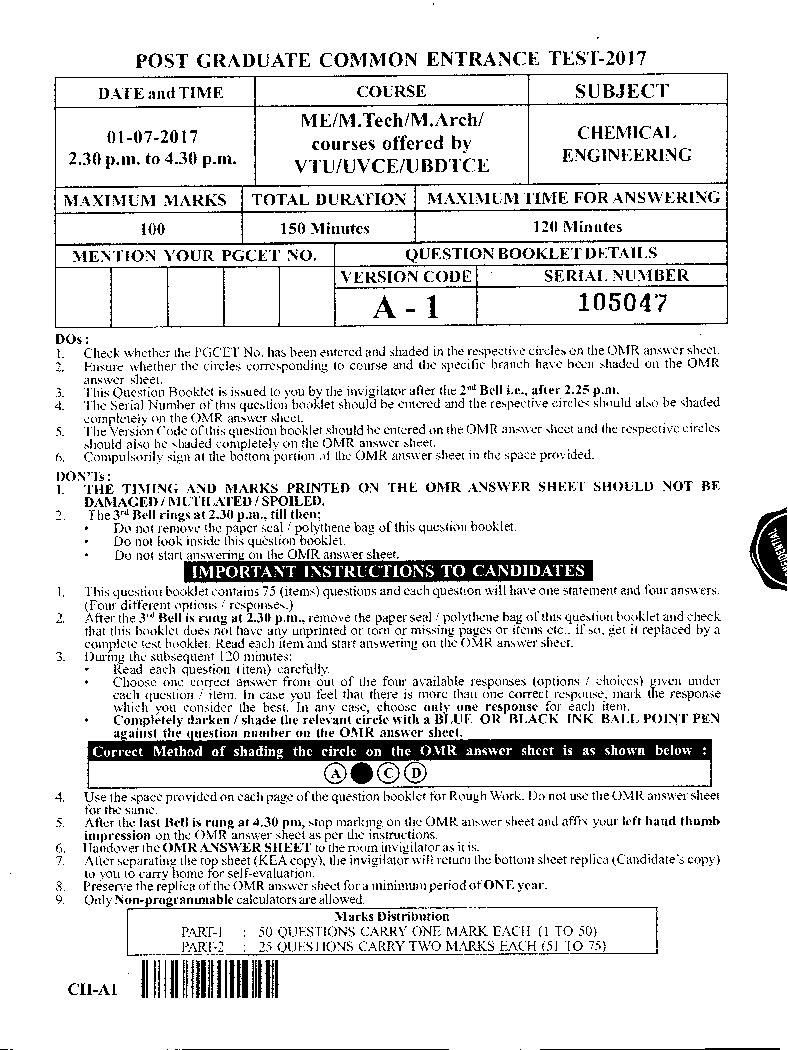
DATE and TIME COURSE SUBJECT
ME/M.Tech/M.Arch/
01-07-2017 CHEMICAL
courses offered by
2.30 p.ni. to 4.30 p.m. ENGINEERING
VTU/UVCE/UBDTCE
MAXIMUM MARKS TOTAL DURATION MAXIMUM TIME FOR ANSWERING
100 150 Minutes 120 Minutes
MENTION YOUR PGCET NO. QUESTION BOOKLET DETAILS
VERSION CODE SERIAL NUMBER
A- 1 105047
DOs :
1. Check whether the PGCET No. has been entered and shaded in the respective circles on the OMR answer sheet.
2. Ensure whether the circles corresponding to course and the specific branch have been shaded on the OMR
answer sheet.
3. This Question Booklet is issued to you by the invigilator after the 2" Bell i.e., after 2.25 p.m.
4. The Serial Number of this question booklet should be entered and the respective circles should also be shaded
completely on the OMR answer sheet.
5. The Version Code of this question booklet should be entered on the OMR answer sheet and the respective circles
should also be shaded completely on the OMR answer sheet.
6. Compulsorily sign at the bottom portion of the OMR answer sheet in the space provided.
DON'Ts :
1. THE TIMING AND MARKS PRINTED ON THE OMR ANSWER SHEET SHOULD NOT BE
DAMAGED / MUTILATED / SPOILED.
2. The 3rd Bell rings at 2.30 p.m., till then;
• Do not remove the paper seal / polythene bag of this question booklet.
• Do not look inside this question booklet.
• Do not start answering on the OMR answer sheet.
IMPORTANT INSTRUCTIONS TO CANDIDATES
1. This question booklet contains 75 (items) questions and each question will have one statement and four answers.
(Four different options / responses.)
2. After the 3" Bell is rung at 2.30 p.m., remove the paper seal / polythene bag of this question booklet and check
that this booklet does not have any unprinted or torn or missing pages or items etc., if so, get it replaced by a
complete test booklet. Read each item and start answering on the OMR answer sheet.
3. During the subsequent 120 minutes:
• Read each question (item) carefully.
• Choose one correct answer from out of the four available responses (options l choices) given under
each question / item. In case you feel that there is more than one correct response, mark the response
which you consider the best. In any case, choose only one response for each item.
• Completely darken / shade the relevant circle with a BLUE OR BLACK INK BALL POINT PEN
aoainst the uestion number on the OMR answer sheet.
Correct Method of shading the circle on the OMR answer sheet is as shown below :
CDOCX)
4. Use the space provided on each page of the question booklet for Rough Work. Do not use the OMR answer sheet
for the same.
5. After the last Bell is rung at 4.30 pm, stop marking on the OMR answer sheet and affix your left hand thumb
impression on the OMR answer sheet as per the instructions.
6. Handover the OMR ANSWER SHEET to the room invigilator as it is.
7. After separating the top sheet (KEA copy), the invigilator will return the bottom sheet replica (Candidate's copy)
to you to carry home for self-evaluation.
8. Preserve the replica of the OMR answer sheet for a minimum period of ONE year.
9. Only Non-programmable calculators are allowed.
Marks Distribution
PART-I : 50 QUESTIONS CARRY ONE MARK EACH (1 TO 50)
PART-2 : 25 QUESTIONS CARRY TWO MARKS EACH (51 TO 75)
CH-A1 11 wi 11111111111111
Page 2
PART —1
Each question carries one mark. (50 x 1 = 50)
1. All spontaneous processes are 4. C p — C, = R is valid for
(A) Irreversible
(A) Gases at a very low temperature
(B) Reversible
(B) Gases at very high temperature
(C) Adiabatic
(C) Ideal gas
(D) Isothermal
(D) Real gas
2. First law of thermodynamics deals
with
5. Work done is a
(A) Direction of energy transfer
(A) Property of the system
(B) Reversible process only
(B) Path function
(C) Irreversible process only
(C) Point function
(D) Isothermal process
(D) State description of a system
3. Equation which relates pressure,
volume and temperature of gas is
6. Gain Margin is equal to
called
(A) Gibbs — Duhem equation (A) Amplitude ratio
(B) Equation of state (B) Reciprocal of Amplitude ratio
(C) Ideal gas equation (C) Gain of P-D controller
(D) Real gas equation (D) Gain of steady state process
CH 3 A-1
Page 3
(A) If it exhibits an unbounded (A) Decay Ratio — Overshoot
response to a bounded input
If its output response is (B) Decay Ratio = (Overshoot)2
(B)
unbounded for all unbounded
input (C) Overshoot increases for increasing
damping co-efficient.
(C) If it exhibits an bounded
response to a unbounded input (D) Overshoot decreases for increasing
damping co-efficient.
(D) If its output response is bounded
for all bounded input
11. Which of the following is a controlling
8. The transfer function of a first order factor in very fast heterogeneous
system is reaction ?
S
(A) (A) Heat and mass transfer effects
TS + 1
(B) Temperature
(B)
TS 1- 1
(C) Pressure
(C)
TS ± (D) Composition of reactant
1
(D)
12. Rate determining step in a reaction
consisting of a number of steps in
9. When the damping co-efficient of the series is the
second order system is less than 1, it is
called (A) Fastest step
(A) under damped system (B) Intermediate step
(B) over damped system
(C) Un-predictable step
(C) critically damped system
(D) Slowest step
(D) vibrating system
A-1 4 CH
Page 4
is atmospheric air is
(A) The time required to reduce the (A) 79
concentration of the reacting
substance to half its initial value.
(B) 23
(B) Half of the space time of a
reaction. (C) 21
(C) Half of the residence time of a (D) 29
reaction.
(D) Double of the residence time of a
reaction.
17. A gaseous fuel in order to develop
luminosity on burning must contain
14. With increase in temperature, the
(A) Carbon monoxide
equilibrium conversion of a reversible
exothermic reaction
(B) Hydrocarbon
(A) Increases
(C) Hydrogen
(B) Remains unaffected
(C) Decreases (D) Oxygen
(D) Decreases linearly with
temperature
18. Combustion of pulverised coal as
compared to that of lump coal
15. The reaction in which rate equation
corresponds to a stoichiometric (A) Develops a non-luminous flame
equation is called
(B) Develops a low temperature
(A) Parallel reaction flame
(B) Autokinetic reaction
(C) Can be done with less excess air
(C) Elementary reaction
(D) Provide a lower rate of heat
(D) Non-elementary reaction release
C11 5 A-1
Page 5
characterized by head of
(A) Still fluid
(A) Smoke formation
(B) Turbulent flow
(B) High flue gas temperature
(C) Laminae flow
(C) High percentage of oxygen in (D) Flowing fluid
flue gas
(D) High carbon monoxide content 23. Non-uniform flow occurs when
in flue gas (A) Direction and magnitude of
velocity at all points are
20. — 40 °C is equal to (B) Velocity of successive fluid
particles, at any point is same at
(A) + 40 °F successive periods of time.
(C) Magnitude and direction of
(B) — 40 °F velocity do not change from
point to point in the fluid.
(C) 39 °F
(D) Velocity depth, pressure, etc.
change point to point in the fluid
(D) — 39 °F
flow.
24. The loss of head due to sudden
21. A fluid in equilibrium means
expansion of a pipe is
(A) its viscosity is zero. V 1 2 — V,2
(A) h —
(B) shear stresses are acting on the
fluid but no flow behaviour is 0.5\71 2
manifested. (B)
2g
(C) it is free from shear stresses. (V1 — V2 )2
(C) h L—
2g
(D) a .hypothetical situation because
fluids are never in equilibrium. (D) h L = (V1 — V,) / 2g
A-1 6 CH
Page 6
centrifugal pump on water per second (A) Grizzles
per unit weight of water is given by
(B) Trammels
1 (C) Shaking screen
(A) — V ti p
g
(D) Vibrating screen
(B)V Ul
g "2 29. Compressibility co-efficient for an
absolute compressible cake is
1
(C) g (V‘3,, u, — V u )
— (A) 0
(B)
(D) uig
(C) 100
(D) infinite
26. Horse power required for a roll
30. A sphere settles freely through a pool
ceusher is directly proportional to
of liquid and the settling is in Stoke's
law range. The terminal velocity of
(A) Reduction ratio
sphere will
(B) Size of product (A) Be independent of the liquid
viscosity
(C) Motor size
(B) Increases linearly with viscosity
(D) Size of feed (C) Decreases linearly with viscosity
(D) Decreases inversely with the
square of viscosity
27. Length to diameter ratio of a ball Mill
is usually around 31. Provision of fins on a given heat
transfer surface will be more if there
(A) 0 — 25 are
(B) 1 — 1.5 (A) fewer number of thin fins
(B) fewer number of thick fins
(C) 10
(C) large number of thin fins
(D) 100 (D) large number of thick fins
CH 7 A-1
Page 7
thick sphere (Q) of radius r and r, is a function of
equal to (A) Reynold's Number & Prendtl
Number
471k (t 1 —t,)
(A) (B) Grashoff's Number & Prendtl
-r i
Number
(C) Prendtl Number
(B)
(D) Froude Number & Reynold's
Number
47tk r l r2 t2 )
(C) (r, r1 )
36. The Z-component of the total mass
471r r
'I' 2 flux of a component A in a binary
(D)
(t 1 —1,) mixture of A and B is given by
(CA
CA (NAz + N Bz )— DAB
aZ
33. Ratio of heat transfer co-efficient to
the flow of heat per unit temperature (7CA
CA (NAz + NB7)+ DAB
rise due to the velocity aZ
(A) Stanton Number aCA
--DAB
(B) Prandtl Number ez
(C) Grashoff's Number (D) - -( + N,,,)
(D) Mach Number
37. Adsorption of gases on solids
34. Fouling Factor is used
(A) Increases with increasing
(A) in heat exchange design as a temperature.
safety factor
(B) Decreases with increasing
(B) In case of Newtonian fluids temperature.
(C) When liquid exchanges heat with Decreases with increasing
gas pressure.
(D) Pressure drop calculation (D) Remains constant with
increasing temperature.
A-1 8 CH
Page 8
a distillation column) the murphee try
(A) Boron, Copper, Manganese
efficiency is defined by
(B) Calcium, Molybdenum, Zinc
(A) —
Yn I (C) Iron, Sulphur, Molybdenum
(D) Calcium, Magnesium, Sulphur
Y —Y„
(B)
Y—
42. Raw materials for production of urea
Y „ — Y„,
(C) are
— Y,,
(A) Carbon dioxide and brine
Y —Y
(D) " (B) Carbon dioxide and Ammonia
Y., Yi,
(C) Carbon disulphide and ammonia
(D) Carbon disulphide, brine and
39. Lewin Number = 1 signifies ammonia
(A) N pi' = N SC
(B) N SA.: = N Re 43. Crude oil is made up mainly of
(A) Alkanes, Cycloalkanes and
(C) Npr= N I2e
Aromatics ties
(D) Nst• N pr (B) Alkanes, Aldehydes and Ketones
(C) Alkanes, Alkenes and Alkynes
40. The variation of Knudren diffusion (D) Heavy metals & Gases
co-efficient (DKA) with the absolute
temperature (T) follows
44. Thermoplastic serine are not usually
(A) DKA x T
(A) soft
(B) DK A x T3 2
(B) stronger
Ti 2
DKA x (C) Less brittle
(D) DKA x T2 (D) Can be reclaimed from the
wastes
C11 9 A-1
Page 9
removal equipment is the most
(A) Basic Refractory efficient
(B) Acidic Refractory (A) Bas filter
(C) Mentral Refectory (B) Scrubber
(D) Not a refractory material (C) Electrostatic Precipitator
(D) Cyclone Separator
46. Which of the following is a man made
source of air pollution ?
49. Polluted water having Low BOD are
(A) Automobile exhaust most economically treated in
(B) Forest fire Sedimentation tank
(A)
(C) Bacterial action in soil and
(B) Oxidation ponds
swamp areas
(C) Sludge digester
(D) Volcanoes
(D) Clarifier
47. Carbon monoxide is a pollutant, which
causes
50. Pick out the one which is not a
(A) respiratory disease (eg. ashthma) chemical coagulant
(B) Asphyxiation (suffocation leading (A) Aluminium sulphate
to death)
(B) Ferrous sulphate
(C) Retardation in crop growth
(C) Hydrated lime
(D) Damage to building materials
like marble (D) Chloraminc
A-1 10 CH
Page 10
(Each question carries two marks) (25 x 2 = 50)
51. For zero order constant volume 53. Rate constants tier two reactions arc k1
reaction A ---> R taking place in a and k, at 300 K. A i and A, arc
batch reactor, the conversion is 50% of arrhenius constants. What is the ratio
A after 5 minutes. If the initial E I /E, if k1 /k, = A l /A, ?
concentration of A is 1.2 mol/lit. What
is the conversion after 5 minutes if the (A) 4
initial concentration is 1 mol/lit. ? (B) 3
(C) 2
(A) 40%
(D) 1
(B) 50%
54. Keeping all else same in the operation
(C) 60% of mixed flow adiabatic reactor, what
happens to conversion if the feed
temperature is increased for an
(D) 70%
endothermic reaction ?
(A) Conversion increases
(B) Conversion decreases
52. What is the relation between E and F (C) Conversion remain constant
curves ? (D) Conversion increases linearly
dF
(A) E= 55. A single effect evaporator is fed with
dt
4000 kg/hr of weak liquor containing
17% caustic by weight and is
dE concentrated to get thick liquor
(B) F = dt
containing 40/a by weight of caustic.
Calculate the amount of water
dE evaporated.
(C) t=
dF (A) 2100 kg/hr
(B) 2200 kg/hr
dF
(D) A= (C) 2300 kg./hr
dU
(D) 2400 kg/hr
C11 11 A-1
Page 11
of a system is given by
(A)
cA
(B) 10 (A)
\c nI T, P,
(C) 11
( J
(D) 12 (B)
P, n
57. How many moles of H,SO4 will
(C)
contain 64 kg of S ?
(A)
r
(D) —
(B) P
(C) 3
(D) 4
60. 20 kg of water is vaporized at constant
temperature of 100 °C and 1 atm
pressure. The heat added to the system
is 2257 kJ/kg. The specific volume of
58. A gas mixture contains 0.28 kgmol of
HC/, 0.34 kgmol of N, and 0.09 kgmol liquid and vapor arc 1.04 x 10⁻³ and
167.2 x 10⁻² m3/kg respectively. Find
of 0,. What is the average molecular
AU.
weight of the gas ?
(A) 21,798 kJ/kg
(A) 31.8
(B) 41.8 (B) 33,798 kJ/kg
(C) 53.8 (C) 41,798 kJ/kg
(D) 63.8
(D) 51,798 kJ/kg
A-1 12 CII
Page 12
64. The radiative heat transfer rate per unit
is based on
(A) Zeroth Law area (w/m2) between two plane parallel
(B) First Law grey surfaces (emissivity = 0.9)
(C) Second Law
maintained at 400 K and 300 K is
(D) Third Law
(A) 992
62. A thin flat plate 2m x 2m is hanging
freely in air. The temperature of the
surroundings is 25 °C. Solar radiation (B) 812
is falling on one side of three plates at
the rate. of 500 W/m2. Temperature of !OA11:./1
f Tfl
the plate will remain constant at 30 °C,
if the convective heat transfer
coefficient (in w/m2 °C) is (D) 567
(A) 25
(B) 50
(C) 100
(D) 200 65. The equivalent diameter for flow
through a rectangular duct of width B
63. A counterflow shell and tube
exchanger is used to heat water with and height H is
hot exhaust gases. The water
(C = 4180 J/kg °C) flows at a rate of HB
(A)
2 kg/s while the exhaust gas 2 (H+B)
(1030 J/kg °C) flows at the rate of
5.25 kg/s. If the heat transfer surface
HB
area is 32.5 m- and the overall heat (B)
+B)
transfer coefficient is 200 W/m2 °C,
what is the NTU for the heat
exchanger '? ")HB
(C)
(A) 1.2 H+B
(B) 2.4
4HB
(C) 4.5 (D)
(H+B)
(D) 8.6
CII 13 A-1
Page 13
as, to he caused by a. Smooth roll crusher
(angle of nip = a). which of the
(A) F D =7) SU-CDA
following relationships has to be
satisfied.
(B) FD = Su2CDA
(A) (1 ?_ 2 tan-I ).t
(C) F D = 2SU2CDA
(B) 5 tan a
(D) F D = 2SuC DA2
(C) a < 2 tan la
(D) 2 tan-I a
67. Reynolds number is significant in,
(A) Supersonics, as with projectile
end jet propulsion. 69. In constant pressure filtration,
(B) Full immersion or completely (A) The filtrate flow rate is
enclosed flow, as with pipes, maximum at the start and
aircraft wings, nozzles etc. deceases continuously to the end.
(C) Simultaneous motion through (B) The filtrate flow rate is minimum
two fluids where there is a at the start and increases
surface discontinuity, gravity continuously to the end.
forces, and wave making effect
(C) The filtrate flow rate is constant.
with seip hull's.
(D) Increases slowly to a constant
(D) Evaporation of liquid.
value.
A-1 14 CH
Page 14
of A and B (kA = 1.5) containing 60 controller with a scale range of
mole % A is flash vaporized. If 40% 0 — 120 °C when the output changes
of the feed is vaporized, the mole from 20 — 100 kNin2 as the temperature
fraction of A in the liquid product is rises from 95 — 110 °C is
(A) 0.6 (A) 5.33
(B) 10.6
(B) 0.4
(C) 83.33
(C) 0.3
(D) 12.5
(D) 0.5
74. For a unit step input, a system with
forward path transfer function
71. For a certain mass transfer process, 20
= 1 x 10⁻³ cm/s and DAB = 1 x 10⁻⁵ G(s) = —i
s and feedback path transfer
cm'/s. The film thickness in 'cm' is function H(S) = (S + 5), has a steady
then state output of
(A) 0.1 (A) 0
(B) 0.5
(B) 0.01
(C) 0.2
(C) 0.001
(D) 0.6
(D) 0.0001
75. The number of roots of the equation
72. The drying rate in the constant rate 2S4 + S3 + 3S2 + 5S + 7 =
period in kg/m2 is
that lie in the right half of S plane is
(A) 1.00 (A) two
(B) 1.03 (B) zero
(C) 1.06 (C) one
(D) 1.09 (D) three
CH 15 A-1
Page 15
Document Details
| Board / Org | KEA |
| Exam | Karnataka Post Graduate Common Entrance Test |
| Type | Question Paper |
| Pages | 15 |
| Updated | 22 Jul 2026 |