Edudel Syllabus Class 12 History
Finished viewing? Save it for later —
Download Edudel Syllabus Class 12 History (PDF · 7 pages)About Edudel Syllabus Class 12 History
Edudel Syllabus Class 12 History is available here for free download. Published by Delhi School Education for Class 12, this syllabus can be viewed online or downloaded as a PDF (7 pages). Candidates preparing for Class 12 can use Edudel Syllabus Class 12 History to understand the exam pattern, the type of questions asked, and the overall difficulty level.
Frequently Asked Questions
How can I download Edudel Syllabus Class 12 History?
Open this page and click the Download button to save Edudel Syllabus Class 12 History as a PDF. It is completely free on AglaSem Docs.
Is Edudel Syllabus Class 12 History free to download?
Yes. Edudel Syllabus Class 12 History can be viewed online and downloaded as a PDF free of cost on AglaSem Docs.
How many pages does Edudel Syllabus Class 12 History have?
Edudel Syllabus Class 12 History contains 7 pages, which you can read online or download together as a single PDF.
Where can I find more Class 12 study material?
You can find more Class 12 question papers, sample papers, syllabus, and answer keys on AglaSem Docs.
Edudel Syllabus Class 12 History – Text
Read the full text of this syllabus below — useful to quickly search, copy and reference the content online without downloading the PDF.
📄 View text version (6 pages)
Page 1
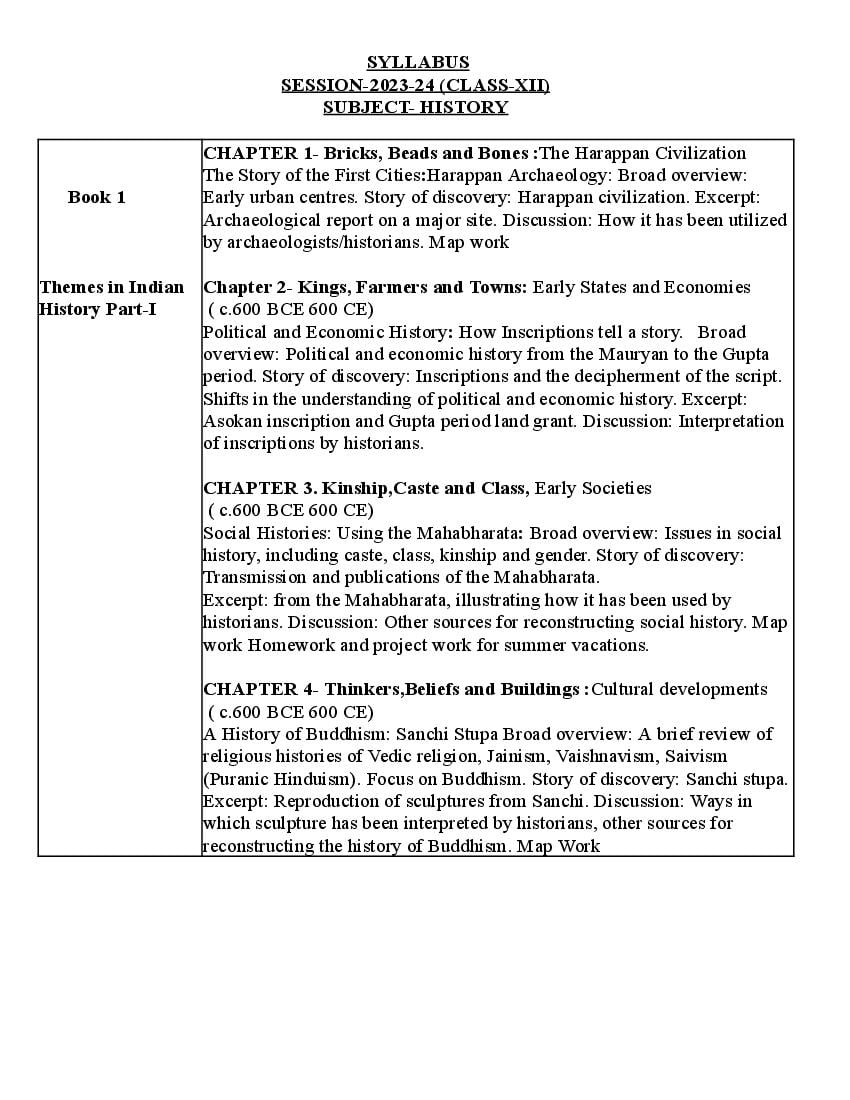
SESSION-2023-24 (CLASS-XII)
SUBJECT- HISTORY
CHAPTER 1- Bricks, Beads and Bones :The Harappan Civilization
The Story of the First Cities:Harappan Archaeology: Broad overview:
Book 1 Early urban centres. Story of discovery: Harappan civilization. Excerpt:
Archaeological report on a major site. Discussion: How it has been utilized
by archaeologists/historians. Map work
Themes in Indian Chapter 2- Kings, Farmers and Towns: Early States and Economies
History Part-I ( c.600 BCE 600 CE)
Political and Economic History: How Inscriptions tell a story. Broad
overview: Political and economic history from the Mauryan to the Gupta
period. Story of discovery: Inscriptions and the decipherment of the script.
Shifts in the understanding of political and economic history. Excerpt:
Asokan inscription and Gupta period land grant. Discussion: Interpretation
of inscriptions by historians.
CHAPTER 3. Kinship,Caste and Class, Early Societies
( c.600 BCE 600 CE)
Social Histories: Using the Mahabharata: Broad overview: Issues in social
history, including caste, class, kinship and gender. Story of discovery:
Transmission and publications of the Mahabharata.
Excerpt: from the Mahabharata, illustrating how it has been used by
historians. Discussion: Other sources for reconstructing social history. Map
work Homework and project work for summer vacations.
CHAPTER 4- Thinkers,Beliefs and Buildings :Cultural developments
( c.600 BCE 600 CE)
A History of Buddhism: Sanchi Stupa Broad overview: A brief review of
religious histories of Vedic religion, Jainism, Vaishnavism, Saivism
(Puranic Hinduism). Focus on Buddhism. Story of discovery: Sanchi stupa.
Excerpt: Reproduction of sculptures from Sanchi. Discussion: Ways in
which sculpture has been interpreted by historians, other sources for
reconstructing the history of Buddhism. Map Work
Page 2
(c.Tenth to Seventeenth century)
Book 2 Medieval Society through Travellers' Accounts: Broad Overview: Outline
of social and cultural life as they appear in travellers accounts. Story of
their writings: A discussion of where they travelled, why they travelled,
what they wrote, and for whom they wrote. Excerpts: from Alberuni, Ibn
Themes in Indian Batuta, Francois Bernier.
History Part-II Discussion- What these travel accounts can tell us and how they have been
interpreted by historians.
CHAPTER 6- The Bhakti-Sufi Traditions: Changes in religious beliefs
and devotional texts (c.Eighth to Eigthteenth century)
(a)Outline of religious developments during this period.
(b)Ideas and practices of the Bhakti-Sufi saints.
Story of Transmission: How Bhakti-Sufi compositions have been
preserved. Excerpt: Extracts from selected Bhakti-Sufi works.
Discussion on Ways in which these have been interpreted by historians
Chapter 7: An Imperial Capital Vijayanagara (c.Fourteenth to Sixteenth
century)
Broad overview: (a) Outline of new buildings during Vijayanagar
period-temples, forts, irrigation facilities.
(b) Relationship between architecture and the political system. Story of
Discovery: Account of how Hampi was found.
Excerpt: Visuals of buildings at Hampi .Discussion: Ways in which
historians have analyzed and interpreted these structures. Map work
● Syllabus of mid term Examination to be completed by
15/09/2023
● REVISION WORK MID TERM SYLLABUS
● DISCUSSION ON QUESTION PAPER, PROJECT WORK
Page 3
theMughal empire (c.Sixteenth -Seventeenth centuries)
Book 3 Agrarian Relations: The Ain-i- Akbari ,Broad overview:
(a)Structure of agrarian relations in the 16th and 17th centuries.
(b)Patterns of change over the period. Story of Discovery: Account of the
compilation and translation of Ain-i-Akbari.
Themes in Indian Excerpt: from the Ain-i-Akbari
History Part-III Discussion: Ways in which historians have used the text to reconstruct
history.
CHAPTER 09: Colonialism And The Countryside:Exploring Official
Archives)
(a)Life of zamindars, peasants and artisans in the late 18th century
(b)East India Company, revenue settlements and surveys.
(c)Changes over the nineteenth century. Official records: An account of
why official investigations into rural societies were undertaken and the
types of records and reports produced.
Excerpts: From Fifth Report, Accounts of Frances Buchanan-Hamilton and
Deccan Riots Report. Discussion: What the official records tell and do not
tell, and how they have been used by historians. Map work.
CHAPTER 10- Rebels and the Raj The Revolt of 1857 and Its
Representations
(a) The events of 1857-58. How these events were recorded and narrated?
Focus: Lucknow. Excerpts: Pictures of 1857. Extracts from contemporary
accounts. Discussion: How the pictures of 1857 shaped British opinion of
what had happened. Map Work
CHAPTER 11- Mahatma Gandhi and the Nationalist Movement : Civil
Disobedience and Beyond
(a)The Nationalist Movement 1918 - 48.
(b)The nature of Gandhian politics and leadership.
Focus: Mahatma Gandhi and the three movements and his last days as
“finest hours” Excerpts: Reports from English and Indian language
newspapers and other contemporary writings.
Discussion: How newspapers can be a source of history. Map work
Page 4
(a)Independence and the new nation state.
(b)The making of the Constitution. Focus: The Constitutional Assembly
debates. Excerpts: from the debates.
Discussion: What such debates reveal and how they can be analyzed. Map
work, Project Work.
● Syllabus of Pre Board Examination to be completed
by 15/12/2023
DECEMBER – MARCH
CHAPTER 1-15
REVISION FROM SUPPORT MATERIAL AND MAP PRACTICE
WORK. PRE BOARD EXAM
QUESTION PAPER DISCUSSION AND SOLUTION OF
STUDENTS PROBLEMS
PRACTICE OF CBSE QUESTION PAPERS. REVISION WORK
BOARD EXAMS
Page 5
S. No Page No. Part – I Maps
1 2 Mature Harappan sites: Harappa, Banawali, Kalibangan, Balakot,
Rakhigarhi, Dholavira, Nageshwar,
Lothal, Mohenjodaro, Chanhudaro, KotDiji.
2 3 Mahajanapada and cities: Vajji, Magadha, Kosala, Kuru, Panchala,
Gandhara, Avanti, Rajgir, Ujjain, Taxila,
Varanasi.
3 33 Distribution of Ashokan inscriptions:
Pillar inscriptions – Sanchi, Topra, Meerut Pillar and Kaushambi.
Kingdom of Cholas, Cheras and Pandyas.
4 43 Important kingdoms and towns:
Kushanas, Shakas, Satavahanas, Vakatakas,Guptas
Cities/towns: Mathura, Kanauj, Puhar, Braghukachchha, Shravasti, Rajgir,
Vaishali, Varanasi,Vidisha
4 95 Major Buddhist Sites: Nagarjunakonda, Sanchi, Amaravati, Lumbini,
Bharhut, Bodh Gaya, Ajanta
S.No. Page NO. Part - 2 Maps
6 174 Bidar, Golconda, Bijapur, Vijayanagar, Chandragiri, Kanchipuram, Mysore,
Thanjavur, Kolar, Tirunelveli
7 214 Territories under Babur, Akbar and Aurangzeb:
Delhi, Agra, Panipat, Amber, Ajmer, Lahore, Goa.
S.No. Page NO. Part - 3 Maps
8 287 Territories/cities under British Control in1857: Punjab, Sindh, Bombay,
Madras Berar, Bengal, Bihar,
Orissa, Surat, Calcutta, Patna, Allahabad
Page 6
Kanpur, Azamgarh, Calcutta, Benaras, Gwalior, Jabalpur, Agra, Awadh
10 Important centres of the National Movement: Champaran, Kheda,
Ahmedabad, Benaras, Amritsar, Chauri Chaura, Lahore, Bardoli, Dandi,
Bombay (Quit India Resolution), Karachi
Document Details
| Board / Org | Delhi Board |
| Exam | Class 12 |
| Type | Syllabus |
| Pages | 7 |
| Updated | 22 Jul 2026 |