Edudel Syllabus Class 12 Home Science
Finished viewing? Save it for later —
Download Edudel Syllabus Class 12 Home Science (PDF · 8 pages)About Edudel Syllabus Class 12 Home Science
Edudel Syllabus Class 12 Home Science is available here for free download. Published by Delhi School Education for Class 12, this syllabus can be viewed online or downloaded as a PDF (8 pages). Candidates preparing for Class 12 can use Edudel Syllabus Class 12 Home Science to understand the exam pattern, the type of questions asked, and the overall difficulty level.
Frequently Asked Questions
How can I download Edudel Syllabus Class 12 Home Science?
Open this page and click the Download button to save Edudel Syllabus Class 12 Home Science as a PDF. It is completely free on AglaSem Docs.
Is Edudel Syllabus Class 12 Home Science free to download?
Yes. Edudel Syllabus Class 12 Home Science can be viewed online and downloaded as a PDF free of cost on AglaSem Docs.
How many pages does Edudel Syllabus Class 12 Home Science have?
Edudel Syllabus Class 12 Home Science contains 8 pages, which you can read online or download together as a single PDF.
Where can I find more Class 12 study material?
You can find more Class 12 question papers, sample papers, syllabus, and answer keys on AglaSem Docs.
Edudel Syllabus Class 12 Home Science – Text
Read the full text of this syllabus below — useful to quickly search, copy and reference the content online without downloading the PDF.
📄 View text version (10 pages)
Page 1
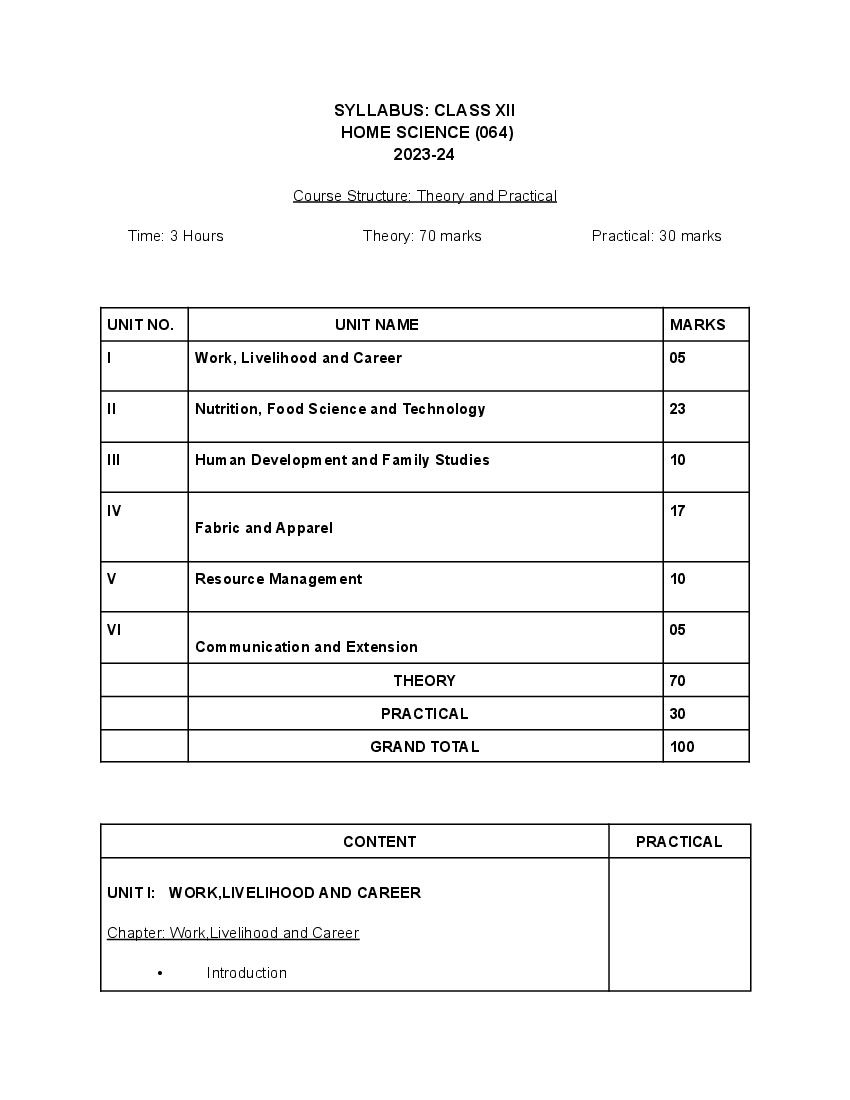
HOME SCIENCE (064)
2023-24
Course Structure: Theory and Practical
Time: 3 Hours Theory: 70 marks Practical: 30 marks
UNIT NO. UNIT NAME MARKS
I Work, Livelihood and Career 05
II Nutrition, Food Science and Technology 23
III Human Development and Family Studies 10
IV 17
Fabric and Apparel
V Resource Management 10
VI 05
Communication and Extension
THEORY 70
PRACTICAL 30
GRAND TOTAL 100
CONTENT PRACTICAL
UNIT I: WORK,LIVELIHOOD AND CAREER
Chapter: Work,Livelihood and Career
• Introduction
Page 2
b. Work, careers and livelihood
• Traditional occupation in India
a. Agriculture
b. Handicrafts
c. Indian cuisine
d. Visual arts
• Work, Age and Gender
a. Gender issues in relation to work
b. Issues and concerns related to women and work
c. KGBV
d. Beti Bachao, Beti Padhao Yojana
• Attitudes and approaches to work and life skills for
livelihood
a. Attitudes and approaches to work
b. Life skills for livelihood
c. Essential soft skills at workplace
d. Ergonomics
Definition and need for Ergonomics
e. Benefits of Ergonomics
• Entrepreneurship
a. Definition and characteristics
UNIT II: NUTRITION, FOOD SCIENCE AND TECHNOLOGY
Chapter: Clinical Nutrition and Dietetics
❖ Introduction
■ Nutrition
■ Clinical Nutrition
❖ Significance
❖ Basic concepts
■ Diet therapy
■ Types of diets: Regular Diet and Modified diets
■ Changes in consistency
❖ Feeding routes
❖ Prevention of chronic diseases
❖ Preparing for a career
❖ Scope
Page 3
normal diet to soft
• Introduction diet for elderly
people.
• Significance
• Basic concept
a. Public health nutrition
b. Nutritional Problems of India
- Protein energy malnutrition
- Micronutrient deficiencies
● Iron deficiency anaemia
● Vitamin A deficiency
● Iodine deficiency disorders
• Strategies/Intervention to tackle Nutritional problems
- Diet or food based strategies
- Nutrient based strategies
• Nutrition programmes operating in India 2. Development
a. ICDS and preparation of
supplementary
b. Nutrient Deficiency Control Programmes
foods for nutrition
c. Food Supplementation Programmes programmes.
d. Food Security Programme
• Health Care
• Scope
Chapter: Food Processing and Technology
• Introduction
• Significance
• Basic Concepts 3. Planning a
a. Food Science menu for a school
b. Food Processing canteen or
mid-day meal in
c. Food Technology
school for a week
d. Food Manufacturing
• Development of food processing and technology 4.Design, prepare
• Importance of Food processing and Preservation and evaluate a
• Classification of food on the basis of extent and type of processed food
processing product.
• Preparing for a career
• Scope
Chapter: Food Quality and Food Safety
• Introduction
• Significance
5. Qualitative test
Page 4
a. Food safety (Toxicity & Hazard) adulteration
b. Hazards (Physical, chemical and biological) in:pure ghee, tea
leaves, whole
c. Food infection
black pepper,
d. Food poisoning turmeric powder,
e. Food quality milk, asafoetida
• Food standards regulation in India-FSSA (2006)
• International Organization and agreements in the area of
Food Standards, Quality, Research and Trade
a. Codex Alimentarius Commission
b. International Organization for Standardisation
c. World Trade Organization
• Food Safety Management Systems
a. Good manufacturing practices (GMP)
b. Good handling practices (GHP)
c. Hazard Analysis Critical Control Points (HACCP)
• Scope
UNIT III: HUMAN DEVELOPMENT AND FAMILY STUDIES
Chapter: Early Childhood Care and Education
• Significance
• Basic concepts
• Preparing for a career
• Scope
Chapter: Management of Support Services, Institutions and Programmes
for Children, Youth and Elderly
• Significance
• Basic concepts 6. Preparation of
• Why are children vulnerable? any one toy for
Page 5
a. ICDS appropriate) using
b. SOS Children’s Village locally available
and indigenous
c. Children’s Homes run by the Government
material
d. Adoption
• Why are Youths Vulnerable? OR
• Youth programmes in India
• Why are the elderly vulnerable? Preparation and
• Some programmes for the elderly use of anyone
• Preparing for a career teaching aid to
communicate
• Scope.
socially relevant
messages for
children/
adolescents
/adults in the
community.
UNIT VI: COMMUNICATION AND EXTENSION
Chapter: Development Communication and Journalism
• Introduction
• Significance
• Basic concepts
a. Development
b. Development Journalism
c. Development Communication
• Methods of Communication
a. Campaign
b. Radio and Television
c. Print Media
d. Information and Communication Technologies
• Knowledge and skills required for a career in this field
• Scope and career avenues in Development
Communication
Mid Term syllabus to be completed by 15 September 2023
Revision of Unit I, Unit II, UnitIII,and Unit VI Mid - Term
Practical Exam,
Page 6
• Practice of CBSE sample questions papers, previous year conducted before
CBSE and DoE Question Papers and DoE practice Mid - Term Theory
questions papers. Examination
2023-24
MID TERM EXAMINATION- 2023-24
Discussion on Mid-Term Question Paper-2023-24 with Marking Scheme to be done after the
evaluation of answer sheets of students.
UNIT IV: FABRIC AND APPAREL
Chapter: Design for Fabric and Apparel
• Introduction
• Basic concepts (Design: Structural & Applied)
• Elements of design
● Colour 7. Preparation of
● Texture any one article
● Line using applied
● Shapes or form textile design
• Principles of Design techniques; tie
● Proportion and dye / batik /
● Balance block
● Emphasis
● Rhythm
● Harmony
• Preparing for career
• Scope
Chapter: Fashion Design and Merchandising
• Introduction
• Significance
• Basic Concepts
● Fashion terminology –Fashion ,fads, style, classic
• Fashion Development
● France-The centre of fashion
● Fashion Evolution
• Fashion Merchandising
• Fashion Retail Organization
• Preparing for a career
Page 7
Chapter: Care and Maintenance of Fabrics in Institution
• Introduction 8. Remove
• Basic concepts different types of
● Washing equipment stains from white
● Drying equipment cotton cloth –Ball
● Ironing/pressing equipment pen, curry,
• Institutions grease, ink,
• Preparing for a career lipstick, tea and
• Scope
UNIT V: RESOURCE MANAGEMENT 9. Evaluate any
one advertisement
Chapter: Hospitality Management for any job
• Introduction
• Significance
• Basic concepts
• Departments involved in hospitality management of an
organization
• Scope
Chapter: Consumer Education and Protection 10. Develop a
leaflet/pamphlet
• Introduction for Consumer
• Significance of Consumer Education and Protection Education and
• Basic concepts Protection on any
○ Consumer product one of the
○ Consumer behaviour following-
○ Consumer forum
○ Consumer footfalls A. Consumer
○ Consumer problems Protection Act
○ Consumer Rights (CPA)
○ Standardized marks (ISI, Wool Mark, Hall Mark, Silk Mark)
○ Protection Councils B. Consumer
○ Consumer Responsibilities Responsibilities
○ Scope
C. Consumer
Organization
Page 8
Problems
Full syllabus to be completed by 15th December, 2023
COMMON PRE- BOARD SCHOOL EXAMINATION- 2023-24
Discussion of Pre-Board question paper with Marking Scheme A. Pre- board
Unit wise REVISION of whole syllabus from Support Material Practical 2023-24
Practice of CBSE sample questions papers, previous year CBSE
and DoE Question Papers and DoE practice questions papers. B. Practice and
Revision of
Project and
Practical
C. Practice of viva
questions
PROJECT
ANY ONE OF THE FOLLOWING PROJECT MAY BE UNDERTAKEN AND EVALUATED-
1. Study of an integrated community based, nutrition/health programme being implemented in
own area, with reference to-
● Programme objectives
● Focal Group/Beneficiaries
● Modalities of implementation
2. Visit to the neighbouring areas and interview two adolescents and two adults regarding
their perception of persons with special needs.
3. Profile any two person (child/adult) with special needs to find out their diet, clothing,
activities, physical and psychological needs.
4. Planning any five messages for nutrition, health and life skills using different modes of
communication for different focal groups.
5. Market survey of any five processed foods with their packaging and label information.
SCHEME FOR PRACTICAL EXAMINATION 30 Marks
1. Project (5 marks)
2. Modification of any one family meal for elderly person. Preparing any one of the
modified dishes. (5marks)
OR
Development and preparation of any one supplementary food for pre-schooler
Page 9
OR
Planning a menu for school canteen and preparing any one nutritious dish.
3. Identify adulterant using chemical test in any one of the following- pure ghee, tea
leaves, whole black pepper, turmeric powder, milk, asafoetida. (2 marks)
4. Prepare a sample using applied textile design techniques- Tie and dye/Batik/Block
Printing. (4 marks)
5. Remove any one of the stains from white cotton cloth -Ball pen, curry, grease, ink,
lipstick, tea, coffee (2 marks)
6. Develop a leaflet/pamphlet for Consumer Education and Protection on any one of the
following (5 marks)
a) Consumer Protection Act (CPA)
b)Consumer responsibilities
c) Consumer organization
d) Consumer Problems
7. File (5 marks)
8. Viva (2 marks)
QUESTION PAPER DESIGN 2023-24
HOME SCIENCE (CODE NO 064)
CLASS- XI & XII
TIME- 3 HOURS MAX.MARKS: 70
S.No. Typology of Questions Total marks %
Weightage
1. Remembering & Understanding- 28 40%
Knowledge and understanding based questions
terms, concepts, principles, or theories; Identify,
define, or recite, interpret, compare, contrast,
explain, paraphrase information)
Page 10
or knowledge/concepts based questions (Use
abstract information in concrete situation, to
apply knowledge to new situations. Use given
content to interpret asituation, provide an
example, or solve a problem
3. Formulation, analysis, Evaluation and 21 30%
creativity based question
(Appraise, judge, and /or justify the value or
worth of a decision or outcome, or to predict
outcomes)
Classify, compare, contrast, or differentiate
between different pieces of integrate unique
piece of information from a variety of sources)
Total 70 100
NOTE: Internal Choice of 30% will be given
No Chapter wise weightage, care should be taken to cover all chapters
Weightage to difficulty level of questions
S. No. Estimated difficulty Percentage
1. Easy 20
2. Average 60
3. Difficult 20
Prescribed NCERT textbooksfor Class XII Home Science (064):
Human Ecology and Family Sciences I - https://ncert.nic.in/textbook.php?lehe1=0-10
Human Ecology and Family Sciences II - https://ncert.nic.in/textbook.php?lehe2=0-15
Document Details
| Board / Org | Delhi Board |
| Exam | Class 12 |
| Type | Syllabus |
| Pages | 8 |
| Updated | 22 Jul 2026 |