Rajasthan Board Varishtha Upadhyaya Question Paper 2020 General Science
Finished viewing? Save it for later —
Download Rajasthan Board Varishtha Upadhyaya Question Paper 2020 General Science (PDF · 8 pages)About Rajasthan Board Varishtha Upadhyaya Question Paper 2020 General Science
Rajasthan Board Varishtha Upadhyaya Question Paper 2020 General Science is available here for free download. Published by Rajasthan Board for Rajasthan Varishtha Upadhyay, this question paper can be viewed online or downloaded as a PDF (8 pages). Candidates preparing for Rajasthan Varishtha Upadhyay can use Rajasthan Board Varishtha Upadhyaya Question Paper 2020 General Science to understand the exam pattern, the type of questions asked, and the overall difficulty level.
Frequently Asked Questions
How can I download Rajasthan Board Varishtha Upadhyaya Question Paper 2020 General Science?
Open this page and click the Download button to save Rajasthan Board Varishtha Upadhyaya Question Paper 2020 General Science as a PDF. It is completely free on AglaSem Docs.
Is Rajasthan Board Varishtha Upadhyaya Question Paper 2020 General Science free to download?
Yes. Rajasthan Board Varishtha Upadhyaya Question Paper 2020 General Science can be viewed online and downloaded as a PDF free of cost on AglaSem Docs.
How many pages does Rajasthan Board Varishtha Upadhyaya Question Paper 2020 General Science have?
Rajasthan Board Varishtha Upadhyaya Question Paper 2020 General Science contains 8 pages, which you can read online or download together as a single PDF.
Where can I find more Rajasthan Varishtha Upadhyay study material?
You can find more Rajasthan Varishtha Upadhyay question papers, sample papers, syllabus, and answer keys on AglaSem Docs.
Rajasthan Board Varishtha Upadhyaya Question Paper 2020 General Science – Text
Read the full text of this question paper below — useful to quickly search, copy and reference the content online without downloading the PDF.
📄 View text version (8 pages)
Page 1
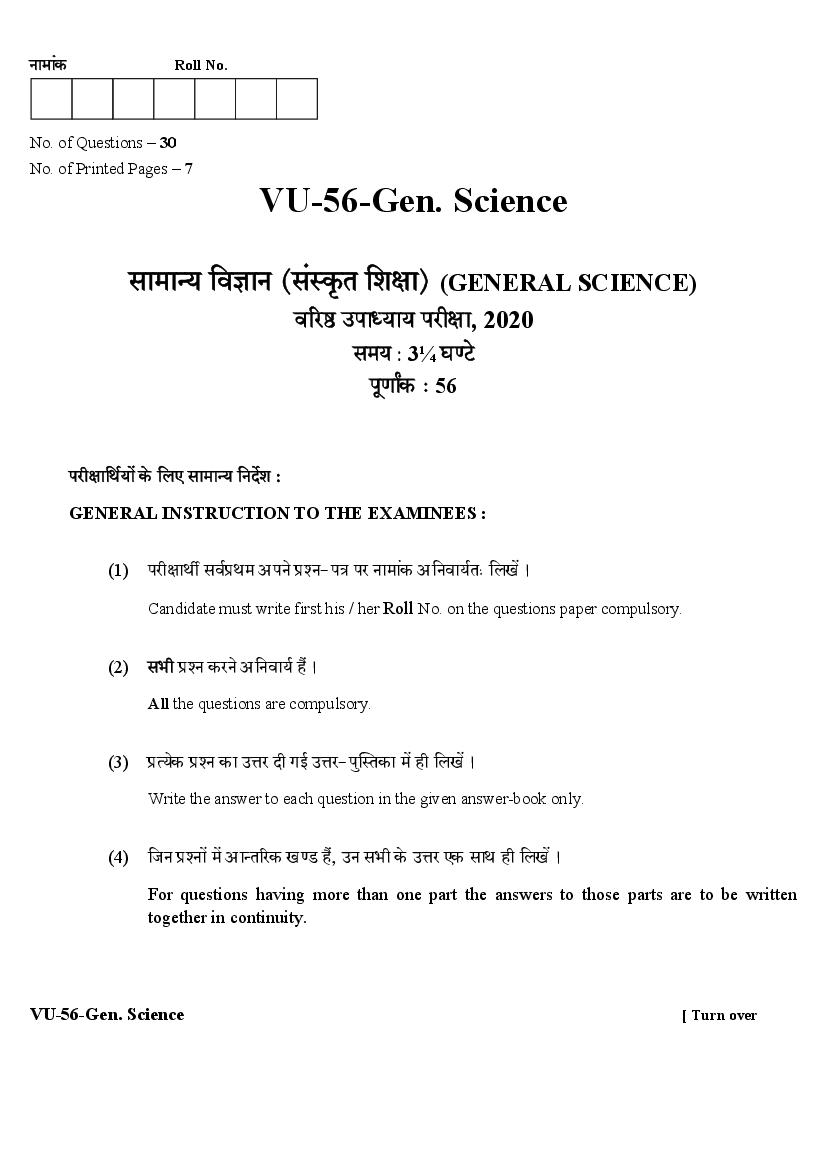
No. of Questions – 30
No. of Printed Pages – 7
( ) (GENERAL SCIENCE)
, 2020
3¼
56
:
GENERAL INSTRUCTION TO THE EXAMINEES :
(1) -
Candidate must write first his / her Roll No. on the questions paper compulsory.
(2)
All the questions are compulsory.
(3) -
Write the answer to each question in the given answer-book only.
(4) ,
For questions having more than one part the answers to those parts are to be written
together in continuity.
VU-56-Gen. Science [ Turn over
Page 2
(5) - //
If there is any error/difference/contradiction in Hindi & English version of the
question paper, the question of the Hindi version should be treated valid.
(6)
1- 13 1
14-24 2
25-27 3
28-30 4
Section Q. Nos. Marks per Question
A 1- 13 1
B 14-24 2
C 25-27 3
D 28-30 4
(7) 28 30
There are internal choice in Question Nos. 28 to 30.
-
SECTION - A
1.
Define magnetic flux. 1
2.
Write the difference between moving magnet galvanometer and moving coil
galvanometer. 1
3.
Write Lenz’s law. 1
4.
Write any one example of electron deficient compound. 1
Page 3
5.
Write the definition of fertilization. 1
6.
Write the types of inflorescence of malvaceae family. 1
7.
Write relation between half life and mean life. 1
8.
Write the value of maximum efficiency of a full wave rectifier circuit. 1
9. N2(g) + 3 H2(g) 2NH3(g) (Kc)
Write expression for equilibrium constant (Kc) for the reaction
N2(g) + 3 H2(g) 2NH3(g). 1
10.
Write any one example of thermosetting polymer. 1
11.
Write main difference between endocrine and exocrine glands. 1
12.
Write botanical name of medicinal plant used in the high blood pressure regulation. 1
13. ?
Morphine alkaloids are derived from which medicinal plant ? 1
VU-56-Gen. Science [ Turn over
Page 4
-
SECTION - B
14. 5 10–4 C 2.25 N
A force of 2.25 N acts on the charge 5 10–4 C located in the electric field. Calculate the
intensity of electric field. 2
15.
Derive the formula to find the internal resistance of the primary cell by a potentiometer. 2
16.
= o sin t
Derive an expression = o sin t of induced emf due to rotating coil in a uniform
magnetic field. 2
17. sp3
Explain sp3 hybridisation with an example. 2
18.
Explain gravity separation method used for concentration of ores. 2
19.
Write any two differences between internal structure of monocot and dicot stem. 1+1=2
20.
Write any two differences between transpiration and evaporation. 2
21.
Explain digestive system of earthworm. 2
Page 5
22. P- N-
Write any two differences between P-type and N-type semiconductors. 2
23. () [] (r)
Establish a relation between magnetic susceptibility [] and relative permittivity (r). 2
24.
() (I)
()
(II)
() (III)
() (IV)
Match the following : ½+½+½+½=2
Name of Ore Name of metal
(A) Siderite (I) Copper
(B) Malachite (II) Aluminium
(C) Calamine (III) Iron
(D) Cryolite (IV) Zinc
-
SECTION - C
25. ?
What is common ion effect ? Explain the application of common ion effect in qualitative
analysis. 1+2=3
VU-56-Gen. Science [ Turn over
Page 6
26. ()
(i) (ii) – 6, 6
()
(A) Write the name of monomer units of following polymers.
(i) Terylene (ii) Nylon-6, 6
(B) Write the name of polymer used in making rain coat. 1+1+1=3
27. ()
()
(A) Write the name of enzyme, used in the conversion of starch into maltose.
(B) Explain the transportation of oxygen and carbon dioxide in respiration mechanism.
1+1+1=3
-
SECTION - D
28. ()
()
()
()
() X-
() -
(A) Write definition of isotope.
(B) Write any two postulates of Bohr’s atomic model.
(C) Draw a labelled diagram of discharge tube for production of positive rays. 1+2+1=4
OR
(A) Define radioactivity.
(B) Explain any two uses of X-rays.
(C) Draw a labelled diagram of Davission – Germer experiment.
Page 7
29. ()
() C4H10
()
() C4H8
(A) Define homologous series. Write two examples of homologous series of alkanes.
(B) Draw the structures of chain isomers of molecular formula C4H10 and write their
names. 1+1+1+1=4
OR
(A) Define isomerism. Write the name of types of isomerism.
(B) Draw the structures of chain isomers of molecular formula C4H8 and write their
names.
30. () , ?
()
()
()
()
()
(A) Why hormones of adrenal gland are life saving hormones ?
(B) Draw a labelled diagram of male reproductive system of human.
(C) Draw a labelled diagram structure of spermatogenesis. 1+1+2=4
OR
(A) Write the function of secreted hormones by thyroid gland.
(B) Draw a labelled diagram structure of nephron.
(C) Draw a labelled diagram of mechanism of fertilization in mammals.
____________
VU-56-Gen. Science [ Turn over
Page 8
Document Details
| Board / Org | Rajasthan Board |
| Exam | Rajasthan Varishtha Upadhyay |
| Type | Question Paper |
| Pages | 8 |
| Updated | 30 Apr 2026 |