KIITEE 2026 Syllabus
Finished viewing? Save it for later —
Download KIITEE 2026 Syllabus (PDF · 15 pages)About KIITEE 2026 Syllabus
KIITEE 2026 Syllabus is available here for free download. Published by Default for Admission Tests, this syllabus can be viewed online or downloaded as a PDF (15 pages). Candidates preparing for Admission Tests can use KIITEE 2026 Syllabus to understand the exam pattern, the type of questions asked, and the overall difficulty level.
Frequently Asked Questions
How can I download KIITEE 2026 Syllabus?
Open this page and click the Download button to save KIITEE 2026 Syllabus as a PDF. It is completely free on AglaSem Docs.
Is KIITEE 2026 Syllabus free to download?
Yes. KIITEE 2026 Syllabus can be viewed online and downloaded as a PDF free of cost on AglaSem Docs.
How many pages does KIITEE 2026 Syllabus have?
KIITEE 2026 Syllabus contains 15 pages, which you can read online or download together as a single PDF.
Where can I find more Admission Tests study material?
You can find more Admission Tests question papers, sample papers, syllabus, and answer keys on AglaSem Docs.
KIITEE 2026 Syllabus – Text
Read the full text of this syllabus below — useful to quickly search, copy and reference the content online without downloading the PDF.
📄 View text version (15 pages)
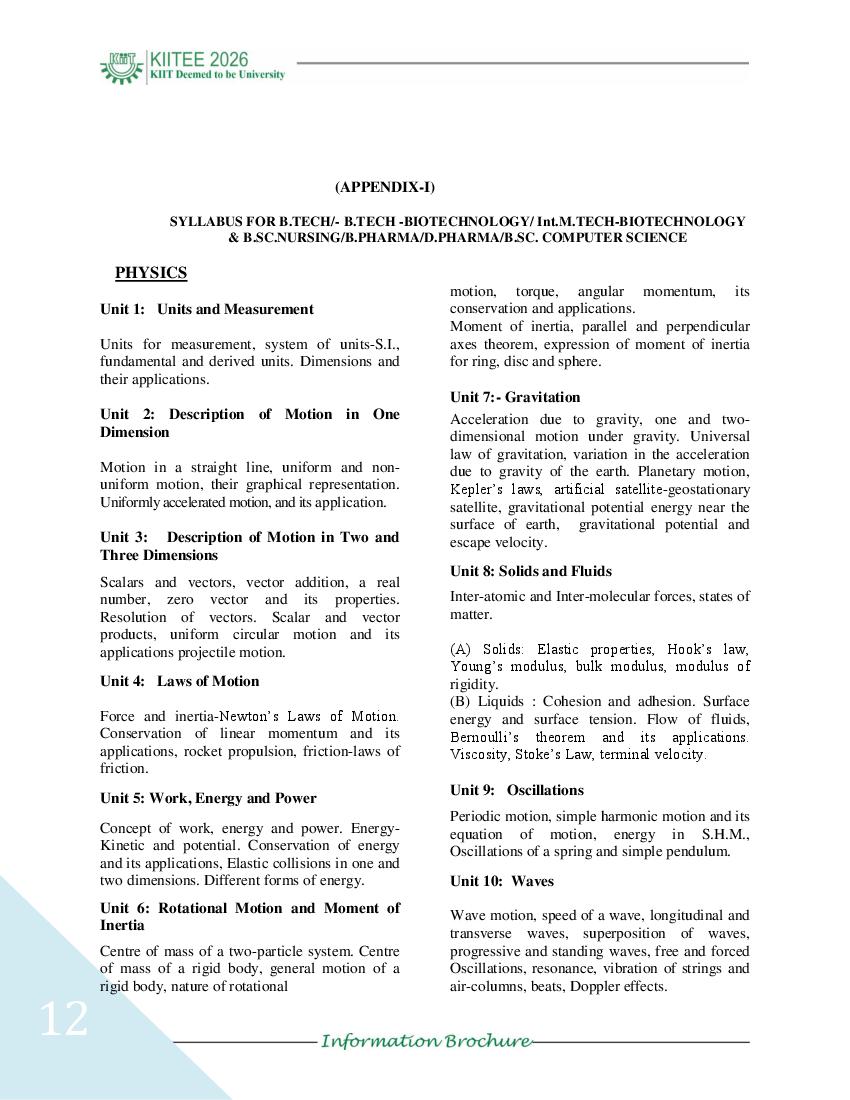
Page 1
SYLLABUS FOR B.TECH/- B.TECH -BIOTECHNOLOGY/ Int.M.TECH-BIOTECHNOLOGY
& B.SC.NURSING/B.PHARMA/D.PHARMA/B.SC. COMPUTER SCIENCE
PHYSICS
motion, torque, angular momentum, its
Unit 1: Units and Measurement conservation and applications.
Moment of inertia, parallel and perpendicular
Units for measurement, system of units-S.I., axes theorem, expression of moment of inertia
fundamental and derived units. Dimensions and for ring, disc and sphere.
their applications.
Unit 7:- Gravitation
Unit 2: Description of Motion in One Acceleration due to gravity, one and two-
Dimension dimensional motion under gravity. Universal
law of gravitation, variation in the acceleration
Motion in a straight line, uniform and non- due to gravity of the earth. Planetary motion,
uniform motion, their graphical representation. Kepler’s laws, artificial satellite-geostationary
Uniformly accelerated motion, and its application. satellite, gravitational potential energy near the
surface of earth, gravitational potential and
Unit 3: Description of Motion in Two and escape velocity.
Three Dimensions
Unit 8: Solids and Fluids
Scalars and vectors, vector addition, a real
number, zero vector and its properties. Inter-atomic and Inter-molecular forces, states of
Resolution of vectors. Scalar and vector matter.
products, uniform circular motion and its
applications projectile motion. (A) Solids: Elastic properties, Hook’s law,
Young’s modulus, bulk modulus, modulus of
Unit 4: Laws of Motion rigidity.
(B) Liquids : Cohesion and adhesion. Surface
Force and inertia-Newton’s Laws of Motion. energy and surface tension. Flow of fluids,
Conservation of linear momentum and its Bernoulli’s theorem and its applications.
applications, rocket propulsion, friction-laws of Viscosity, Stoke’s Law, terminal velocity.
friction.
Unit 9: Oscillations
Unit 5: Work, Energy and Power
Periodic motion, simple harmonic motion and its
Concept of work, energy and power. Energy- equation of motion, energy in S.H.M.,
Kinetic and potential. Conservation of energy Oscillations of a spring and simple pendulum.
and its applications, Elastic collisions in one and
two dimensions. Different forms of energy. Unit 10: Waves
Unit 6: Rotational Motion and Moment of Wave motion, speed of a wave, longitudinal and
Inertia transverse waves, superposition of waves,
Centre of mass of a two-particle system. Centre progressive and standing waves, free and forced
of mass of a rigid body, general motion of a Oscillations, resonance, vibration of strings and
rigid body, nature of rotational air-columns, beats, Doppler effects.
12
Page 2
voltmeter.
Thermal expansion of solids, liquids and gases
and their specific heats, Relationship between
Cp and Cv for gases, first law of thermodynamics, Unit 17: Magneto statics
thermodynamic processes. Second law of
Bar magnet, magnetic field, lines of force,
thermodynamics, Carnot cycle efficiency of heat
torque on a bar magnet in a magnetic field,
engines.
earth’s magnetic field, para, dia and ferro
magnetism, magnetic induction, magnetic
susceptibility.
Unit 12: Transference of Heat
Modes of transference of heat. Thermal Unit 18: Electromagnetic Induction and
conductivity. Black body radiations, Kirchoff’s Alternating Currents
Law, Wien’s law, Stefan’s law of radiation and Induced e.m.f., Faraday’s Law,Lenz’s Law, Self
Newton’s law of cooling. and Mutual Inductance, alternating currents,
Unit 13: Electrostatics impedance and reactance, power in a.c. Circuits
with L.C. And R Series Combination, resonant
Electric charge-its unit and conservation, circuits. Transformer and A.C. generator.
Coulomb’s law, dielectric constant, electric
field, lines of force, field due to dipole and its Unit 19: Ray Optics
behaviour in a uniform electric field, electric
flux, Gauss’s theorem and its applications. Reflection and refraction of light at plane and
Electric potential, potential due to a point curved surfaces, total internal reflection, optical
charge. Conductors and insulators, distribution fibre; deviation and dispersion of light by a
of charge on conductors. Capacitance, parallel prism; Lens formula, magnification and
plate capacitor, combination of capacitors, resolving power, microscope and telescope.
energy of capacitor.
Unit 20: Wave Optics
Unit 14: Current Electricity Wave nature of light; Interference- Young’s
double slit experiment. Diffraction-diffraction
Electric current and its unit, sources of energy,
due to a single slit. Elementary idea of
cells-primary and secondary, grouping of cells
polarization.
resistance of different materials, temperature
dependence, specific resistivity, Ohm’s Unit 21: Electromagnetic Waves
law,Kirchoff’s law, series and parallel circuits.
Wheatstone Bridge with their applications and Electromagnetic waves and their characteristics,
potentiometer with their applications. Electromagnetic wave spectrum from gamma to
radio waves-propagation of EM waves in
Unit 15 : Thermal and Chemical Effects of atmosphere.
Currents Unit 22: Electron and Photons
Heating effects of current, electric power, simple Charge on an electron, e/m for an electron,
concept of thermo-electricity-Seeback effect photoelectric effect and Einstein’s equation of
and thermocouple, Chemical effect of current- photoelectric effect.
Faraday’s laws of electrolysis.
Unit 23: Atoms, Molecules and Nuclei
Unit 16: Magnetic Effects of Currents
Alpha particles scattering experiment, Atomic
Oersted’s experiment, Bio-Savert’s law, masses, size of the nucleus; radioactivity; Alpha,
magnetic filed due to straight wire, circular loop beta and gamma particles/rays and their
and solenoid, force on a moving charge in a properties, radioactive decay law, half life and
uniform magnetic field ( Lorentz force), force mean life of radio-active nuclei, binding energy,
and torques on currents in a magnetic field, force
13
mass energy relationship, nuclear fission and
between two current carrying wires, moving coil nuclear fusion.
Page 3
Unit 24: Solids and Semi-Conductors
Devices Types of solutions, Units of concentration,
Vapour-pressure of solutions and Raoult’s law.
Energy bands in solids, conductors, insulators Colligative properties. Determination of
and semi-conductors, pn junction, diodes, diode molecular mass. Non-ideal solutions and
as rectifier, transistor action, transistor as an abnormal molecular masses. Volumetric
amplifier. analysis-concentration unit.
CHEMISTRY
Unit 5: Chemical Energetics and Thermodynamics
Unit 1: Some Basic Concepts: Energy changes during a chemical reaction,
Measurement in chemistry (Precision, Internal energy and Enthalpy, Internal energy
significant figures, S.I. units, Dimensional and Enthalpy changes, Origin of Enthalpy
analysis). Laws of chemical combination. change in a reaction, Hess’s Law of constant
Atomic Mass, Molecular Mass, mole concept, heat summation, numericals based on these
Molar Mass, determination of Molecular concepts. Enthalpies of reactions (Enthalpy of
formula. Chemical equation, stoichiometry of neutralization, Enthalpy of combustion,
Chemical reactions. Enthalpy of fusion and vaporization).
Unit 2 : States of Matter Sources of energy(conservation of energy
Gaseous state, measurable properties of gases, sources and identification of alternative sources,
Boyle’s Law, Charle’s Law and absolute scale pollution associated with consumption of fuels.
of temperature, Avogadro’s hypothesis, ideal gas The sun as the primary source).
equation, Dalton’s law of partial pressures.
First law of thermodynamics; Relation between
Internal energy and Enthalpy, application of first
Kinetic molecular theory of gases (the
law of thermodynamics.
microscopic model of gas), deviation form ideal
Second law of thermodynamics: Entropy, Gibbs
behaviour.
energy, Spontaneity of a chemical reaction,
Gibbs energy change and chemical equilibrium,
The solid state ( classification of solids, X-ray
Gibbs energy available for useful work.
studies of crystal lattices and unit cells, packing
of constituent particles in crystals). Unit 6: Chemical Equilibrium
Imperfection in solids, electrical, magnetic and
dielectic properties of solids. Liquid state Equilibria involving physical changes (solid-
(Properties of liquids, Vapour pressure, Surface liquid, liquid-gas equilibrium involving
tension, Viscosity). dissolution of solids in liquids, gases in liquids,
general characteristics of equilibrium involving
Unit 3: Atomic Structure physical processes)
Constituents of the atom (discovery of electron, Equilibria involving chemical systems (the law
rutherford model of the atom). of chemical equilibrium, the magnitude of the
Electronics structure of atoms-nature of light equilibrium constant, numerical problems).
and electromagnetic waves, atomic spectra, Effect of changing conditions of systems at
bohr’s model of hydrogen, shortcomings of the equilibrium (change of concentration, change of
bohr model. temperature, effect of catalyst-Le Chateliar’s
Dual nature of matter and radiation. de-Broglie principle).
relation. The uncertainty principle, Quantum Equilibria involving ions- ionization of
Mechanical Model of the atom, Orbitals and electrolytes, weak and strong electrolytes, acid-
Quantum numbers. Shapes of orbitals. Aufbau base equilibrium, various concepts of acids and
principle, Pauli Exclusion principle, Hund’s bases, ionization of water, pH scale, solubility
product, numericals based on these concepts.
14
Rule, Electronics Configuration of atoms.
Page 4
Unit 7: Redox Reactions and Electrochemistry Properties
Oxidation and reduction as an electron transfer Modern periodic law, Types of elements –
concept. Redox reactions in aqueous solutions- Representatives elements ( s & p block,
electrochemical cells. e.m.f. of a galvanic cell. Transition elements – d-block elements, inner
transition elements-f-block elements. Periodic
Dependence of e.m.f. on concentration and trends in properties-ionization enthalpy, electron
temperature (NERNST). equation and numerical gain enthalpy, atomic radii, valence, periodicity
problems based on it .Electrolysis, Oxidation in properties of compounds).
number (rules for assigning oxidation number,
redox reactions in terms of oxidation number, Unit 11: Chemical Bonding and
nomenclature). Balancing of oxidation-reduction Molecular Structure
equations.
Chemical bonds and Lewis structure, shapes of
Electrolytic conduction. Molar conductivity, molecules ( VSEPR theory), Quantum theory of
Kohlrausch’s Law and its applications, Voltaic the covalent bond, hydrogen and some other
cell, Electrode potential and Electromotive simple molecules, carbon compounds,
force, Gibb’s energy change and cell potential. hybridization, Boron and Beryllium compounds.
Electrode potential and products of electrolysis,
Fuel cells, corrosion and its prevention. Coordinate covalent bond, ionic bond as an
extreme case of polar covalent bond, ionic
Unit 8: Rates of Chemical Reactions and character of molecules and polar molecules.
Chemical Kinetics Bonding in solid state ionic, molecular and
covalent solids, metals. Hydrogen bond,
Rate of reaction, Instantaneous rate of reaction Resonance.
and order of reaction. Factors affecting rates of Molecules : Molecular orbital. Theory-bond
reactions- factors affecting rate of collisions order and magnetic properties of H2,O2,N2,F2 on
encountered between the reactant molecules, the basis of MOT. Hybridisation involving s, p
effect of temperature on the reaction rate, and d orbitals (including shapes of simple
concept of activation energy catalyst. Effect of organic molecules), Dipole moment and
light of rates of reactions. Elementary reactions structure of molecules.
as steps to more complex reactions. How fast are
chemical reactions? Unit 12: Chemistry of Non-Metals - 1
Hydrogen (unique position in periodic table,
Rate law expression. Order of a reaction (with
occurrence, isotopes, properties, reactions and
suitable examples).Units of rates and specific
uses), Hydrides-molecular, soline and interstitial
rate constant. Order of reaction and effect of
concentration ( study will be confined to first Oxygen (occurrence, preparation, properties and
order only). Temperature dependence of rate reactions, uses),simple oxides; ozone
constant – Fast reactions (only elementary
idea). Mechanism of reaction ( only elementary Water and hydrogen peroxide, structure of water
idea). Photochemical reactions. molecule and its aggregates, physical and
Unit 9: Surface Chemistry chemical properties of water, hard and soft
water, water softening, hydrogen peroxide-
Surface : Adsorption – physical and chemical
preparation, properties, structure and uses.
adsorption, adsorption isotherms.
Nitrogen- Preparation, properties, uses,
Colloids-Preparation and general properties,
compounds of Nitrogen-Ammonia, Oxides of
Emulsions, Micelles.
Nitrogen, Nitric Acid-preparation, properties
Catalysis : Homogeneous and heterogeneous,
and uses.
structure of catalyst, Enzymes, Zeolites.
15
Page 5
properties and uses, compounds-oxides,
Boron-occurrence, isolation, physical and
sulphides, halides.
chemical properties, borax and boric acid, uses
of boron and its compounds.
Unit 16: Chemistry of Representative
Carbon, inorganic compounds of carbon-oxides, Elements
halides, carbides, elemental carbon.
Periodic properties- Trends in groups and
Silicon- occurrence, preparation and properties, periods (a) Oxides-nature (b) Halides-melting
oxides and oxyacids of phosphorus, chemical points (c) Carbonates and sulphates-solubility.
fertilizers.
The chemistry of s and p block elements,
Sulphur – occurrence and extraction, properties electronics configuration, general characteristic
and reactions, oxides, Sulphuric acid – properties and oxidation states of the following:-
preparation, properties and uses, sodium
Group 1 elements - Alkali metals
thiosulphate.
Group 2 elements - Alkaline earth metals
Halogens- occurrence, preparation, properties, Group 13 elements - Boron family
hydrogen halides, uses of halogens. Group 14 elements - Carbon family
Group 15 elements - Nitrogen family
Noble gases- discovery, occurrence and
Group 16 elements - Oxygen family
isolation, physical properties, chemistry of noble
Group 17 elements - Halogen family
gases and their uses.
Group 18 elements - Noble gases &
Hydrogen
Unit 14: Chemistry of Lighter Metals
Unit 17: Transition Metals Including
Sodium and Potassium- occurrence and Lanthanides
extraction, properties and uses. Important
compounds-NaCl, Na2CO3,NaHCO3, NaOH, Electronic configuration : General characteristic
KCI,KOH. properties, oxidation states of transition metals.
First row transition metals and general
Magnesium and calcium-occurrence and
properties of their compounds-oxides, halides
extraction, properties and uses. Important
and sulphides.
compounds Mgcl2, MgSO4, CaO, Ca(OH)2,CaCO3,
General properties of a second and third row
CaSO4, Plaster of paris, Bleaching Powder.
transition elements ( Groupwise discussion).
Aluminium –occurrence, extraction properties
Preparation and reactions, properties and uses of
and uses, compounds-AlCI3, alums.
Potassium dichromate Potassium permanganate.
Cement.
Inner Transition Elements: General discussion
Biological role of Sodium, Potassium, with special reference to oxidation states and
Magnesium and Calcium. lanthanide contraction.
Unit 18: Coordination Chemistry and Organo
Unit 15:- Heavy Metals Metallics
Iron – Occurrence and extraction, compounds of
Coordination compounds, Nomenclature:
iron, oxides, halides, sulphides, sulphate, alloy
Isomerism in coordination compounds; Bonding
and steel.
in coordination compounds, Werner’s coordination
Copper and Silver- occurrence and extraction, theory. Applications of coordination compounds.
properties and uses, compounds-sulphides,
halides and sulphates, photography. Unit 19: Nuclear Chemistry
Nature of radiation from radioactive substances.
Zinc and Mercury- occurrence and extraction, Nuclear reactions; Radio-active disintegration
properties and uses, compounds-oxides, halides; series; Artificial transmutation of elements;
sulphides and sulphates. Nuclear fission and Nuclear fusion: Isotopes and
16
their applications: Radio carbon-dating.
Page 6
Organic Compounds Classification. Sources of hydrocarbons:
Purification (crystallization, sublimation, distillation, Alkanes- General methods of preparation (from
differential extraction, chromatography). unsaturated hydrocarbons, alkylhalides,
aldehydes, ketones and carburoxylic acids).
Qualitative analysis, detection of nitrogen, Physical properties and reactions (Substitution),
sulphur, phosphorus and halogens. Oxidation and miscellaneous). Conformations of
alkanes(ethane, popane butane) and cyclohexane,
Quantitative analysis- estimation of carbon,
sawhorse and Newman projections)-mechanism of
hydrogen, nitrogen, halogens, sulphur, phosphorus
halogaration of alkanes.
( basic principles only)
Alkanes and Alkynes- General methods of
Determination of molecular mass-Silver salt preparation physical peorperties, Chemical
method, cholroplatinate salt method reactions-Mechanism of electrophilic addition
reactions in alkenes-Markowni Koff’s Rule,
Calculation of empirical formula and molecular
peroxide effect. Acidic character of alkynes.
formula.
Polymerisation of alkenes.
Numerical problems in organic quantitative
Aromatic hydrocarbons- Benzene and its
analysis, modern methods of structure
homologues, Isomerism, Chemical reactions of
elucidation.
benzene. Structure of benzene, resonance.
Unit 21: Some Basic Principles Directive influence of substituents.
Classification of Organic Compounds. Petroleum – Hydro Carbons from Petroleum,
Cracking and reforming, quality of gasoline-
Tetravalency of Carbon, Homologous series. Octane number, gasoline additives.
Functional groups- - C=C-,-C C-,and groups
containing halogen, oxygen, nitrogen and Unit 23: Organic Compound Containing
sulphur. General introduction to naming organic Halogens
compounds-Common names and IUPAC
nomenclature of alphatic, aromatic and Cyclic ( Haloakanes and Haloarenes)
Compounds. Illustration with examples of
Compounds having not more than three same of Methods of preparation, physical properties and
different functional groups/ atoms. Isomerism- reactions. Preparation, properties and uses of
Structural and stereoisomerism (geometrical and Chloroform and lodoform.
optical). Chirality-Isomerism in Compounds Unit 24 : Organic Compounds Containing
having one and two chiral Centres. Enantiomers, Oxygen
diastereoisomers, recemic forms, recemisation
General methods of preparation, correlation of
& resolution.
physical properties with their structures,
Covalent bond fission-Homolytic and
chemical properties and uses of Alchols,
Heterolytic: free radicals carbocations and
polyhydric alcohols, Ethers, aldehydes, ketones,
carbanions. Stability of Carbocations and free-
carboxylic acids and their derivatives, Phenol,
radicals. Electrophiles and Nucleophiles.
Benzaldehyde and Benzoic acid -their important
Electron displacement in a covalent bond- methods of preparation and reactions. Acidity of
inductive effect, electromeric effect, resonance carboxylic acids and phenol effect of
Common types of organic reactions- substituents on the acidity of carboxylic acids.
Substitution, addition, elimination and
rearrangement reactions. Illustration with
examples.
17
Page 7
Nitrogen (APPENDIX-II)
(Cyanides, isocyanides, nitrocompounds and
SYLLABUS FOR B.TECH./B.DESIGN/
amines)
BIOTECHNOLOGY- (B.TECH / M.TECH)
Nomenclature and classification of amines, /B.PHARMA/D.PHARMA
cyanides, isocyanides, nitrocompounds and their MATHEMATICS
methods of preparation; correlation of their
physical properties with structure, chemical
reactions and uses- Basicity of amines.
Unit 26: Synthetic and Natural Polymers Unit 1:- Sets, Relations and Functions
Classification on Polymers, natural and synthetic Sets and their Representations, Union,
polymers (with stress on their general methods intersection and complements of sets, and their
of preparation) and important uses of the algebraic properties, Relations, equivalence
following. relations, mappings, one-one, into and onto
mappings, composition of mappings.
Teflon, PVC, Polystyrene, Nylon-66, terylene,
Bakelite) Unit 2: Complex Numbers
Unit 27: Bio Molecules and Biological Complex numbers in the form a+ib and their
Processes representation in a plane. Argand diagram.
Algebra of complex numbers, Modulus and
The Cell and Energy Cycle Argument (or amplitude) of a complex number,
Carbohydrates: Monosaccharides, Disaccharides, square root of a complex number. Cube roots of
Polysaccharides unity, triangle inequality.
Amino acids and Peptides- Structure and Unit 3: Matrices and Determinants
classification.
Proteins and Enzymes-Structure of Proteins, Determinants and matrices of order two and
Role of enzymes. three, properties of determinants, Evaluation of
determinants. Area of triangles using
Nucleic Acids-DNA and RNA determinants; Addition and multiplication of
Biological functions of Nucleic acids-Protein matrices, adjoint and inverse of matrix. Test of
synthesis and replication. consistency and solution of simultaneous linear
equations using determinants and matrices.
Lipids – Structure, membranes and their
functions. Unit 4: Quadratic Equations
Unit 28: Chemistry In Action
Quadratic equations in real and complex
Dyes, Chemicals in medicines (antipyretic, number system and their solutions. Relation
analgesic, antibiotics & tranquilisers), between roots and co-efficients, nature of roots,
Rocket propellants. formation of quadratic equations with given
( Structural formulae non-evaluative) roots; Symmetric functions of roots, equations
reducible to quadratic equations-application to
Unit 29: Environmental Chemistry practical problems.
Environmental pollutants; soil, water and air Unit 5 : Permutations and Combinations
pollution; major atmospheric pollutants; acid
rain, Ozone and its reactions causing ozone layer Fundamental principle of counting; Permutation
depletion, effects of the depletion of ozone layer, as an arrangement and combination as selection,
18
industrial air pollution. Meaning of P (n,r) and C (n,r). Simple applications.
Page 8
Ordinary differential equations, their order and
Unit 6: Binomial Theorem and Its degree. Formation of differential equations.
Applications Solution of differential equations by the method
Binomial Theorem for a positive integral index; of separation of variables. Solution of
general term and middle term; Binomial homogeneous and linear differential equations,
and those of the type
Theorem for any index. Properties of Binomial
Co-efficients. Simple applications for d2y = f(x)
approximations. dx2
Unit 11:- Two Dimensional Geometry
Unit 7: Sequences and Series Recall of Cartesian system of rectangular co-
ordinates in a plane, distance formula, area of a
Arithmetic, Geometric and Harmonic
triangle, condition of the collinearity of three
progressions. Insertion of Arithmetic Geometric
points and section formula, centroid and in-
and Harmonic means between two given
centre of a triangle, locus and its equation,
numbers. Relation Between A.M., G.M. and
translation of axes, slope of a line, parallel and
H.M. Special series: Sn,Sn2,Sn3. Arithmetico-
perpendicular lines, intercepts of a line on the
Geometric Series, Exponential and Logarithmic
coordinate axes.
series.
The straight line and pair of straight lines
Unit 8: Differential Calculus Various forms of equations of a line, intersection
Polynomials, rational, trigonometric, logarithmic of line, angles between two lines, conditions for
and exponential functions, Inverse functions. concurrence of three lines, distance of a point
Graphs of simple functions. Limits, Continuity; from a line Equations of internal and external
differentiation of the sum, difference, product bisectors of angles between two lines,
and quotient of two functions: differentiation of coordinates of centroid, orthocenter and
trigonometric, inverse trigonometric, circumcentre of a triangle, equation of family of
logarithmic, exponential, composite and implicit lines passing through the point of intersection of
functions; derivatives of order upto two. two lines, homogeneous equation of second
Applications of derivatives: Rate of change of degree in x and y, angle between pair of lines
quantities, monotonic-increasing and decreasing through the origin, combined equation of the
functions, Maxima and minima of functions of bisectors of the angles between a pair of lines,
one variable, tangents and normals, Rolle’s and condition for the general second degree equation
Lagrange’s Mean Value Theorems. to a represent a pair of lines, point of
intersection and angle between two lines.
Unit 9:- Integral Calculus Circles and Family of Circles
Integral as an anti-derivative. Fundamental Standard form of equation of a circle, general
integrals involving algebraic, trigonometric, form of the equation of a circle, its radius and
exponential and logarithmic functions. centre, equation of a circle in the parametric
Integration by substitution, by parts and partial form, equation of a circle when the end points of
fractions. Integration using trigonometric a diameter are given, points of intersection of a
identities. Integral as limit of a sum. Properties line and a circle with the centre at the origin and
of definite integrals. Evaluation of definite conditions for a line to be tangent to the circle,
integrals; Determining areas of the regions length of the tangent, equation of the tangent,
bounded by simple curves. equation of a family of circles through the
intersection of two circles, condition for two
intersecting circles to be orthogonal.
19
Page 9
Conic Sections
Sections of cones, equations of conic sections B.TECH BIOTECHNOLOGY- & Int.
(parabola, ellipse and hyperbola) in standard M.TECH.BIOTECHNOLOGY/B.SC.NURSI
forms, condition for NG/B.PHAR & D.HARMA
y = mx+c to be a tangent and point (s) of
tangency.
BIOLOGY (BOTANY AND ZOOLOGY)
Unit 12: Three Dimensional Geometry Unit : 1 Diversity in Living World
Coordinates of a point in space, distance
between two points; Section formula, direction Biology – its meaning and relevance to
ratios and direction cosines, angle between two mankind
intersecting lines. Skew lines, the shortest What is living; Taxonomic categories and
distance between them and its equation.
aids (Botanical gardens, herbaria, museums,
Equations of a line and a plane in different
forms; intersection of a line and a plane, zoological parks); Systematics and Binomial
coplanar lines, equation of a sphere, its centre system of nomenclature.
and radius. Diameter form of the equation of a Introductory classification of living
sphere. organisms (Two-kingdom system, Five-
kingdom system); Major groups of each
Unit 13: Vector Algebra kingdom alongwith their salient features
Vectors and Scalars, addition of vectors, (Monera, including Archaebacteria and
components of a vector in two dimensions and Cyanobacteria, Protista, Fungi, Plantae,
three dimensional space, scalar and vector Animalia); Viruses; Lichens
products, scalar and vector triple product. Plant kingdom – Salient features of major
Application of vectors to plane geometry. groups (Algae to Angiosperms);
Animal kingdom – Salient features of
Unit 14: Probability Nonchordates up to phylum, and Chordates
up to class level.
Probability of an event, addition and
multiplication theorems of probability and their
application; Conditional probability, Total
probability theorem . Bayes’ Theorem,
Unit : 2 Cell : The Unit of Life ; Structure
independence of events. and Function
Unit 15: Trigonometry Cell wall; Cell membrane; Endomembrane
Trigonometrically identities and equations. system (ER, Golgi apparatus/Dictyosome,
Inverse trigonometric functions and their Lysosomes, Vacuoles); Mitochondria;
properties. Properties of triangles, including Plastids; Ribosomes; Cytoskeleton; Cilia
centroid, incentre, circum-centre and and Flagella; Centrosome and Centriole;
orthocenter, solution of triangles. Heights and Nucleus; Microbodies. Structural differences
Distances. between prokaryotic and eukaryotic, and
between plant and animal cells. Cell cycle
(various phases); Mitosis; Meiosis.
Biomolecules – Structure and function of
Carbohydrates, Proteins, Lipids, and Nucleic
acids.
Enzymes – Chemical nature, types,
properties and mechanism of action.
20
Page 10
organs, digestion and absorption;
Mendelian inheritance; Chromosome theory Respiratory system –
of inheritance; Gene interaction; Incomplete organs, breathing and exchange and
dominance; Co-dominance; Complementary transport of gases. Body fluids and
genes; Multiple alleles; Linkage and circulation – Blood, lymph, double
Crossing over; Inheritance patterns of circulation, regulation of cardiac activity;
hemophilia and blood groups in humans. Hypertension, Coronary artery diseases.
DNA –its organization and replication; Excretion system – Urine formation,
Transcription and Translation; Gene regulation of kidney function
expression and regulation; DNA Locomotion and movement – Skeletal
fingerprinting. system, joints, muscles, types of movement.
Theories and evidences of evolution, Control and co-ordination – Central and
including modern Darwinism. peripheral nervous systems, structure and
function of neuron, reflex action and sensory
Unit : 4 Structure and Function – Plants reception; Role of various types of
endocrine glands; Mechanism of hormone
Morphology of a flowering plant; Tissues action.
and tissue systems in plants; Anatomy and
function of root, stem(including Unit : 6 Reproduction, Growth and
modifications), leaf, inflorescence, flower Movement in Plants
(including position and arrangement of
different whorls, placentation), fruit and Asexual methods of reproduction; Sexual
seed; Types of fruit; Secondary growth; Reproduction - Development of male and
Absorption and movement of water female
(including diffusion, osmosis and water gametophytes; Pollination (Types and
relations of cell) and of nutrients; agents); Fertilization; Development of
Translocation of food; Transpiration and embryo, endosperm, seed and fruit
gaseous exchange; Mechanism of stomatal (including parthenocarpy and apomixis).
movement. Growth and Movement – Growth phases;
Mineral nutrition – Macro- and micro- Types of growth regulators and their role in
nutrients in plants including deficiency seed dormancy, germination and movement;
disorders; Biological nitrogen fixation Apical dominance; Senescence; Abscission;
mechanism. Photo- periodism; Vernalisation; Various
Photosynthesis – Light reaction, cyclic and types of movements.
non-cyclic photophosphorylation; Various
pathways of carbon dioxide fixation; Unit : 7 Reproduction and Development
Photorespiration; Limiting factors. in Humans
Respiration – Anaerobic, Fermentation,
Aerobic; Glycolysis, TCA cycle; Electron Male and female reproductive systems;
transport system; Energy relations. Menstrual cycle; Gamete production;
Unit : 5 Structure and Function - Animals Fertilisation; Implantation; Embryo
Tissues; Elementary knowledge of development; Pregnancy and parturition;
morphology, anatomy and functions of Birth control and contraception.
different systems of earthworm, cockroach
and frog.
21
Page 11
Unit : 8 Ecology and Environment free-living nitrogen-fixing microbes,
mycorrhizae); Biopesticides (micro-
Meaning of ecology, environment, habitat organisms as biocontrol agents for pests and
and niche. Ecological levels of organization pathogens); Bioherbicides; Microorganisms
(organism to biosphere); Characteristics of as pathogens of plant diseases with special
Species, Population, Biotic Community and reference to rust and smut of wheat,
Ecosystem; Succession and Climax. bacterial leaf blight of rice, late blight of
Ecosystem – Biotic and abiotic components; potato, bean mosaic, and root - knot of
Ecological pyramids; Food chain and Food vegetables.
web; Energy flow; Major types of
ecosystems including agroecosystem.
Ecological adaptations – Structural and Bioenergy – Hydrocarbon - rich plants as
physiological features in plants and animals substitute of fossil fuels.
of aquatic and desert habitats.
Biodiversity – Meaning, types and
conservation strategies (Biosphere reserves,
National parks and Sanctuaries) Unit:10 Biotechnology and its Applications
Environmental Issues – Air and Water
Pollution (sources and major pollutants); Microbes as ideal system for biotechnology;
Global warming and Climate change; Microbial technology in food processing,
Ozonedepletion; Noise pollution; industrial production (alcohol, acids,
Radioactive pollution; Methods of pollution enzymes, antibiotics), sewage treatment and
control (including an idea of energy generation.
bioremediation); Deforestation; Extinction Steps in recombinant DNA technology –
of species (Hot Spots). restriction enzymes, DNA insertion by
vectors and other methods, regeneration of
Unit : 9 Biology and Human Welfare recombinants.
Applications of R-DNA technology. In
Animal husbandry – Livestock, Poultry, human health –Production of Insulin,
Fisheries; Major animal diseases and their Vaccines and Growth hormones, Organ
control. Pathogens of major communicable transplant, Gene therapy. In Industry –
diseases of humans caused by fungi, Production of expensive enzymes, strain
bacteria, viruses, protozoans and helminths, improvement to scale up bioprocesses. In
and their control. Cancer; AIDS. Agriculture – GM crops by transfer of genes
Adolescence and drug/alcohol abuse; Basic for nitrogen fixation, herbicide-resistance
concepts of immunology. Plant Breeding and pest-resistance including Bt crops
and Tissue Culture in crop improvement.
22
Page 12
SYLLABUS FOR B.TECH. (LATERAL ENTRY)
MATHEMATICS
Application of eigen values and vectors to
Unit 1: Ordinary Differential Equation solve the system of homogeneous linear
differential equation.
Differential equation of first order. Linear Unit 6 : Vectors:
differential equation of second order
(homogeneous and nonhomogeneous case). Vector algebra, product of vectors, vector
Cauchy, Euler’s equation, Application of first differentiation, vector differential operator,
order differential equations (mixture gradient, directional derivatives, divergence,
problem, Newton’s law of cooling, curl, line integral, double integral, green’s
orthogonal trajectory). Application to LCR theorem.
circuits, Application to free and forced ENGINEERING MECHANICS
vibration of Mass spring system. Unit 1:- Statics
Conditions of equilibrium, concept of free
Unit 2: Series Method
body diagram, methods of moments and
Properties of power series, Radius of
solution to engineering problems.
convergence of power series, Legender’s
equation and Legender’s polynomial, properties Friction : Static friction, ladder friction,
of Legender’s polynomial, Gamma function, problems with friction, Belt friction and
ordinary and singular point Frobenious screw jack, force analysis of plane trusses (
method, Bessel’s equation and properties of method of joint, method of sections, plane
Bessel’s function. frames, methods of members), Parallel
forces in a plane, Centre of parallel forces,
Unit 3: Laplace Transform Pappus Guldinus theorems, MI of plane
Laplace transforms of standard function, figures, parallel axis theorem, perpendicular
periodic functions, Unit step function, axis theorem, Polar MI, Principle of virtual
Transforms of derivatives and integrals. work for a single particle, rigid bodies, ideal
Differentiation and integration of systems and constrained bodies.
transforms, Linearity property, Inverse
Laplace transform, Shifting theorems, Unit 2: Dynamics
Convolution. Application to solve
differential and integral equations ( initial Force proportional to displacement, free
value problem). vibration, D’ Alembert’s principle,
momentum and impulse. Application to
Unit 4: Fourier Series principle of linear momentum to a single
particle, rigid bodies and ideal systems.
Periodic function, Fourier series, Euler’s
Application to principle of angular
formula, Even and odd functions, Fourier
momentum to a single particle and rotating
series expansions of even and odd function,
rigid bodies. Principle of conservation of
half range expansion of functions,
momentum. \
Expansion of functions with finite
Unit 3: Work and Energy
discontinuities.
Unit 5: Matrix Principle of work and energy for ideal
Types of matrices, algebra of matrices, rank, system, Conservation of energy.
solution of non-homogenous system of
equations, consistency of the system of
equations, Linear dependance and
independance, solution of homogeneous
system of equation. Eigen values and eigen
23
vectors. Norm and inner product.
Orthogonal and projection matrix.
Page 13
ENGINEERING Unit 4: A.C. Circuit
Unit 1: Electrostatics Production of alternating current –
Coulomb’s law, Electric charge, Potential, Instantaneous, average & rms value of
Field & Capacitance, Potential gradient due current and voltage. Peak factor, Form
to spherical cylindrical and plane charges, factor, Amplitude, Frequency, Phase
Electric force, Flux density and permitivity. difference, Addition and subtraction of
Calculation of Capacitance of spherical, alternating quantity. Phasor diagram,
coaxial, cylindrical and parallel plate Resistance, Inductance, Capacitance,
condenser. Energy stored in a electric field. impedance and admittance- power and
power factor-series and parallel circuits. Q
Unit 2: Electromagnetism factor-Three phase circuit. Star-Delta
Magnetic field due to current in conductor. connection-Active and reactive power. Power
Magnetic field intensity and Flux density. measurement with one and two wattmeter
Permeability, B-H curves, Magnetisation, methods-Calculation in RLC circuit, in series
Concept in hystersis. Magnetomotive force circuit.
and Magnetic reluctance.
Unit 5: Instrument
Electrodynamic force:- Faraday’s law of Construction and principle of operation-
electromagnetic induction, Eddy current, PMMC, MI and dynamometer type
emf induced in a conductor moving in a ammeter, voltmeter and dynamometer type
magnetic field. Energy stored in a magnetic wattmeter. Power factor meter.
field. Unit 6: Illumination
Law of illumination- Solid angle, Luminous
Unit 3: D.C. Circuit flux, Luminous intensity, illumination
brightness and luminous efficiency.
Current distribution in series and parallel
circuit. Power and energy in electric circuit. Unit 7: Production Light
Star-Delta conversion. Kirchoff;s law & its
Filament lamp, Arc lamp, Electric discharge
lamps, Sodium vapour lamp, Mercury
application and solve electric circuit by vapour lamp-Theory of electrical energy
branch & loop current method & nodal radiation. Comparison between filament
method. Superposition theorem. lamp and fluorescent lamp.
24
Page 14
SYLLABUS FOR MCA & M.SC. COMPUTER SCIENCE
MATHEMATICS
Unit 1:- Algebra of Sets : Set operations, Simple Applications (to geometry, work and
Union, Intersection, Difference, Symmetric moment).
Difference, Complement, Venn Diagram, Unit 7:-Differential Calculus : Concept of
Cartesian products of sets, Relation and limit, continuity, Derivation of standard
Function, Composite Function, Inverse of a functions, successive differentiation, simple
Function, Equivalence Relation, Kinds of cases, Leibnitz Theorem, Partial differentiation,
Function. Simple cases, derivatives as rate measure,
Unit 2:- Number Systems : Real numbers Maxima and minima, indeterminate forms,
(algebraic and other properties), rational and Geometrical applications such as tangents and
irrational numbers, Complex numbers, Algebra normals to plane curves.
of complex numbers, Conjugate and square root Unit 8:-Integral Calculus:- Standard methods
of a complex number, cube roots of unity, De- of integration ( substitution, by pars, by partial
moivre’s Theorem with simple applications. fractions etc.) Definite integrals and properties
Permutation and combinations and their simple of Definite Integrals, Areas under plane curves,
applications, Mathematical induction, Binomial Differential Equations only simple cases such as
Theorem. Determinants up to third order,
Minors and Cofactors, Properties of (i) dy/dx = f(x)
determinants. Matrices up to third order, Types (ii) dy/dx=f(x) g (y)
of Matrices. Algebra of matrices, Adjoint and (iii) d2y/dx2 = f(x) and application to motions in
inverse of a matrix. Application of determinants a straight line.
and matrices to the solution of linear equation ( Unit 9:-Probability and Statistics : Averages
in three unknows) (Mean, Median and Mode), Dispersion (standard
Unit 3:-Trigonometry : Compound angles, deviation and variance). Definition of probability,
Multiple and Sub-multiple angles, solution of Mutually exclusive events, Independent events,
trigonometric equations, Properties of triangles, Addition theorem.
Inverse circular function.
COMPUTER AWARENESS
Unit 4:- Co-ordinate Geometry of Two Computer Basics: Organization of a Computer,
Dimensions : Straight lines, pairs of straight Central Processing Unit (CPU), Structure of
lines, Circles, Equations of tangents and normals instructions in CPU, input/output devices, computer
to a circle. Equations of Parabola, Ellipse and memory, back-up devices.
Hyperbola, Ellipse and hyperbola in simple
forms and their tangents (Focus, directix,
DATA REPRESENTATION
eccentricity and latus rectum in all cases)
Representation of characters, integers and
fractions, binary and hexadecimal
Unit 5:-Co-ordinate Geometry of Three representations, Binary Arithmetic : Addition,
Dimensions: Distance and division formulae,
subtraction, multiplication, division, simple
Direction cosines and direction ratios.
arithmetic and two’s complement arithmetic,
Projections, Angles between two planes, Angle
floating point representation of numbers,
between a line and plane. Equations of a sphere-
Boolean algebra, truth tables, venn diagram.
general equation.
ANALYTICAL ABILITY AND
Unit 6: -Vector Fundamentals, Dot and Cross LOGICAL REASONING
product of two vectors, Scalar triple product, Questions in this section will test logical
reasoning and quantitative reasoning.
25
Page 15
SYLLBUS FOR M.SC. (BIOTECHNOLOGY / APPLIED MICROBIOLOGY)
BIOLOGY (10+2+3 Standard) Unit 2 :-Chemistry of Functional Groups
Hydrocarbons, alkyl halides, alcohols,
Unit 1:- General Biology aldehydes, ketones, carboxylic acids, amines and
Taxonomy; Heredity; Genetic variation; their derivatives; Aromatic hydrocarbons,
Conservation; Principles of ecology; Evolution; halides, nitro and amino compounds, phenols,
Techniques in modern biology. diazonium salts, carboxylic and sulphonic acids;
Mechanism of organic reaction; Soaps and
Unit 2 :-Biochemistry and Physiology detergents; Synthetic polymers; Biomolecules-
Carbohydrates; Proteins; Lipids; Nucleic acids; aminoacids, proteins, nucleic acids, lipids and
Enzymes; Vitamins; Hormones; Metabolism; carbohydrates (polysaccharides); Instrumental
Photosynthesis. Nitrogen Fixation, Fertilization techniques – chromatography (TLC, HPLC),
and Osmoregulation; Nervous system; electrophoresis, UV-Vis-IR and NMR
Endocrine system; Vascular system; Immune spectroscopy, mass spectrometry, etc.
system; Digestive system, Reproductive System. MATHEMATICS (10+2 Standard)
Unit 3 :-Basic Biotechnology Sets, Relations and Functions, Mathematical
Tissue culture; Application of enzymes;
Induction, Logarithms, Complex numbers,
Antigen-antibody interaction; Antibody
Linear and Quadratic equations, Sequences and
production; Diagnostic aids.
Series, Trignometry, Cartesian System of
Unit 4 :-Molecular Biology Rectangular Coordinates, Straight lines and
DNA; RNA; Replication; Transcription; Family, Circles, Conic Sections, Permutations
Translation; Proteins; Lipids; Membranes; Gene and Combinations, Binomial Theorem,
transfer. Exponential and Logarithmic Series,
Unit 5:-Cell Biology Mathematical Logic, Statistics, Three
Cell cycle; Cytoskeletal elements; Mitochondria; Dimensional Geometry, Vectors, Stocks, Shares
Endoplasmic reticulum; chloroplast; Golgi and Debentures, Average and Partition Values,
apparatus; Signaling. Index numbers, Matrices and Determinants,
Boolean Algebra, Probability, Functions, limits
Unit 6:-Microbiology and Continuity, Differentiation, Application of
Isolation; Cultivation; Characterization and Derivatives, Definite and Indefinite Integrals,
enumeration of virus; Bacteria; Fungi; Protozoa; Differential Equations, Elementary Statics and
Pathogenic micro-organisms. Dynamics, Partnership, Bill of Exchange, Linear
Programming, Annuities, Application of
CHEMISTRY (10+2+3 Standard) Calculus in Commerce and Economics.
Unit 1 :-Atomic Structure PHYSICS (10+2 Standard)
Bohr’s theory and Schrodinger wave equation; Physical World and Measurement, Kinematics,
Periodicity in properties;Chemical bonding; Laws of Motion, Work, Energy and Power
Properties of s, p, d and f block Electrostatics, Current electricity, Magnetic
elements; Complex formation; Coordination Effects of Current and Magnetism,
compounds; Chemical equilibria; Chemical Electromagnetic Induction and Alternating
thermodynamics (first and second law); Current, Electromagnetics waves, Optics, Dual
Chemical kinetics (zero, first, second and third Nature of Matter and Radiations, Atomic
order reactions); Photochemistry; Nucleus, Solids and Semiconductor Devices,
Electrochemistry; Acid-base concepts; Principles of Communication, Motion of System
Stereochemistry of carbon compounds; of Particles and Rigid Body, Gravitation,
Inductive, Electromeric, conjugative effects and Mechanics of Solids and Fluids, Heat and
resonance. Thermodynamics, Oscillations, Waves.
26
Document Details
| Board / Org | Default |
| Exam | Admission Tests |
| Type | Syllabus |
| Pages | 15 |
| Language | english |
| Updated | 22 Jul 2026 |