KIITEE 2027 Sample Paper B.Tech
Finished viewing? Save it for later —
Download KIITEE 2027 Sample Paper B.Tech (PDF · 15 pages)About KIITEE 2027 Sample Paper B.Tech
KIITEE 2027 Sample Paper B.Tech is available here for free download. Published by KIIT for KIITEE, this sample paper can be viewed online or downloaded as a PDF (15 pages). Candidates preparing for KIITEE can use KIITEE 2027 Sample Paper B.Tech to understand the exam pattern, the type of questions asked, and the overall difficulty level.
Frequently Asked Questions
How can I download KIITEE 2027 Sample Paper B.Tech?
Open this page and click the Download button to save KIITEE 2027 Sample Paper B.Tech as a PDF. It is completely free on AglaSem Docs.
Is KIITEE 2027 Sample Paper B.Tech free to download?
Yes. KIITEE 2027 Sample Paper B.Tech can be viewed online and downloaded as a PDF free of cost on AglaSem Docs.
How many pages does KIITEE 2027 Sample Paper B.Tech have?
KIITEE 2027 Sample Paper B.Tech contains 15 pages, which you can read online or download together as a single PDF.
Where can I find more KIITEE study material?
You can find more KIITEE question papers, sample papers, syllabus, and answer keys on AglaSem Docs.
KIITEE 2027 Sample Paper B.Tech – Text
Read the full text of this sample paper below — useful to quickly search, copy and reference the content online without downloading the PDF.
📄 View text version (15 pages)
Page 1
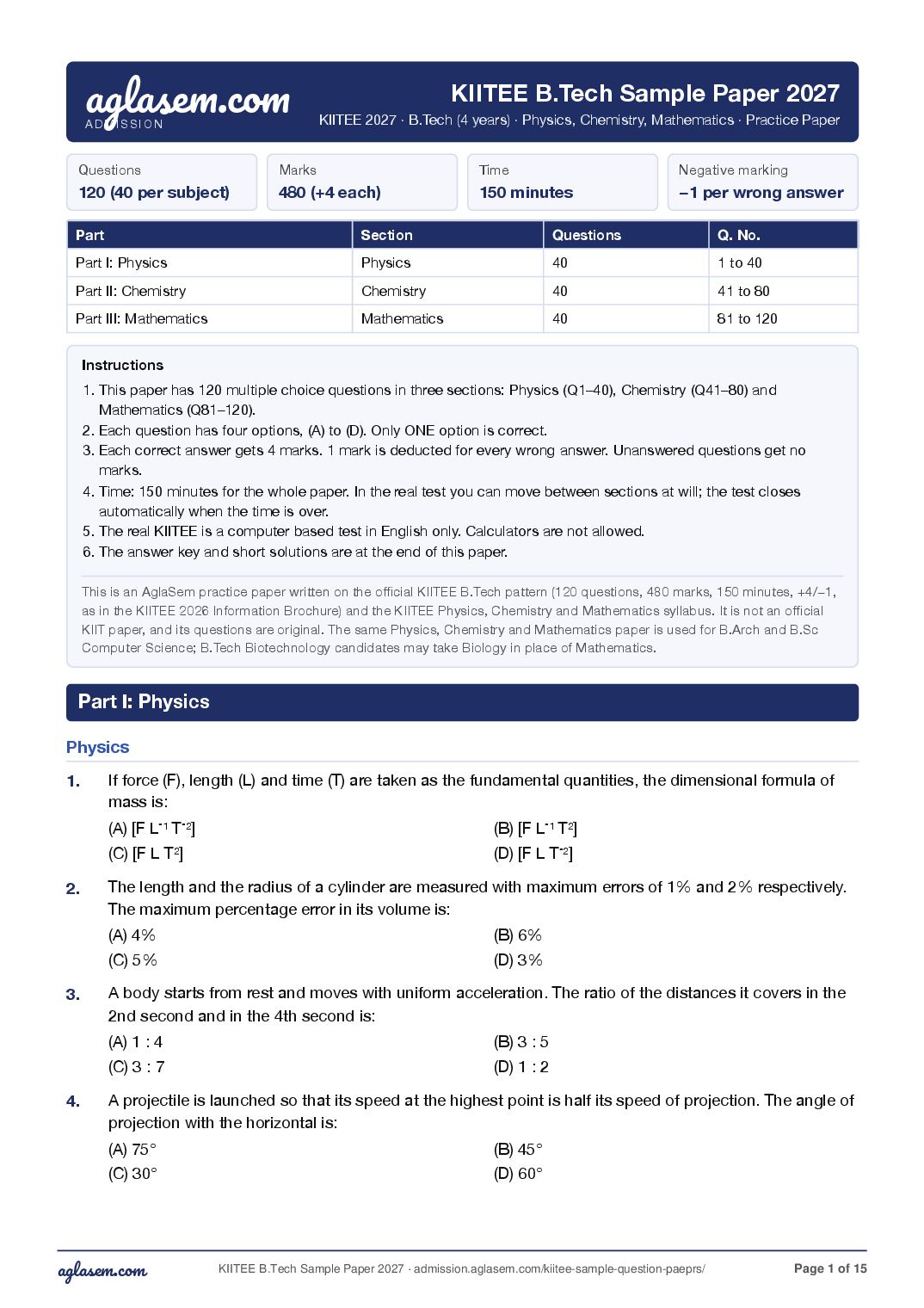
KIITEE B.Tech Sample Paper 2027
KIITEE 2027 · B.Tech (4 years) · Physics, Chemistry, Mathematics · Practice Paper
Questions Marks Time Negative marking
120 (40 per subject) 480 (+4 each) 150 minutes −1 per wrong answer
Part Section Questions Q. No.
Part I: Physics Physics 40 1 to 40
Part II: Chemistry Chemistry 40 41 to 80
Part III: Mathematics Mathematics 40 81 to 120
Instructions
1. This paper has 120 multiple choice questions in three sections: Physics (Q1–40), Chemistry (Q41–80) and
Mathematics (Q81–120).
2. Each question has four options, (A) to (D). Only ONE option is correct.
3. Each correct answer gets 4 marks. 1 mark is deducted for every wrong answer. Unanswered questions get no
marks.
4. Time: 150 minutes for the whole paper. In the real test you can move between sections at will; the test closes
automatically when the time is over.
5. The real KIITEE is a computer based test in English only. Calculators are not allowed.
6. The answer key and short solutions are at the end of this paper.
This is an AglaSem practice paper written on the official KIITEE B.Tech pattern (120 questions, 480 marks, 150 minutes, +4/−1,
as in the KIITEE 2026 Information Brochure) and the KIITEE Physics, Chemistry and Mathematics syllabus. It is not an official
KIIT paper, and its questions are original. The same Physics, Chemistry and Mathematics paper is used for B.Arch and B.Sc
Computer Science; B.Tech Biotechnology candidates may take Biology in place of Mathematics.
Part I: Physics
Physics
1. If force (F), length (L) and time (T) are taken as the fundamental quantities, the dimensional formula of
mass is:
(A) [F L⁻¹ T⁻²] (B) [F L⁻¹ T²]
(C) [F L T²] (D) [F L T⁻²]
2. The length and the radius of a cylinder are measured with maximum errors of 1% and 2% respectively.
The maximum percentage error in its volume is:
(A) 4% (B) 6%
(C) 5% (D) 3%
3. A body starts from rest and moves with uniform acceleration. The ratio of the distances it covers in the
2nd second and in the 4th second is:
(A) 1 : 4 (B) 3 : 5
(C) 3 : 7 (D) 1 : 2
4. A projectile is launched so that its speed at the highest point is half its speed of projection. The angle of
projection with the horizontal is:
(A) 75° (B) 45°
(C) 30° (D) 60°
KIITEE B.Tech Sample Paper 2027 · admission./kiitee-sample-question-paeprs/ Page 1 of 15
Page 2
any help from friction is (g = 10 m/s²):
(A) 3√10 m/s (B) 45 m/s
(C) 90 m/s (D) 30 m/s
6. A 50 kg person stands on a weighing scale in a lift that is moving upward but slowing down at 2.5 m/s².
The reading of the scale is (g = 10 m/s²):
(A) 625 N (B) 500 N
(C) 125 N (D) 375 N
7. A 4 kg block rests on a horizontal floor. The coefficients of static and kinetic friction are 0.5 and 0.3. A
horizontal force of 15 N is applied to it. The friction force on the block is (g = 10 m/s²):
(A) 15 N (B) 0 N
(C) 20 N (D) 12 N
8. A variable force F = 3x² newton acts on a body along the x-axis. The work done by the force as the
body moves from x = 1 m to x = 2 m is:
(A) 21 J (B) 9 J
(C) 7 J (D) 8 J
9. A body of mass m moving with speed v makes a head-on elastic collision with a body of mass 2m at
rest. The fraction of its kinetic energy transferred to the second body is:
(A) 8/9 (B) 1/9
(C) 1/3 (D) 2/3
10. A ring and a solid disc of the same mass and radius roll without slipping with the same linear speed.
The ratio of their total kinetic energies (ring : disc) is:
(A) 2 : 1 (B) 3 : 4
(C) 4 : 3 (D) 1 : 1
11. A force F = (2î + 3ĵ) N acts at a point whose position vector is r = (î + ĵ) m. The torque of the force about
the origin is:
(A) 5 N m along +z (B) 1 N m along +z
(C) 5 N m along −z (D) 1 N m along −z
12. Taking the Earth's radius as 6400 km, the depth below the surface at which the acceleration due to
gravity is 25% less than at the surface is:
(A) 1600 km (B) 3200 km
(C) 4800 km (D) 800 km
13. A wire is stretched so that the stress in it is S. If Young's modulus of the material is Y, the elastic
potential energy stored per unit volume of the wire is:
(A) S²/Y (B) S²/(2Y)
(C) S/(2Y) (D) 2S²/Y
14. Eight identical rain drops, each falling with terminal velocity v, combine to form a single bigger drop. The
terminal velocity of the bigger drop is:
(A) 4v (B) 8v
(C) 16v (D) 2v
15. The displacement of a particle in simple harmonic motion is x = 4 sin(2πt + π/6) cm, where t is in
seconds. The maximum speed of the particle is:
(A) 2π cm/s (B) 16π cm/s
(C) 4π cm/s (D) 8π cm/s
KIITEE B.Tech Sample Paper 2027 · admission./kiitee-sample-question-paeprs/ Page 2 of 15
Page 3
is doubled (same string material and thickness), the new fundamental frequency is:
(A) f (B) 2f
(C) 4f (D) f/2
17. A monatomic ideal gas is heated at constant pressure. The fraction of the heat supplied that goes into
raising its internal energy is:
(A) 2/5 (B) 5/3
(C) 3/5 (D) 2/3
18. A monatomic ideal gas (γ = 5/3) is compressed adiabatically to one-eighth of its volume. Its pressure
becomes:
(A) 16 times (B) 32 times
(C) 64 times (D) 8 times
19. A black body at 2000 K emits most strongly at a wavelength of 1.45 μm. When its temperature is raised
to 2900 K, the wavelength of maximum emission becomes:
(A) 1.0 μm (B) 1.45 μm
(C) 2.1 μm (D) 0.5 μm
20. Two rods of the same length and cross-section, with thermal conductivities K₁ and K₂, are joined end to
end. The equivalent thermal conductivity of the combination is:
(A) K₁ + K₂ (B) (K₁ + K₂)/2
(C) 2K₁K₂/(K₁ + K₂) (D) √(K₁K₂)
21. A parallel plate capacitor has capacitance C in air. A dielectric slab of dielectric constant K and
thickness equal to half the plate separation is placed between the plates. The new capacitance is:
(A) 2KC/(K + 1) (B) 2C/(K + 1)
(C) KC (D) (K + 1)C/2
22. A point charge q is placed at one corner of a cube. The total electric flux through the whole surface of
the cube is:
(A) q/(6ε₀) (B) q/(24ε₀)
(C) q/ε₀ (D) q/(8ε₀)
23. A battery of emf 12 V and internal resistance 2 Ω is connected to a variable external resistor. The
maximum power that can be delivered to the external resistor is:
(A) 9 W (B) 36 W
(C) 18 W (D) 72 W
24. A uniform wire of resistance 12 Ω is bent into a circle. The resistance between two points on the circle
that are a quarter of the circumference apart is:
(A) 3 Ω (B) 2.25 Ω
(C) 4.5 Ω (D) 9 Ω
25. Two heating coils, used one at a time on the same supply, boil a given quantity of water in 10 minutes
and 15 minutes. If both are connected in parallel to the same supply, the same water will boil in:
(A) 6 minutes (B) 7.5 minutes
(C) 25 minutes (D) 12.5 minutes
26. A particle of mass m and charge q, starting from rest, is accelerated through a potential difference V
and then enters a uniform magnetic field B at right angles to it. The radius of its circular path is:
(A) (1/B)√(2mV/q) (B) (1/B)√(2qV/m)
(C) (1/B)√(mV/q) (D) B√(2mV/q)
KIITEE B.Tech Sample Paper 2027 · admission./kiitee-sample-question-paeprs/ Page 3 of 15
Page 4
ammeter of range 0 to 2 A, one should connect:
(A) about 0.05 Ω in series (B) about 0.05 Ω in parallel
(C) about 50 kΩ in series (D) about 5 Ω in parallel
28. A current of 3 A flows through an inductor of self-inductance 0.2 H. The energy stored in its magnetic
field is:
(A) 1.8 J (B) 0.9 J
(C) 0.3 J (D) 0.6 J
29. In a series LCR circuit at resonance, the rms voltages across the inductor, the capacitor and the resistor
are 120 V, 120 V and 50 V respectively. The rms supply voltage is:
(A) 170 V (B) 290 V
(C) 240 V (D) 50 V
30. A thin convex glass lens (refractive index 1.5) has a focal length of 20 cm in air. When it is immersed in
water (refractive index 4/3), its focal length becomes:
(A) 20 cm (B) 80 cm
(C) 26.7 cm (D) 40 cm
31. An object 2 cm tall is placed 10 cm in front of a convex mirror of focal length 15 cm. The image is:
(A) 30 cm in front of the mirror, 6 cm tall and inverted
(B) 30 cm behind the mirror, 6 cm tall and erect
(C) 6 cm behind the mirror, 1.2 cm tall and erect
(D) 6 cm in front of the mirror, 1.2 cm tall and inverted
32. In Young's double-slit experiment the slits are 0.5 mm apart and the screen is 1 m away. For light of
wavelength 500 nm the fringe width is:
(A) 10 mm (B) 0.5 mm
(C) 1 mm (D) 0.1 mm
33. The polarising (Brewster) angle for a transparent medium is 60°. The critical angle for this medium is:
(A) sin⁻¹(1/2) (B) sin⁻¹(√3/2)
(C) sin⁻¹(2/3) (D) sin⁻¹(1/√3)
34. The speed of electromagnetic waves in a non-magnetic medium of relative permittivity 4 is:
(A) 3 × 10⁸ m/s (B) 0.75 × 10⁸ m/s
(C) 6 × 10⁸ m/s (D) 1.5 × 10⁸ m/s
35. Light of wavelength 310 nm falls on a metal whose work function is 2.5 eV. The stopping potential for
the emitted photoelectrons is (take hc = 1240 eV nm):
(A) 4.0 V (B) 2.5 V
(C) 6.5 V (D) 1.5 V
36. According to Bohr's model, the ratio of the radius of the third orbit of Li²⁺ (Z = 3) to the radius of the first
orbit of hydrogen is:
(A) 1/3 (B) 3
(C) 9 (D) 1
37. A radioactive substance has a half-life of 20 minutes. The time taken for 75% of a sample to decay is:
(A) 60 minutes (B) 20 minutes
(C) 40 minutes (D) 30 minutes
KIITEE B.Tech Sample Paper 2027 · admission./kiitee-sample-question-paeprs/ Page 4 of 15
Page 5
pairs in silicon is about (hc = 1240 eV nm):
(A) 560 nm (B) 2250 nm
(C) 1130 nm (D) 113 nm
39. A NAND gate with both its inputs joined together works as:
(A) a NOR gate (B) an OR gate
(C) a NOT gate (D) an AND gate
40. In a common-emitter transistor circuit, a change of 0.02 mA in the base current causes a change of 1
mA in the collector current. The current gain β is:
(A) 20 (B) 50
(C) 49 (D) 51
Part II: Chemistry
Chemistry
41. The number of moles of oxygen atoms present in 49 g of H₂SO₄ is:
(A) 4 (B) 1
(C) 2 (D) 0.5
42. The mass of anhydrous Na₂CO₃ (molar mass 106 g/mol) needed to prepare 250 mL of a 0.2 M solution
is:
(A) 2.65 g (B) 5.3 g
(C) 21.2 g (D) 10.6 g
43. Under identical conditions, the ratio of the rates of diffusion of H₂ and O₂ is:
(A) 1 : 16 (B) 16 : 1
(C) 1 : 4 (D) 4 : 1
44. The total number of orbitals in the shell with principal quantum number n = 4 is:
(A) 8 (B) 4
(C) 16 (D) 32
45. A solution is made by mixing 46 g of ethanol (C₂H₅OH) with 36 g of water. The mole fraction of ethanol
in the solution is:
(A) 1/2 (B) 1/3
(C) 0.56 (D) 2/3
46. A non-volatile solute is dissolved in a solvent whose vapour pressure is 100 mm Hg. If the mole fraction
of the solute is 0.2, the vapour pressure of the solution is:
(A) 100 mm Hg (B) 80 mm Hg
(C) 120 mm Hg (D) 20 mm Hg
47. The standard enthalpies of formation of CO₂(g), H₂O(l) and CH₄(g) are −393.5, −285.8 and −74.8 kJ/mol
respectively. The standard enthalpy of combustion of methane is:
(A) +890.3 kJ/mol (B) −604.5 kJ/mol
(C) −890.3 kJ/mol (D) −1039.9 kJ/mol
48. For the reaction 2SO₂(g) + O₂(g) ⇌ 2SO₃(g), the relation between Kp and Kc is:
(A) Kp = Kc(RT)⁻¹ (B) Kp = Kc(RT)
(C) Kp = Kc (D) Kp = Kc(RT)⁻²
KIITEE B.Tech Sample Paper 2027 · admission./kiitee-sample-question-paeprs/ Page 5 of 15
Page 6
(A) 2.7 (B) 3.0
(C) 11.0 (D) 11.3
50. The oxidation state of chromium in CrO₅ (which has two peroxide groups) is:
(A) +10 (B) +5
(C) +6 (D) +8
51. The quantity of electricity needed to reduce 1 mol of MnO₄⁻ ions to Mn²⁺ ions is:
(A) 5 F (B) 2 F
(C) 7 F (D) 3 F
52. For a zero-order reaction, the half-life is:
(A) directly proportional to the initial concentration
(B) proportional to the square of the initial concentration
(C) inversely proportional to the initial concentration
(D) independent of the initial concentration
53. For coagulating a negatively charged arsenious sulphide (As₂S₃) sol, the most effective ion is:
(A) Na⁺ (B) Ba²⁺
(C) PO₄³⁻ (D) Al³⁺
54. Among F, Cl, Br and I, the element with the most negative electron gain enthalpy is:
(A) I (B) Br
(C) F (D) Cl
55. The hybridisation of sulphur and the shape of the SF₄ molecule are:
(A) sp³d², square planar (B) sp³d, see-saw
(C) dsp², square planar (D) sp³, tetrahedral
56. Which one of the following molecules is polar (has a non-zero dipole moment)?
(A) CCl₄ (B) SO₂
(C) CO₂ (D) BeF₂
57. In the structure of diborane (B₂H₆) there are:
(A) four 3c–2e bonds and one B–B double bond
(B) two 2c–2e B–H bonds and four 3c–2e bonds
(C) six 2c–2e B–H bonds and one B–B bond
(D) four 2c–2e B–H bonds and two 3c–2e B–H–B bonds
58. Which of the following oxides of nitrogen is paramagnetic?
(A) N₂O₃ (B) N₂O
(C) N₂O₅ (D) NO
59. The basicity of phosphorous acid, H₃PO₃, is:
(A) 1 (B) 0
(C) 2 (D) 3
60. Among the alkali metal ions in water, the one with the lowest ionic mobility is:
(A) Na⁺ (B) Li⁺
(C) Cs⁺ (D) K⁺
KIITEE B.Tech Sample Paper 2027 · admission./kiitee-sample-question-paeprs/ Page 6 of 15
Page 7
(A) nickel (B) copper
(C) zirconium (D) germanium
62. Because of the inert pair effect, the most stable oxidation state of lead in its compounds is:
(A) +1 (B) +4
(C) +2 (D) +3
63. The spin-only magnetic moment of the Cr³⁺ ion (Z of Cr = 24) is about:
(A) 4.90 BM (B) 2.83 BM
(C) 3.87 BM (D) 5.92 BM
64. The IUPAC name of K₃[Fe(C₂O₄)₃] is:
(A) tripotassium oxalatoiron(II)
(B) potassium trioxalatoiron(III)
(C) potassium trioxalatoferrate(II)
(D) potassium trioxalatoferrate(III)
65. The total number of stereoisomers of the octahedral ion [Co(en)₂Cl₂]⁺ (en = ethane-1,2-diamine) is:
(A) 2 (B) 1
(C) 4 (D) 3
66. The hybridisation, shape and magnetic nature of [Ni(CO)₄] are:
(A) sp³, tetrahedral, diamagnetic
(B) dsp², square planar, paramagnetic
(C) sp³, tetrahedral, paramagnetic
(D) dsp², square planar, diamagnetic
67. The Ziegler–Natta catalyst, used for polymerising ethene, is a combination of:
(A) Pd and BaSO₄ (B) TiCl₄ and Al(C₂H₅)₃
(C) V₂O₅ and SO₂ (D) Ni and H₂
68. A nucleus of uranium-238 (Z = 92) emits one alpha particle and then two beta (β⁻) particles. The final
nucleus is:
(A) Th-234 (Z = 90) (B) Pa-234 (Z = 91)
(C) U-234 (Z = 92) (D) Th-230 (Z = 90)
69. A mixture of o-nitrophenol and p-nitrophenol is best separated by:
(A) simple filtration
(B) sublimation
(C) fractional crystallisation from benzene
(D) steam distillation
70. A hydrocarbon contains 80% carbon by mass. Its empirical formula is:
(A) C₂H₅ (B) CH₄
(C) CH₂ (D) CH₃
71. Which of the following carboxylic acids is the weakest?
(A) CH₃COOH (B) C₆H₅COOH
(C) HCOOH (D) FCH₂COOH
KIITEE B.Tech Sample Paper 2027 · admission./kiitee-sample-question-paeprs/ Page 7 of 15
Page 8
is:
(A) propanal (B) propane-1,2-diol
(C) propan-2-ol (D) propan-1-ol
73. Chlorobenzene reacts with chlorine in the presence of anhydrous FeCl₃. The main products are:
(A) hexachlorocyclohexane (B) 1,3-dichlorobenzene
(C) benzyl chloride (D) 1,2- and 1,4-dichlorobenzene
74. Which of the following is the most acidic?
(A) 2,4,6-trinitrophenol (B) 4-methylphenol
(C) phenol (D) 2-nitrophenol
75. Which of the following does NOT undergo aldol condensation?
(A) ethanal (B) 2,2-dimethylpropanal
(C) propanal (D) propanone
76. Benzenediazonium chloride reacts with hypophosphorous acid (H₃PO₂) to give:
(A) phenol (B) aniline
(C) chlorobenzene (D) benzene
77. The monomer of neoprene is:
(A) isoprene (2-methylbuta-1,3-diene)
(B) chloroprene (2-chlorobuta-1,3-diene)
(C) acrylonitrile (propenenitrile)
(D) vinyl chloride (chloroethene)
78. On hydrolysis, lactose gives:
(A) glucose only (B) galactose and fructose
(C) glucose and fructose (D) glucose and galactose
79. Which artificial sweetener is used only in cold foods and soft drinks because it is unstable at cooking
temperature?
(A) aspartame (B) alitame
(C) sucralose (D) saccharin
80. Which of the following is a typical component of photochemical smog but not of classical (London)
smog?
(A) sulphur dioxide (B) peroxyacetyl nitrate (PAN)
(C) sulphuric acid droplets (D) soot particles
Part III: Mathematics
Mathematics
81. If n(A) = 40, n(B) = 26 and n(A ∪ B) = 60, then n(A ∩ B) is:
(A) 14 (B) 20
(C) 6 (D) 34
82. The domain of the function f(x) = 1/√(x² − 9) is:
(A) (−∞, −3) ∪ (3, ∞) (B) R − {3}
(C) (−3, 3) (D) [−3, 3]
KIITEE B.Tech Sample Paper 2027 · admission./kiitee-sample-question-paeprs/ Page 8 of 15
Page 9
(A) 3 (B) 26
(C) 24 (D) 8
84. The value of (1 + i)^10/(1 − i)^8 is:
(A) −2i (B) 2
(C) 32i (D) 2i
85. The principal argument of (1 + i√3)/(1 − i) is:
(A) 7π/12 (B) 5π/12
(C) −π/12 (D) π/12
86. A is a square matrix of order 3 with |A| = 4. The value of |adj(2A)| is:
(A) 256 (B) 128
(C) 1024 (D) 64
87. The solution of the system x + y + z = 4, 2x − y + z = 8 and x + 2y − z = −3 is (x, y, z) =
(A) (−1, 2, 3) (B) (2, 1, 1)
(C) (3, −1, 2) (D) (2, −1, 3)
88. The system kx + y + z = 0, x + ky + z = 0, x + y + kz = 0 has a non-trivial solution when k equals:
(A) 0 or 3 (B) 1 or −2
(C) −1 or 2 (D) 1 only
89. If α and β are the roots of 2x² − 6x + 3 = 0, then 1/α² + 1/β² is:
(A) 3/8 (B) 2/3
(C) 8/3 (D) 4
90. The number of different arrangements of the letters of the word COLLEGE is:
(A) 1260 (B) 5040
(C) 630 (D) 2520
91. The number of ways in which 5 boys and 3 girls can sit in a row so that no two girls sit next to each
other is:
(A) 40320 (B) 14400
(C) 4320 (D) 2880
92. The term independent of x in the expansion of (2x − 1/x²)⁶ is:
(A) 240 (B) −240
(C) −160 (D) 60
93. If the coefficients of x² and x³ in the expansion of (2 + x/3)ⁿ are equal, then n is:
(A) 18 (B) 20
(C) 12 (D) 15
94. The sum of the first n terms of an AP is 3n² + 2n. Its 10th term is:
(A) 56 (B) 62
(C) 59 (D) 320
95. The third term of a GP is 4. The product of its first five terms is:
(A) 1024 (B) 4096
(C) 256 (D) 64
KIITEE B.Tech Sample Paper 2027 · admission./kiitee-sample-question-paeprs/ Page 9 of 15
Page 10
(A) 8 (B) 4
(C) 2 (D) 16
97. The value of lim(x→0) (tan 2x − sin 2x)/x³ is:
(A) 4 (B) 0
(C) 8 (D) 2
98. For x > 0, the derivative of x^x with respect to x is:
(A) x^x(1 − ln x) (B) x^x(1 + ln x)
(C) x · x^(x − 1) (D) x^x ln x
99. The maximum value of f(x) = x e^(−x) for real x is:
(A) e (B) 2/e²
(C) 1/e (D) 1
100. The points on the curve y = x³ − 12x + 1 at which the tangent is parallel to the x-axis are:
(A) (2, −15) and (−2, 17) (B) (2, −15) only
(C) (0, 1) only (D) (2, 17) and (−2, −15)
101. ∫ dx/(x² − 4) equals:
(A) (1/4) ln|(x + 2)/(x − 2)| + C (B) (1/4) ln|(x − 2)/(x + 2)| + C
(C) (1/2) ln|(x − 2)/(x + 2)| + C (D) (1/2) tan⁻¹(x/2) + C
102. ∫ e^x (1/x − 1/x²) dx equals:
(A) e^x/x + C (B) e^x ln x + C
(C) −e^x/x + C (D) e^x/x² + C
103. The value of ∫₀^(π/4) tan² x dx is:
(A) π/4 (B) 1 + π/4
(C) π/4 − 1/2 (D) 1 − π/4
104. The area of the region bounded by the parabola y = x² and the line y = 4 is:
(A) 8/3 sq. units (B) 64/3 sq. units
(C) 32/3 sq. units (D) 16/3 sq. units
105. The order and degree of the differential equation y = x(dy/dx) + √[1 + (dy/dx)²] are:
(A) order 1, degree 1 (B) order 1, degree 2
(C) order 2, degree 2 (D) order 2, degree 1
106. The general solution of the differential equation dy/dx + y = e^(−x) is:
(A) y = (x + C)e^x (B) y = x e^(−x) + Ce^x
(C) y = Ce^(−x) − x (D) y = (x + C)e^(−x)
107. The distance between the parallel lines 5x − 12y + 4 = 0 and 10x − 24y − 18 = 0 is:
(A) 13 (B) 1
(C) 1/2 (D) 2
108. The equation of the circle with centre (2, −3) that passes through the point (5, 1) is:
(A) x² + y² − 4x + 6y + 12 = 0 (B) x² + y² − 4x + 6y − 25 = 0
(C) x² + y² + 4x − 6y − 12 = 0 (D) x² + y² − 4x + 6y − 12 = 0
109. The equation of the parabola with focus (0, 2) and directrix y = −2 is:
(A) x² = −8y (B) x² = 8y
(C) y² = 8x (D) x² = 4y
KIITEE B.Tech Sample Paper 2027 · admission./kiitee-sample-question-paeprs/ Page 10 of 15
Page 11
(A) 3/4 (B) 4/5
(C) 3/5 (D) 5/4
111. The distance of the point (2, 3, 4) from the plane 3x − 6y + 2z + 11 = 0 is:
(A) 1 (B) 1/7
(C) 7 (D) 2
112. The angle between the planes x + y + 2z = 3 and 2x − y + z = 5 is:
(A) 60° (B) 30°
(C) 90° (D) 45°
113. The area of the parallelogram whose adjacent sides are a = î + 2ĵ + 3k̂ and b = −3î − 2ĵ + k̂ is:
(A) 12√5 sq. units (B) 180 sq. units
(C) 6√5 sq. units (D) 3√5 sq. units
114. The vectors î − ĵ + k̂ , 2î + ĵ − k̂ and λî − ĵ + λk̂ are coplanar when λ equals:
(A) 0 (B) 3
(C) 1 (D) −1
115. Two cards are drawn one after the other, without replacement, from a well-shuffled pack of 52 cards.
The probability that both are aces is:
(A) 1/221 (B) 2/221
(C) 1/169 (D) 1/13
116. A fair coin is tossed 5 times. The probability of getting exactly 3 heads is:
(A) 5/16 (B) 3/16
(C) 1/2 (D) 5/32
117. The mean and variance of a binomial distribution are 6 and 2 respectively. Then:
(A) n = 9, p = 2/3 (B) n = 18, p = 1/3
(C) n = 12, p = 1/2 (D) n = 9, p = 1/3
118. The value of cos(π/5) cos(2π/5) is:
(A) 1/8 (B) 1/2
(C) √5/4 (D) 1/4
119. The general solution of 2cos² x − 3cos x + 1 = 0 is (n is any integer):
(A) x = nπ + (−1)ⁿ π/6 (B) x = 2nπ or x = 2nπ ± π/3
(C) x = nπ or x = nπ ± π/3 (D) x = 2nπ ± π/6 only
120. The value of sin⁻¹(3/5) + cos⁻¹(12/13) is:
(A) cos⁻¹(56/65) (B) sin⁻¹(16/65)
(C) sin⁻¹(56/65) (D) sin⁻¹(63/65)
KIITEE B.Tech Sample Paper 2027 · admission./kiitee-sample-question-paeprs/ Page 11 of 15
Page 12
1 B 2 C 3 C 4 D 5 D 6 D 7 A 8 C 9 A 10 C
11 B 12 A 13 B 14 A 15 D 16 A 17 C 18 B 19 A 20 C
21 A 22 D 23 C 24 B 25 A 26 A 27 B 28 B 29 D 30 B
31 C 32 C 33 D 34 D 35 D 36 B 37 C 38 C 39 C 40 B
41 C 42 B 43 D 44 C 45 B 46 B 47 C 48 A 49 D 50 C
51 A 52 A 53 D 54 D 55 B 56 B 57 D 58 D 59 C 60 B
61 D 62 C 63 C 64 D 65 D 66 A 67 B 68 C 69 D 70 D
71 A 72 D 73 D 74 A 75 B 76 D 77 B 78 D 79 A 80 B
81 C 82 A 83 C 84 D 85 A 86 C 87 D 88 B 89 C 90 A
91 B 92 A 93 B 94 C 95 A 96 A 97 A 98 B 99 C 100 A
101 B 102 A 103 D 104 C 105 B 106 D 107 B 108 D 109 B 110 B
111 A 112 A 113 C 114 C 115 A 116 A 117 A 118 D 119 B 120 C
Solutions
Physics
1. (B) F = MLT⁻², so M = F L⁻¹ T².
2. (C) V = πr²l, so ΔV/V = 2(Δr/r) + Δl/l = 2(2%) + 1% = 5%.
3. (C) With u = 0, the distance in the nth second is a(2n − 1)/2, which is proportional to (2n − 1). For n = 2 and 4 this
gives 3 : 7.
4. (D) At the top only the horizontal component u cos θ remains. u cos θ = u/2 gives cos θ = 1/2, so θ = 60°.
5. (D) For no friction, tan θ = v²/(rg), so v = √(rg tan θ) = √(90 × 10 × 1) = 30 m/s.
6. (D) The acceleration is downward (2.5 m/s²), so N = m(g − a) = 50 × 7.5 = 375 N.
7. (A) Limiting friction = 0.5 × 40 = 20 N, which is more than 15 N, so the block does not move. Static friction just
balances the applied force: 15 N.
8. (C) W = ∫ F dx = ∫₁² 3x² dx = [x³]₁² = 8 − 1 = 7 J.
9. (A) For a head-on elastic collision with the target at rest, fraction transferred = 4m₁m₂/(m₁ + m₂)² = 4(m)(2m)/(3m)² =
8/9.
10. (C) Ring: ½mv² + ½(mr²)(v/r)² = mv². Disc: ½mv² + ½(½mr²)(v/r)² = ¾mv². Ratio = 1 : 3/4 = 4 : 3.
11. (B) τ = r × F = (1 × 3 − 1 × 2) k̂ = +1 k̂ N m.
12. (A) g(d) = g(1 − d/R). 0.75g = g(1 − d/R) gives d = R/4 = 1600 km.
13. (B) Energy per unit volume = ½ × stress × strain = ½ × S × (S/Y) = S²/(2Y).
14. (A) Volume is conserved: 8 × (4/3)πr³ = (4/3)πR³, so R = 2r. Terminal velocity ∝ r², so it becomes 4v.
15. (D) v(max) = Aω = 4 × 2π = 8π cm/s.
16. (A) f = (1/2L)√(T/μ). Four times the tension doubles √T; twice the length halves 1/L. The frequency stays f.
ₚ ₚ
17. (C) ΔU/Q = nCᵥΔT/(nC ΔT) = Cᵥ/C = (3R/2)/(5R/2) = 3/5.
18. (B) PVᵞ = constant, so P₂/P₁ = (V₁/V₂)ᵞ = 8^(5/3) = 2⁵ = 32.
19. (A) By Wien's law λ(m)T is constant: λ = 1.45 × 2000/2900 = 1.0 μm.
20. (C) In series the thermal resistances add: 2L/(KA) = L/(K₁A) + L/(K₂A), so K = 2K₁K₂/(K₁ + K₂).
21. (A) C' = ε₀A/[(d/2) + (d/2K)] = (ε₀A/d) × 2K/(K + 1) = 2KC/(K + 1).
22. (D) Eight such cubes around the corner would enclose the charge completely, so one cube receives 1/8 of the flux
q/ε₀.
KIITEE B.Tech Sample Paper 2027 · admission./kiitee-sample-question-paeprs/ Page 12 of 15
Page 13
24. (B) The two arcs are 3 Ω and 9 Ω in parallel: (3 × 9)/(3 + 9) = 27/12 = 2.25 Ω.
25. (A) Heat needed H = V²t/R, so t ∝ R. In parallel R = R₁R₂/(R₁ + R₂), so t = t₁t₂/(t₁ + t₂) = 150/25 = 6 minutes.
26. (A) qV = ½mv² gives mv = √(2mqV). r = mv/(qB) = √(2mqV)/(qB) = (1/B)√(2mV/q).
27. (B) Shunt S = I(g)G/(I − I(g)) = (0.002 × 50)/1.998 ≈ 0.05 Ω, connected in parallel with the galvanometer.
28. (B) U = ½LI² = ½ × 0.2 × 9 = 0.9 J.
29. (D) V = √[V(R)² + (V(L) − V(C))²] = √(50² + 0²) = 50 V. At resonance V(L) and V(C) cancel.
30. (B) 1/f ∝ (μ(lens)/μ(medium) − 1). In air this is 0.5; in water it is 1.5/(4/3) − 1 = 0.125. So f(water) = 20 × 0.5/0.125 =
80 cm.
31. (C) With f = +15 cm and u = −10 cm: 1/v = 1/15 + 1/10 = 1/6, so v = +6 cm (behind, virtual). m = −v/u = 0.6, so the
image is erect and 1.2 cm tall.
32. (C) β = λD/d = (500 × 10⁻⁹ × 1)/(0.5 × 10⁻³) = 10⁻³ m = 1 mm.
33. (D) By Brewster's law μ = tan 60° = √3. The critical angle C satisfies sin C = 1/μ = 1/√3.
34. (D) v = c/√(μᵣεᵣ) = (3 × 10⁸)/√(1 × 4) = 1.5 × 10⁸ m/s.
35. (D) Photon energy = 1240/310 = 4.0 eV. K(max) = 4.0 − 2.5 = 1.5 eV, so the stopping potential is 1.5 V.
ₙ
36. (B) r ∝ n²/Z. For Li²⁺, n = 3: 9/3 = 3 times the first Bohr radius of hydrogen.
37. (C) When 75% has decayed, 25% = 1/4 remains, which takes two half-lives = 40 minutes.
38. (C) λ(max) = hc/E(g) = 1240/1.1 ≈ 1127 nm, in the near infrared.
39. (C) With A = B, Y = (A·A)' = A', which is the NOT operation.
40. (B) β = ΔI(C)/ΔI(B) = 1/0.02 = 50.
Chemistry
41. (C) Molar mass of H₂SO₄ = 98 g/mol, so 49 g = 0.5 mol. Each molecule has 4 O atoms: 0.5 × 4 = 2 mol of O atoms.
42. (B) Moles needed = 0.2 × 0.250 = 0.05 mol. Mass = 0.05 × 106 = 5.3 g.
43. (D) By Graham's law r ∝ 1/√M: r(H₂)/r(O₂) = √(32/2) = √16 = 4.
44. (C) The number of orbitals in a shell is n² = 16 (one 4s, three 4p, five 4d and seven 4f).
45. (B) 46 g ethanol = 1 mol and 36 g water = 2 mol. Mole fraction of ethanol = 1/(1 + 2) = 1/3. (0.56 is its mass
fraction.)
46. (B) By Raoult's law p = p⁰ × x(solvent) = 100 × 0.8 = 80 mm Hg.
47. (C) CH₄ + 2O₂ → CO₂ + 2H₂O. ΔH = [−393.5 + 2(−285.8)] − (−74.8) = −965.1 + 74.8 = −890.3 kJ/mol.
48. (A) Kp = Kc(RT)^Δn, with Δn = 2 − 3 = −1.
49. (D) [OH⁻] = 2 × 10⁻³ M, so pOH = 3 − 0.30 = 2.70 and pH = 14 − 2.70 = 11.3.
50. (C) CrO₅ has one O²⁻ and two O₂²⁻ groups: x − 2 − 2(2) = 0, so x = +6. (Taking all O as −2 would wrongly give +10.)
51. (A) Mn changes from +7 to +2, a gain of 5 electrons per ion, so 5 faradays are needed per mole.
52. (A) For zero order, [A] = [A]₀ − kt, so t½ = [A]₀/(2k), which is directly proportional to [A]₀.
53. (D) By the Hardy–Schulze rule a negative sol is coagulated by cations, and the higher the charge, the greater the
power: Al³⁺ > Ba²⁺ > Na⁺.
54. (D) Fluorine is very small, so the added electron feels strong repulsion in the compact 2p shell. Chlorine therefore
has the most negative electron gain enthalpy.
55. (B) S has 4 bond pairs and 1 lone pair (5 electron pairs): sp³d, with the lone pair in an equatorial position, giving a
see-saw shape.
56. (B) SO₂ is bent (S has a lone pair), so the bond moments do not cancel. CO₂ and BeF₂ are linear and CCl₄ is
tetrahedral, so their bond moments cancel.
57. (D) Diborane has four terminal B–H bonds (two-centre two-electron) and two bridging B–H–B 'banana' bonds
(three-centre two-electron). There is no B–B bond.
KIITEE B.Tech Sample Paper 2027 · admission./kiitee-sample-question-paeprs/ Page 13 of 15
Page 14
paired.
59. (C) H₃PO₃ is HPO(OH)₂: one H is bonded directly to P and is not ionisable. Only the two O–H hydrogens are acidic.
60. (B) Li⁺ is the smallest ion and is the most heavily hydrated, so its hydrated ion is the largest and moves the slowest.
61. (D) Zone refining suits semiconductors such as Ge and Si. Copper is refined electrolytically, zirconium by the van
Arkel method and nickel by the Mond process.
62. (C) Down group 14 the ns² pair is reluctant to take part in bonding, so Pb(II) is more stable than Pb(IV); this is why
PbO₂ is a strong oxidising agent.
63. (C) Cr³⁺ is 3d³ with 3 unpaired electrons: μ = √[3(3 + 2)] = √15 ≈ 3.87 BM.
64. (D) The complex ion is an anion, so iron is named 'ferrate'. Three C₂O₄²⁻ ligands give −6, and the charge is −3, so
Fe is +3.
65. (D) The trans isomer has a mirror plane (1 isomer). The cis isomer is chiral and exists as a pair of enantiomers (2).
Total = 3.
66. (A) Ni is in the 0 state (3d⁸4s²). CO is a strong-field ligand: the 4s electrons pair into 3d, giving 3d^10, and 4s4p³
(sp³) orbitals form a tetrahedral, diamagnetic complex.
67. (B) Ziegler–Natta catalyst is triethylaluminium with titanium tetrachloride. Pd/BaSO₄ is Lindlar's catalyst (partly
poisoned).
68. (C) α emission lowers A by 4 and Z by 2: Th-234 (Z = 90). Each β⁻ raises Z by 1 with no change in A: U-234 (Z =
92), an isotope of the parent.
69. (D) o-Nitrophenol has intramolecular hydrogen bonding, so it is steam volatile. p-Nitrophenol is held by
intermolecular hydrogen bonds and stays behind.
70. (D) C : H = 80/12 : 20/1 = 6.67 : 20 = 1 : 3, so the empirical formula is CH₃ (the molecule could be C₂H₆).
71. (A) The +I effect of the methyl group destabilises the carboxylate ion. pKa values: acetic 4.76, benzoic 4.20, formic
3.75, fluoroacetic about 2.6.
72. (D) Hydroboration–oxidation adds H and OH across the double bond in an anti-Markovnikov way, so OH ends up
on the terminal carbon.
73. (D) Cl deactivates the ring (−I) but directs the incoming group to the ortho and para positions (+R), so 1,2- and 1,4-
dichlorobenzene are formed, the para isomer in larger amount.
74. (A) Three nitro groups (−M and −I) strongly stabilise the phenoxide ion, so picric acid is by far the most acidic. A
methyl group lowers acidity.
75. (B) Aldol condensation needs an α-hydrogen. In (CH₃)₃C–CHO the α-carbon carries no hydrogen.
76. (D) H₃PO₂ (or ethanol) reduces the diazonium group and replaces –N₂⁺ by H, giving benzene. Warming with water
would give phenol.
77. (B) Neoprene, a synthetic rubber, is polychloroprene. Natural rubber is a polymer of isoprene; PVC is from vinyl
chloride.
78. (D) Lactose (milk sugar) is made of β-D-galactose and β-D-glucose linked by a glycosidic bond. Sucrose gives
glucose and fructose, maltose gives glucose only.
79. (A) Aspartame (a dipeptide methyl ester) breaks down on heating. Saccharin and sucralose are stable at cooking
temperature.
80. (B) Photochemical smog forms from NOₓ and hydrocarbons in sunlight and contains O₃, PAN and aldehydes.
Classical smog is smoke plus SO₂ and its acid products.
Mathematics
81. (C) n(A ∩ B) = n(A) + n(B) − n(A ∪ B) = 40 + 26 − 60 = 6.
82. (A) We need x² − 9 > 0 (strictly, as it is under a root in the denominator), so |x| > 3.
83. (C) (g∘f)(1) = g(f(1)) = g(5) = 25 − 1 = 24. (f∘g)(1) would be f(0) = 3.
84. (D) (1 + i)/(1 − i) = i, so the expression is i^8 × (1 + i)² = 1 × 2i = 2i.
85. (A) arg(1 + i√3) = π/3 and arg(1 − i) = −π/4. The argument of the quotient is π/3 + π/4 = 7π/12, which lies in (−π, π].
KIITEE B.Tech Sample Paper 2027 · admission./kiitee-sample-question-paeprs/ Page 14 of 15
Page 15
87. (D) Third minus first: y − 2z = −7. Second minus twice the first: −3y − z = 0, so z = −3y. Then 7y = −7: y = −1, z = 3
and x = 2.
88. (B) The coefficient determinant must be zero: k³ − 3k + 2 = (k − 1)²(k + 2) = 0, so k = 1 or k = −2.
89. (C) α + β = 3, αβ = 3/2. α² + β² = 9 − 3 = 6, so 1/α² + 1/β² = 6/(9/4) = 8/3.
90. (A) 7 letters with L twice and E twice: 7!/(2! × 2!) = 5040/4 = 1260.
91. (B) Arrange the boys in 5! = 120 ways. That leaves 6 gaps; choose and fill 3 of them with the girls in ⁶P₃ = 120
ways. Total = 120 × 120 = 14400.
92. (A) T(r+1) = C(6,r)(2x)^(6−r)(−1/x²)^r = C(6,r)2^(6−r)(−1)^r x^(6−3r). r = 2 gives 15 × 16 = 240.
93. (B) Coefficient of x^r is C(n,r)2^(n−r)3^(−r). Equating r = 2 and r = 3: 6 C(n,2) = C(n,3), so 3 = (n − 2)/6 and n = 20.
94. (C) a(10) = S(10) − S(9) = (300 + 20) − (243 + 18) = 320 − 261 = 59.
95. (A) The terms are a/r², a/r, a, ar, ar² with a = 4 the middle term. Their product is a⁵ = 4⁵ = 1024.
96. (A) 1 − cos 4x = 2 sin² 2x, so the limit = 2 × (2)² × lim (sin 2x/2x)² = 8.
97. (A) tan y − sin y = y³/2 + higher terms. With y = 2x this is 8x³/2 = 4x³, so the limit is 4.
98. (B) Let y = x^x, so ln y = x ln x. Then y'/y = ln x + 1, so y' = x^x(1 + ln x).
99. (C) f'(x) = e^(−x)(1 − x) = 0 at x = 1, where f changes from increasing to decreasing. f(1) = 1/e.
100. (A) dy/dx = 3x² − 12 = 0 gives x = ±2; y(2) = 8 − 24 + 1 = −15 and y(−2) = −8 + 24 + 1 = 17.
101. (B) ∫ dx/(x² − a²) = (1/2a) ln|(x − a)/(x + a)| + C with a = 2.
102. (A) This is ∫ e^x [f(x) + f'(x)] dx with f(x) = 1/x, f'(x) = −1/x², so the answer is e^x f(x) + C = e^x/x + C.
103. (D) tan² x = sec² x − 1, so the integral is [tan x − x]₀^(π/4) = 1 − π/4.
104. (C) They meet at x = ±2. Area = ∫₋₂² (4 − x²) dx = 16 − 16/3 = 32/3.
105. (B) Write p = dy/dx. Removing the root: (y − xp)² = 1 + p², which is of degree 2 in p. The highest derivative is the
first, so order 1, degree 2.
106. (D) Integrating factor e^x: d(y e^x)/dx = 1, so y e^x = x + C and y = (x + C)e^(−x).
107. (B) The second line is 5x − 12y − 9 = 0. Distance = |4 − (−9)|/√(25 + 144) = 13/13 = 1.
108. (D) r² = 3² + 4² = 25. (x − 2)² + (y + 3)² = 25 expands to x² + y² − 4x + 6y + 13 − 25 = 0, i.e. x² + y² − 4x + 6y − 12 =
0.
109. (B) x² + (y − 2)² = (y + 2)² simplifies to x² = 8y.
110. (B) x²/25 + y²/9 = 1, so a² = 25, b² = 9 and e = √(1 − 9/25) = 4/5.
111. (A) |3(2) − 6(3) + 2(4) + 11|/√(9 + 36 + 4) = |6 − 18 + 8 + 11|/7 = 7/7 = 1.
112. (A) cos θ = |(1)(2) + (1)(−1) + (2)(1)|/(√6 × √6) = 3/6 = 1/2, so θ = 60°.
113. (C) a × b = 8î − 10ĵ + 4k̂ , so |a × b| = √(64 + 100 + 16) = √180 = 6√5.
114. (C) Their scalar triple product must be zero: (λ − 1) + 3λ + (−2 − λ) = 3λ − 3 = 0, so λ = 1.
115. (A) (4/52) × (3/51) = 12/2652 = 1/221.
116. (A) C(5,3)(1/2)⁵ = 10/32 = 5/16.
117. (A) np = 6 and npq = 2 give q = 1/3, so p = 2/3 and n = 6/(2/3) = 9.
118. (D) cos 36° = (√5 + 1)/4 and cos 72° = (√5 − 1)/4. Their product is (5 − 1)/16 = 1/4.
119. (B) (2cos x − 1)(cos x − 1) = 0 gives cos x = 1 (x = 2nπ) or cos x = 1/2 (x = 2nπ ± π/3).
120. (C) cos⁻¹(12/13) = sin⁻¹(5/13). sin(A + B) = (3/5)(12/13) + (4/5)(5/13) = 36/65 + 20/65 = 56/65; both angles are acute
and the sum is below π/2, so it equals sin⁻¹(56/65).
KIITEE B.Tech Sample Paper 2027 · admission./kiitee-sample-question-paeprs/ Page 15 of 15
Document Details
| Board / Org | KIIT |
| Exam | KIITEE |
| Type | Sample Paper |
| Pages | 15 |
| Language | english |
| Updated | 27 Oct 2026 |