ISC Class 12 Syllabus 2023 Art (Revised)
Finished viewing? Save it for later —
Download ISC Class 12 Syllabus 2023 Art (Revised) (PDF · 4 pages)About ISC Class 12 Syllabus 2023 Art (Revised)
ISC Class 12 Syllabus 2023 Art (Revised) is available here for free download. Published by CISCE for Class 12, this syllabus can be viewed online or downloaded as a PDF (4 pages). Candidates preparing for Class 12 can use ISC Class 12 Syllabus 2023 Art (Revised) to understand the exam pattern, the type of questions asked, and the overall difficulty level.
Frequently Asked Questions
How can I download ISC Class 12 Syllabus 2023 Art (Revised)?
Open this page and click the Download button to save ISC Class 12 Syllabus 2023 Art (Revised) as a PDF. It is completely free on AglaSem Docs.
Is ISC Class 12 Syllabus 2023 Art (Revised) free to download?
Yes. ISC Class 12 Syllabus 2023 Art (Revised) can be viewed online and downloaded as a PDF free of cost on AglaSem Docs.
How many pages does ISC Class 12 Syllabus 2023 Art (Revised) have?
ISC Class 12 Syllabus 2023 Art (Revised) contains 4 pages, which you can read online or download together as a single PDF.
Where can I find more Class 12 study material?
You can find more Class 12 question papers, sample papers, syllabus, and answer keys on AglaSem Docs.
ISC Class 12 Syllabus 2023 Art (Revised) – Text
Read the full text of this syllabus below — useful to quickly search, copy and reference the content online without downloading the PDF.
📄 View text version (4 pages)
Page 1
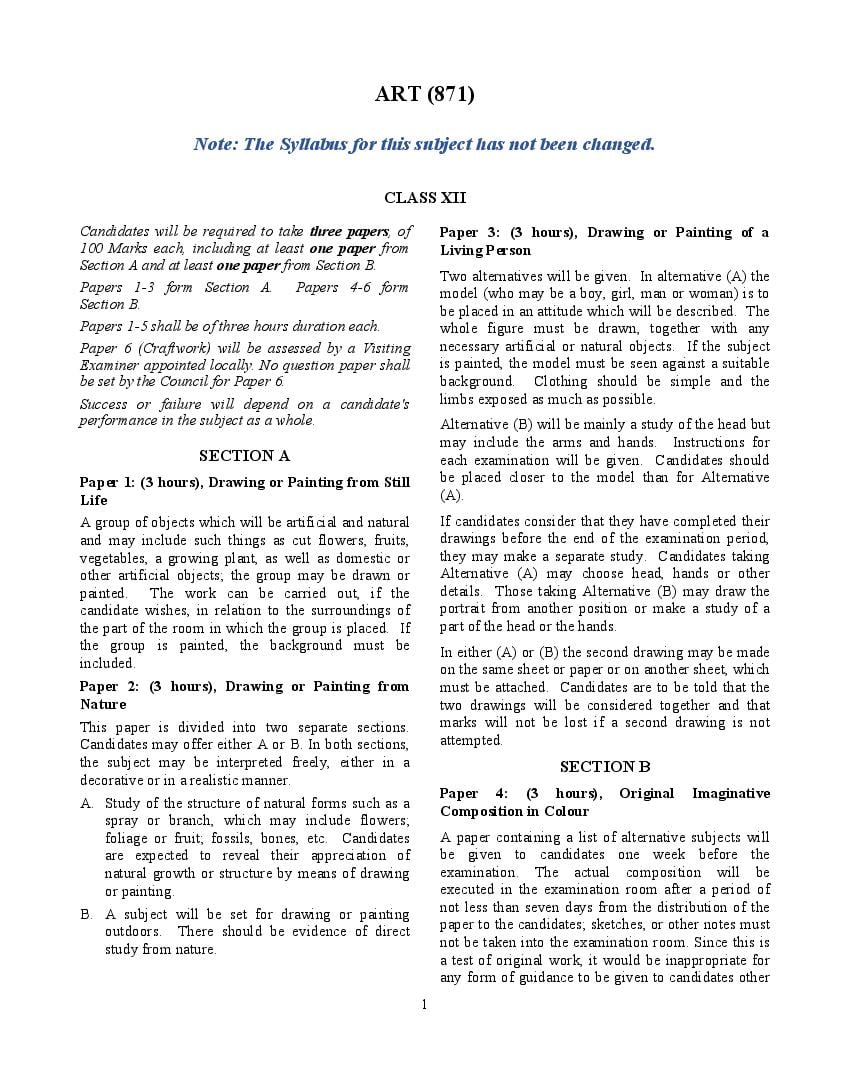
Note: The Syllabus for this subject has not been changed.
CLASS XII
Candidates will be required to take three papers, of Paper 3: (3 hours), Drawing or Painting of a
100 Marks each, including at least one paper from Living Person
Section A and at least one paper from Section B.
Two alternatives will be given. In alternative (A) the
Papers 1-3 form Section A. Papers 4-6 form model (who may be a boy, girl, man or woman) is to
Section B. be placed in an attitude which will be described. The
Papers 1-5 shall be of three hours duration each. whole figure must be drawn, together with any
Paper 6 (Craftwork) will be assessed by a Visiting necessary artificial or natural objects. If the subject
Examiner appointed locally. No question paper shall is painted, the model must be seen against a suitable
be set by the Council for Paper 6. background. Clothing should be simple and the
Success or failure will depend on a candidate's limbs exposed as much as possible.
performance in the subject as a whole. Alternative (B) will be mainly a study of the head but
may include the arms and hands. Instructions for
SECTION A each examination will be given. Candidates should
Paper 1: (3 hours), Drawing or Painting from Still be placed closer to the model than for Alternative
Life (A).
A group of objects which will be artificial and natural If candidates consider that they have completed their
and may include such things as cut flowers, fruits, drawings before the end of the examination period,
vegetables, a growing plant, as well as domestic or they may make a separate study. Candidates taking
other artificial objects; the group may be drawn or Alternative (A) may choose head, hands or other
painted. The work can be carried out, if the details. Those taking Alternative (B) may draw the
candidate wishes, in relation to the surroundings of portrait from another position or make a study of a
the part of the room in which the group is placed. If part of the head or the hands.
the group is painted, the background must be In either (A) or (B) the second drawing may be made
included. on the same sheet or paper or on another sheet, which
Paper 2: (3 hours), Drawing or Painting from must be attached. Candidates are to be told that the
Nature two drawings will be considered together and that
This paper is divided into two separate sections. marks will not be lost if a second drawing is not
Candidates may offer either A or B. In both sections, attempted.
the subject may be interpreted freely, either in a SECTION B
decorative or in a realistic manner.
Paper 4: (3 hours), Original Imaginative
A. Study of the structure of natural forms such as a
Composition in Colour
spray or branch, which may include flowers;
foliage or fruit; fossils, bones, etc. Candidates A paper containing a list of alternative subjects will
are expected to reveal their appreciation of be given to candidates one week before the
natural growth or structure by means of drawing examination. The actual composition will be
or painting. executed in the examination room after a period of
B. A subject will be set for drawing or painting not less than seven days from the distribution of the
outdoors. There should be evidence of direct paper to the candidates; sketches, or other notes must
study from nature. not be taken into the examination room. Since this is
a test of original work, it would be inappropriate for
any form of guidance to be given to candidates other
1
Page 2
themes will be set; these may be given in the form of over 60 cm in any dimension is not acceptable
titles indicating the subjects, or of specified objects because of difficulties in handling.
for inclusion in a composition, or in any other form
(c) Cloth or rug designed and woven by the
that will stimulate the imagination. Candidates should
candidate on the loom for any specified purpose.
base their work if possible on scenes that they have
When possible this should show experience of
themselves observed. Any style, or technique,
spinning and dyeing.
including that which is traditional in the candidates'
own area, may be used. (d) Cotton, wool, silk, bark cloth or other material
dyed in a pattern as in block-printing, screen-
Paper 5: (3 hours), Crafts ‘A’
printing, batik, tie-and dye, etc. The piece should
Candidates will be required to answer any one be at least a square metre in area. Blocks should
question. The object of this paper is to test the not be sent.
ability of candidates in craftwork where the material
(e) Embroidery, mosaic, collage or decorative
is restricted to flat paper, ink and/or colour. Question
panels, unframed, but simply and suitably
will be set requiring the design and execution of the
mounted, showing evidence of ability to relate
following:
design to media.
the page of a book, book cover, or end papers;
(f) Puppet or marionette (including the type used in
a notice or pictorial poster; shadow plays) representing a specified character
or person. It is desirable that the puppets should
a card such as a Christmas card or invitation card
be made in relation to a play, and notes on their
or emblem;
particular dramatic use should be included.
a patterned paper for a specific purpose.
(g) Prints in colour or black and white, from an
Several but not all of these alternative subjects will original wood or lino block or a monotype. The
be set and candidates will be required to select any main work must be clearly labelled and suitably
one of them. There will be an opportunity to make mounted. Blocks need not be sent.
full use of the calligrapher's art with drawn and
(h) Example of a local craft made by the candidate.
painted, pen-made or brush-written lettering.
This should be supported by a second entry
Paper 6: Crafts ‘B’ showing a personal development of this craft.
This Paper is restricted to school candidates. Each candidate must confine his entry to ONE
The candidates must submit at least one and not more craft.
than two examples of Craftwork, which they have The work submitted must be the unaided work of the
executed during the school year in any one craft from candidate. It must be accompanied by a statement
the following eight categories. Further evidence of from the Principal of the school to this effect.
study in the form of working drawings, small
notebook or photographs may also be submitted. GENERAL
(a) Earthenware or stoneware pottery such as a jug, 1. Any medium may be used provided that it is
bowl, dish, vase or hollowed pottery form which suitable for the subject. Painted work must be
the candidate has either moulded, hand built or carried out in a quick-drying medium and must
thrown on the wheel and decorated if he or she so be completely dry before it is dispatched. When
wishes. acrylic paint is used for examination work, it
(b) Abstract or figurative sculpture including reliefs. must be mixed with water. All paints used must
These can be carved, constructed, assembled, cast be of adequate quality: if coloured crayons or
or modelled in any suitable material. chalk are used, they must have a range and
quality comparable with that of paints and must
Candidates must be warned not to submit work in be carefully fixed at the examination centre
material that is likely to break in transit; clay before the work is sent to the Council.
must always be fired and modelling in plaster Monochrome may be used where permitted by
2
Page 3
accepted as satisfying the requirement in respect the drawings.
of colour for Paper 4.
8. Examiners are caused great inconvenience by
2. Candidates must use their judgment with regard candidates failing to write their examination
to (i) the size of a drawing or painting, (ii) the numbers either clearly or correctly, thus making
proportion of height to width within the space identification difficult. Schools are asked to co-
available. In all cases credit will be given for operate by directing the candidates to clearly
good composition. write their Unique Identification Number (UID
Number) and Index Number both, clearly and
3. In each of Papers 1 to 4, the test is one of free
correctly on their examination work and that on
drawing or painting, therefore, any mechanical
drawings and paintings this must be written on
means of execution of the drawing or painting,
the front (top right hand corner) and also on the
(such as measuring or ruling) are not allowed.
back. They must not write anything else on the
Instruments and tracing paper are allowed for
front of the picture. Failure to observe this
Paper 5, but candidates are advised to restrict
instruction may result in loss of marks.
their use as far as possible.
4. Where question or printed instructions are STANDING INSTRUCTIONS FOR
provided for alternative groups, etc., the SUPERVISING EXAMINERS
Supervising Examiner in consultation with an Art
Teacher will decide which of these alternatives is Papers 1-3
to form the subject of the examination, after The printed 'Instructions' for these papers which are
taking account of local convenience, etc. At sent to schools well in advance of the examination
centres for candidates from more than one will be limited as far as possible to the subjects of the
school, both the alternative subjects in Paper 2 tests. They are for the use of the Supervising
(Plant Drawing) must be provided if they are Examiner only, in consultation with the Art Teacher.
required by schools or candidates.
It is important that early attention should be given to
5. Suitable alternative subjects will be provided for the provision of the objects and / or models required.
the different areas, so far as this may appear In papers 1 to 3, both alternatives must be set if
desirable; account will be taken of different required by candidates.
climatic conditions in the selection of flower
specimens, etc. The group or subject should be so arranged that each
candidate obtains an uninterrupted view: for Paper 1
6. The paper supplied for use in the examination candidates should not be more than 3.60 meters from
room will be about 35 cm x 25 cm. Schools or the group. Candidates may form a semicircle but not
candidates wishing to work on a larger scale, not a complete circle round the group; more than one
larger than Half Imperial or Royal (64 cm x 51 session may be arranged if there is a large number of
cm) or on a different type or tone of paper, will candidates. The examination must be held in good
be at liberty to provide their own. Work which is light but care must be taken that sunlight does not fall
carried out on stiff boards or which is mounted upon the group or subject while work is in progress.
cannot be accepted. The paper used by candidates If the group or subject is painted, the background
must not be less than 35 cm x 25 cm and the must be included.
work submitted must fill or approximately fill the
page. The surface on which the group of objects for Paper 1
and the group for painting only in Paper 2 is arranged
7. All drawings must be packed flat and not must be below the eye level of the candidates.
rolled: Half-Imperial and Royal sheets should be
folded across the middle. When drawings are too Drawing or Painting from Still Life
large to enclose in the envelopes provided, it is This is a test of direct observation and free drawing.
essential that the information required on the Both themes as given in the question paper should be
front of the envelope be given and that the set by the art teacher and the candidates should select
the theme they want to attempt. Proper space and
3
Page 4
candidates to draw and colour their desired option.
The Supervising Examiner should avail himself of
In the setting of the objects of the theme, care must the services of the Art Teacher for posing the model
be taken to ensure that each item is visible either and for re-posing after the model has been resting.
fully or partially to all candidates.
Five minutes will be allowed for the model to relax
Care must be taken by the art teacher in selection of after each twenty minutes' posing. During these
the objects. They should not be unnecessarily intervals candidates may continue to work on their
complicated in shape or have complex patterns or drawings. The Supervising Examiners may vary the
labels over and above the basic requirements. length of the posing periods and of the intervals at
their discretion. The period of 2 or 3 hours includes
Drawing or Painting from Nature
the time during which the model is resting.
Alternative A: Study of the structure of natural
Two models must be provided if Alternatives A and
forms
B are required by different candidates at the same
It is desirable that each candidate be given a separate session. If more than one model is employed for
specimen and be permitted to handle and arrange it. either A or B, this should be stated on the answer
If the specimens named in the Instructions are not envelope.
available, Supervising Examiners may, with the The model is to be posed in good light and shade.
assistance of the Art Teacher, substitute other Candidates must be so placed that each has a good
specimens as similar as possible to those, which have view of the pose.
been set. The name of the specimen used must be
Original Imaginative Composition in Colour
stated on the back of the drawing in small block
capitals. Copies of the Paper are to be given to the candidates
at least a week before the paper is taken in the
Sprays, when these are set, must be reasonably large
examination room and candidates should be
and full and in good condition; they should be
instructed to bring their copies of the question paper
displayed in a vase or bottle and be clearly visible
with them at the time fixed for this paper.
against a plain background. The container must not
be drawn. ‘Crafts A’
Alternative B: Drawing or painting outdoors At centres where the necessary arrangements can be
made, candidates may cut and print from a block in
One subject will be set for painting or drawing
the examination room. Folded and cut-out paper may
outdoors. It can include a study of plants, creepers or
be used in making designs. Collage may be used.
climbers growing against walls, pergolas, rockeries
and other such features. Plants grown in pots and Paper 6 (Craftwork)
containers which can be kept indoors can be set.
The specimens of Craftwork should not be dispatched
There should be evidence to understand the general
to the Council. Pieces of pottery, sculpture or
characteristic and growing habit of the subject as it
carving must not exceed 1m in any dimension nor
grows in its natural environment.
weigh more than 18 kg. Craftwork submitted for one
examination must not be submitted for a subsequent
one. This paper is to be assessed by a Visiting
Examiner appointed locally.
4
Document Details
| Board / Org | CISCE |
| Exam | Class 12 |
| Type | Syllabus |
| Pages | 4 |
| Language | english |
| Updated | 22 Jul 2026 |