Goa Board Class 10 Question Paper June 2019 Mathematics English
Finished viewing? Save it for later —
Download Goa Board Class 10 Question Paper June 2019 Mathematics English (PDF · 12 pages)About Goa Board Class 10 Question Paper June 2019 Mathematics English
Goa Board Class 10 Question Paper June 2019 Mathematics English is available here for free download. Published by Goa Board for Class 10, this question paper can be viewed online or downloaded as a PDF (12 pages). Candidates preparing for Class 10 can use Goa Board Class 10 Question Paper June 2019 Mathematics English to understand the exam pattern, the type of questions asked, and the overall difficulty level.
Frequently Asked Questions
How can I download Goa Board Class 10 Question Paper June 2019 Mathematics English?
Open this page and click the Download button to save Goa Board Class 10 Question Paper June 2019 Mathematics English as a PDF. It is completely free on AglaSem Docs.
Is Goa Board Class 10 Question Paper June 2019 Mathematics English free to download?
Yes. Goa Board Class 10 Question Paper June 2019 Mathematics English can be viewed online and downloaded as a PDF free of cost on AglaSem Docs.
How many pages does Goa Board Class 10 Question Paper June 2019 Mathematics English have?
Goa Board Class 10 Question Paper June 2019 Mathematics English contains 12 pages, which you can read online or download together as a single PDF.
Where can I find more Class 10 study material?
You can find more Class 10 question papers, sample papers, syllabus, and answer keys on AglaSem Docs.
Goa Board Class 10 Question Paper June 2019 Mathematics English – Text
Read the full text of this question paper below — useful to quickly search, copy and reference the content online without downloading the PDF.
📄 View text version (12 pages)
Page 1
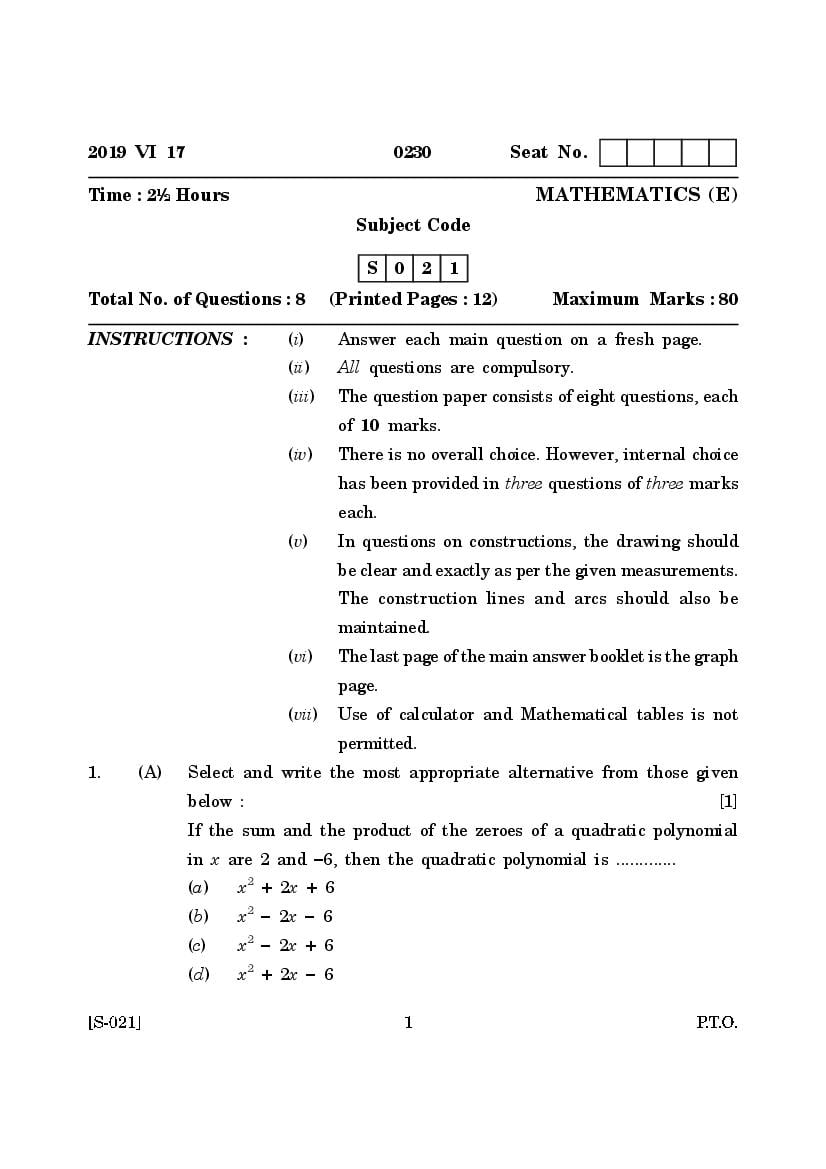
Time : 2½ Hours MATHEMATICS (E)
Subject Code
S 0 2 1
Total No. of Questions : 8 (Printed Pages : 12) Maximum Marks : 80
INSTRUCTIONS : (i) Answer each main question on a fresh page.
(ii) All questions are compulsory.
(iii) The question paper consists of eight questions, each
of 10 marks.
(iv) There is no overall choice. However, internal choice
has been provided in three questions of three marks
each.
(v) In questions on constructions, the drawing should
be clear and exactly as per the given measurements.
The construction lines and arcs should also be
maintained.
(vi) The last page of the main answer booklet is the graph
page.
(vii) Use of calculator and Mathematical tables is not
permitted.
1. (A) Select and write the most appropriate alternative from those given
below : [1]
If the sum and the product of the zeroes of a quadratic polynomial
in x are 2 and –6, then the quadratic polynomial is .............
(a) x2 + 2x + 6
(b) x2 – 2x – 6
(c) x2 – 2x + 6
(d) x2 + 2x – 6
Page 2
(i) The HCF and LCM of the two numbers are 9 and 90 respectively.
If one number is 18, find the other number.
(ii) What is the exponent of 2 in the prime factorisation of 864 ?
(C) Assuming that 5 is an irrational number,
Prove that : 3 5 2 is also an irrational number. [3]
(D) Find the other two zeroes of the polynomial
4 3 2
3x – 23x + 62x – 68x + 24, if two of its zeroes are 2 and 3. [4]
2. (A) Select and write the most appropriate alternative from those given
below : [1]
The pair of linear equations x + 2y = 5 and 3x + ky + 15 = 0 have
no solution. Therefore the value of k is ................
(a) 6
(b) 5
1
(c)
5
1
(d)
6
Page 3
is 7. If 27 is subtracted from the number then its digits are reversed.
Write down two equations in x and y to represent the above
statements. [2]
(C) Find the soluion of ANY ONE of the following pair of linear
equations : [3]
(i) 5x + 8y = 9 and 2x + 3y = 4 (by elimination method)
(ii) 2x + 3y = 17 and 3x – 2y = 6 (by cross multiplication method)
(D) Find the solution of the following pair of linear equations
graphically : [4]
2x – y = 4 and
2y + x = 7
Rewrite and complete the following tables :
2x y 4 2y x 7
x x
y y
(Plot at least 3 points for each line using a graph paper.)
Page 4
below : [1]
A die is thrown once, therefore the probability of getting a number
less than 7 on its top face is ....................
(a) 0
1
(b)
3
1
(c)
2
(d) 1
(B) A bag contains cards which are numbered from 2 to 90. One card is
drawn at random from the bag. Find the probability that it
bears : [2]
(i) a two digit number
(ii) a square number
(C) Find the roots of ANY ONE of the following quadratic equations : [3]
(i) 9x2 – 22x + 8 = 0 (By factorisation method)
(ii) 2x2 + 9x + 5 = 0 (By completing the square method)
Page 5
were found damaged. He sold each of the remaining articles at ` 5 more
than what he paid for it. He got a profit of ` 50 on the whole transaction.
Find the number of articles he bought. [4]
4. (A) Select and write the most appropriate alternative from those given
below : [1]
If the nth term of the AP : 3, 7, 11, 15 ........ is 79, then the value of
n = ............
(a) 10
(b) 15
(c) 20
(d) 25
(B) Find the mode of the following distribution of marks obtained by
80 students in a Mathematics test : [2]
Marks Obtained Number of Students
0—10 6
10—20 8
20—30 12
30—40 32
40—50 22
(Write your answer correct to two places of decimal)
Page 6
with the first installment of ` 1,000. If he increases the installment
by ` 100 every month, find the amount paid by him in 30 installments.
What loan does he still have to pay after the 30th installment ? [3]
(D) The following table shows the daily income of 55 people in a
village : [4]
Daily Income No. of Class Deviation
` (C.I.) People Mark d i = xi – a fi × d i
(fi) (xi)
0—50 5 — — —
50—100 10 — — —
100—150 15 — — —
150—200 12 — — —
200—250 8 — — —
250—300 5 — — —
Total fi = 55 fidi = —
Taking class-mark (denoted by a) of the class interval 100–150 as the
‘‘Assumed mean’’, rewrite and complete the table. Also find the mean
of daily income by the assumed mean method.
(Write your answer correct to one place of decimal)
Page 7
below : [1]
From a point P, 10 cm away from the centre of a circle, a tangent PT
of length 8 cm is drawn. Therefore, the radius of the circle is .............
(a) 4 cm
(b) 5 cm
(c) 6 cm
(d) 7 cm
(B) In the adjoining figure, a circle inscribed in a triangle ABC touches
its sides AB, BC and AC at points D, E and F respectively. If
AB = 12 cm, BC = 8 cm and AC = 10 cm.
Then find the length of AD, BE and CF. [3]
10 cm
8 cm
12 cm
Page 8
distance of 7.5 cm from the centre of the circle. Using a pair of
compasses and ruler construct two tangents PX and PY to the circle.
Measure and state the length of each tangent segment. [3]
(D) Using pair of compasses and ruler, construct PQR with sides
PQ = 6.5 cm, QR = 7 cm and PR = 6 cm. Then construct P QR whose
4
sides are of the corresponding sides of PQR. [3]
3
6. (A) Select and write the most appropriate alternative from those given
below : [1]
1 1
If sin (A – B) = and cos (A + B) = , then A and B are
2 2
respectively .....................
(a) 45°, 15° (b) 15°, 45° (c) 30°, 60° (d) 60°, 30°
(B) Attempt ANY ONE of the following : [3]
5
(i) In ABC, B = 90° and tan C = .
12
cos C + sin C
Find the value of : .
sin C
Page 9
of trigonometric ratios :
cos 30 sin 60 .
1 cos 60 sin 30
(C) Prove the following identity : [2]
2 sin 2 2 sin 4
sec 1.
2 cos4 cos2
(D) Attempt the following :
(i) Find the distance between the points A(–3, –14) and B(3, –6). [2]
(ii) Find the value of m if the points D(3, 7), E(–1, 2) and F(–5, m)
are collinear. [2]
7. (A) Select and write the most appropriate alternative from those given
below : [1]
2 2
ABC ~ DEF and their areas are 64 cm and 49 cm respectively.
If AB = 5.6 cm then DE = ...............
(a) 63 cm (b) 49 cm (c) 6.3 cm (d) 4.9 cm
(B) Given : In ABC, DE BC where the points D and E lie on AB and
AC respectively, EM AB and DN AC : [3]
AD AE
Prove that : =
DB EC
Page 10
is perpendicular to the sides AB and CD. P is the point of intersection
of the two diagonals. Prove that : [3]
3AB2 AC2 BC2
(D)
A boy standing on a horizontal plane at B, watches the top of the flag
post ‘PR’ at a distance of 100 m from him at an angle of elevation
of 30° as shown in the figure. A girl standing at G on the roof of
20 m high building ‘GH’, finds the angle of elevation of the top of the
same flag post to be 45°. Both the boy and the girl are on the opposite
sides of the flag post. Find the distance of the top of the flat post from
the girl. (Take 2 1.41 ) [3]
Page 11
below : [2]
(i) The area of a ring whose outer and inner radii are 5 cm and
2 cm respectively is .............
(a) 3 cm2
2
(b) 7 cm
(c) 21 cm2
(d) 66 cm2
(ii) In a circle of a radius 12 cm, an arc subtends an angle of 60°
at the centre. Therefore, the length of the arc is ..............
(a) 2 cm
(b) 4 cm
(c) 12 cm
(d) 24 cm
(B) A metal cup is in the form of a frustum of a cone whose radii of bottom
and top are 7 cm and 14 cm respectively, as shown in the figure. If
the capacity of the cup is 2156 cm3, find the height of the cup.
22
(Use ) [2]
7
14 cm
h
7 cm
Page 12
AB = 8 cm and CB = 6 cm. With AC as a diameter a semicircle is
drawn and with BC as radius a quadrant of a circle is drawn, as shown
in the figure. Find the area of the shaded region. (Use = 3.14) [3]
(D) A house has an overhead cylindrical tank which is filled by pumping
water from an underground cuboidal tank. The dimensions of the cuboidal
tank are 2.5 m × 2 m × 1.5 m and it is completely filled with water.
The overhead tank which is empty, has a height of 2 m with radius
of its base as 70 cm. If water is pumped to fill the overhead tank
completely with water, find the height of the water left in the cuboidal
22
tank. (Use ) [3]
7
Document Details
| Board / Org | Goa Board |
| Exam | Class 10 |
| Type | Question Paper |
| Pages | 12 |
| Updated | 22 Jul 2026 |