TAPAS Entrance Exam Syllabus 2025-26
Finished viewing? Save it for later —
Download TAPAS Entrance Exam Syllabus 2025-26 (PDF · 4 pages)About TAPAS Entrance Exam Syllabus 2025-26
TAPAS Entrance Exam Syllabus 2025-26 is available here for free download. Published by Rashtrotthana Parishat for TAPAS, this syllabus can be viewed online or downloaded as a PDF (4 pages). Candidates preparing for TAPAS can use TAPAS Entrance Exam Syllabus 2025-26 to understand the exam pattern, the type of questions asked, and the overall difficulty level.
Frequently Asked Questions
How can I download TAPAS Entrance Exam Syllabus 2025-26?
Open this page and click the Download button to save TAPAS Entrance Exam Syllabus 2025-26 as a PDF. It is completely free on AglaSem Docs.
Is TAPAS Entrance Exam Syllabus 2025-26 free to download?
Yes. TAPAS Entrance Exam Syllabus 2025-26 can be viewed online and downloaded as a PDF free of cost on AglaSem Docs.
How many pages does TAPAS Entrance Exam Syllabus 2025-26 have?
TAPAS Entrance Exam Syllabus 2025-26 contains 4 pages, which you can read online or download together as a single PDF.
Where can I find more TAPAS study material?
You can find more TAPAS question papers, sample papers, syllabus, and answer keys on AglaSem Docs.
TAPAS Entrance Exam Syllabus 2025-26 – Text
Read the full text of this syllabus below — useful to quickly search, copy and reference the content online without downloading the PDF.
📄 View text version (5 pages)
Page 1
TAPAS Entrance Exam
Syllabus 2025-26
EXAM YEAR TYPE
TAPAS 2025 Syllabus
Notes · Sample Papers · Previous Year Papers · Mock Tests
Page 2
. e
em las
as ag
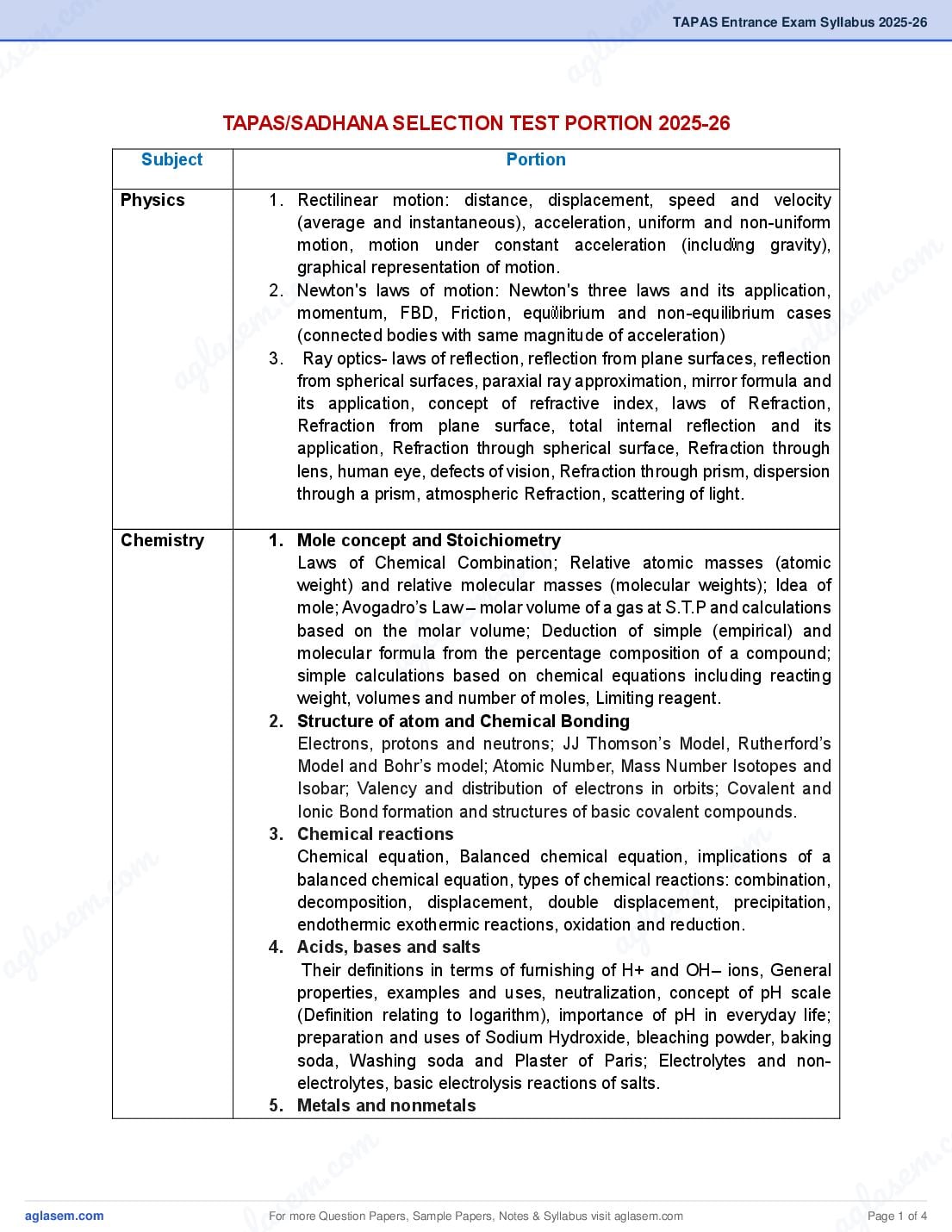
TAPAS/SADHANA SELECTION TEST PORTION 2025-26
Subject Portion
Physics 1. Rectilinear motion: distance, displacement, speed and velocity
(average and instantaneous), acceleration, uniform and non-uniform
m
co
motion, motion under constant acceleration (including gravity),
om .
graphical representation of motion.
.c e m
s
2. Newton's laws of motion: Newton's three laws and its application,
e m momentum, FBD, Friction, equilibrium and non-equilibrium cases
l a
l a s (connected bodies with same magnitude of acceleration)
a g
ag
3. Ray optics- laws of reflection, reflection from plane surfaces, reflection
from spherical surfaces, paraxial ray approximation, mirror formula and
its application, concept of refractive index, laws of Refraction,
Refraction from plane surface, total internal reflection and its
application, Refraction through spherical surface, Refraction through
lens, human eye, defects of vision, Refraction through prism, dispersion
through a prism, atmospheric Refraction, scattering of light.
m
Chemistry 1. Mole concept and Stoichiometry
. co
Laws of Chemical Combination; Relative atomic masses (atomic
em
weight) and relative molecular masses (molecular weights); Idea of
a s
mole; Avogadro’s Law – molar volume of a gas at S.T.P and calculations
g l
based on the molar volume; Deduction of simple (empirical) and
a
molecular formula from the percentage composition of a compound;
simple calculations based on chemical equations including reacting
weight, volumes and number of moles, Limiting reagent.
2. Structure of atom and Chemical Bonding
Electrons, protons and neutrons; JJ Thomson’s Model, Rutherford’s
Model and Bohr’s model; Atomic Number, Mass Number Isotopes and
Isobar; Valency and distribution of electrons in orbits; Covalent and
Ionic Bond formation and structures of basic covalent compounds.
m
c. o
3. Chemical reactions
m
c. o
Chemical equation, Balanced chemical equation, implications of a
e m
s
balanced chemical equation, types of chemical reactions: combination,
em la
decomposition, displacement, double displacement, precipitation,
las endothermic exothermic reactions, oxidation and reduction.
ag
ag 4. Acids, bases and salts
Their definitions in terms of furnishing of H+ and OH– ions, General
properties, examples and uses, neutralization, concept of pH scale
(Definition relating to logarithm), importance of pH in everyday life;
preparation and uses of Sodium Hydroxide, bleaching powder, baking
soda, Washing soda and Plaster of Paris; Electrolytes and non-
electrolytes, basic electrolysis reactions of salts.
5. Metals and nonmetals
m . c
c. o s e m
m a
se
For more Question Papers, Sample Papers, Notes & Syllabus visit
g lPage 1 of 4
Page 3
series and its application; Formation and properties of ionic
compounds; Basic metallurgical processes; Corrosion and its
prevention.
Mathematics 1. REAL NUMBERS:
Fundamental Theorem of Arithmetic - statements after reviewing work
done earlier and after illustrating and motivating through examples,
Proofs of irrationality of sqrt 2 etc
2. POLYNOMIALS:
Zeros of a polynomial. Relationship between zeros and coefficients of
quadratic polynomials
3. PAIR OF LINEAR EQUATIONS IN TWO VARIABLES:
Pair of linear equations in two variables and graphical method of their
solution, consistency/inconsistency. Algebraic conditions for number of
solutions. Solution of a pair of linear equations in two variables
algebraically - by substitution, by elimination. Situational problems.
4. COORDINATE GEOMETRY:
Concepts of coordinate geometry, graphs of linear equations. Distance
formula. Section formula (internal division).
5. TRIANGLES:
Definitions, examples, counter examples of similar triangles.
Properties of similar triangles.
6. INTRODUCTION TO TRIGONOMETRY:
Trigonometric ratios of an acute angle of a right-angled triangle. Proof
of their existence (well defined); Values of the trigonometric ratios of
30, 45 and 60 degrees etc. Relationships between the ratios.
TRIGONOMETRIC IDENTITIES Proof and applications
7. HEIGHTS AND DISTANCES:
Angle of elevation, Angle of Depression. Simple problems on heights
and distances.
8. AREAS RELATED TO CIRCLES:
For more Question Papers, Sample Papers, Notes & Syllabus visit Page 2 of 4
Page 4
. e
em las
as ag
Area of sectors and segments of a circle. Problems based on areas
and perimeter / circumference of the above said plane figures. (In
calculating area of segment of a circle, problems should be restricted
to central angle of 60°, 90° and 120° only.
9. STATISTICS:
o m
m . c
Mean, median and mode of grouped data
.c o process: e m
em organisms, nutrition in Human beings, Human alimentary canal. gla s
Biology 1. Life
s
• Nutrition: Autotrophic and heterotrophic nutrition, Nutrition in
g la • Respiration: Aerobic and anaerobic respiration, Breakdown of glucose,a
a ATP, Human respiratory system, Haemoglobin.
• Transportation: Transportation in Human beings, the Heart, Blood,
Double circulation, Blood pressure, blood vessels, platelets, lymph,
Transportation in plants, transport of water, transpiration, transport of
food and other substance, translocation.
• Excretion: Excretion in Human beings, excretory system in Human
beings, structure of nephron, artificial kidney (Haemodialysis),
m
co
Excretion in plants.
.
em
2. Control and Coordination:
a s
• Coordination in animals: Animal nervous system, Structure of neuron,
l
g
neuromuscular junction, reflex action, reflex arc, Human brain, Bony
a
box, vertebral column, nervous tissue.
• Coordination in plants, response to stimuli in plants, movements due to
growth, geotropism, response of plant to the direction of light.
• Hormones in animals, endocrine glands.
3. The Fundamental unit of life:
• Cells, various kinds of cells, compound microscope.
• Composition of cell and structural organization of a cell: Plasma
m
c. o
membrane/cell membrane, cell wall, nucleus, cytoplasm, Prokaryotic
m
c. o
cell and eukaryotic cell, Cell organelles (Endoplasmic reticulum, Golgi
e m
s
apparatus, lysosomes, mitochondria, plastids, vacuoles).
s em la
• Animal cell and plant cell.
la ag
• Cell division: Mitosis and Meiosis.
ag 4. Tissue:
• Plant tissue: Meristematic tissue, Permanent tissue (simple permanent
and complex permanent), section of stem, various types of simple
tissues (parenchyma, Collenchyma, sclerenchyma), types of complex
tissue (tracheid, vessels, xylem parenchyma, phloem), guard cells and
epidermal cells.
m . c
c. o s e m
m a
se
For more Question Papers, Sample Papers, Notes & Syllabus visit
g l
Page 3 of 4
Page 5
(Squamous, stratified squamous, cuboidal, columnar), Connective
tissue, Types of connective tissues ( Types of blood cells, Compact
bone, Hyaline cartilage, Areolar tissue, adipose tissue), Muscular
tissue, types of muscle fibres (striated muscle, smooth muscle, cardiac
muscle), Nervous tissue, neuron unit of nervous tissue.
For more Question Papers, Sample Papers, Notes & Syllabus visit Page 4 of 4
Document Details
| Board / Org | Rashtrotthana Parishat |
| Exam | TAPAS |
| Type | Syllabus |
| Pages | 4 |
| Language | english |
| Updated | 31 Oct 2026 |