TAPAS Entrance Exam Sample Questions 2026-27
Finished viewing? Save it for later —
Download TAPAS Entrance Exam Sample Questions 2026-27 (PDF · 22 pages)About TAPAS Entrance Exam Sample Questions 2026-27
TAPAS Entrance Exam Sample Questions 2026-27 is available here for free download. Published by Rashtrotthana Parishat for TAPAS, this sample paper can be viewed online or downloaded as a PDF (22 pages). Candidates preparing for TAPAS can use TAPAS Entrance Exam Sample Questions 2026-27 to understand the exam pattern, the type of questions asked, and the overall difficulty level.
Frequently Asked Questions
How can I download TAPAS Entrance Exam Sample Questions 2026-27?
Open this page and click the Download button to save TAPAS Entrance Exam Sample Questions 2026-27 as a PDF. It is completely free on AglaSem Docs.
Is TAPAS Entrance Exam Sample Questions 2026-27 free to download?
Yes. TAPAS Entrance Exam Sample Questions 2026-27 can be viewed online and downloaded as a PDF free of cost on AglaSem Docs.
How many pages does TAPAS Entrance Exam Sample Questions 2026-27 have?
TAPAS Entrance Exam Sample Questions 2026-27 contains 22 pages, which you can read online or download together as a single PDF.
Where can I find more TAPAS study material?
You can find more TAPAS question papers, sample papers, syllabus, and answer keys on AglaSem Docs.
TAPAS Entrance Exam Sample Questions 2026-27 – Text
Read the full text of this sample paper below — useful to quickly search, copy and reference the content online without downloading the PDF.
📄 View text version (23 pages)
Page 1
TAPAS Entrance Exam
Sample Questions
2026-27
EXAM YEAR TYPE
TAPAS 2026 Sample Paper
Notes · Sample Papers · Previous Year Papers · Mock Tests
Page 2
m .co
c. o
e m
em l a s
s a g
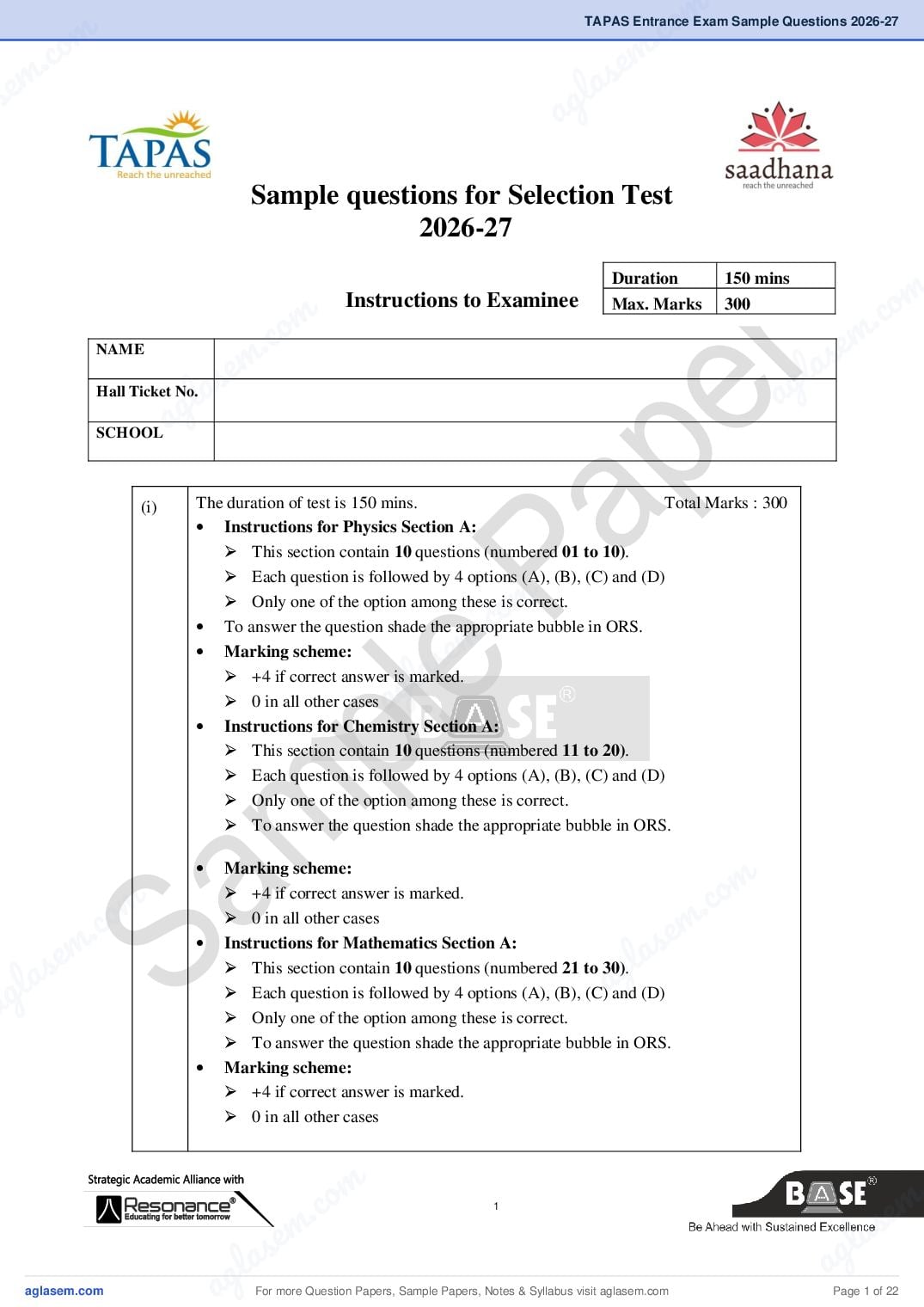
Sample questions for Selection Test
2026-27
m
c. o
Duration 150 mins
m
co
Instructions to Examinee Max. Marks 300
. em
em l a s
s
NAME
g l a ag
SCHOOL a
Hall Ticket No.
(i) The duration of test is 150 mins. Total Marks : 300
• Instructions for Physics Section A:
➢ This section contain 10 questions (numbered 01 to 10).
m
➢ Each question is followed by 4 options (A), (B), (C) and (D)
. co
➢ Only one of the option among these is correct.
em
• To answer the question shade the appropriate bubble in ORS.
• Marking scheme:
l a s
a g
➢ +4 if correct answer is marked.
➢ 0 in all other cases
• Instructions for Chemistry Section A:
➢ This section contain 10 questions (numbered 11 to 20).
➢ Each question is followed by 4 options (A), (B), (C) and (D)
➢ Only one of the option among these is correct.
➢ To answer the question shade the appropriate bubble in ORS.
m
co
• Marking scheme:
m .
c. o
➢ +4 if correct answer is marked.
m
se
➢ 0 in all other cases
s em la
•
g
Instructions for Mathematics Section A:
la a
➢ This section contain 10 questions (numbered 21 to 30).
ag ➢ Each question is followed by 4 options (A), (B), (C) and (D)
➢ Only one of the option among these is correct.
➢ To answer the question shade the appropriate bubble in ORS.
• Marking scheme:
➢ +4 if correct answer is marked.
➢ 0 in all other cases
m .
.co s e m
e m a
1
a s g l
l a
ag For more Question Papers, Sample Papers, Notes & Syllabus visit Page 1 of 22
Page 3
• Instructions for questions numbered 31 to 42
➢ This section contain 12 questions (numbered 31 to 42).
➢ Each question is followed by 4 options (A), (B), (C) and (D)
➢ Only one of the option among these is correct.
➢ To answer the question shade the appropriate bubble in ORS.
➢
• Instructions for questions numbered 43 to 45
➢ This section contain linked comprehension questions (numbered 43 to 45)
➢ A passage is given which is followed by three questions
➢ Corresponding to each question, there are 4 options (A), (B), (C) and (D)
➢ Only one of the option among these is correct.
➢ To answer the question shade the appropriate bubble in ORS.
• Marking scheme:
➢ +4 if correct answer is marked.
➢ 0 in all other cases
• Instructions for Section B:
• Instructions for Quantitative Aptitude
➢ This section contain 15 questions (numbered 46 to 60).
➢ These questions are based on quantitative aptitude.
➢ Answer to each question is an integer between 000 to 999 (both values
inclusive).
➢ To answer the question, shade the appropriate bubble in ORS (optical response
sheet).
• Marking scheme:
➢ +4 if correct answer is marked.
➢ 0 in all other cases.
• Instructions for Physics Section B:
➢ This section contain 5 questions (numbered 61 to 65 )
➢ Answer to each question is an integer between 000 to 999 (both values
inclusive).
➢ To answer the question, shade the appropriate bubble in ORS
• Marking scheme:
➢ +4 if correct answer is marked.
➢ 0 in all other cases
• Instructions for Chemistry Section B:
➢ This section contain 5 questions (numbered 66 to 70)
➢ Answer to each question is an integer between 000 to 999 (both values
inclusive).
➢ To answer the question, shade the appropriate bubble in ORS
2
For more Question Papers, Sample Papers, Notes & Syllabus visit Page 2 of 22
Page 4
m .co
c. o
e m
em l a s
s a g
• Marking scheme:
➢ +4 if correct answer is marked.
➢ 0 in all other cases
• Instructions for Mathematics Section B:
➢ This section contain 5 questions (numbered 71 to 75)
m
➢ Answer to each question is an integer between 000 to 999 (both values
m c. o
co
inclusive).
.
➢ To answer the question, shade the appropriate bubble in ORS
e m
m
e scheme: l a s
a s
l ➢ +4 if correct answer is marked.
• Marking
ag
g
a ➢ 0 in all other cases
➢ 0 in all other cases
Instructions for filling the ORS (OPTICAL RESPONSE SHEET):
1. Write your name and register number with black ball point pen in the response
sheet and darken the appropriate circle under each alphabet/digit.
o m
2. While marking your answers in the ORS, darken the circle/s (in full) as shown in
c
. WRONG
the example below using Black ball point pen.
e m
s
WRONG WRONG CORRECT
xA B C
✓ D
g l a
A B C D A B C D B C D
3. Folding of ORS, straya markings on the ORS will lead to rejection during
evaluation.
Space for rough work is provided in the question paper booklet.
m
m .co
c. o se
m
s em g la
gla a
a
m .
.co s e m
e m a
3
a s g l
l a
ag For more Question Papers, Sample Papers, Notes & Syllabus visit Page 3 of 22
Page 5
PHYSICS
Multiple choice questions with one correct alternative
1. A cut diamond sparkles because of its
(A) Hardness (B) High refractive index
(C) Emission of light by the diamond (D) Absorption of light by the diamond
Ans (B)
Due to high refractive index its critical angle is very small so that most of the light incident on the
diamond is total internally reflected repeatedly and diamond sparkles.
2
2. A transparent solid cylindrical rod has a refractive index of . It is surrounded by air. A light ray is
3
incident at the mid-point of one end of the rod as shown in the figure. The incident angle for which the
light ray grazes along the wall of the rod is
1 3
(A) sin −1 (B) sin −1
2 2
2 1
(C) sin −1 (D) sin −1
3 3
Ans (D)
sin
At interface 1 : = sin = sin r … (1)
sin r
At interface 2 : (90 − r) = C sin(90 − r) = sin C
1 1
cos r = sin C =
1
cor = = 3 / 2 r = 30
2/ 3
2 1
From eqn. (1), sin = sin 30 =
3 3
1
= sin −1
3
3. If aperture of lens is halved then effect on image will be
(A) no effect on size (B) intensity of image decreases
(C) both (A) and (B) (D) none of (A), (B) and (C)
Ans (C)
Since intensity (Aperture), so intensity of image will decrease but no change in the size occurs.
4. A particle is moving with a constant speed along a straight line path. A force is not required to
(A) Increase its speed (B) Decrease the momentum
(C) Change the direction (D) Keep it moving with uniform velocity
Ans (D)
Particle will move with uniform velocity due to inertia.
4
For more Question Papers, Sample Papers, Notes & Syllabus visit Page 4 of 22
Page 6
m .co
c. o
e m
em l a s
s a g
5. A person sitting in an open car moving at constant velocity throws a ball vertically up into air. The ball
falls
(A) Outside the car (B) In the car ahead of the person
(C) In the car to the side of the person (D) Exactly in the hand which threw it up
Ans (D)
Horizontal velocity of ball and person are same so both will cover equal horizontal distance in a given
m
c. o
interval of time and after following the parabolic path the ball falls exactly in the hand which threw it up.
m
co m
6. A reference frame attached to the earth
m .
(A) Is an inertial frame by definition
s e
s e l a
ag
(B) Cannot be an inertial frame because earth is revolving round the sun
l a
ag
(C) Is an inertial frame because Newton’s laws are applicable
(D) Is an inertial frame because the earth is rotating about its own axis
Ans (B)
The frame of reference which are at rest or in uniform motion are called inertial frames while frames
which are accelerated with respect to each other are non-inertial frames. Spinning or rotating frames are
accelerated frames, hence these are non-inertial frames.
7. A ball is dropped vertically from a height d above the ground. It hits the ground and bounces up
d
m
vertically to a height . Neglecting subsequent motion and air resistance, its velocity v varies with the
co
2
.
height h above the ground as
s em
g l a
(A) (B)
a (C) (D)
Ans (A)
The graph between h and v is the parabola. Taking upward direction as positive, we find that at h = d,
velocity is zero. Then its – VE magnitude increases. At h = 0, the velocity is magnitude increases. At
d
h = 0, the velocity is reversed and then goes on decreasing to zero at h = .
m
2
m .co
c. o
8. If a body loses half of its velocity on penetrating 3 cm in a wooden block, then how much will it
m
se
penetrate more before coming to rest?
s em g la
(A) 1 cm (B) 2 cm (C) 3 cm (D) 4 cm
gla a
Ans (A)
a
We know, v2 – u2 = 2ax
u
substituting, v = , x = 3 cm, a = – a (retardation)
2
2
u u2
We, find − u 2 = −2a 3 that is, a =
2 8
Now, for the calculation of total distance penetrated, we have
v2 – u2 = 2ax – u2 = – 2ax (because final velocity v = 0)
m .
.co s e m
e m a
5
a s g l
l a
ag For more Question Papers, Sample Papers, Notes & Syllabus visit Page 5 of 22
Page 7
x =
2a
u2 u2
Substituting a = (calculated above), we get x = = 4 cm
g u2
2
8
Hence, remaining distance penetrated by the body before coming to rest = (x – x) = (4 – 3) cm = 1 cm
9. A person slides freely down a frictionless inclined plane while his bag falls down vertically from the
same height. The final speeds of the man (VM) and the bag (VB) should be such that
(A) VM < VB (B) VM = VB
(C) they depend on the masses (D) VM > VB
Ans (B)
v bottom = 2 gh
It depends on height and not the length of the inclined plane.
10. Which of the following statements for an object in equilibrium is not true?
(A) The object must be at rest (B) The object can be at rest
(C) The object may be moving at constant speed (D) The acceleration of the object is zero
Ans (A)
In the state of equilibrium, the object may be at rest or in motion with uniform velocity.
CHEMISTRY
Multiple choice questions with one correct alternative
11. An element X on exposure to moist air turns reddish-brown and a new compound Y is formed. The
substance X and Y are
(A) X = Fe, Y = Fe2O3 (B) X = Ag, Y = Ag2S
(C) X = Cu, Y = CuO (D) X = Al, Y = Al2O3
Ans (A)
12. During the formation of sodium chloride from its constituents
(A) Na undergoes oxidation and acts as an oxidizing agent
(B) Na undergoes reduction and Cl undergoes oxidation
(C) Cl undergoes reduction and acts as a reducing agent
(D) Na acts as a reducing agent and Cl acts as an oxidizing agent
Ans (D)
During the formation of NaCl, Na undergoes oxidation and Cl undergoes reduction. Hence, Na is the
reducing agent and Cl is the oxidizing agent.
6
For more Question Papers, Sample Papers, Notes & Syllabus visit Page 6 of 22
Page 8
m .co
c. o
e m
em l a s
s a g
13. Which one of the following constitutes a group of the isoelectronic species?
(A) C22− ,O2− ,CO, NO (B) NO+ ,C22− ,CN− , N2
(C) CN− , N2 ,O22− ,C22− (D) N2 ,O−2 , NO+ ,CO
Ans (B)
Species having same number of electrons are iso-electronic calculating the number of electrons in each
species given here, we get.
m
CN−(6 + 7 + 1 = 14); N2 (7 + 7 = 14)
m c. o
O22− (8 + 8 + 2 = 18); C22− (6 + 6 + 2 = 14) O−2 (8 + 8 + 1= 17); NO+(7 + 8 −1 = 14)
.co
CO(6 + 8 = 14); NO (7 + 8 = 15)
s e m
e m l a
s
From the above calculation we find that all the species listed in choice (B) have 14 electrons each so it is
g a
lpH of acid rain? ag
the correct answer.
a
14. What is the
(A) around 5.6 (B) around 4.3 (C) around 6.5 (D) around 3.4
Ans (A)
15. Match the following
Natural Source Acid
(i) Orange (P) Tartaric acid
m
(ii) Tamarind (Q) Citric acid
. co
(iii) Tomato (R) Lactic acid
em
(iv) Curd (S) Oxalic acid
(A) (i) → (P); (ii) → (Q); (iii) → (R); (iv) → (S)
l a s
g
(B) (i) → (Q); (ii) → (P); (iii) → (S); (iv) → (R)
a
(C) (i) → (Q); (ii) → (S); (iii) → (P); (iv) → (R)
(D) (i) → (R); (ii) → (S); (iii) → (P); (iv) → (Q)
Ans (B)
16. A colourless solution of a compound gives a precipitate with AgNO3 solution but no precipitate with a
solution of Na2CO3. The action of concentrated H2SO4 on the compound liberates a suffocating reddish
brown gas. The compound is
m
(A) Ba(CH3COO)2 (B) CaBr2 (C) NaI (D) NaBr
m .co
Ans (D)
c. o se
m
Ag+ + Br− → AgBr (pale yellow); NaBr + Na2CO3 → No reaction
em17. Calculate the average atomic mass of carbon from the following la
2NaBr + 2H2SO4 → Br2 (reddish brown) + SO2 + SO24− + 2Na+ + 2H2O
las a g
ag Isotope
C 12
Relative abundance (%) Atomic mass (amu)
98.892 12
13
C 1.108 13.00335
14
C 2 10−10 14.00317
(A) 12.2 (B) 12.02 (C) 12.011 (D) 12.1
Ans (C)
m .
.co s e m
e m a
7
a s g l
l a
ag For more Question Papers, Sample Papers, Notes & Syllabus visit Page 7 of 22
Page 9
(A) 2.20 g (B) 1.11 g (C) 0.82 g (D) 0.55 g
Ans (D)
0.56
= 0.025 mol
22.4
0.0125 mol of CH4 = 0.2 g
0.0125 mol of C2H4 = 0.35 g
Mass of the mixture = 0.55 g
19. Sting of ants/bees containing can be neutralised by rubbing
(A) soap (B) acetic acid (C) alcohol (D) common salt
Ans (A)
Soap contains sodium hydroxide which neutralises the formic acid in the Sting.
20. When iron nail is dipped in CuSO4 solution the blue colour of the solution fades. This is an example of
(A) Displacement reaction (B) Double displacement reaction
(C) Oxidation reaction (D) Decomposition reaction
Ans (A)
MATHEMATICS
Multiple choice questions with one correct alternative
21. If a2 + b2 = 1, x2 +y2 =1 and c2 +z2 =1. Then the maximum value of ax + by + cz is
3 1 3 4
(A) (B) (C) (D)
2 3 4 3
Ans (A)
(a – x)2 + (b – y)2 + (c – z)2 0
a 2 + x 2 + b2 + c2 + y2 + z2 2(ax + by + cz)
3
ax + by + cz
2
22. If , be the roots of the equation (x – a)(x – b) = c, c 0, then the roots of the equation
(x − ) (x − ) + c = 0 are
(A) a, b (B) a, c (C) b, c (D) a + c, b + c
Ans (A)
(x – a) (x – b) = c
x 2 − (a + b)x + ab − c = 0
+ = a + b, = ab – c
Consider (x – )(x – ) + c = 0
x 2 − ( +)x + + c = 0
x 2 − (a + b)x + ab − c + c = 0 ( x − a )( x − b ) = 0
roots are a, b.
23. If n +1 = 20102 + 20112, then find the value of 2n + 1 .
(A) 2010 (B) 2011 (C) 4021 (D) 4019
8
For more Question Papers, Sample Papers, Notes & Syllabus visit Page 8 of 22
Page 10
m .co
c. o
e m
em l a s
s a g
Ans (C)
n + 1 = 20102 + 20112
n = 20102 + (20112 − 1)
= 20102 + 2010 2012
= 2 2010 2011
2n + 1 = 20102 + 20112 + 2 2010 2011
m
= (2010 + 2011)2
m c. o
2n + 1 = 4021
.co 10
s e m
em a
24. The sum of a number and its reciprocal is . Find the number.
s l
ag
3
l a
1 1 1
g
(A) 3 (B) (C) (D) 3 or
Ans (D)a
3 9 3
Let number be x
1 10
x + = 3x 2 − 10x + 3 = 0
x 3
1
(x − 3)(3x − 1) = 0 x = 3 or
3
25. If A(−2, 4), B(0, 0), C(4, 2) are vertices of ABC, then the length of the median through vertex A is
m
. co
(A) 5 units (B) 6 units (C) 7 units (D) 9 units
em
Ans (A)
s
A
0+4 0+2
l a
D= , = (2, 1)
AD = (2 + 2) + (1 − 4) = 4 + 3 = 5ag
2 2
2 2 2 2
B C
D
26. 5 years hence, the age of a man shall be 3 times the age of his son, while 5 years earlier the age of man
was 7 times the age of his son. The present age of the man is
(A) 45 years (B) 50 years (C) 47 years (D) 40 years
Ans (D)
Let present ages of man and his son respectively be x, y
m
So (x + 5) = 3(y + 5) and (x − 5) = 7(y − 5)
m .co
x − 3y = 10 … (1)
c. o se
m
x − 7y = −30 … (2)
em l a
(2) − (1) −4y = −40 y = 10
s g
la 27. In the given figure, O is centre of a circle, AOC is its diameter suchathat ACB = 50 . If AT is the
So, x = 40
ag tangent to the circle at point A. Then BAT is C
(A) 40
O B
(B) 50
(C) 60
(D) 65 A T
Ans (B)
m .
.co s e m
e m a
9
a s g l
l a
ag For more Question Papers, Sample Papers, Notes & Syllabus visit Page 9 of 22
Page 11
BAC = 40
Now BAT = 90 − 40 = 50
28. P is a point inside ABC. If PBA = 20, BAC = 50 and PCA = 35, then the measure of BPC is
(A) 65
(B) 75
(C) 90
(D) 105
Ans (D)
In APB, APB = 180 − a − 20
In APC, APC = 180 − b − 35
APB + APC = 360 − (a + b) − 55 = 360 − 50 − 55 = 360 − 105 = 255
Required BPC = 360 − 255 = 105 .
29. Four times the sum of digits of a two digit number is equal to the number itself. If the digit in its unit
place is a perfect square, then the digit in its ten’s place is
(A) 8 (B) 6 (C) 4 (D) 2
Ans (D)
Let the two digit number be xy.
Given, 10x + y 4(x + y) = 10x + y
4x + 4y = 10x + y 3y = 6x y = 2x
Given y is a perfect square
Single digit perfect squares are 1, 4 and 9, we have y = 2x [x = 1, 9 does not satisfy the equations]
4 = 2x x = 2.
1
30. X takes 3 hours more than Y to walk 30 km. But, if X doubles his pace, he is ahead of Y by 1 hours.
2
Find the speed of Y in km h−1.
(A) 5 (B) 10 (C) 15 (D) 20
Ans (A)
Let the speed of X and Y be x kmh −1 and y kmh −1 respectively. Then,
30 30
Time taken by X to cover 30 km = hrs and time taken by Y to cover 30 km = hrs
x y
By the given conditions, we have
30 30 10 10
− = 3 − =1
x y x y
If X doubles his pace, then speed of X is 2x kmh −1 … (i)
30
Times taken by X to cover 30 km = hrs
2x
30
Times taken by Y to cover 30 km = hrs
y
According to the given conditions, we have
10
For more Question Papers, Sample Papers, Notes & Syllabus visit Page 10 of 22
Page 12
m .co
c. o
e m
em l a s
s 30 30 1 30 30 3 10 5 1 a g
− =1 − = − =
y 2x 2 y 2x 2 y x 2
10 20
− + =1
x y … (ii)
1 1
Putting = u and = , in equations (i) and (ii) we get
x y
m
10u − 10 = 1 10u − 10 − 1 = 0 … (iii)
m c. o
−10u + 20 = 1 − 10u + 20 − 1 = 0 … (iv)
.co e m
1
s
Adding equations (iii) and (iv), we get 10v − 2 = 0 v =
e m l a
5
1
l a s
Putting = in equation (iii), we get 10u − 3 = 0 u =
3
ag
ag
5 10
3 1 3 10 1 1 1
Now, u = = x = and = = y = 5
10 x 10 3 5 y 5
10
Hence, X's speed = km h −1 and Y's speed = 5 kmh −1
3
BIOLOGY
Multiple choice questions with one correct alternative
m
. co
31. Storage, photosynthesis, buoyancy are the functions respectively exhibited in which of the following set
em
of tissues
a s
(A) Chlorenchyma, aerenchyma, parenchyma
(B) Aerenchyma, sclerenchyma, chlorenchyma
g l
(C) Parenchyma, chlorenchyma, aerenchyma
(D) Sclerenchyma, chlorenchyma, collenchyma
a
Ans (C)
32. A farmer cultivating sugar cane expects increase in yield by the application of the ___________
phytohormone
(A) Cytokinin (B) Abscisic acid (C) Gibberellin (D) Auxin
Ans (C)
o m
m .c
33. Difference in concentration of ions between the root and soil occurs due to
c. o m
(A) Active absorption (B) Passive absorption (C) Transpiration (D) Simple diffusion
e
m34. Statement- A 25 meter tall tree supplies water from root to leaf at the tip ofltheastree
Ans (A)
s e g
l a a
ag
Which of the following reasons would be appropriate for the given statement?
(i) The electrical motor present in plant helps in the movement of water to the greater height 25 m
(ii) The suction force created by the evaporation of water from cells of leaf pulls water from xylem cells
of roots
(iii) Water is supplied through a process called translocation
(iv) Transpiration helps in reducing water loss
(A) Both (i) and (iii) (B) (ii), (iii) and (iv)
(C) Only (iv) (D) Only (ii)
m .
.co s e m
e m a
11
a s g l
l a
ag For more Question Papers, Sample Papers, Notes & Syllabus visit Page 11 of 22
Page 13
35. Statement I: Mitosis helps in growth, replaces old, dead and injured cells, it maintains the constant
chromosome number from one generation to another generation.
Statement II: Mitosis undergoes two consecutive divisions and results in 4 identical daughter cells.
Statement III: Meiosis reduces the number of chromosomes in the daughter cells to the half of the
mother cell.
(A) Statement I, Statement II and Statement III are correct
(B) Statement I and Statement II are correct, Statement III is incorrect
(C) Statement I and Statement III are correct, Statement II is incorrect
(D) Statement II is correct, Statement I and Statement III are incorrect.
Ans (C)
36. Identify the correct function of (i), (ii) and (iii) in the following diagram and choose the correct option
given below
(A) (i) - Increases length of the root only, (ii) - increases the length of leaf,
(iii) - decreases the stem length
(B) (i) - Increases length of stem and root and forms new cells, (ii) - increases the stem length,
(iii) - increases the girth of stem and root
(C) (i) - Decreases length of stem and root, (ii) - Increases length of stem and root,
(iii) - increases the girth of stem and root,
(D) (i) - Increases length of the root only, (ii) - increases the girth of stem and root,
(iii) - Increases length of stem and root
Ans (B)
37. What is the correct order of the reflex arc?
(A) Effector → Spinal cord → Sensory neuron → Motor neuron → Receptors
(B) Receptors → Motor neuron → Sensory neuron → Spinal cord → Effector
(C) Receptors → Sensory neuron → Spinal cord → Motor neuron → Effector
(D) Spinal cord → Motor neuron → Sensory neuron → Effector → Receptors
Ans (C)
12
For more Question Papers, Sample Papers, Notes & Syllabus visit Page 12 of 22
Page 14
m .co
c. o
e m
em l a s
s a g
38. Match the following
Column I Column II
(i) Abscisic acid (p) Synthesized at shoot tip
(ii) Cytokinin (q) Growth of stem
(iii) Gibberellin (r) Inhibits growth
(iv) Auxin (s) Rapid cell division
m
c. o
(t) Stimulates the ripening of fruit
m
co
(A) (i) → (r); (ii) → (s); (iii) → (q); (iv) → (p)
.
(B) (i) → (s); (ii) → (q); (iii) → (r); (iv) → (p)
e m
e m
(C) (i) → (s); (ii) → (t); (iii) → (q); (iv) → (p)
l a s
l a s
(D) (i) → (r); (ii) → (t); (iii) → (s); (iv) → (p)
ag
a
Ans (A)
g
39. What are systolic and diastolic blood pressures?
(A) The pressure of blood inside artery during ventricular relaxation and pressure of blood inside artery
during ventricular contraction respectively.
(B) The pressure of blood inside artery during ventricular contraction and pressure of blood inside artery
during ventricular relaxation respectively.
(C) The pressure of blood inside vein during ventricular contraction and pressure of blood inside vein
m
co
during ventricular relaxation respectively.
.
em
(D) The pressure of blood inside vein during ventricular relaxation and pressure of blood inside vein
s
during ventricular contraction respectively.
l a
40. Find the correct statement/s and select thegcorrect option from the following
Ans (B)
a
(i) Mitochondria have two membrane coverings
(ii) The outer membrane is very porous allowing all types of substances to pass through
(iii) The inner membrane is semipermeable, smooth and without folds
(iv) Mitochondria have their own lysosomes and ribosomes
(A) (i) and ii (B) (ii) and (iii) (C) (i), (ii) and (iii) (D) (i), (ii), (iii) and (iv)
Ans (A)
m
m .co
41. Which of the following is a consequence of adrenaline stimulation of the sympathetic nervous system?
c. o se
m
(A) Dilation of blood vessels (B) Constriction of blood vessels
em la
(C) Relaxation of skeletal muscles (D) Increased blood flow to skin
las a g
Ans (B)
ag
m .
.co s e m
e m a
13
a s g l
l a
ag For more Question Papers, Sample Papers, Notes & Syllabus visit Page 13 of 22
Page 15
tissue.
(A) (i) → collagen fibre, (ii) → mast cell (iii) → Reticular fibre, (iv) → fibroblast, (v) → plasma cell
(B) (i) → mast cell, (ii) → fibroblast, (iii) → collagen fibre, (iv) → Reticular fibre, (v) → plasma cell
(C) (i) → Reticular fibre, (ii) → mast cell, (iii) → fibroblast, (iv) → collagen fibre, (v) → plasma cell
(D) (i) → Reticular fibre, (ii) → fibroblast, (iii) → plasma cell, (iv) → mast cell, (v) → collagen fibre
Ans (D)
Read the passage given below and answer questions 43 to 45 by choosing the correct
alternative
Lysosomes are membrane bound organelles in animal cells that function primarily to digest and recycle
cellular waste. They contain a variety of digestive enzymes capable of breaking down proteins, nucleic acids,
carbohydrates, and lipids. These enzymes are synthesized in the rough endoplasmic reticulum and
subsequently processed and packaged into lysosomes by the Golgi apparatus. Lysosomes fuse with other
cellular components such as damaged organelles or ingested particles, enabling the breakdown and recycling
of their contents. They are also involved in autophagy, a process where they help clear out malfunctioning
cellular components to maintain overall cellular health. Disruptions in lysosomal function can lead to
lysosomal storage diseases, which are characterized by the accumulation of undigested substrates due to
enzyme deficiencies.
43. Which cellular components do lysosomes fuse with to perform their function?
(A) Mitochondria and ribosomes (B) Golgi vesicles and endoplasmic reticulum
(C) Damaged organelles and ingested particles (D) Plasma membrane and cytoskeleton
Ans (C)
44. What is the role of lysosomes in autophagy as mentioned in the passage?
(A) To produce new cellular components
(B) To break down and recycle malfunctioning cellular components
(C) To store genetic information
(D) To transport materials between organelles
Ans (B)
45. Where are lysosomal enzymes synthesized and modified?
(A) Mitochondria (B) Endoplasmic reticulum
(C) nucleus (D) Endoplasmic reticulum and Golgi apparatus
Ans (D)
14
For more Question Papers, Sample Papers, Notes & Syllabus visit Page 14 of 22
Page 16
m .co
c. o
e m
em l a s
s a g
PART B
Quantitative Aptitude
Numerical problems
(The answer to each of the following question is an integer ranging from 0 to 999)
46. A is two years older than B who is twice as old as C. If the total of ages of A, B, C is 27, then age of B is
m
Ans 10
m c. o
Given A = B + 2
.co e m
B = 2C
m s
Let C = x B = 2x
s e l a
a ag
A = 2x + 2
l
ag
2x + 2 + 2x + x = 27
5x = 25
x=5
B = 10
47. On dividing 15968 by a certain number, the quotient is 89 and the remainder is 37. Then the divisor is
Ans 179
dividend − remainder 15968 − 37
Divisor = = = 179
quotient 89
m
. co
48. A sum of Rs. 312 was divided among 100 boys and girls in such a way that each boy gets Rs. 3.60 and
s em
each girl gets Rs. 2.40. The number of girls are
l a
Ans 40
Let number of girls be x boys be 100 − x
So x 2.40 + (100 − x) 3.60 = 312 a g
x 2.40 + 360 − x 3.60 = 312
1.2x = 48
48
x= = 40
1.2
49. If 50 % of (x − y) = 30 % of (x + y), then what percent of x is y?
m
co
Ans 25
m .
50 % of (x − y) = 30 % of (x + y)
c. o se
m
50 30
(x − y) = (x + y)
em la
100 100
las x = 4y
a g
g
y
a
Required percentage = 100 % = 25%
x
50. a and b are two positive integers such that the least prime factor of a is 3 and the least prime factor of b is
5. Then, the least prime factor of (a + b) is
Ans 2
Clearly, 2 is neither a factor of a nor that of b
a and b are odd
m .
.co s e m
e m a
15
a s g l
l a
ag For more Question Papers, Sample Papers, Notes & Syllabus visit Page 15 of 22
Page 17
Least prime factor of a + b is 2
51. One pipe can fill a tank three time as fast as another pipe. If together the two pipes can fill the tank in 36
minutes, then find the time taken (in minutes) by the slower pipe alone to fill the tank.
Ans 144
Let the slower pipe alone fill the tank in x minutes.
x
Then, faster pipe will fill it in minutes.
3
1 3 1 4 1
+ = = x = 144 min
x x 36 x 36
52. The product of the ages of Shyam and Sunil is 240. If twice the age of Sunil is more than Shyam's age by
4 years, what is Sunil's age?
Ans 12
Let age of Sunil = x and age of Shyam = y
then xy = 240 …(i)
2x = y + 4 y = 2x – 4 y = 2(x − 2) …(ii)
Substituting equation (ii) in equation (i)
240
We get x × 2(x − 2) = 240 x(x − 2) = x(x − 2) = 120 …(iii)
2
x(x − 2) = 120 x2 − 2x – 120 = 0 (x − 12) (x + 10) = 0 x = 12 or − 10
Since x is the age, cannot be negative. x = 12
53. One third of Arun’s marks in Mathematics exceeds half of his marks in English by 30. If he got
240 marks in two subjects together, how many marks did he get in English?
Ans 60
Marks in Maths = x
Marks in English = y
1 1
Given x = y + 30
3 2
2x − 3y = 180 … (1)
and x + y = 240 … (2)
From (1) and (2) x = 180, y = 60
54. The sum of two numbers is 22. Five times one number is equal to 6 times the other. Find the sum of
squares of the numbers.
Ans 244
Let the numbers be x and (22 − x).
Then, 5x = 6 (22 − x) 11x = 132 x = 12.
So, the numbers are 12 and 10.
55. On selling 17 balls at Rs720, there is a loss equal to the cost price of 5 balls. What is the cost price of a
ball ?
Ans 60
(C.P. of 17 balls) − (S.P. of 17 balls) = (C.P. of 5 balls)
16
For more Question Papers, Sample Papers, Notes & Syllabus visit Page 16 of 22
Page 18
m .co
c. o
e m
em l a s
s a g
C.P. of 12 balls = S.P. of 17 balls = Rs. 720
C.P. of 1 ball =
720
= Rs. 60
12
56. A sum of Rs. 800 amounts to Rs. 920 in 3 years at simple interest. If the interest rate is increased by 3 %,
it would amount to how much?
Ans 992
m
S.I = 920 − 800 = 120
m c. o
co
P = 800, T = 3
.
100 SI
e m
s
PTR
Now SI = R =
m
%
e l a
PT
s
100
l a ag
100 120
ag
R= = 5%
800 3
New rate = (5 + 3) % = 8 %
800 8 3
New SI = = 192
100
New amount = R(800 + 192) = Rs.992
57. Village X has a population of 68000, which is decreasing at the rate of 1200 per year. Village Y has a
population of 42000, which is increasing at the rate of 800 per year. The number of years after which the
m
population of the two villages become equal is
. co
Ans 13
em
Let the population of X and Y be equal after p years.
68000 − 1200p = 42000 + 800p
l a s
a g
2000p = 26000
p = 13
58. A can do a piece of work in 10 days, B in 15 days. They work for 5 days. The rest of the work was
finished by C in 2 days. If they get Rs. 1500 for the whole work, find the sum of daily wages of B and C.
Ans 225
1 1
Part of the work done by A = 5 =
10 2
1 1
m
Part of the work done by B = 5 =
co
15 3
m .
c. o m
1 1 1
se
Part of the work done by C = 1 − + =
em
2 3 6
s g la
la
1 1 1
a
So, (A’s share) : (B’s share) : (C’s share) = : : = 3: 2 :1
g
2 3 6
a 3 2 1
A’s share = 1500 = 750 , B’s share = 1500 = 500 and C’s share = 1500 = 250
6 6 6
750 500 250
A’s daily wages = =150 , B’s daily wages = =100 and C’s daily wages = 125
5 5 2
Daily wages of B and C = (100 + 125) = 225
m .
.co s e m
e m a
17
a s g l
l a
ag For more Question Papers, Sample Papers, Notes & Syllabus visit Page 17 of 22
Page 19
40 minutes less. If he had moved 2 km hr−1 slower, he would have taken 40 minutes more. Find the
distance (in km) the man has covered.
Ans 40
Let distance = x km and usual rate = y km hr−1
x x 40
− = or 2y(y + 3) = 9x and … (i)
y y + 3 60
x x 40
− = or y(y − 2) = 3x … (ii)
y − 2 y 60
On dividing equation (i) by equation (ii), and on simplifying we get x = 40 km
60. If 12 men can reap 120 acres of land in 36 days, how many acres of land can 54 men reap in 54 days?
Ans 810
M1 = 12, W1 = 120 acres, D1 = 36 days
M2 = 54, W2 = x, D2 = 54 days
M1D1 M 2 D 2
=
W1 W2
12 36 54 54
=
120 x
54 54 120
x= = 810 acres
12 36
PHYSICS
Numerical problems
61. The wavelength of light in two liquids x’ and ‘y’ is 3500 Å and 7000 Å, then the critical angle of x
relative to y will be ______
Ans 30
n 3500 1
The critical angle C is given by sin C = 2 = 1 = = C = 30
n1 2 7000 2
62. A ball of mass 0.2 kg is thrown vertically upwards by applying a constant force by hand. If the hand
moves 0.2 m while applying the force and that ball goes upto 2m height further, find the magnitude of
the force (in N). (Consider g = 10 ms−2)
Ans 22
Let the balls starts moving with velocity ‘u’ and it reaches up to maximum height
Hmax, then
u2
From H max = u = 2g(H max ) = 2 10 2 = 2 10 m / s
2g
This velocity is supplied to the boil by the hand and initially the hand was at rest, it
acquires this velocity in distance of 0.2 meter
u2 40
a= = = 100 m / s 2 .
2s 2 0.2
So upward force on the ball F = m(g + a)
18
For more Question Papers, Sample Papers, Notes & Syllabus visit Page 18 of 22
Page 20
m .co
c. o
e m
em l a s
s a g
0.2 (10 + 100) = 0.2 110 = 22 N.
63. Same force acts on two bodies of different masses 3 kg and 5 kg initially at rest. The ratio of time taken
to acquire same final velocity is 3 : x, then the value of x is _____
Ans 5
v 1
t = t (v is same)
a a
m
c. o
t a m 3 1
1 = 2 = 1 = , a , F is same
m
co
t 2 a1 m 2 5 m
. e m
em a s
64. A man is throwing balls in air. He throws next ball when previous one is at highest point. If he throws
s l
a ag
each ball after 2 seconds, then height to which ball rises is ______ m. (take g = 10 m/s2)
l
ag
Ans 20
The ball reaches the highest point after 2 seconds
Using v = u + at
We find 0 = u – g × 2 or u = 2g
v2 − u 2 (0)2 − 4g 2
Hence, h= = = 2g = 20 m
2a 2 (−g)
65. A body dropped from a height ‘h’ with an initial speed zero reaches the ground with a velocity of
3 km h −1 . Another body of the same mass was dropped from the same height ‘h’ with an initial speed
m
co
4 km h −1 , will reach the ground with a velocity of ______ km h−1.
.
em
Ans 5
Initial velocity, u = 0
l a s
a g
Final velocity, v = 3 km/h
Distance, S = h
Substituting the values in the following eqn.,
v 3
v = u + gt t = = … (1)
g 10
1
Now, from S = ut + gt 2 , we have
2
2
1 1 3
m
h = gt 2 = 10 (using (1))
co
2 2 10
m .
c. o m
Therefore, h = 0.45
em se
Now, for IInd body : u = 4 km/h
s g la
v2 – u2 = 2gh or v2 – 16 = 2 × 10 × 0.45
la
(using (2))
g
On solving, we get v = 5 km/h
a
a CHEMISTRY
Numerical problems
66. Caffeine has a molecular mass of 194. If it contains 28.9% by mass of nitrogen, number of atoms of
nitrogen in one molecule of caffeine is
Ans 4
m .
Mass of one molecule of caffeine = 194 amu
.co s e m
e m a
19
a s g l
l a
ag For more Question Papers, Sample Papers, Notes & Syllabus visit Page 19 of 22
Page 21
Amount of nitrogen present in one molecule = 194 = 56 amu = four nitrogen atoms
100
67. What is the volume occupied by 30.1 1023 molecules of carbon dioxide gas at STP? (in L)
Ans 112
Number of molecules = 30.1 1023
30.1 1023
Number of moles of gas = = 5 moles
6.023 1023
Volume occupied by 5 moles of gas = 22.4 5 = 112 L
68. A signature made by graphite (carbon) pencil weighs 6.00 mg. Number of carbon atoms present in the
signature is nearly equal to ___ 1020
[Avogadro number = 6 1023 ; atomic mass of carbon = 12]
Ans 3
Mass of carbon = 6.00 mg = 6.00 10−3 g
6 1023 6.0 10−3
Number of carbon atoms = = 3 1020
12
69. The number of moles of CO2 gas containing 30.1 1023 molecules of it is ____
Ans 5
1 mol of CO2 contains 6.023 1023 molecule
6.023 1023 molecules are present in 1 mol
30.1 1023
So, 30.1 1023 molecules would be present in = 5 moles
6.023 1023
70. N2 + 3H2 → 2NH3
How many grams of ammonia can be formed from 14 g of N2?
Ans 17
N2 + 3H2 → 2NH3
28 g 6g 2 17 = 34 g
(14 2) (3 2)
28 g of N2 gives 34 g of NH3
34 14
14 g of N2 gives = 17 g of NH3
28
MATHEMATICS
Numerical problems
2x
71. If = 1 , then the value of 3x is
1
1+
x
1+
1− x
Ans 2
2x 2x 2x 2x
= = = = 1 2x = 2 − x 3x = 2
1+
1
1+
1 1+1− x 2 − x
1− x + x 1
1− x 1− x
20
For more Question Papers, Sample Papers, Notes & Syllabus visit Page 20 of 22
Page 22
m .co
c. o
e m
em l a s
s g
aa = a then find the value of a.
3b
72. Let a and b be real numbers, with a > 1 and b > 0. If ab = ab and
b
Ans 4
a a 1
ab = ab and = a 3b (ab) = a b a 3b a2 = a4b b =
b b 2
1
1 a
Substituting b = in ab = ab = a 2
m
2 2
c. o
a = 2 a a = 4a a(a − 4) = 0
m
2
c o
a = 0 (or) a = 4, since a > 1, then a = 4.
73. A rhombus OABC is .drawn inside a circle whose centre is at O in such a way that the vertices A, B and e
m
m a s
e are on the circle. If the area of the rhombus is 32 3 m , then find the radius goflthe
la s
C of the rhombus 2
a
Ans 8 a
g
circle in metres.
OABC is a rhombus with centre O
Let the diagonal be OB = 2x and AC = 2y
Radius of the circle = OB = OA = OC = 2x
Let P be the point of intersection of diagonals
In POC, OC2 = OP2 + PC2
m
or (2x)2 = x2 + y2 or 4x2 = x2 + y2
. co
y
x= … (i)
em
3
a s
1
l
Also, area of rhombus = 2x 2y = 32 3 .
a g
2
Given that
2xy = 32 3 or xy = 16 3 or x 3x = 16 3 or 3x 2 = 16 3 x=4
radius = 2 4 = 8 m
74. In the given figure, DE || BC, AD = 2 cm, BD = 2.5 cm, AE = 3.2 cm and DE = 4 cm, then BC (in cm),
is
A
m
m .co
c. oAns 9
D E
m
em By similarity, ADE ~ ABC AD = DE = AE se
B C
s g la
gla a
a
AB BC AC
2 4
= BC = 9
4.5 BC
75. Find the absolute value of a + b such that the zeroes of q(x) = x3 + 2x2 + a, are also the zeroes of the
polynomial p ( x ) = x5 − x 4 − 4x3 + 3x 2 + 3x + b ?
Ans 3
m .
.co s e m
e m a
21
a s g l
l a
ag For more Question Papers, Sample Papers, Notes & Syllabus visit Page 21 of 22
Page 23
divided by q (x), the remainder is zero. Let us now divide p (x) by q (x) to obtain the remainder
x3 + 2x 2 + a ) x5 − x 4 − 4x3 + 3x 2 + 3x + b ( x 2 − 3x + 2
x 5 + 2x 4 + ax 2
− − −
−3x 4 − 4x 3 + ( 3 − a ) x 2 + 3x + b
−3x 4 − 6x 3 − 3ax
+ + +
2x 3 + ( 3 − a ) x 2 + 3x (1 + a ) + b
2x3 + 4x2 + 2a
− − −
( −1 − a ) x 2 + 3x (1 + a ) + b − 2a
If p (x) is divisible by q (x), then remainder must be zero
Now, Remainder = 0
( −1 − a ) x 2 + 3x (1 + a ) + b − 2a = 0 for all x.
− 1 − a = 0, 3(1 + a ) = 0 and b − 2a = 0 [On equating the coefficients of like powers of x]
a = −1 and b − 2a = 0
a = −1 and b = −2
***
22
For more Question Papers, Sample Papers, Notes & Syllabus visit Page 22 of 22
Document Details
| Board / Org | Rashtrotthana Parishat |
| Exam | TAPAS |
| Type | Sample Paper |
| Pages | 22 |
| Language | english |
| Updated | 31 Oct 2026 |