Edudel Syllabus Class 12 Physics
Finished viewing? Save it for later —
Download Edudel Syllabus Class 12 Physics (PDF · 8 pages)About Edudel Syllabus Class 12 Physics
Edudel Syllabus Class 12 Physics is available here for free download. Published by Delhi School Education for Class 12, this syllabus can be viewed online or downloaded as a PDF (8 pages). Candidates preparing for Class 12 can use Edudel Syllabus Class 12 Physics to understand the exam pattern, the type of questions asked, and the overall difficulty level.
Frequently Asked Questions
How can I download Edudel Syllabus Class 12 Physics?
Open this page and click the Download button to save Edudel Syllabus Class 12 Physics as a PDF. It is completely free on AglaSem Docs.
Is Edudel Syllabus Class 12 Physics free to download?
Yes. Edudel Syllabus Class 12 Physics can be viewed online and downloaded as a PDF free of cost on AglaSem Docs.
How many pages does Edudel Syllabus Class 12 Physics have?
Edudel Syllabus Class 12 Physics contains 8 pages, which you can read online or download together as a single PDF.
Where can I find more Class 12 study material?
You can find more Class 12 question papers, sample papers, syllabus, and answer keys on AglaSem Docs.
Edudel Syllabus Class 12 Physics – Text
Read the full text of this syllabus below — useful to quickly search, copy and reference the content online without downloading the PDF.
📄 View text version (8 pages)
Page 1
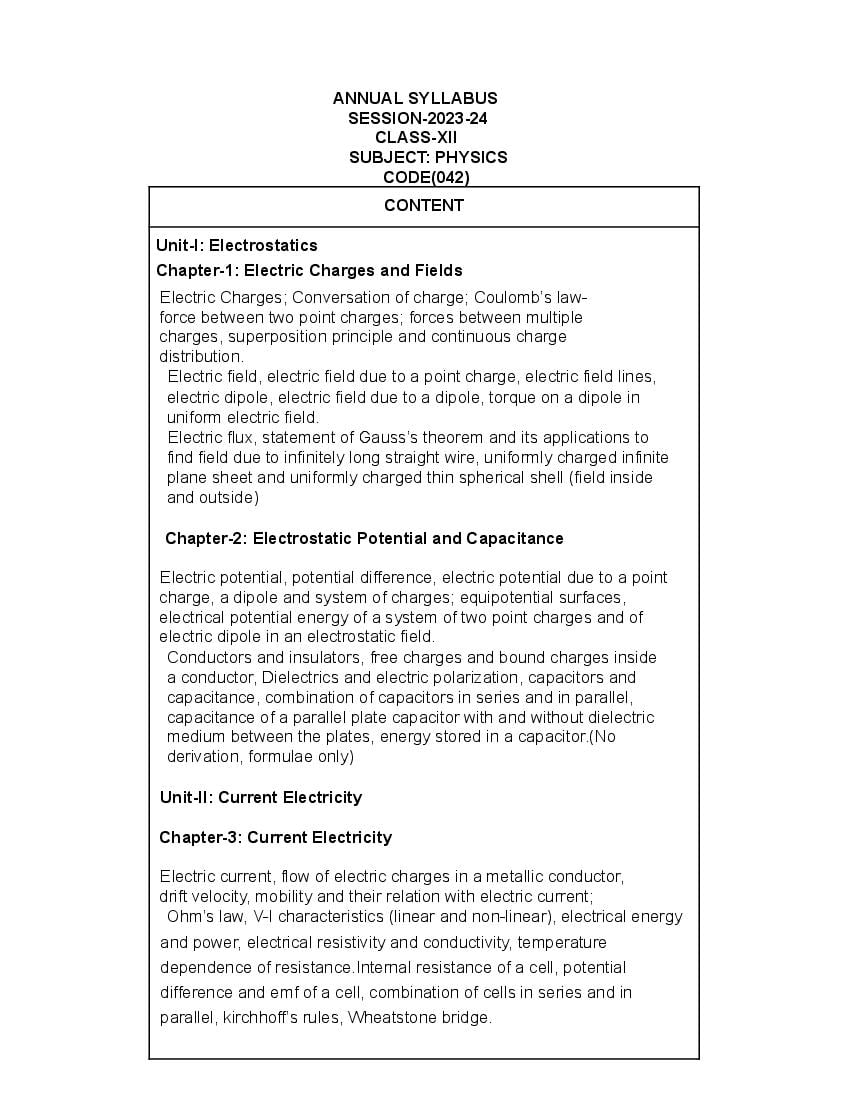
SESSION-2023-24
CLASS-XII
SUBJECT: PHYSICS
CODE(042)
CONTENT
Unit-I: Electrostatics
Chapter-1: Electric Charges and Fields
Electric Charges; Conversation of charge; Coulomb’s law-
force between two point charges; forces between multiple
charges, superposition principle and continuous charge
distribution.
Electric field, electric field due to a point charge, electric field lines,
electric dipole, electric field due to a dipole, torque on a dipole in
uniform electric field.
Electric flux, statement of Gauss’s theorem and its applications to
find field due to infinitely long straight wire, uniformly charged infinite
plane sheet and uniformly charged thin spherical shell (field inside
and outside)
Chapter-2: Electrostatic Potential and Capacitance
Electric potential, potential difference, electric potential due to a point
charge, a dipole and system of charges; equipotential surfaces,
electrical potential energy of a system of two point charges and of
electric dipole in an electrostatic field.
Conductors and insulators, free charges and bound charges inside
a conductor, Dielectrics and electric polarization, capacitors and
capacitance, combination of capacitors in series and in parallel,
capacitance of a parallel plate capacitor with and without dielectric
medium between the plates, energy stored in a capacitor.(No
derivation, formulae only)
Unit-II: Current Electricity
Chapter-3: Current Electricity
Electric current, flow of electric charges in a metallic conductor,
drift velocity, mobility and their relation with electric current;
Ohm’s law, V-I characteristics (linear and non-linear), electrical energy
and power, electrical resistivity and conductivity, temperature
dependence of resistance.Internal resistance of a cell, potential
difference and emf of a cell, combination of cells in series and in
parallel, kirchhoff’s rules, Wheatstone bridge.
Page 2
Chapter-4: Moving Charges and Magnetism
Concept of magnetic field, Oersted’s experiment.
Biot – Savart law and its application to the current carrying circular loop.
Ampere’s law and its applications to infinitely long straight wire. Straight
solenoid (only qualitative treatment), force on a moving charge in
uniform magnetic and electric fields,
Force on a current-carrying conductor in a uniform magnetic field, force
between two parallel current-carrying conductors-definition of ampere,
torque experienced by a current loop in uniform magnetic field; Current
loop as a magnetic dipole and its magnetic dipole moment, moving coil
galvanometer-its current sensitivity and conversion to ammeter and
voltmeter.
Chapter-5: Magnetism and Matter
Bar magnet, bar magnet as an equivalent solenoid (qualitative
treatment only), magnetic field intensity due to a magnetic dipole
(bar magnet) along its axis and perpendicular to its axis (qualitative
treatment only), torque on a magnetic dipole (bar magnet) in a
uniform magnetic field (qualitative treatment only), magnetic field
lines.
Magnetic properties of materials- Para-, dia- and ferro - magnetic
substances with examples, Magnetization of materials, effect of
temperature on magnetic properties.
Unit-IV: Electromagnetic Induction and Alternating Currents
Chapter-6: Electromagnetic Induction
Electromagnetic induction; Faraday’s laws, induced EMF and current;
Lenz’s Law, Self and mutual induction.
Chapter-7: Alternative Current
Alternating current, peak and RMS value of alternating current/voltage;
reactance and impedance; LCR series circuit (phasors only),
resonance; power in AC circuits, power factor, wattless current.
AC generator and transformer.
Unit-V: Electromagnetic Waves
Chapter-8: Electromagnetic Waves
Basic idea of displacement current, Electromagnetic waves, their
characteristics, their Transverse nature (qualitative ideas only).
Electromagnetic spectrum (radio waves, microwaves, infrared, visible,
Page 3
uses.
Unit-VI: Optics
Chapter-9: Ray Optics and Optical Instruments
Ray Optics: Reflection of light, spherical mirrors, mirror formula;
refraction of light, total internal reflection and optical fibers, refraction
at spherical surfaces, lenses, thin lens formula, lens maker’s formula.
Magnification, power of a lens, combination of thin lenses in contact,
refraction of light through a prism.
Optical instruments: Microscopes and astronomical telescopes
(reflecting and refracting) and their magnifying powers.
Revision
Mid term syllabus to be completed by 15/09/23
Discussion of questions of mid Term exam
Chapter-10: Wave Optics
Wave Optics: Wavefront and Huygens’s principle, reflection and
refraction of plane waves at a plane surface using wave fronts. Proof
of laws of reflection and refraction using Huygens’s principle.
Interference, Young’s double slit experiment and expression for fringe
width(no derivation, final expression only)
coherent sources and sustained interference of light, diffraction due
to a single slit, width of central maximum(qualitative treatment only).
Unit-VII: Dual Nature of Radiation and Matter
Chapter-11: Dual Nature of Radiation and Matter
Dual nature of radiation, Photoelectric effect, Hertz and Lenard’s
observations; Einstein’s Photoelectric equation- particle nature of
light. Experimental study of photoelectric effect.
Matter waves-wave nature of particles, de-Broglie relation,
Unit-VIII: Atoms and Nuclei
Chapter-12: Atoms
Alpha-particle scattering experiment; Rutherford’s model of atoms;
Bohr model of hydrogen atom, Expression for radius of nth possible
orbit, velocity and energy of electron in nth orbit, hydrogen line
spectra(qualitative treatment only)
Chapter-13: Nuclei
Composition and size of nucleus, nuclear force
Mass-energy relation, mass defect; binding energy per nucleon and
its variation with mass number; nuclear fission, nuclear fusion
Page 4
Chapter-14: Semiconductor Electronics:Materials, Devices and
Simple Circuits
Energy bands in conductors, semiconductors and insulators (qualitative
ideas only)Intrinsic and extrinsic semiconductors-p and n type,p-n
junction, Semiconductor diode - I-V characteristics in forward and
reverse bias ,application of junction diode- diode as a rectifier.
Syllabus to be completed by 15/12/23
PRACTICALS
The record, to be submitted by the students, at the time of their annual examination, has to
include:
● Record of at least 8 Experiments [with a minimum of 4 from each section],
to be performed by the students.
● Record of at least 6 Activities [with 3 each from section A and section B], to be
performed by the students.
● The Report of the project carried out by the students.
Evaluation Scheme
Time : 3 hours Max. Marks: 30
Two experiments one from each section 7+7 Marks
Practical record [experiments and activities] 5 Marks
One activity from any section 3 Marks
Investigatory Project 3 Marks
Viva on experiments, activities and project 5 Marks
Total 30 marks
Section A
EXPERIMENTS
1. To determine resistivity of two / three wires by plotting a graph for potential difference versus
current.
2. To find resistance of a given wire / standard resistor using a meter bridge.
Page 5
bridge.
OR
To verify the laws of combination (parallel) of resistances using a meter bridge.
4. To determine resistance of a galvanometer by half-deflection method and to find its figure of merit.
5. To convert the given galvanometer (of known resistance and figure of merit) into a voltmeter
of desired range and to verify the same.
OR
To convert the given galvanometer (of known resistance and figure of merit) into an ammeter of
desired range and to verify the same.
6. To find the frequency of AC mains with a sonometer.
Activities
1. To measure the resistance and impedance of an inductor with or without iron core.
2. To measure resistance, voltage (AC/DC), current (AC) and check continuity of a given circuit using
a multimeter.
3. To assemble a household circuit comprising three bulbs, three (on/off) switches, a fuse and a power
source.
4. To assemble the components of a given electrical circuit.
5. To study the variation in potential drop with length of a wire for a steady current.
6. To draw the diagram of a given open circuit comprising at least a battery, resistor/rheostat, key,
ammeter and voltmeter. Mark the components that are not connected in proper order and correct the
circuit and also the circuit diagram.
SECTION-B
Experiments
1. To find the value of v for different values of u in case of a concave mirror and to find the
focal length.
2. To find the focal length of a convex mirror, using a convex lens.
3. To find the focal length of a convex lens by plotting graphs between u and v or between 1/u and 1/v.
4. To find the focal length of a concave lens, using a convex lens.
5. To determine angle of minimum deviation for a given prism by plotting a graph between angle
of incidence and angle of deviation.
6. To determine the refractive index of a glass slab using a travelling microscope.
Page 6
8. To find the refractive index of a liquid using a concave mirror and a plane mirror.
9. To draw the I-V characteristic curve for a p-n junction diode in forward and reverse
bias.
Activities
1. To identify a diode, an LED, a resistor and a capacitor from a mixed collection of such items.
2. Use a multimeter to see the unidirectional flow of current in case of a diode and an LED and check
whether a given electronic component (e.g., diode) is in working order.
3. To study the effect of intensity of light (by varying distance of the source) on an LDR.
4. To observe refraction and lateral deviation of a beam of light incident obliquely on a glass
slab.
5. To observe diffraction of light due to a thin slit.
6. To study the nature and size of the image formed by a (i) convex lens, or (ii) concave mirror, on a
screen by using a candle and a screen (for different distances of the candle from the lens/mirror).
7. To obtain a lens combination with the specified focal length by using two lenses from the given
set of lenses.
Suggested Investigatory Projects
1. To study various factors on which the internal resistance/EMF of a cell depends.
2. To study the variations in current flowing in a circuit containing an LDR because of a variation in
(a) the power of the incandescent lamp, used to 'illuminate' the LDR (keeping all the lamps at a fixed
distance).
(b) the distance of an incandescent lamp (of fixed power) used to 'illuminate' the LDR.
3. To find the refractive indices of (a) water (b) oil (transparent) using a plane mirror, an equiconvex
lens (made from a glass of known refractive index) and an adjustable object needle.
4. To investigate the relation between the ratio of (i) output and input voltage and (ii) number of turns
in the secondary coil and primary coil of a self-designed transformer.
5. To investigate the dependence of the angle of deviation on the angle of incidence using a hollow
prism filled one by one, with different transparent fluids.
Page 7
suspended in a vertical plane by making use of Coulomb's law.
7. To study the factor on which the self-inductance of a coil depends by observing the effect of this
coil, when put in series with a resistor/(bulb) in a circuit fed up by an A.C. source of adjustable
frequency.
8. To study the earth's magnetic field using a compass needle -bar magnet by plotting magnetic field
lines and tangent galvanometer.
QUESTION PAPER DESIGN
THEORY(Class: XI/XII)
SESSION 2023-24
Maximum Marks: 70 Duration: 3 hrs.
S Typology of Questions Total Approximate
No. Marks Percentage
1 Remembering: Exhibit memory of previously learned 27 38 %
material by recalling facts, terms, basic concepts, and
answers.
Understanding: Demonstrate understanding of facts
and ideas by organizing, comparing, translating,
interpreting, giving descriptions, and stating main ideas
2 Applying: Solve problems to new situations by 22 32%
applying acquired knowledge, facts, techniques and
rules in a different way.
3 Analysing : Examine and break information into parts by 21 30%
identifying motives or causes. Make inferences and find
evidence to support generalizations
Evaluating:
Present and defend opinions by making judgments
about information, validity of ideas, or quality of work
based on a set of criteria.
Creating:
Page 8
combining elements in a new pattern or proposing
alternative solutions.
Total Marks 70 100
Practical 30
Gross Total 100
Note:
The above template is only a sample. Suitable internal variations may be made for
generating similar templates keeping the overall weightage to different forms of
questions and typology of questions same.
For more details kindly refer to Sample Question Paper of class XII for the year 2023-
24 published by CBSE at its website.
For further information kindly refer to C.B.S.E guidelines https://cbseacademic.nic.in/
Document Details
| Board / Org | Delhi Board |
| Exam | Class 12 |
| Type | Syllabus |
| Pages | 8 |
| Updated | 22 Jul 2026 |