TBSE Class 11 Syllabus 2021 Chemistry
Finished viewing? Save it for later —
Download TBSE Class 11 Syllabus 2021 Chemistry (PDF · 5 pages)About TBSE Class 11 Syllabus 2021 Chemistry
TBSE Class 11 Syllabus 2021 Chemistry is available here for free download. Published by Tripura Board for Class 11, this syllabus can be viewed online or downloaded as a PDF (5 pages). Candidates preparing for Class 11 can use TBSE Class 11 Syllabus 2021 Chemistry to understand the exam pattern, the type of questions asked, and the overall difficulty level.
Frequently Asked Questions
How can I download TBSE Class 11 Syllabus 2021 Chemistry?
Open this page and click the Download button to save TBSE Class 11 Syllabus 2021 Chemistry as a PDF. It is completely free on AglaSem Docs.
Is TBSE Class 11 Syllabus 2021 Chemistry free to download?
Yes. TBSE Class 11 Syllabus 2021 Chemistry can be viewed online and downloaded as a PDF free of cost on AglaSem Docs.
How many pages does TBSE Class 11 Syllabus 2021 Chemistry have?
TBSE Class 11 Syllabus 2021 Chemistry contains 5 pages, which you can read online or download together as a single PDF.
Where can I find more Class 11 study material?
You can find more Class 11 question papers, sample papers, syllabus, and answer keys on AglaSem Docs.
TBSE Class 11 Syllabus 2021 Chemistry – Text
Read the full text of this syllabus below — useful to quickly search, copy and reference the content online without downloading the PDF.
📄 View text version (5 pages)
Page 1
Ó˚§yÎ˚ˆlÏ Ó˚ ˛õyë˛ƒÜ˛Ù ˆÌˆÏܲ x˛õ§y!Ó˚ï˛ xÇ¢§Ù)•
ܲ!Ùܲ lÇ xôƒyÎ˚ ˆÎ xÇ¢à%ˆÏ°y x˛õ§y!Ó˚ï˛ •ˆÏÎ˚ˆÏSÈ
˛õòyˆÏÌ≈Ó˚ ≤ÃÜ,˛!ï˛ñ Ó˚y§yÎ˚•zlܲ §ÇˆÏÎyà §)eyÓ!°ñ í˛y°ê˛ˆÏlÓ˚
≤ÃÌÙ xôƒyÎ˚ Ó˚§yÎ˚ˆÏîÓ˚ ˆÙÔ!°Ü˛ ôyÓ˚îy ˛õyÓ˚Ùyî!Óܲï˛c / ˆÙÔ°ñ ˛õÓ˚Ùyî% G xî%Ó˚ ôyÓ˚îyñ fiÌ)° §ÇˆÏܲï˛
G xyî!Óܲ §ÇˆÏÜ˛ï˛–
•zˆÏ°Ü˛ê˛∆lñ ˆ≤Ãyê˛l ~ÓÇ !lí˛zê˛∆ˆÏlÓ˚ xy!ÓflÒyÓ˚ñ ˛õÓ˚Ùyî%ܲÙyAܲñ
!mï˛#Î˚ xôƒyÎ˚ ˛õÓ˚Ùyî%Ó˚ àë˛l xy•zˆÏ§yˆÏê˛y˛õ ~ÓÇ xy•zˆÏ§yÓyÓ˚ñ ÌÙ§ˆÏlÓ˚ ÙˆÏí˛° ~ÓÇ ~Ó˚
§#ÙyÓÂôï˛yñ Ó˚yòyÓ˚ˆÏÊ˛yˆÏí≈˛Ó˚ ÙˆÏí˛° ~ÓÇ ~Ó˚ §#ÙyÓÂôï˛y–
ï,˛ï˛#Î˚ xôƒyÎ˚ ˆÙÔ° §Ù)ˆÏ•Ó˚ ˆ◊!î!Ó˲yà ~ÓÇ ˆ◊!î!ÓlƒyˆÏ§Ó˚ ï˛yͲõÎ≈ ‡ ≤ÈÏÎ˚yçl#Î˚ï˛yñ ˛õÎ≈yÎ˚§yÓ˚!îÓ˚ !ÓܲyˆÏ¢Ó˚
ôÙ≈yÓ!°Ó˚ ˛õÎ≈yÎ˚Ó,!_ §Ç!«˛Æ •z!ï˛•y§ñ 100 ~Ó˚ x!ôܲ ˛õÓ˚Ùyî% ܲÙyAܲ !Ó!¢T˛ ˆÙÔ°
§Ù)ˆÏ•Ó˚ lyÙܲÓ˚î–
ã˛ï%˛Ì≈ xôƒyÎ˚ Ó˚y§yÎ˚!lܲ Órôl ~ÓÇ xyî!Óܲ àë˛l !ܲS%È•z x˛õ§yÓ˚î ܲÓ˚y •Î˚!l
xyhs˝Ó˚yî!Óܲ !ÙÌ!fl;Î˚yñ ÓrôˆÏlÓ˚ ≤ÃܲyÓ˚ñ àƒyˆÏ§Ó˚ ï˛Ó˚°#ܲÓ˚îñ
˛õM˛Ù xôƒyÎ˚ ˛õòyˆÏÌ≈Ó˚ xÓfiÌy §ÇÜ˛ê˛ í˛z£÷Ïï˛yñ à!ï˛¢!=˛ ~ÓÇ xî%Ó˚ ˆÓà å≤ÃyÌ!Ùܲ ôyÓ˚îyä–
ï˛Ó˚° xÓfiÌy ı Óy‹õã˛y˛õñ §ywï˛y ~ÓÇ ˛õ,¤˛ê˛yl åà%îàï˛
ôyÓ˚îyÙyeñ ày!î!ï˛Ü˛ !ӈϟ’£Ïî !l‹±ˆÏÎ˚yçlä
£Ï¤˛ xôƒyÎ˚ ï˛y˛õà!ï˛!Óòƒy ï˛y˛õ@˝ à y•#ï˛y G xyˆÏ ˛ õ!«˛Ü˛ï˛y˛õñ §yÙƒÓfiÌyÓ˚ ¢ï≈ ˛ §Ù) • ñ
ï˛y˛õà!ï˛!ÓòƒyÓ˚ ï,˛ï˛#Î˚ §)e å§Ç!«˛Æ ˛õ!Ó˚ã˛Î˚ä–
§ÆÙ xôƒyÎ˚ §yÙƒyÓfiÌy Ó•%«˛yÓ˚ܲ#Î˚ xˆÏ¡‘Ó˚ xyÎ˚l#˲Ólñ ˆ•u˛yÓ˚§l §Ù#ܲÓ˚îñ °ÓˆÏlÓ˚
xyo≈ !ӈϟ’£Ïî å≤ÃyÌ!Ùܲ ôyÓ˚îyä
xT˛Ù xôƒyÎ˚ ˆÓ˚í˛: !Ó!ܲÎ˚y ˆÓ˚í˛: !Ó!ܲÎ˚yÓ˚ ≤ÈÏÎ˚yà
˛õÎ≈yÎ˚§yÓ˚!îˆÏï˛ •y•zˆÏí»˛yˆÏçˆÏlÓ˚ xÓfiÌylñ •y•zˆÏí»˛yˆÏçˆÏlÓ˚ ≤Û!ï˛
lÓÙ xôƒyÎ˚ •y•zˆÏí»˛yˆÏçl ôÙ≈ ~ÓÇ ÓƒÓ•yÓ˚ñ •y•zˆÏí»˛yˆÏçl ˛õyÓ˚x:y•zí˛ ≤Û!ï˛ñ !Ó!ܲÎ˚yñ
àë˛l ~ÓÇ ÓƒÓ•yÓ˚–
!ܲS%È à%Ó˚%c˛õ)î≈ ˆÎÔˆÏàÓ˚ ≤Û!ï˛ G ôÙ≈ ı ˆ§y!í˛Î˚yÙ Ü˛yˆÏÓ≈yˆÏlê˛ñ
ò¢Ù xôƒyÎ˚ S ÓœÜ˛ ˆÙÔ°§Ù)• ˆ§y!í˛Î˚yÙ ˆÜœ˛yÓ˚y•zí˛ñ ˆ§y!í˛Î˚yÙ •y•zí»˛:y•zí˛ ~ÓÇ ˆ§y!í˛Î˚yÙ
•y•zˆÏí»˛yˆÏçl ܲyÓ≈ˆÏlê˛ñ ˆ§y!í˛Î˚yÙ ~ÓÇ ˛õê˛y!§Î˚yˆÏÙÓ˚ ˜ç!Óܲ
à%Ó˚%c–
ܲƒy°!§Î˚yÙ x:y•zí˛ ~ÓÇ Ü˛ƒy°!§Î˚yÙ Ü˛yÓ≈ˆlÏ ê˛ ~ÓÇ !¢ˆÏ“ ~ˆÏòÓ˚
ÓƒÓ•yÓ˚ñ ÙƒyàˆÏl!¢Î˚yÙ ~ÓÇ Ü˛ƒy°!§Î˚yˆÏÙÓ˚ ˜ç!Óܲ à%Ó˚%c–
Page 2
!ܲS%È à%Ó˚%c˛õ)î≈ ˆÎÔà ~ÓÇ ÓƒyÓ•yÓ˚ı !§!°Ü˛l ˆê˛ê˛∆yˆÏÜœ˛yÓ˚y•zí˛ñ
!§!°ˆÏܲyl§‰ñ !§!°ˆÏÜ˛ê˛ ~ÓÇ !çG°y•zê˛§‰ ï˛yˆÏòÓ˚ ÓƒÓ•yÓ˚–
myò¢ xôƒyÎ˚ ˜çÓ Ó˚§yÎ˚ˆÏlÓ˚ !ܲS%È ˆÙÔ!°Ü˛ l#!ï˛ !Ó¢%!ÂôܲÓ˚ˆÏîÓ˚ ˛õÂô!ï˛§Ù)•ñ à%îàï˛ ~ÓÇ ˛õ!Ó˚Ùyîàï˛
G !ܲÎ˚yˆÏÜ˛Ô¢° !ӈϟ’£Ïî–
eˆÏÎ˚yò¢ xôƒyÎ˚ •ƒyˆÏ ° y!çˆÏ l ¢lñ çyÓ˚ î ~ÓÇ !Ó˲yçˆÏ l Ó˚ Ù% = ˛Ù) ° ܲ
•y•zˆÏí»˛yܲyÓ≈l !ܲÎ˚yˆÏÜ˛Ô¢°– ܲƒy™yÓ˚ çll¢#°ï˛y ~ÓÇ !Ó£Ïy=˛ï˛y–
ã˛ï%˛ò≈¢ xôƒyÎ˚ ˛õ!Ó˚ˆÏÓ¢ Ó˚§yÎ˚l §¡õ)î≈ xôƒyÎ˚–
Blue Print of Question : Class XI : Chemistry : 70 Marks : 2020-21
Chapter Topic 1 Marks 2 Marks 3 Marks 5 Marks Total
Ch-1 Basic Concept of Chemistry -- 2(1) 3(1) -- 5
Ch-2 Atomic Structure 1(1) 2(1) 3(1) -- 6
Ch-3 Periodic Table 1(2) 2(1) -- -- 4
Ch-4 Chemical bonding 1(2) -- 3(1) -- 5
Ch-5 Gaseous state 1(1) -- 3(1) -- 4
Ch-6 Thermodynamics 1(3) --- 3(1) -- 6
Ch-7 Equilibrium 1(2) --- --- 5(1) 7
Ch-8 Redox reactions 1(1) 2(1) -- -- 3
Ch-9 Hydrogen 1(1) 2(1) -- -- 3
Ch-10 S-block elements 1(2) 2(1) -- -- 4
Ch-11 P-block elements 1(1) -- -- 5(1) 6
Ch-12 Organic Chemistry Some
basic Principle 1(1) -- 3(1) 5(1) 9
Ch-13 Hydrocarbans 1(3) 2(1) 3(1) -- 8
Total = 70
Page 3
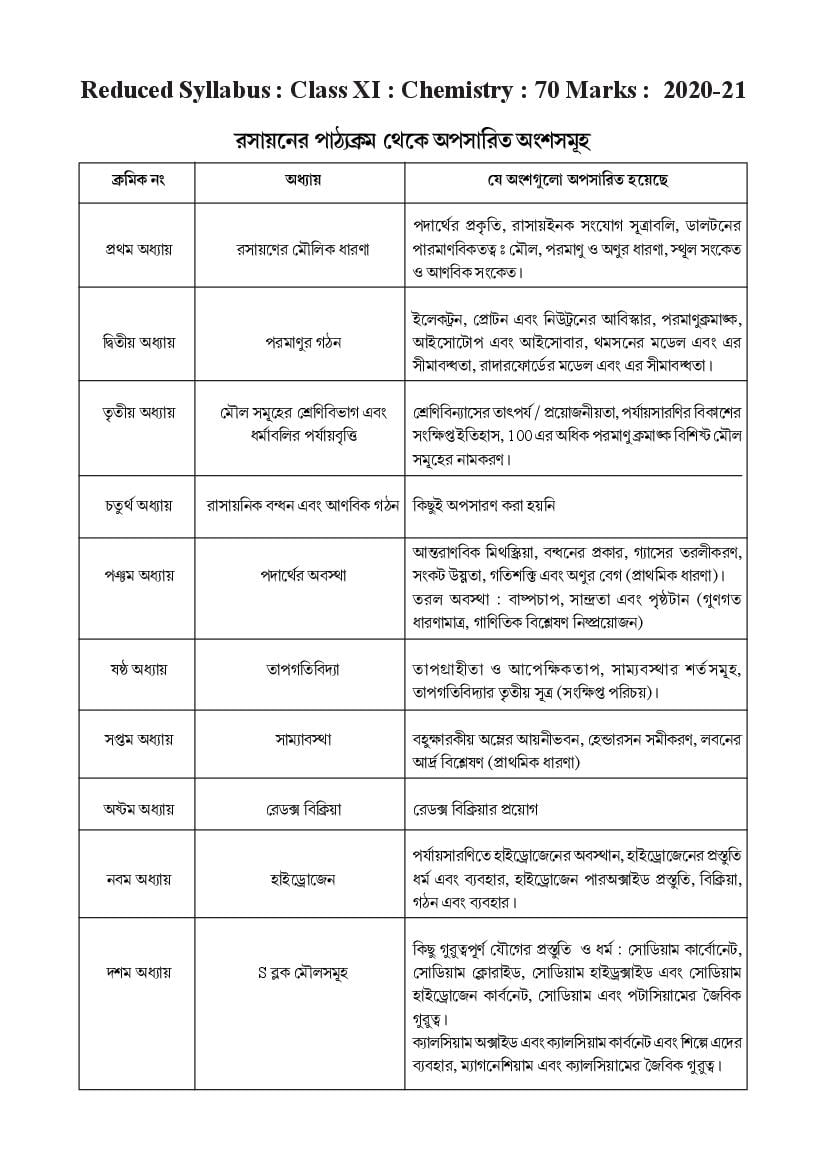
Deleted Part of Class XI Chemistry Syllabus
Sl.No. Topics Portion to be Deleted
Some Basic Concept of Chemis- Nature of matter, laws of chemical combination,
Chapter-1 try Dalton’s atomic theory : concept of elements, at-
oms and molecules, empirical and molecular formula.
Discovery of Electron, proton and neutron, atomic
Chapter-2 Structure of Atom number, isotopes and isobars, Thomson’s model and
its limitations, Retherford’s model and its limitations.
Chapter-3 Classification of Elements and Significance of classification, brief history of the
Periodicity in properties development of periodic table, Nomenclature of el-
ements with atomic number greater than 100
Chemical bonding and molecular None
Chapter-4 Structure
Intermolecular interactions, types of bonding, liq-
uefaction of gases, critical temperature, kinetic en-
States of matter : Gases and ergy and molecular speeds (elementary idea).
Chapter-5 Liquids Liquid State : vapour pressure, viscosity and sur-
face tension (qualitative idea only, no mathematical
derivations)
Heat capacity and specific heat, criteria for equilib-
Chemical Thermodynamics
Chapter-6 rium. Third law of thermodynamics (brief introduc-
tion).
Equilibrium Ionization of polybasic acids, Henderson equation,
Chapter-7
hydrolysis of salts (elementary idea).
Chapter-8 Redox Reactions Applications of redox reactions.
Position of hydrogen in periodic table,
Chapter-9 Hydrogen preparation,properties and uses of hydrogen, hydro-
gen peroxide-preparation, reactions, structure and
use.
Preparation and properties of some important com-
S-Block Elements pounds : Sodium Carbonate, Sodium Chloride, So-
Chapter-10 dium Hydroxide and Sodium Hydrogen carbonate,
Biological importance of Sodium and Potassium.
Calcium Oxide and Calcium Carbonate and their
industrial uses, biological importance of Magnesium
and Calcium.
Page 4
ides, important compounds of silicon and
uses : Silicon Tetrachloride, silicones,
silicates and zeolites, their uses.
Organic Chemistry : Some basic Methods of purification, qualitative and
Chapter-12 Principles and Techniques quantitative analysis.
Free radical mechanism of halogenation,
Hydrogen combustion and pyrolysis.
Chapter-13
Carcinogenicity and Toxicity
Chapter-14 Entire Chapter
Environmental Chemistry
CHEMISTRY PRACTICAL
(The following portion to be deleted)
I. Experiments based on pH
(a) any one of the following experiments :
* Determination of pH of some solutions obtained from fruit juices, solution of known and varied
concentrations of acids, bases and salts using pH paper or universal indicator.
* Comparing the pH of solutions of strong and weak acids of soame concentration.
* Study the pH change in the titration of strong base using universal indicator.
(b) Study the pH change by common-ion in case of weak acids and weak bases.
II. Chemical Equilibrium
One of the following experiments :
a) Study the shift in equilibrium between ferric ions and thiocyanate ions by increasing / decreasing
the concentration of either of the ions.
b) Study the shift in equilibrium between [Co(H2O)6]2+ and chloride ions by changing the concentra-
tion of either of the ions.
Page 5
Sl.No. Evaluation scheme of Examination Marks
1 Volumetric Analysis 08
2 Salt Analysis 08
3 Viva 04
4 Note book 05
5 Attendance 05
Total 30
Micro-chemical methods are available for several of the practical experiment.
Wherever possible, such techniques should be used.
Topics to be Studied
E. Quantitative Estimation.
i) Using a Chemical balance.
ii) Preparation of standard solution of Oxalic acid.
iii) Determination of strength of given soultion of sodium hydroxde by titrating it againts standard
solution of oxalic acid.
iv) Preparation of standard solution of sodium carbonate.
v) Determination of strength of a given soluting of hydrochloric acid by titrating it against stan
dard sodium carbonate solution.
F. Qualitative Analysis
(a) Determination of one anion and one cation in given salt.
Cations - Pb2+, Cu2+, Al3+, Fe3+, Mn2+, Ni2+, Zn2+, Co2+, Ca2+, Sr2+, Ba2+, Mg2+, [NH4]+
Anions - [CO3]2–, S2–, [SO3]2–, [NO3]–, Cl–, Br–, I–, [PO4]3–, [C2O4]2–, CH3COO–
(Note : Insoluble salts excluded)
(b) Detection of -Nitrogen, Sulphur, Chlorine in organic compounds.