TBSE Class 11 Syllabus 2021 Psychology
Finished viewing? Save it for later —
Download TBSE Class 11 Syllabus 2021 Psychology (PDF · 4 pages)About TBSE Class 11 Syllabus 2021 Psychology
TBSE Class 11 Syllabus 2021 Psychology is available here for free download. Published by Tripura Board for Class 11, this syllabus can be viewed online or downloaded as a PDF (4 pages). Candidates preparing for Class 11 can use TBSE Class 11 Syllabus 2021 Psychology to understand the exam pattern, the type of questions asked, and the overall difficulty level.
Frequently Asked Questions
How can I download TBSE Class 11 Syllabus 2021 Psychology?
Open this page and click the Download button to save TBSE Class 11 Syllabus 2021 Psychology as a PDF. It is completely free on AglaSem Docs.
Is TBSE Class 11 Syllabus 2021 Psychology free to download?
Yes. TBSE Class 11 Syllabus 2021 Psychology can be viewed online and downloaded as a PDF free of cost on AglaSem Docs.
How many pages does TBSE Class 11 Syllabus 2021 Psychology have?
TBSE Class 11 Syllabus 2021 Psychology contains 4 pages, which you can read online or download together as a single PDF.
Where can I find more Class 11 study material?
You can find more Class 11 question papers, sample papers, syllabus, and answer keys on AglaSem Docs.
TBSE Class 11 Syllabus 2021 Psychology – Text
Read the full text of this syllabus below — useful to quickly search, copy and reference the content online without downloading the PDF.
📄 View text version (4 pages)
Page 1
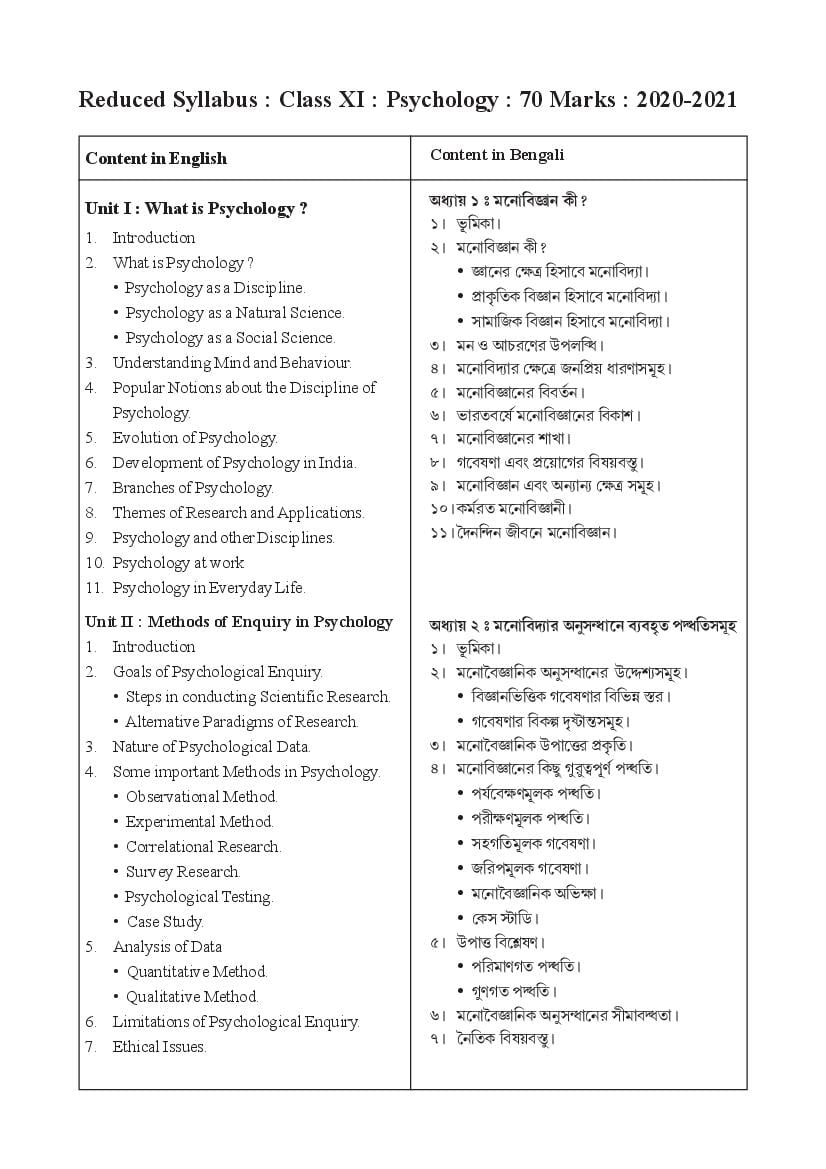
Content in English Content in Bengali
Unit I : What is Psychology ? xôƒyÎ˚ 1 / ÙˆÏly!ÓK˛yl ܲ#⁄
2– ÙˆÏly!ÓK˛yl ܲ#⁄
2. What is Psychology ?
• K˛yˆÏlÓ˚ ˆ«˛e !•§yˆÏÓ ÙˆÏly!Óòƒy–
• Psychology as a Discipline.
• ≤ÃyÜ,˛!ï˛Ü˛ !ÓK˛yl !•§yˆÏÓ ÙˆÏly!Óòƒy–
• Psychology as a Natural Science.
• §yÙy!çܲ !ÓK˛yl !•§yˆÏÓ ÙˆÏly!Óòƒy–
• Psychology as a Social Science. 3– Ùl G xyã˛Ó˚ˆÏîÓ˚ í˛z˛õ°!kô–
3. Understanding Mind and Behaviour. 4– ÙˆÏly!ÓòƒyÓ˚ ˆ«˛ˆÏe çl!≤ÃÎ˚ ôyÓ˚îy§Ù)•–
4. Popular Notions about the Discipline of 5– ÙˆÏly!ÓK˛yˆÏlÓ˚ !ÓÓï≈˛l–
Psychology. 6– ˲yÓ˚ï˛ÓˆÏ£Ï≈ ÙˆÏly!ÓK˛yˆÏlÓ˚ !Óܲy¢–
5. Evolution of Psychology. 7– ÙˆÏly!ÓK˛yˆÏlÓ˚ ¢yáy–
6. Development of Psychology in India. 8– àˆÏÓ£Ïîy ~ÓÇ ≤ÈÏÎ˚yˆÏàÓ˚ !Ó£ÏÎ˚Ó›–
7. Branches of Psychology. 9– ÙˆÏly!ÓK˛yl ~ÓÇ xlƒylƒ ˆ«˛e §Ù)•–
8. Themes of Research and Applications. 10– ܲÙ≈Ó˚ï˛ ÙˆÏly!ÓK˛yl#–
9. Psychology and other Disciplines. 11– ˜òl!®l ç#ÓˆÏl ÙˆÏly!ÓK˛yl–
10. Psychology at work
11. Psychology in Everyday Life.
Unit II : Methods of Enquiry in Psychology xôƒyÎ˚ 2 / ÙˆÏly!ÓòƒyÓ˚ xl%§rôyˆÏl ÓƒÓ•,ï˛ ˛õÂô!ï˛§Ù)•
2. Goals of Psychological Enquiry. 2– ÙˆÏly˜ÏÓK˛y!lܲ xl%§rôyˆÏlÓ˚ ˛í˛zˆÏj¢ƒ§Ù)•–
• Steps in conducting Scientific Research. • !ÓK˛yl!˲!_ܲ àˆÏÓ£ÏîyÓ˚ !Ó!˲ߨ hflÏÓ˚–
• Alternative Paradigms of Research. • àˆÏÓ£ÏîyÓ˚ !Óܲ“ ò,T˛yhs˝§Ù)•–
3. Nature of Psychological Data. 3– ÙˆÏly˜ÏÓK˛y!lܲ í˛z˛õyˆÏ_Ó˚ ≤ÃÜ,˛!ï˛–
4. Some important Methods in Psychology. 4– ÙˆÏly!ÓK˛yˆÏlÓ˚ !ܲS%È à%Ó˚%c˛õ)î≈ ˛õÂô!ï˛–
• Observational Method. • ˛õÎ≈ˆÏÓ«˛îÙ)°Ü˛ ˛õÂô!ï˛–
• Experimental Method. • ˛õÓ˚#«˛îÙ)°Ü˛ ˛õÂô!ï˛–
• Correlational Research. • §•à!ï˛Ù)°Ü˛ àˆÏÓ£Ïîy–
• Survey Research. • ç!Ó˚˛õÙ)°Ü˛ àˆÏÓ£Ïîy–
• Psychological Testing. • ÙˆÏly˜ÏÓK˛y!lܲ x!˲«˛y–
• Case Study. • ˆÜ˛§ fiê˛y!í˛–
5. Analysis of Data 5– í˛z˛õy_ !ӈϟ’£Ïî–
• Quantitative Method. • ˛õ!Ó˚Ùyîàï˛ ˛õÂô!ï˛–
• Qualitative Method. • à%îàï˛ ˛õÂô!ï˛–
6. Limitations of Psychological Enquiry. 6– ÙˆÏly˜ÏÓK˛y!lܲ xl%§rôyˆÏlÓ˚ §#ÙyÓÂôï˛y–
7. Ethical Issues. 7– ˜l!ï˛Ü˛ !Ó£ÏÎ˚Ó›–
Page 2
Behaviour 1– Ë)˛!Ùܲy–
1. Introduction 2– !ÓÓï≈˛ˆÏlÓ˚ ˛õ!Ó˚ˆÏ≤Ã!«˛ï˛–
2. Evolutionary Perspective. 3– ¢yÓ˚#Ó˚Ó,_#Î˚ ~ÓÇ §yÇfl,Ò!ï˛Ü˛ !˲!_–
3. Biological and Cultural Roots 4– xyã˛Ó˚ˆÏîÓ˚ ˜ç!Óܲ !˲!_–
4. Biological Basis of Behaviour. • !lí˛zÓ˚l–
• Neurons
5– fl¨yÎ˚%ï˛sf ~ÓÇ xhs˝«˛Ó˚y @˝Ã!rÌÓ˚ àë˛l G ܲyÎ≈yÓ°# ~ÓÇ
xyã˛Ó˚î G x!˲K˛ï˛yÓ˚ §ˆÏAà ï˛yˆÏòÓ˚ §¡õÜ≈˛–
5. Structure and Functions of Nervous
• fl¨yÎ˚%ï˛sf–
System and Endocrine System and their
• xhs˝/«˛Ó˚y @˝Ã!rÌï˛sf–
Relationship with Behaviour
6– ÓÇ¢à!ï˛ / !çl ~ÓÇ xyã˛Ó˚î–
and Experience.
7– §yÇfl,Ò!ï˛Ü˛ !˲!_ / xyã˛Ó˚ˆÏîÓ˚ §ÙyçÈüȧyÇfl,Ò!ï˛Ü˛ Ó˚)˛õyÎ˚l–
• The Nervous system.
• §Çfl,Ò!ï˛Ó˚ ôyÓ˚îy–
• The Endocrine system.
8– §Çfl,Ò!ï˛Ü˛Ó˚î–
6. Heredity : Genes and Behaviour. 9– §yÙy!çܲ#ܲÓ˚î–
7. Cultural Basis : Socio-Cultural Shaping 10– ˛õÓ˚§Çfl,Ò!ï˛ @˝Ã•î–
of Behaviour.
• Concept of Culture.
8. Enculturation.
9. Socialization.
10. Acculturation.
Unit IV : Human Development xôƒyÎ˚ 4 / ÙylÓ !Óܲy¢
1. Introduction 1– Ë)˛!Ùܲy–
2. Meaning of Development 2– !ÓܲyˆÏ¢Ó˚ xÌ≈–
* Life-Span Perspective on • ç#ÓlÓƒy˛õ# !ÓܲyˆÏ¢Ó˚ ˛õ!Ó˚ˆÏ≤Ã!«˛ï˛–
Development 3– !ÓܲyˆÏ¢Ó˚ ≤Ã˲yÓ!ÓhflÏyÓ˚ܲyÓ˚# í˛z˛õyòyl–
3. Factors Influencing Development 4– !ÓܲyˆÏ¢Ó˚ ≤çAà–
4. Context of Development 5– !Óܲy¢Ù)°Ü˛hflψÏÓ˚Ó˚ ˛õ!Ó˚ò¢≈l–
5. Overview of Developmental Stages • ≤Ãy܉˛çß√hflÏÓ˚–
* Prenatal Stage • ˜¢¢Ó–
* Infancy • Óy°ƒÜ˛y°–
* Childhood • ÓÎ˚/§!rôܲyˆÏ°Ó˚ ÓyôyÈüÈ!Ó˛õ!_–
* Challenges of Adolescence • ≤ÃyÆÓÎ˚flÒ ~ÓÇ Óyôܲƒç!lï˛ hflÏÓ˚–
* Adulthood and Old Age
Unit V : Sensory, Attentional and xôƒyÎ˚ 5 / §ÇˆÏÓòlñ ÙˆÏlyˆÏÎyà ~ÓÇ ≤Ãï˛ƒ«˛îÙ)°Ü˛ ≤Ã!ܲÎ˚y
Perceptual Process 1– Ë)˛!Ùܲy–
2– ˛˛õ,!ÌÓ#ˆÏܲ çyly–
3– í˛zj#˛õˆÏܲÓ˚ fl∫Ó˚)˛õ ~ÓÇ ≤ÃܲyÓ˚ˆÏ˲ò–
2. Knowing the World
4– §ÇˆÏÓòˆÏlÓ˚ Ó˚)˛õ–
3. Nature and Varieties of Stimulus
• ò,!T˛àï˛ §ÇˆÏÓòl–
Page 3
* Visual Sensation 5– ÙˆÏlyˆÏÎyàÙ)°Ü˛ ≤Ã!ܲÎ˚y–
* Auditory Sensation • !lÓ≈yã˛lÙ)°Ü˛ ÙˆÏlyˆÏÎyà–
5. Attentional Processes • !fiÌ!ï˛¢#° ÙˆÏlyˆÏÎyà–
* Selective Attention 6– ≤Ãï˛ƒ«˛îÙ)°Ü˛ ≤Ã!ܲÎ˚y–
* Sustained Attention • ≤Ãï˛ƒ«˛îÙ)°Ü˛ ≤Ã!ܲÎ˚yÓ˚ ò,!T˛Ë˛!Aà–
6. Perceptual Processes 7– ≤Ãï˛ƒ«˛îܲyÓ˚#–
* Processing Approaches in Perception 8– ≤Ãï˛ƒ«˛îÙ)°Ü˛ §Çàë˛ˆÏlÓ˚ l#!ï˛–
7. The Perceiver 9– fiÌylñ à˲#Ó˚ï˛y G ò)Ó˚ˆÏcÓ˚ ≤Ãï˛ƒ«˛î–
8. Principles of Perceptual Organisation
• ~Ü˛ã˛«%˛Ù)°Ü˛ §)e ~ÓÇ !mÈüÈã˛«%˛Ù)°Ü˛ §)e–
9. Perception of Space, Depth, and Distance
10– ≤Ãï˛ƒ«˛îÙ)°Ü˛ fiÌyÎ˚#c
11– xôƒy§–
* Monocular Cues and Binocular Cues
12– ≤Ãï˛ƒ«˛ˆÏî §Ùyç §Çfl,Ò!ï˛Ù)°Ü˛ ≤Ã˲yÓ–
10. Perceptual Constancies
11. Illusions
12. Socio-Cultural Influences on Perception
Unit VI : Learning xôƒyÎ˚ 6 / !¢ál
1. Introduction
2– !¢áˆÏlÓ˚ fl∫Ó˚)˛õ–
2. Nature of Learning
3– !¢áˆÏlÓ˚ ï˛_¥–
3. Paradigms of Learning
4– ≤Ãyã˛#l xl%Óï≈˛l–
4. Classical Conditioning
• ≤Ãyã˛#l xl%Óï≈˛ˆÏlÓ˚ !lô≈yÓ˚ܲ–
* Determinants of Classical Conditioning
5– §!ܲÎ˚‡Îy!sfܲ xl%Óï≈˛l–
5. Operant/Instrumental Conditioning
• §!ܲÎ˚ xl%Óï≈˛ˆÏlÓ˚ !lô≈yÓ˚ܲ–
* Determinants of Operant Conditioning
• Ù)° !¢ál ≤Ã!ܲÎ˚y–
* Key Learning Processes 6– ˛õÎ≈ˆÏÓ«˛îÙ)°Ü˛ !¢ál–
6. Observational Learning 7– K˛ylÙ)°Ü˛ !¢ál–
7. Cognitive Learning 8– ˲y£ÏyÙ)°Ü˛ !¢ál–
8. Verbal Learning 9– ôyÓ˚îyÓ˚ !¢ál–
9. Concept Learning 10– ˆÜ˛Ô¢° !¢ál–
10. Skill Learning 11– !¢ál §M˛y°l–
11. Transfer of Learning 12– !¢áˆÏl §y•yÎƒÜ˛yÓ˚# í˛z˛õyòyl–
12. Factors Facilitating Learning 13– !¢ál ܲï≈˛y / !¢áˆÏlÓ˚ ôÓ˚î–
13. The Learner : Learning Styles 14– !¢álÙ)°Ü˛ x«˛Ùï˛y–
14. Learning Disabilities 15– !¢áˆÏlÓ˚ l#!ï˛Ó˚ ≤ÈÏÎ˚yà–
15. Applications of Learning Principles
Unit VII : Human Memory xôƒyÎ˚ 7 / ÙylÓ flø,!ï˛
2. Nature of Memory 2– flø,!ï˛Ó˚ ≤ÃÜ,˛!ï˛–
3. Information Processing Approach : The 3– ï˛Ìƒ ≤Ã!ܲÎ˚yܲÓ˚î ˛õÂô!ï˛ / ˆfiê˛ç ÙˆÏí˛°–
Stage Model 4– flø,!ï˛ ˛õÂô!ï˛ / §ÇˆÏÓòlàï˛ñ «˛îfiÌyÎ˚#
4. Memory Systems : Sensory, Short-term G ò#â≈fiÌyÎ˚# flø,!ï˛–
Page 4
5. Levels of Processing 6– ò#â≈fiÌyÎ˚# flø,!ï˛Ó˚ ≤ÃܲyÓ˚ˆÏ˲ò
6. Types of Long-term Memory • ˆây£ÏîyÙ)°Ü˛ G ˛õÂô!ï˛Ù)°Ü˛ñ í˛z˛õyáƒylÙ)°Ü˛ G
* Declarative and Procedural; Episodic ¢∑yÌ≈ܲ–
and Semantic 7– K˛yl ≤Ã!ï˛!l!ôc G flø,!ï˛ˆÏï˛ §Çàë˛l–
7. Knowledge Representation and 8– àë˛lÙ)°Ü˛ ≤Ã!ܲÎ˚y !•§yˆÏÓ flø,!ï˛–
Organisation in Memory 9– !Óflø,!ï˛Ó˚ ≤ÃÜ,˛!ï˛ G ܲyÓ˚î–
8. Memory as a Constructive Process • !ã˛•´«˛ˆÏÎ˚Ó˚ ܲyÓ˚ˆÏî !Óflø,!ï˛ñ •hflψϫ˛˛õ G
9. Nature and Causes of Forgetting ˛õ%lÓ˚%ˆÏoˆÏܲ ÓƒÌ≈ï˛y–
* Forgetting due to Trace Decay, 10– flø,!ï˛Ó˚ í˛zߨ!ï˛Ü˛Ó˚î–
Interference and Retrieval Failure • Ùyl§!ã˛e G §Çàë˛l ÓƒÓ•,ï˛ !lˆÏÙy!l:–
10. Enhancing Memory
* Mnemonics using Images and
Organisation
Practical (Assigments) : 30 marks
The students shall be required to undertake one assigment on any one of the following topics :
i) Structure and function of Neurone.
ii) Structure and function of Human Brain.
iii) Structure and function of eye and ear.
N.B.:- * Word limit of the assignment should be 500 words.
* Suitable diagrams are mandatory.
ÓƒÓ•y!Ó˚ܲ ≤Ãܲ“˛õe ˛õ)î≈ÙylÈüÈ30
SÈyeSÈye#ˆÏòÓ˚ !l¡¨!°!áï˛ ˆÎˆÏܲyl ~ܲ!ê˛ Ü˛yÎ≈≤Ãîy°# ÓySÈy•z ܲˆÏÓ˚ ≤Ãܲ“ §¡õyòl ܲÓ˚ˆÏï˛ •ˆÏÓ–
ܲä !lí˛zˆÏÓ˚yˆÏlÓ˚ àë˛l ~ÓÇ Ü˛yÎ≈yÓ°#–
áä ÙylÓ Ù!hflψϋÒÓ˚ àë˛l ~ÓÇ Ü˛yÎ≈yÓ°#–
àä ˆã˛yá ~ÓÇ Ü˛yˆÏlÓ˚ àë˛l ~ÓÇ Ü˛yÎ≈yÓ°#–
!ÓÉoÉ/ÈüÈ D ¢∑§#Ùy ˛õÑyã˛¢ (500) ¢ˆÏ∑Ó˚ ÙˆÏôƒ •ˆÏï˛ •ˆÏÓ !ã˛e§•–