Class 7 Science Notes for Soil
Finished viewing? Save it for later —
Download Class 7 Science Notes for Soil (PDF · 5 pages)About Class 7 Science Notes for Soil
Class 7 Science Notes for Soil is available here for free download. Published by AglaSem for Class 7, this notes can be viewed online or downloaded as a PDF (5 pages). Candidates preparing for Class 7 can use Class 7 Science Notes for Soil to understand the exam pattern, the type of questions asked, and the overall difficulty level.
Frequently Asked Questions
How can I download Class 7 Science Notes for Soil?
Open this page and click the Download button to save Class 7 Science Notes for Soil as a PDF. It is completely free on AglaSem Docs.
Is Class 7 Science Notes for Soil free to download?
Yes. Class 7 Science Notes for Soil can be viewed online and downloaded as a PDF free of cost on AglaSem Docs.
How many pages does Class 7 Science Notes for Soil have?
Class 7 Science Notes for Soil contains 5 pages, which you can read online or download together as a single PDF.
Where can I find more Class 7 study material?
You can find more Class 7 question papers, sample papers, syllabus, and answer keys on AglaSem Docs.
Class 7 Science Notes for Soil – Text
Read the full text of this notes below — useful to quickly search, copy and reference the content online without downloading the PDF.
📄 View text version (7 pages)
Page 1
CLASS 7
SCIENCE
Study Material
DOWNLOAD PDF
Page 2
IMPORTANCE OF SOIL:
• Soil is one of the most important natural resources. It is the uppermost layer of earth’s crust
which is blackish-brown in colour.
• It supports plant growth by holding the roots firmly and supplying water and nutrients to the
plants.
• It acts as a natural habitat for many organisms like an earthworm, fungi, bacteria, ants, etc.
• It is also essential for agriculture which provides us with food, clothing and shelter for all.
• It supplies water and nutrients to plants
SOIL POLLUTION:
• Dumping non-biodegradable substances such as plastic bags and polythene causes soil
pollution.
• Waste products from industries which contain chemicals can affect the soil adversely.
• Excess use of fertilizers and pesticides pollute the soil and decrease its fertility.
SOIL PROFILE:
• Soil is formed by breaking down of rocks by the action of wind, water or climate by the
process called weathering.
• Weathering is a very slow process as it takes thousands of years for a huge rock to turn into
fine particles.
• The soil profile is a vertical section through different layers of the soil, which are called
horizon.
Different horizons of the soil are:
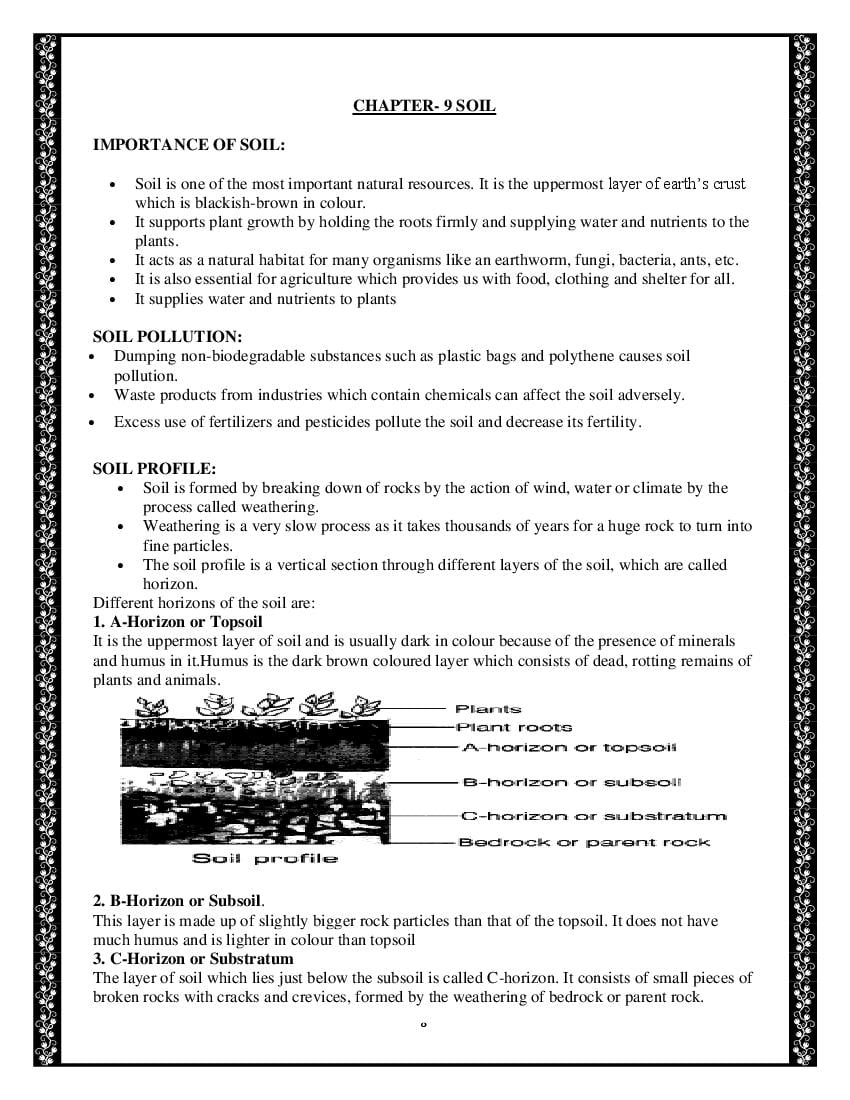
1. A-Horizon or Topsoil
It is the uppermost layer of soil and is usually dark in colour because of the presence of minerals
and humus in it.Humus is the dark brown coloured layer which consists of dead, rotting remains of
plants and animals.
2. B-Horizon or Subsoil.
This layer is made up of slightly bigger rock particles than that of the topsoil. It does not have
much humus and is lighter in colour than topsoil
3. C-Horizon or Substratum
The layer of soil which lies just below the subsoil is called C-horizon. It consists of small pieces of
broken rocks with cracks and crevices, formed by the weathering of bedrock or parent rock.
8
Page 3
Below the C-horizon unweathered solid rock is found which is called as bedrock. Rainwater gets
collected over it to form the water table.
SOIL TYPES
The rock particles present in soil are of different sizes and chemical compositions. On the basis of
sizes, the rock particles present in soil can be divided mainly into four major groups:
(i) Clay: These are formed by the smallest rock particles. These are so small that we cannot see a
single clay particle and it feels smooth.
(ii) Silt: These are made up of somewhat bigger rock particle than clay. It is not so smooth as clay.
Silts are found deposited at river beds. Floods deposit the silt from rivers in the field.
(iii) Sand: These are made up of larger particles enough than that of silt and can be easily seen.
These are coarse to touch due to their larger size.
(iv) Gravel: These are the largest sized rock particles that are present in the soil. These are the tiny
stones that are present in topsoil in very small quantity.
PROPERTIES OF SOIL
• It contains air.
• It can hold water or moisture.
• It can absorb or soak water
• It allows water to pass down through it.
PERCOLATION RATE OF WATER IN SOIL
• The process of passing down water slowly through the soil is called percolation of water.
• Percolation rate is the amount of water (in mL) that is percolated through the soil in unit
time, i.e. in minutes. The percolation rate differs in different soil types.
• Percolation rate (mL/min) = Amount of water(mL) / Percolation time(min)
• Percolation rate is highest in sandy soil because it is very loose and particle size is large
enough.
• Clayey soil is very compact and therefore has the lowest rate of percolation.
• Since clayey soil can retain water in them, it is used to grow paddy because paddy requires
standing water in fields.
• MOISTURE IN SOIL
o The soil contains some water in it which is called soil moisture.
o This moisture is absorbed by the roots of plants. Thus, the moisture content of the
o soil is very important for the growth of crop
Types of Soil Crop Grown
Clayey Soil Wheat, Gram and Paddy
Loamy Soil Lentil, Tomatoes, Corn and Oats
Sandy-loam Soil Potatoes, Cotton and Cereal Rye
9
Page 4
• Clayey and loamy soils are both suitable for growing cereals like wheat and gram. Such soils
are good at retaining water.
• For paddy, soils rich in clay and organic matter and having a good capacity to retain water
are ideal.
• For lentils (masoor) and other pulses, loamy soils which drain water easily, are required.
• For cotton, sandy-loam or loam, which drain water easily and can hold plenty of air, are
more suitable.
• Crops such as wheat are grown in the fine clayey soils because they are rich in humus and
are very fertile.
SOIL EROSION
• The removal of land surface by water wind or ice is known as erosion.
• Soil erosion is mainly caused by the large scale cutting of forest trees and plants, called
deforestation.
• The effects of soil erosion are, famines, flood desertification and damage or spoilage of
environment.
MULTIPLE CHOICE QUESTIONS
1-Which one of the following is a step in the formation of soil?
(a) Earthquakes or volcanic eruptions (b) Weathering of rocks
(c) Addition of humus (d) All are involved in the formation of soil
2-Which physical property of soil is important to us?
(a) Texture (b) Water holding capacity
(c) Both of these (d) None of these
3-Which of the following type of soil will form a colloidal solution when suspended in water?
(a) Clay (b) Silt (c) Sand (d) Gravel
4-Which factor influences soil formation?
(a) Climate (b) Vegetation
(c) Parent rock (d) All of these
5-The proportion of sand, silt and clay in a soil sample determines
(a) structure (b) texture
(c) nutrient potential (d) fertility level
6-The microorganisms present in the soil require moisture (water) and nutrients for growth and
survival. Choose from the options below the habitat (place) where the soil has plenty of water
and nutrients.
(a) Desert (b) Forest (c) Open field (d) Cricket ground
10
Page 5
(a) B-horizon (b) C-horizon (c) A-horizon (d) Surface of soil
8- Soil conservation measures are mainly aimed at protecting which of the following?
(a) Plants (b) Topsoil (c) Sub soil (d) Soil organisms
9- Read the following statements with reference to soil:
(i) Weathering is a very fast process of soil formation.
(ii) Percolation of water is faster in sandy soils.
(iii) Loamy soil contains only sand and clay.
(iv) Top soil contains the maximum amount of humus.
Choose the correct statements from the above.
(a) (ii) and (iv) (b) (i) and (iii) (c) (ii) and (iii) (d) (i) and
(ii)10- In which horizon of soil minerals are found?
(a) A (b) B (c) C (d) None of these
HIGHER ORDER THINKING SKILL QUESTIONS
Question 1. The soil is said to be inseparable part of our life. Why?
Answer: Soil is one of the most important natural resources. It is the uppermost layer of earth’s
crust which is blackish-brown in colour. Major functions of the soil are:
• It supports plant growth by holding the roots firmly and supplying water and
nutrients to the plants.
• It acts as a natural habitat for many organisms like earthworm, fungi, bacteria, ants,
etc.
• It is also essential for agriculture which provides us food, clothing and shelter for all.
• It supplies water and nutrients to plants.
Question 2. Read the following statements and give the appropriate terms for each of
them.
(a) The process of breakdown of rocks by the action of wind, water, sunlight.
(b) Removal of topsoil during heavy rains or strong winds.
(c) Accumulation of wastes in the soil generated by human activity which alter the
features of soil.
(d) The process of movement of water into deeper layers of soil.
Answer: The terms for the above described statements are as follows
(a) Weathering
(b) Soil erosion
(c) Soil pollution
(d) Percolation
Question 3. Rajasthan is a desert state in India. Once while travelling to Rajasthan by train,
Boojho observed several streams and rivulets of rainwater during the journey but to his
11
Page 6
find a suitable explanation for this.
Answer: Deserts are made up of sand, thus when the rainwater falls on land, it percolates
immediately downwards in the spaces between sand particles. So, the streams of water in
desert region are not visible even during rainy seasons.
Question 4. A man digging a pit found that he could dig with ease initially but digging became
difficult as he went deeper. He could not big beyond a depth 5 feet. Provide a suitable scientific
explanation.
Answer: The man digging a pit could dig with ease initially because of the presence of topsoil and
subsoil (mainly comprising of humus and nutrients). But as he digs deeper, he finds it difficult to
dig beyond a depth of 5 feet as lower layers are made up of small partially weathered rocks with
cracks, crevices and with bedrock which make it hard to dig.
Question 5. Continuously water-logged soils are disadvantageous for plant growth. Why?
Answer: Roots although underground possesses living cells that require oxygen for respiration and
production of energy. They absorb oxygen that is present in the spaces between soil particles. But
in water-logged soils, water occupies spaces between soil particles and pushes the oxygen out into
the atmosphere. Thus, roots are deprived of oxygen and this affects the plant growth.
MIND MAP
12
Page 7
Notes
Model Papers Class 6 Notes
Sample Papers Class 7 Notes
Half Yearly Sample Papers Class 8 Notes
Class 9 Notes
Important Resources
Class 10 Notes
Periodic Table
Class 11 Notes
Writing Skills / Formats
Maps of India / World Class 12 Notes
Books and Solutions
NCERT Books
NCERT Book Solutions
HC Verma Chapter Wise Solutions
RD Sharma Solutions
CGBSE Solutions
Document Details
| Board / Org | Aglasem |
| Exam | Class 7 |
| Type | Notes |
| Pages | 5 |
| Language | english |
| Updated | 30 Apr 2026 |