Class 7 Science Notes for Motion and Time
Finished viewing? Save it for later —
Download Class 7 Science Notes for Motion and Time (PDF · 4 pages)About Class 7 Science Notes for Motion and Time
Class 7 Science Notes for Motion and Time is available here for free download. Published by AglaSem for Class 7, this notes can be viewed online or downloaded as a PDF (4 pages). Candidates preparing for Class 7 can use Class 7 Science Notes for Motion and Time to understand the exam pattern, the type of questions asked, and the overall difficulty level.
Frequently Asked Questions
How can I download Class 7 Science Notes for Motion and Time?
Open this page and click the Download button to save Class 7 Science Notes for Motion and Time as a PDF. It is completely free on AglaSem Docs.
Is Class 7 Science Notes for Motion and Time free to download?
Yes. Class 7 Science Notes for Motion and Time can be viewed online and downloaded as a PDF free of cost on AglaSem Docs.
How many pages does Class 7 Science Notes for Motion and Time have?
Class 7 Science Notes for Motion and Time contains 4 pages, which you can read online or download together as a single PDF.
Where can I find more Class 7 study material?
You can find more Class 7 question papers, sample papers, syllabus, and answer keys on AglaSem Docs.
Class 7 Science Notes for Motion and Time – Text
Read the full text of this notes below — useful to quickly search, copy and reference the content online without downloading the PDF.
📄 View text version (7 pages)
Page 1
CLASS 7
SCIENCE
Study Material
DOWNLOAD PDF
Page 2
Distance
Distance is the total path covered by the object in the given interval of time.
Displacement is the shortest path covered by the moving object in the given interval of
time.
Distance=Speed × Time.
Unit of distance is generally measured in units of length like meters, kilometers etc.
Introduction to motion
An object is said to be in motion if it changes its position with respect to time. Eg: A car
moving on a road.
An object is said to be at rest if the object does not change its position with time. Eg: A
person standing on the ground.
Units and their standardization
The standard unit of distance is in meters.
The standard unit of time is in seconds (s).
The standard unit of speed is in meter per second (m/s).
Basics of Motion and Its Types
Types of motion
Types of motion are generally divided into 3. They are:
1. Rectilinear / translator motion: When a body is moving in a straight line, without changing
its direction, then the body is said to possess translator /rectilinear motion.
Eg: A car moving on a straight road.
2. Circular motion: When a body moves in the shape of a circle about a fixed point and a fixed
radius, then the body is said to be in circular motion.
Eg: Motion of planets around the sun.
3. Period / Oscillatory motion: When the motion of a body repeats after fixed intervals of time,
then the body is said to in the periodic/oscillatory motion.
Eg: To and fro motion of a simple pendulum.
Periodic or oscillatory motion
Periodic or oscillatory motion is the motion in which a body repeats its motion after fixed
intervals of time.
Eg: To and fro motion of a simple pendulum, Motion of a car in a circular path, Motion
of planets around the sun.
Oscillations of a simple pendulum
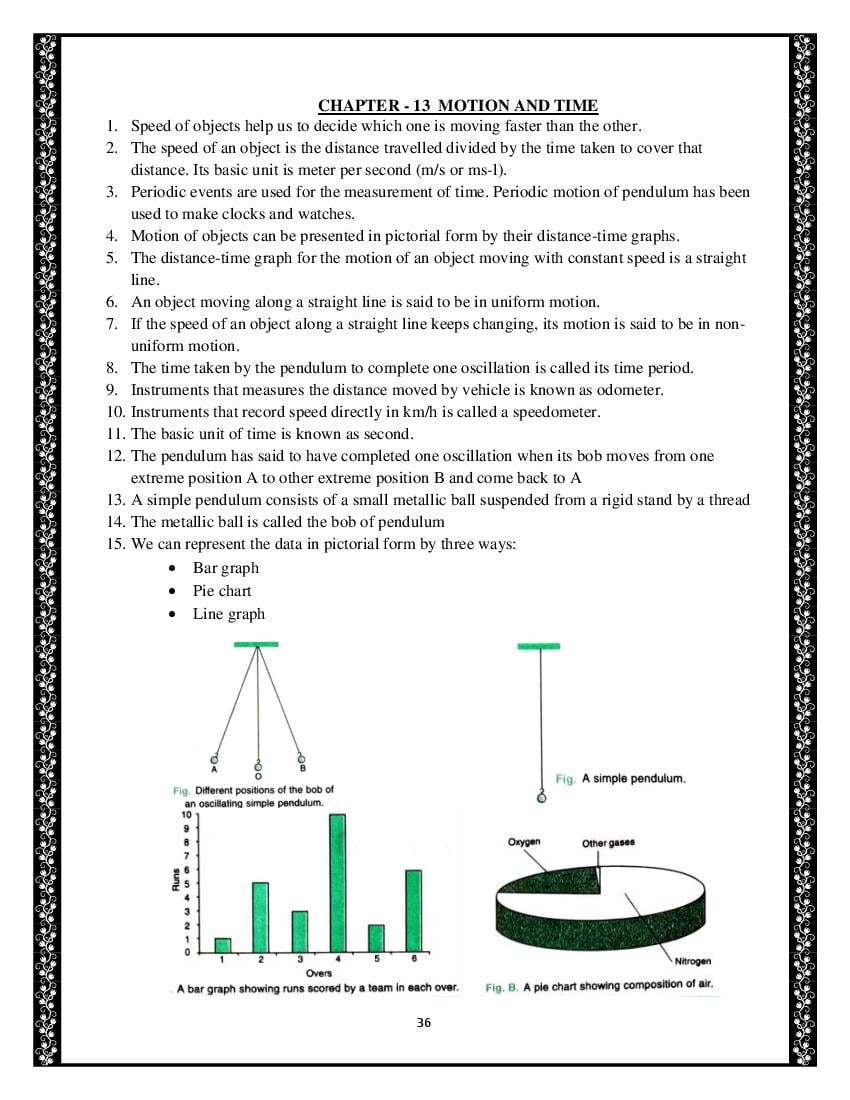
When the bob of a simple pendulum moves from its mean position B to A and back to B
again, then from B to C and back to B again, the pendulum is said to complete 1
oscillation.
In the case of the simple pendulum, the time period is the total time taken by the
pendulum to complete one oscillation.
Time and Speed
Speed (Average Speed)
Speed is the total distance travelled by the object in a given interval of time.
KVS ZIET CHD Class VII-Science 2023-24 Page 55
Page 3
Unit of speed is generally measured in meter per second (m/s), kilometer per hour (km/h).
Uniform and Non-Uniform Motion
1. Uniform motion: When an object moving along a straight line moves with a constant speed,
then the object is said to be in uniform motion.
Eg: A car moving in a straight line with a constant speed.
2. Non-uniform motion: When an object moving along a straight line changes its speed with
respect to time, then the object is said to be in uniform motion.
Eg: The motion of a train.
Measurement of Time
Unit of time is generally measured in seconds, minutes, hours.
The time period is the total time taken by an object to complete one oscillation.
Units of Time
Unit of time is generally measured in seconds, minutes, hours.
Units of Speed
Speed = Distance travelled in the total time interval.
Unit of speed is generally measured in meter per second (m/s) and km/h( kilometer per
hour).
Speedometer and Odometer
Speedometer records the speed of the vehicle directly in kilometer per hour (km/h).
An odometer measures the distance moved by the vehicle directly in kilometers (km).
Distance-time graph
Distance-time graph is the graph plotted between the distance ( in y-axis) and time ( in x-
axis).
The slope of a distance-time graph gives the speed of an object.
SOME IMPORTANT QUESTIONS
1. Classify the following as motion along a straight line, circular or oscillatory motion:
(i) Motion of your hands while running.
(ii) Motion of a horse pulling a cart on a straight road.
(iii) Motion of a child in a merry-go-round.
(iv) Motion of a child on a see-saw.
(v) Motion of the hammer of an electric bell.
(vi) Motion of a train on a straight bridge.
i) Oscillatory ii) Motion along a straight line iii) Circular motion iv) Oscillatory motion
v) Oscillatory motion vi) Motion along a straight line.
2. Which of the following are not correct?
(i) The basic unit of time is second.
(ii) Every object moves with a constant speed.
(iii) Distances between two cities are measured in kilometres.
KVS ZIET CHD Class VII-Science 2023-24 Page 56
Page 4
(v) The speed of a train is expressed in m/h.
Incorrect statements are:
(ii) Every object moves with a constant speed.
(iv) The time period of a given pendulum is constant.
(v) The speed of a train is expressed in m/h.
3. A simple pendulum takes 32 s to complete 20 oscillations. What is the time period of the
pendulum?
Number of oscillations = 20
Total time taken to complete 20 oscillations = 32 s
4. The distance between two stations is 240 km. A train takes 4 hours to cover this distance.
Calculate the speed of the train.
Distance between two stations = 240 kms
Total time take = 4 hrs/240 minutes
= 60 km/h
5. The odometer of a car reads 57321.0 km when the clock shows the time 08:30 AM. What
is the distance moved by the car, if at 08:50 AM, the odometer reading has changed to
57336.0 km? Calculate the speed of the car in km/min during this time. Express the speed
in km/h also.
Initial reading of the odometer = 57321.0
Final reading of the odometer = 57336.0
Distance covered by the car = Final reading of the odometer – Initial reading of the odometer
= 57336.0 – 57321.0 = 15 kms
Starting time of car is 8:30 and it stops at 8:50
Hence, time taken by car = 20 mins
KVS ZIET CHD Class VII-Science 2023-24 Page 57
Page 5
6. Salma takes 15 minutes from her house to reach her school on a bicycle. If the bicycle
has a speed of 2 m/s, calculate the distance between her house and the school.
Time taken by Salma to reach her school by bicycle = 15 mins= 15 x 60 = 90 s
Speed of Salma’s bicycle= 2m/s
Distance covered = speed x time taken
= 2 x 900 = 1800 m
1000m = 1 km
= 1.8 kms
7. Show the shape of the distance-time graph for the motion in the following cases:
(i) A car moving with a constant speed.
(ii) A car parked on a side road.
8. Which of the following relations is correct?
(i) Speed = Distance × Time (ii) Speed = Distance/Time (iii) Speed = Time/Distance
(iv) Speed = 1/Distance x Time
Solution: Answer is (ii) Speed = Distance/Time
KVS ZIET CHD Class VII-Science 2023-24 Page 58
Page 6
(i) km/min (ii) m/min (iii) km/h (iv) m/s
Answer is (iv) m/s
10. A car moves with a speed of 40 km/h for 15 minutes and then with a speed of 60 km/h
for the next 15 minutes. The total distance covered by the car is:
(i) 100 km (ii) 25 km (iii) 15 km (iv) 10 km
The answer is (ii) 25 km
Calculation:
When the speed of the car is 40 km/h
Time taken = 15 min = 15/60 = 0.25 h
Distance covered d1 = speed x time taken
= 40 x 0.25 = 10 kms
When the speed of the car is 60 km/ h
Distance covered d2 = speed x time taken
= 60 x 0.25= 15 kms
Total distance covered by the car = d1 + d2
= 10 + 15
= 25 kms
CHAPTER-10
ELECTRIC CURRENT AND ITS EFFECTS
The flow of electrons across a conductor is known as electric current.
The use of symbols to represent electric components is convenient. A circuit diagram can
be used to represent an electric circuit using these.
When an electric current is passed via a wire, it heats up. It's the current's heating impact.
This effect can be used in a variety of ways.
When enormous electric currents are pushed through wires constructed of specific
materials, they melt quickly and shatter. Electric fuses, which prevent fires and damage to
electrical appliances, are made from these materials.
KVS ZIET CHD Class VII-Science 2023-24 Page 59
Page 7
Notes
Model Papers Class 6 Notes
Sample Papers Class 7 Notes
Half Yearly Sample Papers Class 8 Notes
Class 9 Notes
Important Resources
Class 10 Notes
Periodic Table
Class 11 Notes
Writing Skills / Formats
Maps of India / World Class 12 Notes
Books and Solutions
NCERT Books
NCERT Book Solutions
HC Verma Chapter Wise Solutions
RD Sharma Solutions
CGBSE Solutions
Document Details
| Board / Org | Aglasem |
| Exam | Class 7 |
| Type | Notes |
| Pages | 4 |
| Language | english |
| Updated | 30 Apr 2026 |