TIFR GS 2013 Question Paper Chemistry Y
Finished viewing? Save it for later —
Download TIFR GS 2013 Question Paper Chemistry Y (PDF · 13 pages)About TIFR GS 2013 Question Paper Chemistry Y
TIFR GS 2013 Question Paper Chemistry Y is available here for free download. Published by Default for TIFR GS, this question paper can be viewed online or downloaded as a PDF (13 pages). Candidates preparing for TIFR GS can use TIFR GS 2013 Question Paper Chemistry Y to understand the exam pattern, the type of questions asked, and the overall difficulty level.
Frequently Asked Questions
How can I download TIFR GS 2013 Question Paper Chemistry Y?
Open this page and click the Download button to save TIFR GS 2013 Question Paper Chemistry Y as a PDF. It is completely free on AglaSem Docs.
Is TIFR GS 2013 Question Paper Chemistry Y free to download?
Yes. TIFR GS 2013 Question Paper Chemistry Y can be viewed online and downloaded as a PDF free of cost on AglaSem Docs.
How many pages does TIFR GS 2013 Question Paper Chemistry Y have?
TIFR GS 2013 Question Paper Chemistry Y contains 13 pages, which you can read online or download together as a single PDF.
Where can I find more TIFR GS study material?
You can find more TIFR GS question papers, sample papers, syllabus, and answer keys on AglaSem Docs.
TIFR GS 2013 Question Paper Chemistry Y – Text
Read the full text of this question paper below — useful to quickly search, copy and reference the content online without downloading the PDF.
📄 View text version (13 pages)
Page 1
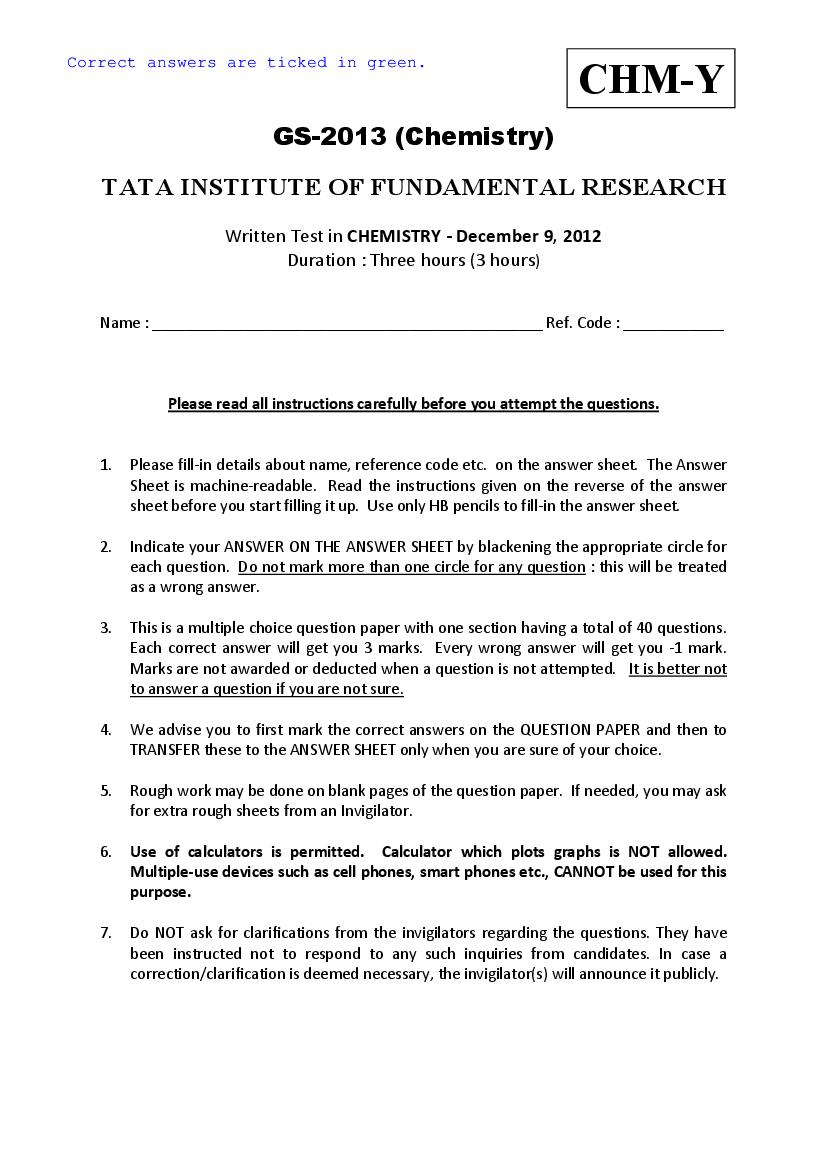
Correct answers are ticked in green.
GS-2013 (Chemistry)
TATA INSTITUTE OF FUNDAMENTAL RESEARCH
Written Test in CHEMISTRY ‐ December 9, 2012
Duration : Three hours (3 hours)
Name : _______________________________________________ Ref. Code : ____________
Please read all instructions carefully before you attempt the questions.
1. Please fill‐in details about name, reference code etc. on the answer sheet. The Answer
Sheet is machine‐readable. Read the instructions given on the reverse of the answer
sheet before you start filling it up. Use only HB pencils to fill‐in the answer sheet.
2. Indicate your ANSWER ON THE ANSWER SHEET by blackening the appropriate circle for
each question. Do not mark more than one circle for any question : this will be treated
as a wrong answer.
3. This is a multiple choice question paper with one section having a total of 40 questions.
Each correct answer will get you 3 marks. Every wrong answer will get you ‐1 mark.
Marks are not awarded or deducted when a question is not attempted. It is better not
to answer a question if you are not sure.
4. We advise you to first mark the correct answers on the QUESTION PAPER and then to
TRANSFER these to the ANSWER SHEET only when you are sure of your choice.
5. Rough work may be done on blank pages of the question paper. If needed, you may ask
for extra rough sheets from an Invigilator.
6. Use of calculators is permitted. Calculator which plots graphs is NOT allowed.
Multiple‐use devices such as cell phones, smart phones etc., CANNOT be used for this
purpose.
7. Do NOT ask for clarifications from the invigilators regarding the questions. They have
been instructed not to respond to any such inquiries from candidates. In case a
correction/clarification is deemed necessary, the invigilator(s) will announce it publicly.
Page 2
Avogadro number = 6.02×10²³ mol-1 e = 1.6×10⁻¹⁹ C
RT/F = 0.0257 V at 25°C h = 6.626×10⁻³⁴ J⋅s
Faraday constant = 96500 C/mol c = 3×10⁸ m s−1
Boltzmann constant k = 1.38×10⁻²³ J K−1 R = 8.314 J K-1 mol-1
Z2
En = − a.u. for hydrogen like atom
2n 2
Mass of an electron = 9.109×10⁻³¹ kg
8kT
Average velocity =
π ⋅m
Standard reduction potential of Al3+ + 3e− → Al is −1.66 V at 25°C
Standard reduction potential of Fe2+ + 2e− → Fe is −0.44 V at 25°C
1. Which of the following will be strongest acid in pure liquid HF:
A) H2O
B) SbF5
C) CH3COOH
D) NaF
2. Which of the following experimental observations best demonstrates the wavelike
character of electrons?
A) The photoelectric effect
B) The flow of electrons in a metal wire
C) The diffraction pattern of electrons scattered from a crystalline solid
D) The deflection of an electron beam by electrical plates
3. What terms can arise from the configuration 2p13p1?
A) 3D, 1D, 3P, 1P, 3S, 1S
B) 3D, 3P, 3S
C) 1D, 1P, 1S
D) 1D, 3P, 3S
4. What is the degeneracy of the energy level with n=6 (n being the principal quantum
number) in a hydrogenic atom or ion?
A) 16
B) 9
C) 36
D) 25
Page 1 of 12
Page 3
O2, Cl2 and CN with their cations (AB+) and anions (AB−). Which of the following
statements is correct in general?
A) The equilibrium bond lengths of all AB+ species will be shorter, and
that of all AB− species will be longer than that of the corresponding AB
species.
B) The equilibrium bond lengths of all AB− species will be shorter, and
that of all AB+ species will be longer than that of the corresponding AB
species.
C) The equilibrium bond lengths of O2+, Cl2+ and CN− ions will be shorter
than the corresponding neutral species. The equilibrium bond lengths of
N2+, NO+ and Cl2− ions will be longer than the corresponding neutral
species.
D) The equilibrium bond lengths of O2+, Cl2+ and CN− ions will be longer
than the corresponding neutral species. The equilibrium bond lengths of
N2+, NO+ and Cl2− ions will be shorter than the corresponding neutral
species.
6. The method of initial rates is used to determine the rate law for the reaction given
below.
2NO (g) + 2H2(g) → N2(g) + 2H2O(g)
The following initial rates were determined at the given partial pressures (p) of
reactants.
pNO(mmHg) pH2(mmHg) Initial rate (M/min)
200 400 0.46
400 200 0.92
400 400 1.85
These data imply which of the following rate laws?
A) rate = k pNO pH2
B) rate = k pNO p2H2
C) rate = k p2NO pH2
D) rate = k p2NO p2H2
7. Which of the following molecular species are expected to be paramagnetic? O2+,
O2− and O22− ?
A) All of them
B) Only O2+ and O2−
C) Only O2+ and O22−
D) Only O2− and O22−
Page 2 of 12
Page 4
of them is chiral?
A B
A) A has a 2-fold rotation axis and B has a plane of symmetry; A is chiral
B) A has a plane of symmetry and B has a centre of inversion; B is chiral
C) A has a plane of symmetry and B has a 2-fold rotation axis; A is chiral
D) A has a plane of symmetry and B has a 2-fold rotation axis; B is chiral
9. The speed of a reaction that involves an enzyme increases as
A) Temperature decreases
B) pH becomes less than optimal
C) Substrate concentration increases
D) All of the above
10. The product of the following reaction will be able to couple with which amino
acids?
NH2
acid
+ NaNO2
NO2
O O O
H2N CHC OH H2N CHC OH O
H2N CHC OH
CH2 CH2 H2N CHC OH
CH2
CH2 CH2
CH2 OH
CH2
OH
NH2
Tyrosine Phenylalanine Lysine Serine
A) Tyrosine and Phenylalanine
B) Tyrosine and Serine
C) Lysine and Serine
D) Phenylalanine and Lysine
Page 3 of 12
Page 5
Ni(CO)2(PMe3)2 is B, then
A) A>B
B) A=B
C) A<B
D) None
12. Predict the products of the following condensation reaction where y : x could be
either 1 or 2:
CHO H
N acid
x + y
Argon
NH HN N HN
N HN NH HN
NH N NH HN
A B C D
A) A and D
B) A and B
C) C and D
D) C and B
13. The Friedel-Crafts reactions are common in organic chemistry. Which of the
following is expected to be a better catalyst?
A) AlBr3
B) AlI3
C) AlCl3
D) MgCl2
14. Which of the following statements is always true regarding conductors and semi-
conductors?
A) Semi-conductors are half as good as conductors when comparing their
electron mobility.
B) Conductors have large band gaps and semi-conductors have small band
gaps.
C) Conductors and semi-conductors do not conduct electricity at high
temperatures.
D) None of the above statements are true.
Page 4 of 12
Page 6
determined at various temperatures.
(i) C(s) + O2(g) → CO2(g)
(ii) C(s) + ½O2(g) → CO(g)
(iii) CO(g) + ½O2(g) → CO2(g)
Which of the following plots would represent most likely the temperature
dependence of ΔG0?
(iii)
(iii)
(i)
(A) (B) (i)
(ii)
ΔG0
(ii)
ΔG0
T T
(i) (ii)
(C) (ii) (D) (iii)
(iii) (i)
ΔG0
ΔG0
T T
16. The reaction of sodium ethoxide with ethyliodide to form diethyl ether is termed
A) electrophilic substitution
B) nucleophilic substitution
C) electrophilic addition
D) radical substitution
17. Compound 1 reacts with vinyl Grignard reagent to give two compounds A and B
after hydrolysis. A gives compound 2 upon heating. Predict the structure of A.
OH O
A) B) C) O
D) HO
Page 5 of 12
Page 7
A) C2h
B) C2v
C) D2h
D) D2d
19. Which of the following statements is true regarding amphiphilic molecules?
A) An amphiphilic molecule consists of both a positive charge and a
negative charge.
B) Amphiphilic molecules show spontaneous aggregation behaviour in
any solvent and at all concentrations.
C) Amphiphilic molecules are insoluble in water.
D) Amphiphilic molecules are known to form liquid crystals.
20. Using crystal field theory, determine the type of d-orbital(s) which will have the
lowest energy in the complex shown below. Based on the above, determine the
comparative rates of reduction of the Mn(V) to Mn(IV) versus Mn(IV) to Mn(III)
states.
A) (dxy); Mn(V) to Mn(IV) is slower than Mn(IV) to Mn(III)
B) (dxy,dyz,dzx); Mn(V) to Mn(IV) is slower than Mn(IV) to Mn(III)
C) (dz2, dx2-y2); Mn(V) to Mn(IV) is faster than Mn(IV) to Mn(III)
D) (dxy); Mn(V) to Mn(IV) is faster than Mn(IV) to Mn(III)
21. Which statement is true of the ground state of the Co2+ ion?
A) The number of unpaired electrons is 0 and the Co2+ ion is paramagnetic.
B) The number of unpaired electrons is 0 and the Co2+ ion is not
paramagnetic.
C) The number of unpaired electrons is 3 and the Co2+ ion is paramagnetic.
D) The number of unpaired electrons is 3 and the Co2+ ion is not
paramagnetic.
22. How many molecules of cetanol (of cross-sectional area 2.58 10-19 m2) can be
adsorbed on the surface of a spherical drop of dodecane of diameter 35.6 nm?
A) 6.16 104
B) 1.23 103
C) 1.54 104
D) 4.90 103
Page 6 of 12
Page 8
sized gold nanoparticles. A student experimented with the following synthesis:
1-nonanethiol (C9H19SH) and HAuCl4 were first mixed (in a molar ratio of 10:1),
and then gold ions were reduced by slowly adding NaBH4. In this synthesis, after
2 hours no precipitate was observed and only a very faint pink colloidal solution
was obtained. This solution was then evaporated onto a glass slide and the sample
characterized by X-ray diffraction.
Given below are three XRD patterns. One out of these three patterns was obtained
by the student when he/she characterized the sample on the glass slides. Which
statement below is true?
A) The synthesis did not yield gold nanoparticles as there was no
precipitate. Therefore, the XRD pattern that will be obtained is that
shown as curve (c) – It is almost a flat baseline indicating no product.
B) 5 nm gold nanoparticles were formed and XRD pattern shown as (a)
represents the product. It signifies that the nanoparticles are crystalline
and the face-centered cubic (fcc) crystal structure can be clearly used
to index the peaks.
C) 5 nm gold nanoparticles will show size-dependent line broadening and
therefore if the product consisted of such particles, then curve (b) will
be obtained.
D) None of the above statements are true.
24. Consider a classical harmonic oscillator with a mass m and a force constant k
oscillating with a frequency ν. Which of the following statements is NOT true for
this system?
A) ν increases if m decreases.
B) The oscillator is most likely to be found at its equilibrium position.
C) The acceleration is maximum at its turning points.
D) ν does not depend on how large the amplitude of the oscillation is.
Page 7 of 12
Page 9
chemical potential for generation of proton gradients across membranes. Suppose
photosynthesis is only 0.5% efficient in creating such gradients, calculate how many
530 nm photons will be required to create a pH gradient (per mole) as shown below
across a cellular membrane under ambient temperature of 300 K?
A) 1000 photons
B) 1010 photons
C) 10 photons
D) 6 1023 photons
26. What is the result of the following reaction?
A)
B)
C) Reaction is unfavourable under given reagents
D) A and B both are plausible
27. What are the limits of detection of the following common analytical methods used
with capillary separations: fluorescence, mass spectrometry, UV-vis absorbance,
and NMR, respectively, in mol?
A) 10-18-10-23, 10-13-10-21, 10-13-10-16, 10-9-10-11
B) 10-13-10-21, 10-18-10-23, 10-13-10-16, 10-9-10-11
C) 10-18-10-23, 10-13-10-21, 10-9-10-11, 10-13-10-16
D) 10-13-10-21, 10-13-10-16, 10-18-10-23, 10-9-10-11
Page 8 of 12
Page 10
diatomic molecule. If the harmonic potential is suddenly transformed into Morse
potential shown in dashed-line how would the zero point energy and shape of
wavefunctions change?
A) Zero-point energy remains the same and wavefunctions do not change.
B) Zero-point energy remains the same but wavefunction reflects a change
on the high Q side.
C) Zero-point energy changes and wavefunction reflects a change on the
high Q side.
D) Potentials never reflect any change in the shape of the wavefunction
29. The cell potential for the following electrochemical system at 25 0C is:
Al(s) | Al3+ (0.01 M) || Fe2+ (0.1 M) | Fe(s)
A) 1.23 V
B) 1.21 V
C) 1.22 V
D) −2.10 V
30. Given three systems, A, B, and C, what could be they if the spacing between the
neighbouring energy levels in A decreases with increasing energy, while that for B
is constant, and that for C increases with increasing energy?
A) A= particle in a one-dimensional box, B= harmonic oscillator,
C=electron in hydrogen atom
B) A= electron in hydrogen atom, B= harmonic oscillator, C= particle in a
one-dimensional box
C) A= particle in a one-dimensional box, B= electron in hydrogen atom,
C= harmonic oscillator
D) A= electron in hydrogen atom, B= particle in a one-dimensional box,
C= harmonic oscillator
Page 9 of 12
Page 11
parameter was determined to be 4.29 Å. If the density of the element is known to be
0.968 g/cm3, how many atoms are present in each unit cell?
A) Not enough information is given to calculate the value.
B) 1
C) 2
D) 3
32. Electrospray ionization mass spectroscopy produces multiply charged ions of
proteins. On application of this technique to hemeprotein it gave a large number of
peaks corresponding to different charge-states of the protein. The three consecutive
peaks are observed at the m/z values:
2061, 1767, 1546
The approximate m/z value of the consecutive fourth peak in the series would be:
A) 1252
B) 1374
C) 1498
D) 1325
33. A is a 5×5 matrix with elements aij = aji. Its eigenvalues are 0, ±1 and ±2. Which
of the following statements best describes the properties of the matrix A?
A) A can be diagonalized by a unitary transformation.
B) A can be diagonalized by an orthogonal transformation.
C) A cannot be inverted.
D) All of the above.
34. Real gases behave differently from ideal gases because:
(i) the molecules of real gases are in constant motion.
(ii) molecules of real gases collide with the walls of the container.
(iii) molecules of real gases have volume.
(iv) molecules of real gases attract each other.
A) i and ii
B) iii only
C) iii and iv
D) all of the above
Page 10 of 12
Page 12
equilibrium at 330 K.
CO(g) + H2O(g) Φ CO2(g) + H2(g) ΔH0 = −41.2 kJ
The temperature of the vessel is then increased to 350 K. Which of the following
statement is correct before the reaction reaches a new equilibrium at this elevated
temperature?
A) The rate constant of the forward reaction will decrease, and the rate
constant of the reverse reaction will increase.
B) Concentrations of all the species will increase, but increase will be
more for the reactants than that for the products.
C) Both A and B.
D) None of the above.
36. Global warming is due to increase of
A) Methane in atmosphere
B) CO2 in atmosphere
C) Water vapour
D) Methane and CO2
37. The state of 2 moles of an ideal gas is changed from the point A to the point B
along three different paths, as shown in the following P-V diagram. If the change of
entropy of the gas in changing its state from state A to B along the path i is denoted
ΔSi, then which of the following statements is correct?
A 1
1
2
B
3
P
3
V
A) ΔS1 > ΔS2 > ΔS3
B) ΔS1 < ΔS2 < ΔS3
C) ΔS1 ≠ ΔS2 ≠ ΔS3
D) ΔS1 = ΔS2 = ΔS3
38. A reaction has a negative (and approximately temperature independent) enthalpy
change. It does not proceed spontaneously at room temperature (25 0C). At which
of the following temperatures is the reaction more likely to become spontaneous?
A) −50 0C
B) 50 0C
C) 100 0C
D) 1000 0C
Page 11 of 12
Page 13
neighbour interactions between sites, the Hamiltonian for a cluster of three Na
atoms in linear and triangular forms is written as:
Assuming the nearest neighbour coupling β < 0, which form (linear or triangular)
of the cluster is more probable for neutral Na3 and for the anion Na3− ?
A) Linear for Na3 and triangular for Na3−
B) Linear for both
C) Triangular for Na3 and linear for Na3−
D) Triangular for both
40. The 1H NMR spectrum of a compound with molecular formula C3H7NO shows
the following features:
Chemical shift (ppm) 6.50 2.25 1.10
Shape broad singlet quartet triplet
Which of the following is in agreement with this information?
A) (CH3)2C=NOH
B) CH3COCH2NH2
C) CH3CH2CONH2
D) HCON(CH3)2
The following question does NOT carry any marks and is given to collect
information only:
41. How much time did you take to complete this chemistry exam?
A) Less than 1 hour.
B) Between 1 to 2 hours.
C) Between 2 to 3 hours.
D) Insufficient time was given.
Page 12 of 12
Document Details
| Board / Org | Default |
| Exam | TIFR GS |
| Type | Question Paper |
| Pages | 13 |
| Updated | 22 Jul 2026 |