Class 7 Science Notes for Electric Current and Its Effect
Finished viewing? Save it for later —
Download Class 7 Science Notes for Electric Current and Its Effect (PDF · 4 pages)About Class 7 Science Notes for Electric Current and Its Effect
Class 7 Science Notes for Electric Current and Its Effect is available here for free download. Published by AglaSem for Class 7, this notes can be viewed online or downloaded as a PDF (4 pages). Candidates preparing for Class 7 can use Class 7 Science Notes for Electric Current and Its Effect to understand the exam pattern, the type of questions asked, and the overall difficulty level.
Frequently Asked Questions
How can I download Class 7 Science Notes for Electric Current and Its Effect?
Open this page and click the Download button to save Class 7 Science Notes for Electric Current and Its Effect as a PDF. It is completely free on AglaSem Docs.
Is Class 7 Science Notes for Electric Current and Its Effect free to download?
Yes. Class 7 Science Notes for Electric Current and Its Effect can be viewed online and downloaded as a PDF free of cost on AglaSem Docs.
How many pages does Class 7 Science Notes for Electric Current and Its Effect have?
Class 7 Science Notes for Electric Current and Its Effect contains 4 pages, which you can read online or download together as a single PDF.
Where can I find more Class 7 study material?
You can find more Class 7 question papers, sample papers, syllabus, and answer keys on AglaSem Docs.
Class 7 Science Notes for Electric Current and Its Effect – Text
Read the full text of this notes below — useful to quickly search, copy and reference the content online without downloading the PDF.
📄 View text version (7 pages)
Page 1
CLASS 7
SCIENCE
Study Material
DOWNLOAD PDF
Page 2
The flow of electrons across a conductor is known as electric current.
The use of symbols to represent electric components is convenient. A circuit diagram can
be used to represent an electric circuit using these.
When an electric current is passed via a wire, it heats up. It's the current's heating impact.
This effect can be used in a variety of ways.
When enormous electric currents are pushed through wires constructed of specific
materials, they melt quickly and shatter. Electric fuses, which prevent fires and damage to
electrical appliances, are made from these materials.
KVS ZIET CHD Class VII-Science 2023-24 Page 59
Page 3
battery is a collection of two or more cells in this configuration.
A wire acts like a magnet when an electric current travels through it.
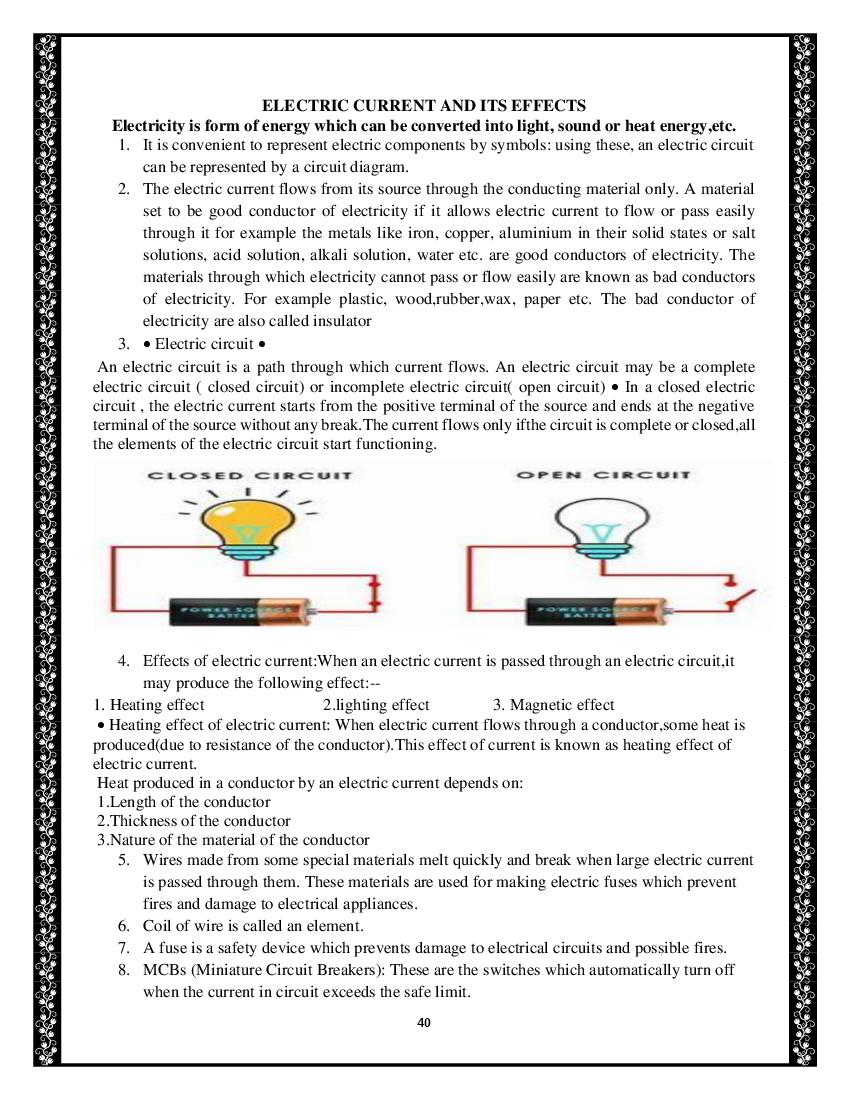
A full path for the flow of electric current is referred to as an electric circuit.
Components of an Electric Circuit: The following are components of an electric circuit:
I. Cell: A cell is a device that provides energy to allow current to flow.
II. Bulb: When an electric current passes through it, it illuminates.
III. Switch: Turns on or off the circuit.
IV. Connecting Wires: These wires assist in the conduct of electric current and the
completion of the circuit.
Electric Current's Effects:
I. Heating Effect: When an electric current runs through a wire, it heats up. This is the
electric current's heating impact. When current travels through an electric heater, a coil of wire
called the element gets red hot. The quantity of heat generated by a wire is determined by the
material, length, and thickness of the wire.
II. Fuse: A fuse is a safety device that protects an electric circuit from harm. A small wire is
inserted into porcelain or insulating material to create it.
III. MCB: The abbreviation MCB stands for Miniature Circuit Breakers. When the current in
a circuit reaches the safe limit, these switches automatically turn off.
Magnetic effect occurs when an electric current travels across a wire. This is the electric
current's magnetic effect. Hans Christian Oersted was the first to notice this.
An electromagnet is a current-carrying coil of insulated wire wound around a piece of
iron. It is a wire coil wound on a soft iron core that is used to separate magnetic material
from garbage. Small electromagnets are used by doctors to remove small bits of magnetic
material that have accidentally fallen into the eye. Electromagnets are also found in many
toys.
SOME IMPORTANT QUESTIONS
1. What is a circuit diagram?
Answer: It is a symbolic representation of an electric circuit.
2. Which property of a conducting wire is utilised in making electric fuse?
Answer: Low melting point of the wire.
3. What is electric current?
Answer: Electric current is flow of electrons.
4. Why does light bulb get hot?
Answer: Light bulb gets hot due to heating effect of the electric current.
5. Who discovered magnetic effect of current?
KVS ZIET CHD Class VII-Science 2023-24 Page 60
Page 4
6. How does a bulb glow?
Answer: In the bulb there is a thin wire, called the filament, which glows and gives off light
when an electric current passes through it.
7. Write some uses of battery.
Answer: Many devices such as torches, transistors, toys, TV remote controls, use batteries.
8. Which wire used in electric heater and why?
Answer: Nichrome wire is used in electric heater because it has a high melting temperature.
9. What is filament?
Answer: In the bulb there is a thin wire, called the filament, which glows when an electric
current passes through it.
10. Is it possible for a wire to melt and break? Why?
Answer: Yes, if a large current passes through a wire, the wire may become so hot that it may
even melt and break.
SOME EXTRA QUESTIONS
1. What is the heating effect of the electric current?
Answer: The wire gets hot when an electric current passes through it. This is the heating effect
of the electric current.
2. Who invented electric bulb?
Answer: The credit for the invention of the electric bulb is usually given to Thomas Alva
Edison, though others before him had worked on it.
3. What are the uses of heating effect of electric current?
Answer: Electrical appliances, such as immersion heaters, hotplates, irons, geysers, electric
kettles, hair dryers uses of heating effect of electric current.
4. Explain the symbol of electric cell.
Answer: In the symbol of the electric cell, the longer line represents the positive terminal and
the thicker, shorter line represents the negative terminal.
5. Name any two effects of electric current.
Answer: The two effects of electric current are:
Heating effect of electric current
Magnetic effect of the electric current
6. Why are fuse wires not used in circuit containing electric cell?
Answer: Fuse wires are not used in circuit containing electric cell because the amount of current
follow is low and if the circuit breaks there is no risk of fire.
7. What is an electric circuit?
Answer: The electric circuit provides a closed path for electricity to pass between the two
terminals of the electric cell. The bulb glows only when current flows through the circuit.
8. We could not see element in electrical appliances. Give reason.
KVS ZIET CHD Class VII-Science 2023-24 Page 61
Page 5
immersion heaters, hotplates, irons, geysers, electric kettles, hair dryers, have elements inside
them.
9. Why a fused bulb does not glow?
Answer: A break in the filament of an electric bulb means a break in the path of the current
between the terminals of the electric cell. Therefore, a fused bulb will not glow as current does
not passes through its filament.
10. Sometimes the cells are placed side by side. Then how are the terminals of the cells
connected?
Answer: There is usually a thick wire or a metal strip connecting the positive terminal of one
cell to the negative terminal of the next cell.
11. Why should we look for ISI mark on electrical appliances?
Answer: Before buying any electrical appliance we should look for ISI mark because this mark
ensures that the appliance is safe and wastage of energy is the minimum.
12. On what factors does the heat produced in a wire depend?
Answer: The amount of heat produced in a wire depends on its material, length and thickness.
Thus, for different requirements, the wires of different materials and different lengths and
thicknesses are used.
13. What is battery? How can it be made using cells?
Answer: A combination of two or more cells is called a battery. Battery can be made by
connecting two or more cells together. The positive terminal of one cell is connected to the
negative terminal of the next cell.
14. Do you think an electromagnet can be used for separating plastic bags from a garbage
heap? Explain.
Answer: No, an electromagnet cannot be used for separating plastic bags from a garbage heap
because plastic bag is a non-magnetic material and will not be attracted by an electromagnet.
LONG QUESTIONS
1. What are electromagnets?
Answer: A core of magnetic material (such as iron) surrounded by a coil of wire behaves like a
magnet when electric current flows through it. When the electric current is switched off, the coil
generally loses its magnetism. Such coils are called electromagnets.
2. How does a heating element work in an electric heater?
Answer: An electric room heater or an electric heater used for cooking. All these contain a coil
of wire. This coil of wire is called an element. When these appliances are switched on after
connecting to the electric supply, their elements become red hot and give out heat.
3. What is MCB and what is it used for?
Answer: These days Miniature circuit breakers (MCBs) are increasingly being used in place of
fuses. These are switches which automatically turn off when current in a circuit exceeds the safe
limit. We can turn them on and the circuit is once again complete.
KVS ZIET CHD Class VII-Science 2023-24 Page 62
Page 6
piece of wire. Would you agree? Give reasons for your response.
Answer: No, electrician should not replace a fuse by a piece of wire because for fuse, wires
made from some special materials are used so that it melt quickly and break when large electric
currents passes through them.
5. What are the reasons for excessive currents in the electrical circuits?
Answer: One reason for excessive currents in electrical circuits is the direct touching of wires.
This may happen if the insulation on the wires has come off due to wear and tear. This may
cause a short circuit. Another reason for excessive current can be the connection of many devices
to a single socket. This may cause overload in the circuit.
6. An electric bulb results in wastage of electricity. Comment
Answer: An electric bulb is used for light but it also gives heat. This is not desirable. This results
in the wastage of electricity. This wastage can be reduced by using fluorescent tube lights in
place of the bulbs. Compact fluorescent lamps (CFLs)/ Light Emitting Diode (LED) also
reduce wastage and can be fixed in the ordinary bulb holders.
7. What is the use of electrical fuse?
Answer: In all buildings fuses are inserted in all electrical circuits. There is a maximum limit on
the current which can safely flow through a circuit. If by accident the current exceeds this safe
limit, the wires may become overheated and may cause fire. If a proper fuse is there in the
circuit, it will blow off and break the circuit. A fuse is thus a safety device which prevents
damages to electrical circuits and possible fires.
CHAPTER-11
LIGHT
Light is a naturally occurring substance that enhances vision and makes objects visible.
Light follows a straight path.
A mirror can be made out of any polished or gleaming surface.
A true image is one that can be obtained on a computer screen. It's made up of light rays
that pass through the screen.
A virtual image is an image that cannot be obtained on a screen. It's made up of light rays
that appear to travel right through the screen.
A planar mirror produces an erect picture. It's a virtual object that's the same size as the
real thing. The picture behind the mirror is the same size as the object in front of it.
KVS ZIET CHD Class VII-Science 2023-24 Page 63
Page 7
Notes
Model Papers Class 6 Notes
Sample Papers Class 7 Notes
Half Yearly Sample Papers Class 8 Notes
Class 9 Notes
Important Resources
Class 10 Notes
Periodic Table
Class 11 Notes
Writing Skills / Formats
Maps of India / World Class 12 Notes
Books and Solutions
NCERT Books
NCERT Book Solutions
HC Verma Chapter Wise Solutions
RD Sharma Solutions
CGBSE Solutions