PSEB 2nd Class Syllabus 2027 English
Finished viewing? Save it for later —
Download PSEB 2nd Class Syllabus 2027 English (PDF · 3 pages)About PSEB 2nd Class Syllabus 2027 English
PSEB 2nd Class Syllabus 2027 English is available here for free download. Published by Punjab Board for Class 2, this syllabus can be viewed online or downloaded as a PDF (3 pages). Candidates preparing for Class 2 can use PSEB 2nd Class Syllabus 2027 English to understand the exam pattern, the type of questions asked, and the overall difficulty level.
Frequently Asked Questions
How can I download PSEB 2nd Class Syllabus 2027 English?
Open this page and click the Download button to save PSEB 2nd Class Syllabus 2027 English as a PDF. It is completely free on AglaSem Docs.
Is PSEB 2nd Class Syllabus 2027 English free to download?
Yes. PSEB 2nd Class Syllabus 2027 English can be viewed online and downloaded as a PDF free of cost on AglaSem Docs.
How many pages does PSEB 2nd Class Syllabus 2027 English have?
PSEB 2nd Class Syllabus 2027 English contains 3 pages, which you can read online or download together as a single PDF.
Where can I find more Class 2 study material?
You can find more Class 2 question papers, sample papers, syllabus, and answer keys on AglaSem Docs.
PSEB 2nd Class Syllabus 2027 English – Text
Read the full text of this syllabus below — useful to quickly search, copy and reference the content online without downloading the PDF.
📄 View text version (4 pages)
Page 1
PSEB 2nd Class
Syllabus 2027 English
EXAM YEAR TYPE SUBJECT
Punjab Class 2 2027 Syllabus English
Notes · Sample Papers · Previous Year Papers · Mock Tests
Page 2
e m
em l a s
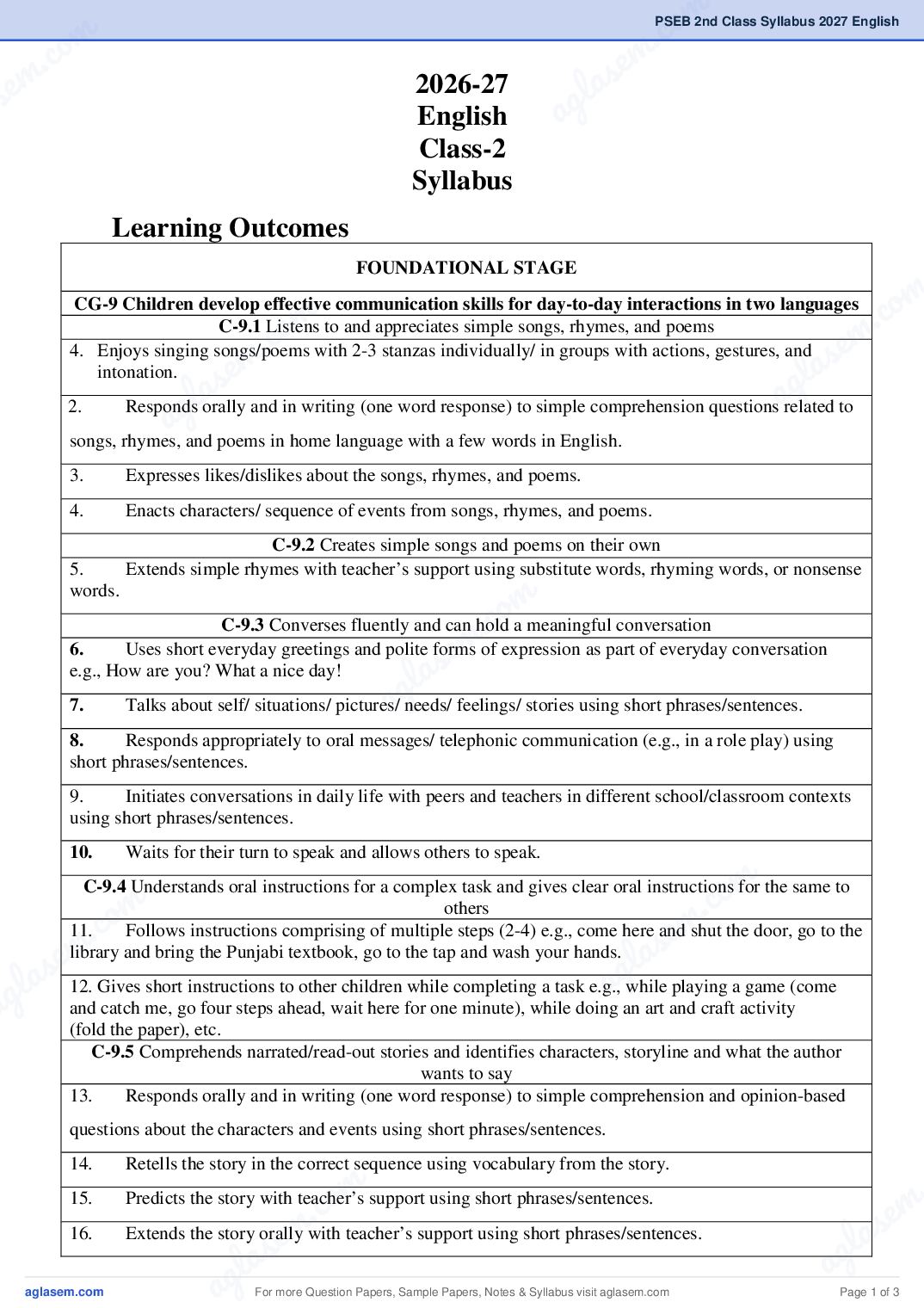
s 2026-27
English ag
Class-2
Syllabus
m
FOUNDATIONAL STAGE
co
m .co
CG-9 Children develop effective communication skills for day-to-day interactions in two languages
. e m
s
C-9.1 Listens to and appreciates simple songs, rhymes, and poems
em la
s
4. Enjoys singing songs/poems with 2-3 stanzas individually/ in groups with actions, gestures, and
intonation.
a g
orally and in writing (one word response) to simple comprehension questionsarelated to
l
2.
a g
Responds
songs, rhymes, and poems in home language with a few words in English.
3. Expresses likes/dislikes about the songs, rhymes, and poems.
4. Enacts characters/ sequence of events from songs, rhymes, and poems.
C-9.2 Creates simple songs and poems on their own
5. Extends simple rhymes with teacher’s support using substitute words, rhyming words, or nonsense
m
co
words.
.
em
C-9.3 Converses fluently and can hold a meaningful conversation
6.
a s
Uses short everyday greetings and polite forms of expression as part of everyday conversation
l
g
e.g., How are you? What a nice day!
7. a
Talks about self/ situations/ pictures/ needs/ feelings/ stories using short phrases/sentences.
8. Responds appropriately to oral messages/ telephonic communication (e.g., in a role play) using
short phrases/sentences.
9. Initiates conversations in daily life with peers and teachers in different school/classroom contexts
using short phrases/sentences.
10.
m
Waits for their turn to speak and allows others to speak.
C-9.4 Understands oral instructions for a complex task and gives clear oral instructions for the same to
c. o e m
others
em
11.
a s
Follows instructions comprising of multiple steps (2-4) e.g., come here and shut the door, go to the
l
s
la 12. g
library and bring the Punjabi textbook, go to the tap and wash your hands.
g a while playing a game (come
a
Gives short instructions to other children while completing a task e.g.,
and catch me, go four steps ahead, wait here for one minute), while doing an art and craft activity
(fold the paper), etc.
C-9.5 Comprehends narrated/read-out stories and identifies characters, storyline and what the author
wants to say
13. Responds orally and in writing (one word response) to simple comprehension and opinion-based
questions about the characters and events using short phrases/sentences.
m .
14. Retells the story in the correct sequence using vocabulary from the story.
15.
Predicts the story with teacher’s support using short phrases/sentences.
s e m
semwith teacher’s support using short phrases/sentences. g l a
la
16. Extends the story orally
g a
a For more Question Papers, Sample Papers, Notes & Syllabus visit Page 1 of 3
Page 3
17. Narrates own short stories with simple plots and characters using short phrases/sentences.
C-9.7 Knows and uses enough words to carry out day-to-day interactions effectively and can guess
meaning of new words by using existing vocabulary
18. Uses vocabulary related to specific themes/topics e.g., seasons, days of the week, months of the
year, etc., in everyday conversations.
19. Uses an expanded range of nouns, verbs, adjectives, adverbs, pronouns, and prepositions in everyday
conversations.
20. Infers the meanings of unfamiliar words with the help of pictures.
CG-11 Children begin to read and write in Language 2 (L2)
C-11.1 Develops phonological awareness and are able to blend Phonemes /syllables into words and
segment words into phonemes/syllables
21. Notices and produces sound words (onomatopoeic words) related to their environment e.g.,
dripping of water – tap-tap, tip-tip; knocking on the door – tak-tak, dham-dham…
22. Produces two syllabic rhyming words e.g. funny, sunny, bunny, etc.
23. Produces alliterations e.g., Bebe bought a big book.
24. Breaks 3-4 syllabic words by clapping, tapping, etc.
25. Identifies words beginning with the same sound and can make word webs/ word chains
26. Produces words with common blends like pl-, sl-, cr-, pr-, st-, sp-, sn-, sc-, sk-, sm-, sw-, etc. (and
class 1 sounds get revised).
C-11.2 Recognizes most frequently occurring letters of the alphabet (forms of akshara) of the script
and uses this knowledge to read and write simple words and sentences
27. Participates in shared/collaborative reading of big books, story charts, textbook, etc., with teacher
and other children.
28. Decodes short, unfamiliar words using knowledge of sound-letter correspondence.
29. Reads short sentences with picture cues.
30. Uses knowledge of sound-letter correspondence to invent spellings e.g., ‘lyk’ for ‘like’ and
‘bathrum’ for ‘bathroom’.
31. Uses small and capital letters appropriately in writing.
32. Completes/writes short sentences using familiar words.
For more Question Papers, Sample Papers, Notes & Syllabus visit Page 2 of 3
Page 4
s em
em
Contents
s g laand I
a using Vowel ‘a’
Chapter 1 My Family
Theme 1 My Family and I Chapter 2 Words
Chapter 3 Words using Vowel ‘e’
Chapter 4 Words using Vowel ‘i’
Theme 2 My Neighbourhood Chapter 5 Words using Vowel ‘o’
Chapter 6 Words using Vowel ‘u’
Chapter 7 Use of a/an
m
.co
Chapter 8 Blends
m
co m
Chapter 9 This/That/These/Those
m . s e
la
Theme 3 Things We Do Chapter 10 Let’s Read and Understand
s e g
a a
Chapter 11 In/On/Under/Behind/Between
l
ag Nature
Chapter 12 Things We Use
Theme 4 Chapter 13 Going to a Zoo
Chapter 14 A Pet Hen
Theme 5 Festivals Chapter 15 Holi
Book prescribed by Punjab School Education Board
RAINBOW ( English Class – II)
m
. co
em
2026-27
a s
lClass-3
English
g
a Syllabus
PREPARATORY STAGE
CG-1 Sustains effective communication skills for day-to-day interactions, enhancing their oral ability
to express ideas
m
C-1.1 Listens to poems, stories, and convrsations and locates important ideas in them
1. Enjoys reciting poems with appropriate intonation and pronunciation individually/ in groups.
c. o 2. Enjoys listening to short stories and conversations.
s e m
s e3.m Shares learnings from the story based on personal experiences. gla
gla 4. Expresses likes/dislikes about the poems and stories and explainsathe reason.
a C-1.3 Converses meaningfully and coherently
5. Uses everyday greetings and polite forms of expression as part of longer conversations e.g., How do
you feel today? Can you please give me your eraser?
6. Narrates daily life experiences using short phrases/sentences and asks why questions.
7. Responds appropriately to oral messages/ telephonic communication (e.g., in a role play) through
elaborate conversations.
o m m .
c
. and allows others to speak. e
8. Maintains the thread/sequence of a conversation using short phrases/sentences.
Waits for their turn to m
e l a s
s g
9. speak
g l a a
a For more Question Papers, Sample Papers, Notes & Syllabus visit Page 3 of 3