ISC Class 12 Syllabus 2023 Hospitality Management (Revised)
Finished viewing? Save it for later —
Download ISC Class 12 Syllabus 2023 Hospitality Management (Revised) (PDF · 3 pages)About ISC Class 12 Syllabus 2023 Hospitality Management (Revised)
ISC Class 12 Syllabus 2023 Hospitality Management (Revised) is available here for free download. Published by CISCE for Class 12, this syllabus can be viewed online or downloaded as a PDF (3 pages). Candidates preparing for Class 12 can use ISC Class 12 Syllabus 2023 Hospitality Management (Revised) to understand the exam pattern, the type of questions asked, and the overall difficulty level.
Frequently Asked Questions
How can I download ISC Class 12 Syllabus 2023 Hospitality Management (Revised)?
Open this page and click the Download button to save ISC Class 12 Syllabus 2023 Hospitality Management (Revised) as a PDF. It is completely free on AglaSem Docs.
Is ISC Class 12 Syllabus 2023 Hospitality Management (Revised) free to download?
Yes. ISC Class 12 Syllabus 2023 Hospitality Management (Revised) can be viewed online and downloaded as a PDF free of cost on AglaSem Docs.
How many pages does ISC Class 12 Syllabus 2023 Hospitality Management (Revised) have?
ISC Class 12 Syllabus 2023 Hospitality Management (Revised) contains 3 pages, which you can read online or download together as a single PDF.
Where can I find more Class 12 study material?
You can find more Class 12 question papers, sample papers, syllabus, and answer keys on AglaSem Docs.
ISC Class 12 Syllabus 2023 Hospitality Management (Revised) – Text
Read the full text of this syllabus below — useful to quickly search, copy and reference the content online without downloading the PDF.
📄 View text version (3 pages)
Page 1
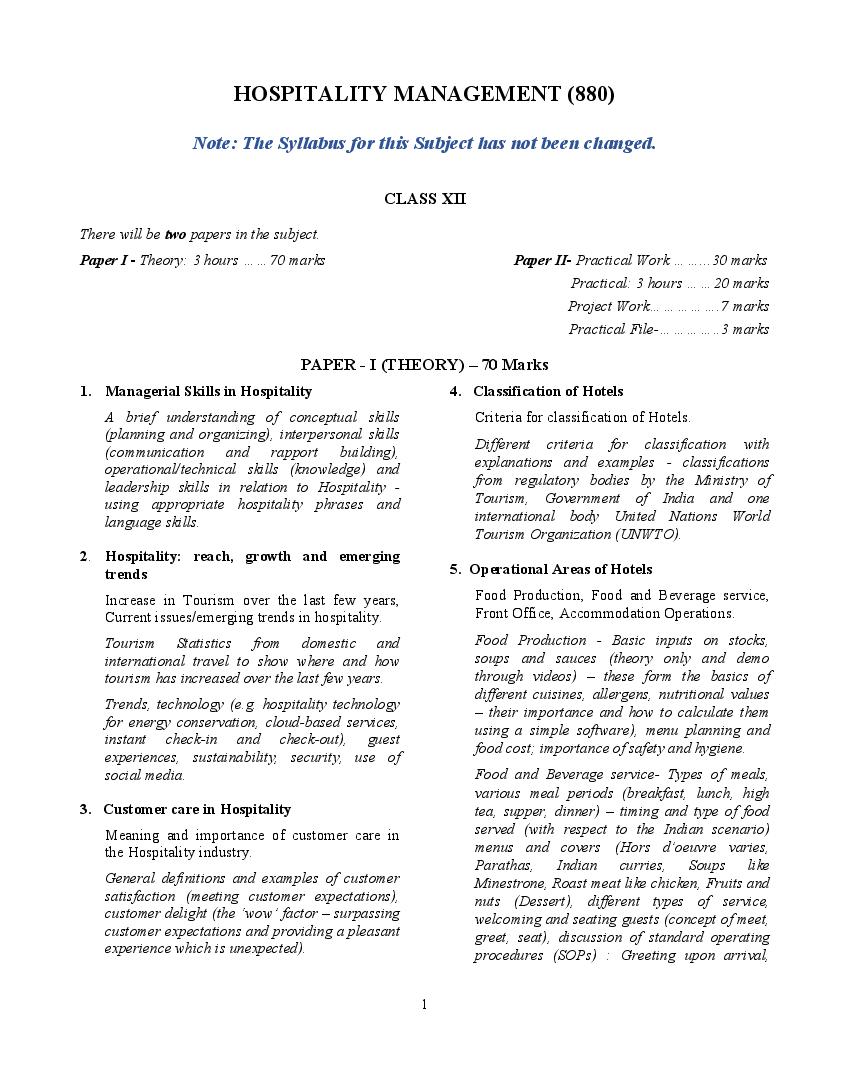
Note: The Syllabus for this Subject has not been changed.
CLASS XII
There will be two papers in the subject.
Paper I - Theory: 3 hours ……70 marks Paper II- Practical Work ……...30 marks
Practical: 3 hours ……20 marks
Project Work…………….7 marks
Practical File-…………..3 marks
PAPER - I (THEORY) – 70 Marks
1. Managerial Skills in Hospitality 4. Classification of Hotels
A brief understanding of conceptual skills Criteria for classification of Hotels.
(planning and organizing), interpersonal skills
Different criteria for classification with
(communication and rapport building),
operational/technical skills (knowledge) and explanations and examples - classifications
leadership skills in relation to Hospitality - from regulatory bodies by the Ministry of
using appropriate hospitality phrases and Tourism, Government of India and one
language skills. international body United Nations World
Tourism Organization (UNWTO).
2. Hospitality: reach, growth and emerging
trends 5. Operational Areas of Hotels
Increase in Tourism over the last few years, Food Production, Food and Beverage service,
Current issues/emerging trends in hospitality. Front Office, Accommodation Operations.
Tourism Statistics from domestic and Food Production - Basic inputs on stocks,
international travel to show where and how soups and sauces (theory only and demo
tourism has increased over the last few years. through videos) – these form the basics of
different cuisines, allergens, nutritional values
Trends, technology (e.g. hospitality technology – their importance and how to calculate them
for energy conservation, cloud-based services,
using a simple software), menu planning and
instant check-in and check-out), guest
food cost; importance of safety and hygiene.
experiences, sustainability, security, use of
social media. Food and Beverage service- Types of meals,
various meal periods (breakfast, lunch, high
3. Customer care in Hospitality tea, supper, dinner) – timing and type of food
Meaning and importance of customer care in served (with respect to the Indian scenario)
the Hospitality industry. menus and covers (Hors d’oeuvre varies,
Parathas, Indian curries, Soups like
General definitions and examples of customer Minestrone, Roast meat like chicken, Fruits and
satisfaction (meeting customer expectations), nuts (Dessert), different types of service,
customer delight (the ‘wow’ factor – surpassing welcoming and seating guests (concept of meet,
customer expectations and providing a pleasant greet, seat), discussion of standard operating
experience which is unexpected). procedures (SOPs) : Greeting upon arrival,
1
Page 2
Handling guest complaints, Mise en place. Visiting Examiner appointed locally and
approved by the Council.
Front Office - Guest cycle, introduction to the
property management systems and their uses Distribution of Marks:
(relationship between different departments).
Cuts of Vegetables 4 Marks
Accommodation Operations - Attributes of AO
Cold Cooking 8 Marks
personnel, planning and control desk,
classification of guest rooms, public area Table Layout 8 Marks
cleaning and maintenance (e.g. common to in-
TOTAL 20 MARKS
house and non-resident guests), decor
(including four different types of flower
arrangements), appropriate wall and floor
The practical examination will be of 3 hours
coverings for guest rooms and public areas.
duration. Practical examination will consist of
PAPER II questions based on the following:
PRACTICAL (20 Marks) 1. Cuts of Vegetables:
Candidates will be expected to complete the Candidates will be required to display any
practical work listed below and maintain a File for two cuts of vegetables (Julienne, Jardiniere,
the same. Macedoine, Chiffonade) and list their uses.
List of Practical Work to be done throughout the 2. Cold Cooking:
year
Candidates will be required to prepare a
(i) Food Production – knife skills, cuts of salad/ chaat/ sandwich for a given number of
vegetables (classical cuts like Julienne, people and display the same with proper
Jardiniere, Macedoine, Chiffonade), nutritional presentation (garnish and plating).
knowledge and calculation of nutritional values,
They will also be required to list down the
menu planning and food cost, pre-preparation
ingredients used (based on the standard
of food such as cold cooking, salads, chaats,
recipe) with correct quantities.
sandwiches, induction cooking.
3. Table Layout
(ii) Food and Beverage Service – service
sequence, restaurant mise-en-place, table Candidates will be required to prepare a table
layout sequence for different meals (breakfast, layout for two people for an à la carte/table
lunch and dinner), table layouts sequence setup d'hôte restaurant for an Indian meal. The
of major meals (breakfast lunch and dinner), layout will need to be according to the
service conventions (do’s and don’ts during the occasion specified. Candidates will be
service) and standard operating procedures required to display the following:
(Greeting upon arrival, Restaurant Service • the correct placement of cutlery,
Sequence, Table Setup, Handling Guest glassware, crockery;
complaint) and phrases used related to the F &
B Department of the hotel, at various times. • napkin folding, specially keeping in
mind the occasion (rose napkin fold,
heart napkin fold, pocket fold), colours of
the napkins used (according to occasion).
They will also be required to draw and label
the table layout prepared.
2
Page 3
(10 Marks)
Practical File – 3 Marks
Project Work – 7 Marks
The Visiting Examiner is required to assess
The candidate is to creatively execute ONE candidates on the basis of the Practical file
project/assignment on any aspect of Hospitality maintained by them during the academic year.
Management. Teachers may assign or students may
choose any one project of their choice. NOTE: No question paper for Project Work will be
The project work is to be assessed by a Visiting set by the Council.
Examiner appointed locally and approved by the
Council.
3
Document Details
| Board / Org | CISCE |
| Exam | Class 12 |
| Type | Syllabus |
| Pages | 3 |
| Language | english |
| Updated | 22 Jul 2026 |