WBCHSE Class 12 Syllabus for Computer Science
Finished viewing? Save it for later —
Download WBCHSE Class 12 Syllabus for Computer Science (PDF · 5 pages)About WBCHSE Class 12 Syllabus for Computer Science
WBCHSE Class 12 Syllabus for Computer Science is available here for free download. Published by West Bengal Board for Class 12, this syllabus can be viewed online or downloaded as a PDF (5 pages). Candidates preparing for Class 12 can use WBCHSE Class 12 Syllabus for Computer Science to understand the exam pattern, the type of questions asked, and the overall difficulty level.
Frequently Asked Questions
How can I download WBCHSE Class 12 Syllabus for Computer Science?
Open this page and click the Download button to save WBCHSE Class 12 Syllabus for Computer Science as a PDF. It is completely free on AglaSem Docs.
Is WBCHSE Class 12 Syllabus for Computer Science free to download?
Yes. WBCHSE Class 12 Syllabus for Computer Science can be viewed online and downloaded as a PDF free of cost on AglaSem Docs.
How many pages does WBCHSE Class 12 Syllabus for Computer Science have?
WBCHSE Class 12 Syllabus for Computer Science contains 5 pages, which you can read online or download together as a single PDF.
Where can I find more Class 12 study material?
You can find more Class 12 question papers, sample papers, syllabus, and answer keys on AglaSem Docs.
WBCHSE Class 12 Syllabus for Computer Science – Text
Read the full text of this syllabus below — useful to quickly search, copy and reference the content online without downloading the PDF.
📄 View text version (5 pages)
Page 1
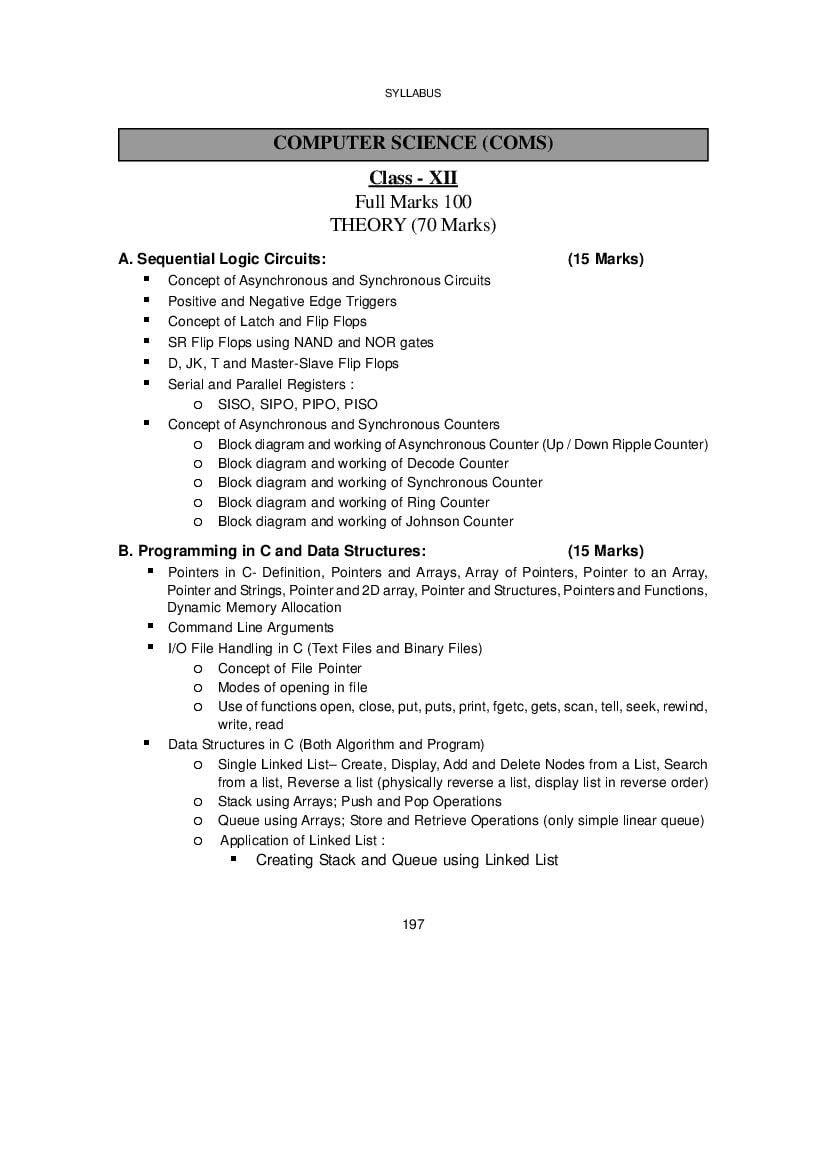
Class - XII
Full Marks 100
THEORY (70 Marks)
A. Sequential Logic Circuits: (15 Marks)
Concept of Asynchronous and Synchronous Circuits
Positive and Negative Edge Triggers
Concept of Latch and Flip Flops
SR Flip Flops using NAND and NOR gates
D, JK, T and Master-Slave Flip Flops
Serial and Parallel Registers :
o SISO, SIPO, PIPO, PISO
Concept of Asynchronous and Synchronous Counters
o Block diagram and working of Asynchronous Counter (Up / Down Ripple Counter)
o Block diagram and working of Decode Counter
o Block diagram and working of Synchronous Counter
o Block diagram and working of Ring Counter
o Block diagram and working of Johnson Counter
B. Programming in C and Data Structures: (15 Marks)
Pointers in C- Definition, Pointers and Arrays, Array of Pointers, Pointer to an Array,
Pointer and Strings, Pointer and 2D array, Pointer and Structures, Pointers and Functions,
Dynamic Memory Allocation
Command Line Arguments
I/O File Handling in C (Text Files and Binary Files)
o Concept of File Pointer
o Modes of opening in file
o Use of functions open, close, put, puts, print, fgetc, gets, scan, tell, seek, rewind,
write, read
Data Structures in C (Both Algorithm and Program)
o Single Linked List– Create, Display, Add and Delete Nodes from a List, Search
from a list, Reverse a list (physically reverse a list, display list in reverse order)
o Stack using Arrays; Push and Pop Operations
o Queue using Arrays; Store and Retrieve Operations (only simple linear queue)
o Application of Linked List :
Creating Stack and Queue using Linked List
197
Page 2
Infix, Prefix and Postfix notations
Infix to Postfix conversion (only conversion using rules, program not
required)
Evaluation of Postfix expression (only evaluation using rules, program not
required)
C. Networking: (15 Marks)
Introduction to Networking (Definition, Advantage, Disadvantage, Application)
o Analogue and Digital Communication
o Modes of Communication: Simplex, Half Duplex and Full Duplex Communication
o Types of Network – LAN, MAN, WAN
o Network Architecture : Client Server & Peer-to-Peer Networks
o Serial and Parallel Communication
o Bandwidth, Channel Capacity, Baud
o Synchronous and Asynchronous Transmission Modes
o Baseband and Broadband Networks
Components of a Network
o Servers (File server, Communication Server, Print Server) and Workstation
o NIC
o Guided Media
Cables – UTP, STP, Co-axial, Fibre Optic
o Unguided Media
Infra-red, Radio & Microwave Communication, Satellite
o Network Operating System – Characteristics
Network Topologies -
o Bus
o Ring
o Star
o Mesh
Network Connecting Devices –
o Hub
o Repeater
o Bridge
o Switch
o Router
o Gateways
198
Page 3
o Ethernet (CSMA /CD) and Token Ring Protocol
Switching Technique
o Circuit, Message and Packet Switching
Use of MODEM
TCP / IP Protocols
o TCP, IP, UDP, FTP, HTTP, TELNET
IP Addressing
o Class A, Class B, Class C IP addresses
Domain Name System
URL
Introduction to Internet
o Basic requirement for connecting to the Internet, ISP
o Services provided by Internet– www, browser, e-mail, search engine, social
networking
o Networking Security – Computer Virus, Concept of Firewall, Password
HTML
o Basic Page Design, Using Ordered and Unordered Lists, Using Image,
Hyperlinking, Using Tables
D. Database Management System (15 Marks)
Introduction of Database :
o Definition of Database
o Database Languages (DDL, DML, DCL)
o DBMS and its components
o Various Data Models – ER Model, Hierarchical Model, Network Model, Relational
Model (only concepts)
Relational Model
o Concept of Relation, Tuple, Attribute, Domain, Degree, Cardinality
o Concept of Keys – Key, Super Key, Candidate Key, Primary Key, Alternate Key
o Concept of Relationships – 1:1, 1:N, N:M relationships
o Database Constraints – Equity Integrity Constraint, Domain Constraint, Referential
Integrity Constraint and Concept of Foreign Key
o Functional Dependency – Full, Partial, Transitive and Trivial Dependencies
o Database Anomalies – Insertion, Deletion and Updation Anomaly
199
Page 4
to 3NF)
Relational Algebra
o Selection Operation
o Projection Operation
o Set Operation
o Cartesian Product
o Natural Join Operation
SQL
o CREATE TABLE, ALTER TABLE, DROP TABLE
o INSERT, DELETE, UPDATE
o SELECT (DISTINCT, FROM, WHERE, AND, OR , IN, NOT, IN, BETWEEN,
LIKE, GROUP BY, HAVING, ORDER BY)
o SUM, AVG, COUNT, MAX, MIN
o GRANT, REVOKE, ROLLBACK
E. Introduction to Object Oriented Programming (10 Marks)
Basic Concept of OOP
o Data Abstraction
o Encapsulation
o Inheritance
o Polymorphism
Implementing OOP using C++
o Basic input / output, branching, looping (simple programs)
o Definition of a Class
o Members of Class – Data Members and Member Functions;
o Concept of Constructor and Destructor (Programming not required)
o Object Creation and accessing members of a Class (simple programs)
F. Practical (30 marks)
Programming in C (Coding, Execution) (10 marks)
o One programming problem in C to be developed and tested in computer during
the examination. Marks are allotted on the basis of the following:
Logic (5 marks)
Documentation (2 marks)
Output presentation (3 marks)
o Types of problems to be given will be of application type from the following
topics:
200
Page 5
Stack using array and linked implementation
Queue using array and linked implementation (only linear queue)
Text and Binary File operations (creation, display, searching, modification)
Web Page design using HTML and SQL (command as per theory syllabus) (5 marks)
Project Work (one project using C and one project using HTML) (5 marks)
o Suggestive Topics:
Application of C (Program on any one of following topics):
Problem related to Numerical Analysis–Bisection Method,
Trapezoidal Rule
Creation and manipulation of telephone index using concept of
files
Creation and addition of polynomials using Linked Lists
Web page designing using HTML (minimum 5 linked pages)
Travel and Tourism
Festivals
Book Catalogue
Pollution and pollution control
Laboratory Copy (5 marks)
Viva Voce (5 marks)
201
Document Details
| Board / Org | West Bengal Board |
| Exam | Class 12 |
| Type | Syllabus |
| Pages | 5 |
| Updated | 22 Jul 2026 |