WBCHSE Class 12 Syllabus for Economics
Finished viewing? Save it for later —
Download WBCHSE Class 12 Syllabus for Economics (PDF · 4 pages)About WBCHSE Class 12 Syllabus for Economics
WBCHSE Class 12 Syllabus for Economics is available here for free download. Published by West Bengal Board for Class 12, this syllabus can be viewed online or downloaded as a PDF (4 pages). Candidates preparing for Class 12 can use WBCHSE Class 12 Syllabus for Economics to understand the exam pattern, the type of questions asked, and the overall difficulty level.
Frequently Asked Questions
How can I download WBCHSE Class 12 Syllabus for Economics?
Open this page and click the Download button to save WBCHSE Class 12 Syllabus for Economics as a PDF. It is completely free on AglaSem Docs.
Is WBCHSE Class 12 Syllabus for Economics free to download?
Yes. WBCHSE Class 12 Syllabus for Economics can be viewed online and downloaded as a PDF free of cost on AglaSem Docs.
How many pages does WBCHSE Class 12 Syllabus for Economics have?
WBCHSE Class 12 Syllabus for Economics contains 4 pages, which you can read online or download together as a single PDF.
Where can I find more Class 12 study material?
You can find more Class 12 question papers, sample papers, syllabus, and answer keys on AglaSem Docs.
WBCHSE Class 12 Syllabus for Economics – Text
Read the full text of this syllabus below — useful to quickly search, copy and reference the content online without downloading the PDF.
📄 View text version (4 pages)
Page 1
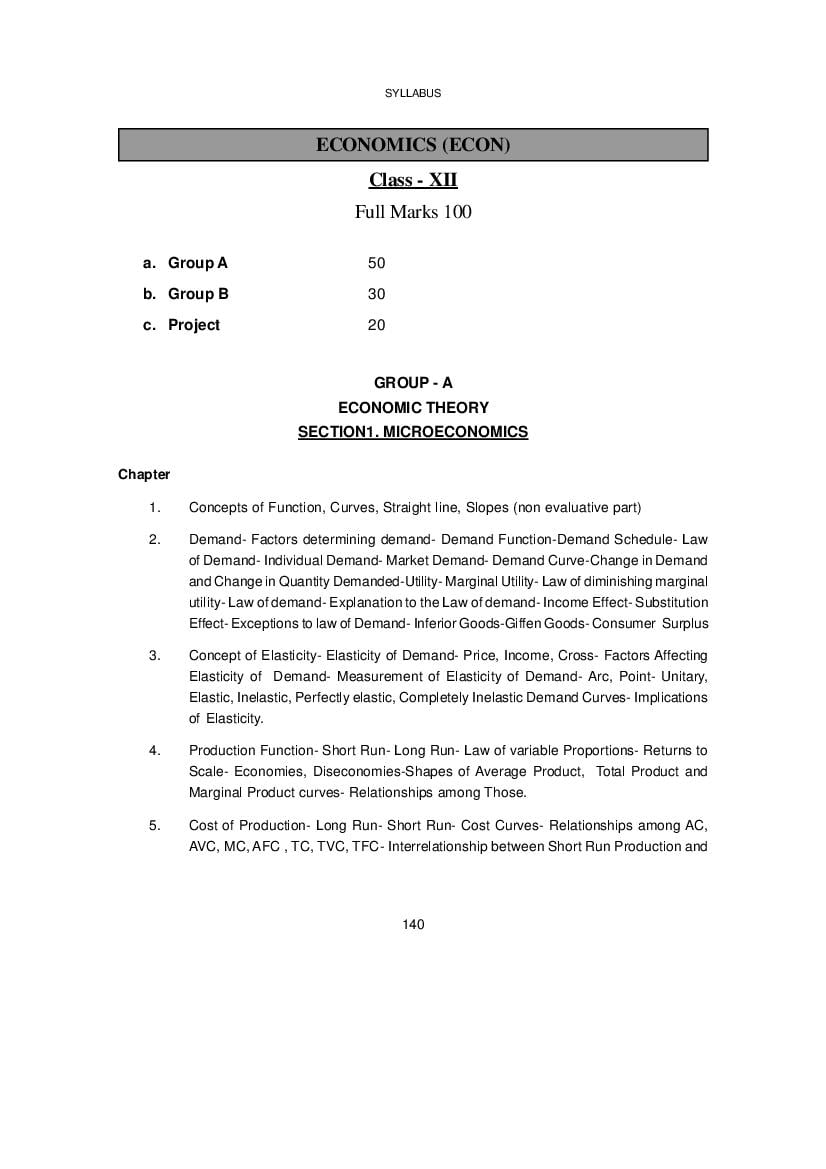
Class - XII
Full Marks 100
a. Group A 50
b. Group B 30
c. Project 20
GROUP - A
ECONOMIC THEORY
SECTION1. MICROECONOMICS
1. Concepts of Function, Curves, Straight line, Slopes (non evaluative part)
2. Demand- Factors determining demand- Demand Function-Demand Schedule- Law
of Demand- Individual Demand- Market Demand- Demand Curve-Change in Demand
and Change in Quantity Demanded-Utility- Marginal Utility- Law of diminishing marginal
utility- Law of demand- Explanation to the Law of demand- Income Effect- Substitution
Effect- Exceptions to law of Demand- Inferior Goods-Giffen Goods- Consumer Surplus
3. Concept of Elasticity- Elasticity of Demand- Price, Income, Cross- Factors Affecting
Elasticity of Demand- Measurement of Elasticity of Demand- Arc, Point- Unitary,
Elastic, Inelastic, Perfectly elastic, Completely Inelastic Demand Curves- Implications
of Elasticity.
4. Production Function- Short Run- Long Run- Law of variable Proportions- Returns to
Scale- Economies, Diseconomies-Shapes of Average Product, Total Product and
Marginal Product curves- Relationships among Those.
5. Cost of Production- Long Run- Short Run- Cost Curves- Relationships among AC,
AVC, MC, AFC , TC, TVC, TFC- Interrelationship between Short Run Production and
140
Page 2
Long Run Cost Curves from Short Run Cost Curves.
6. Revenue- Total –Average- Marginal- Relationships among them- Relationship between
AR MR and E- Revenue Under Variable Price and Fixed Price Situation.
7. Profit Maximization- Producers equilibrium- Shut down condition.
8. Supply- Supply function- Determinants of Supply- Law of Supply- Individual Supply
Curve- Market Supply Curve- Elasticity of Supply- Change in Supply and Change in
quantity supplied- Supply curve of an individual Firm in case of Fixed Price Situation.
9. Different types of market- Perfect competition, monopoly, monopolistic competition,
oligopoly, duopoly, price discrimination, bilateral monopoly, and monophony.
10. Market Equilibrium under Perfect Competition
Characteristics of Perfect Competition- Firm as a Price taker- Conformity with Fixed
Price Situation- Price Determination- Interaction between Market Demand and market
Supply-Equilibrium of a Firm- Short Run- Shut down Point- Supply Curve-Supply
Curve of Industry-Long Run equilibrium- Normal Profit.
11. Equilibrium under Monopoly.
12. Cost Determined Pricing
Mark Up-Arbitrage.
13. Factor Market-
Land market- Rent- Ricardian Theory- Modern Theory-Labour- Labour Demand Curve-
Labour Supply Curve-Marginal Productivity Theory of Distribution-Capital- Liquidity
Preference theory of interest.
SECTION2. MACROECONOMICS
14. National Income and Related Aggregates
Circular Flow of Income- Calculation of National Income- Value Added or product
method, Expenditure method- Income method.
15. Determination of Income and Employment
141
Page 3
Consumption Function- Propensity to consume- Savings and Savings Function-
Propensity to Save- Equilibrium level of Income- Investment Multiplier
Concept of Full Employment-Problem of deficient demand- Excess Demand – Inflation-
Demand Pull- Cost Push
16. Money and Banking
Functions of Commercial Banks- Creation of Money or Credit or Deposit by
Commercial Bank- Credit/Deposit/ Money Multiplier
Functions of Central bank- Credit Control Tools and Methods of Credit Control
17. Fiscal Policy
Expansionary Fiscal Policy- Government Expenditure Multiplier
Deficit Financing.
Recession- Fiscal Policy to Correct Recession
Inflation- Fiscal Policy to Correct Inflationary Pressure.
18. International Trade and Balance of Payments
Balance of Trade- Surplus- Deficit- Balance of Payments- Current Account- Capital
account- Unilateral Transfer- Deficit BOP- Method to Correct Imbalance in BOP-
Foreign Exchange Rate- Flexible Exchange Rate- Floating Exchange rate-Managed
Floating Exchange rates.
GROUP B
INDIAN ECONOMY INCLUDING STATISTICAL TOOLS
SECTION1. STATISTICAL TOOLS
1. Measures of dispersion- Range- Standard Deviation- Lorenz Curve- Gini Coefficient
SECTION 2.INDIAN ECONOMY WITH SPECIAL REFERENCE TO WEST BENGAL
(Poverty, Inequality, Unemployment and Financial Sector)
2. Poverty, Inequality and Unemployment in Indian Economy- Measures and Extent of
Inequality- Policies regarding inequality- Different Measures of Poverty- Poverty situation
in India and West Bengal- Government efforts to combat poverty- Prevailing
Unemployment Situation in India and West Bengal- Different Unemployment reducing
Programme- Impact of Economic Reforms.
142
Page 4
Sector reforms- Private Initiatives in Insurance and Insurance Regulatory and
Development Authority- GATT, WTO, TRIPS and TRIMS- Trade Liberalisation in India.
PROJECT (20 marks)
There may be 2 types of Project, one based on Field Works and other based on
Secondary Data.
Some suggested Field Works are:
1. Survey on Unemployment Situation in a Locality.
2. Survey of Poor People to Understand the Impact of Poverty.
3. Survey of Households to Assess the Impact of Private Banks/ Public Sector
Banks.
Suggested Projects on the Basis of Secondary data are:
1. Unemployment Situation on the Basis of NSSO Data.
2. Expansion of Banking Sector on the Basis of RBI Data.
3. Export Import on the Basis of Foreign Trade Data.
143
Document Details
| Board / Org | West Bengal Board |
| Exam | Class 12 |
| Type | Syllabus |
| Pages | 4 |
| Updated | 22 Jul 2026 |