WBCHSE Class 12 Syllabus for Education
Finished viewing? Save it for later —
Download WBCHSE Class 12 Syllabus for Education (PDF · 3 pages)About WBCHSE Class 12 Syllabus for Education
WBCHSE Class 12 Syllabus for Education is available here for free download. Published by West Bengal Board for Class 12, this syllabus can be viewed online or downloaded as a PDF (3 pages). Candidates preparing for Class 12 can use WBCHSE Class 12 Syllabus for Education to understand the exam pattern, the type of questions asked, and the overall difficulty level.
Frequently Asked Questions
How can I download WBCHSE Class 12 Syllabus for Education?
Open this page and click the Download button to save WBCHSE Class 12 Syllabus for Education as a PDF. It is completely free on AglaSem Docs.
Is WBCHSE Class 12 Syllabus for Education free to download?
Yes. WBCHSE Class 12 Syllabus for Education can be viewed online and downloaded as a PDF free of cost on AglaSem Docs.
How many pages does WBCHSE Class 12 Syllabus for Education have?
WBCHSE Class 12 Syllabus for Education contains 3 pages, which you can read online or download together as a single PDF.
Where can I find more Class 12 study material?
You can find more Class 12 question papers, sample papers, syllabus, and answer keys on AglaSem Docs.
WBCHSE Class 12 Syllabus for Education – Text
Read the full text of this syllabus below — useful to quickly search, copy and reference the content online without downloading the PDF.
📄 View text version (3 pages)
Page 1
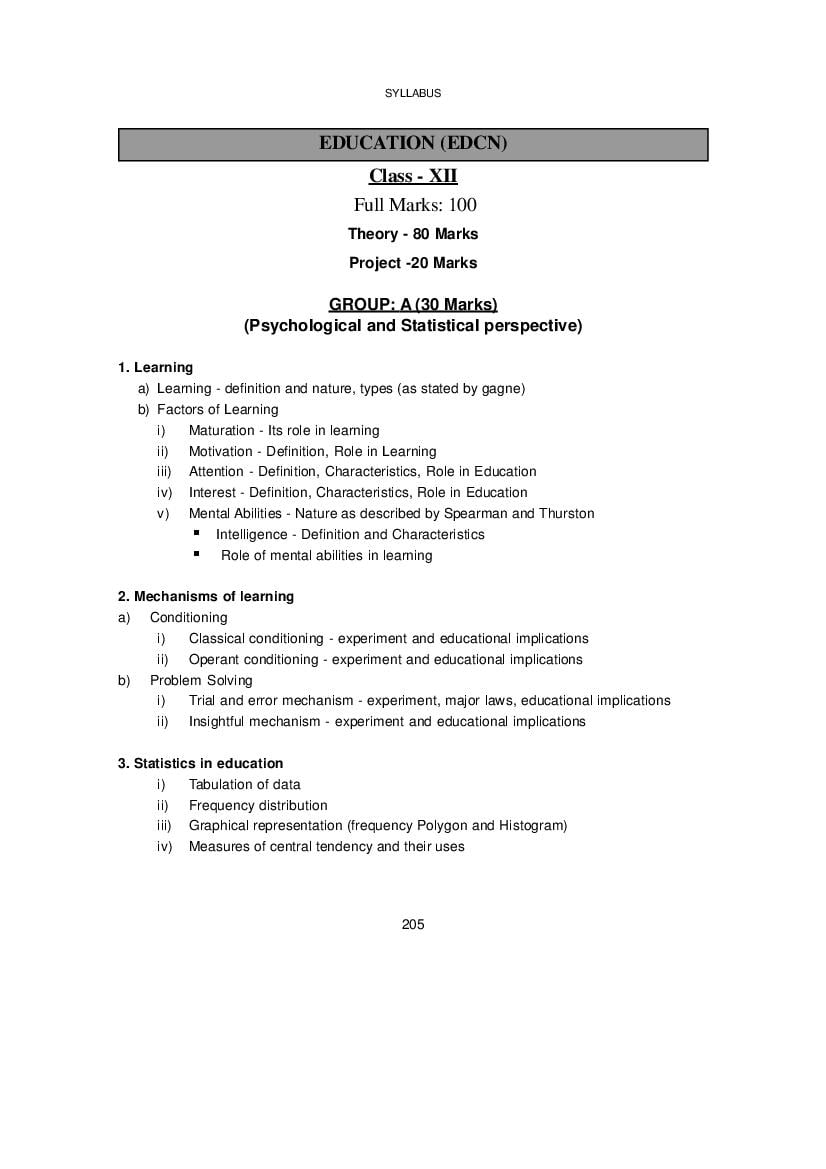
Class - XII
Full Marks: 100
Theory - 80 Marks
Project -20 Marks
GROUP: A (30 Marks)
(Psychological and Statistical perspective)
1. Learning
a) Learning - definition and nature, types (as stated by gagne)
b) Factors of Learning
i) Maturation - Its role in learning
ii) Motivation - Definition, Role in Learning
iii) Attention - Definition, Characteristics, Role in Education
iv) Interest - Definition, Characteristics, Role in Education
v) Mental Abilities - Nature as described by Spearman and Thurston
Intelligence - Definition and Characteristics
Role of mental abilities in learning
2. Mechanisms of learning
a) Conditioning
i) Classical conditioning - experiment and educational implications
ii) Operant conditioning - experiment and educational implications
b) Problem Solving
i) Trial and error mechanism - experiment, major laws, educational implications
ii) Insightful mechanism - experiment and educational implications
3. Statistics in education
i) Tabulation of data
ii) Frequency distribution
iii) Graphical representation (frequency Polygon and Histogram)
iv) Measures of central tendency and their uses
205
Page 2
Historical Development (Post-independent period)
4. Educational provisions in Indian constitution related to women’s education,
equalization of opportunity, education for minority, SC, ST
5. University Education Commission (1948-49) - First Education Commission in free
India, Aims of higher education and concept of Rural University
6. Secondary Education Commission (1952-53), aims of secondary education, structure,
seven stream system and multipurpose schools
7. The Indian Education Commission or Kothari Commission (1964-66) and the modern
system of education in India
a) Concept of general education in present India
Stages of General education in present India
i) Pre-Primary education - Aims and objectives, structure, curriculum and institutions
ii) Primary education - Aims and objectives, structure, curriculum and institutions
iii) Secondary education - Aims and objectives, structure, curriculum and institutions
iv) Higher Secondary - Aims and objectives, structure, curriculum and institutions
v) Higher education - mention the position of higher education according to Kothari
commission
b) Vocational and Technical education prevailing in India
i) Vocational and Technical education - concept, relation, types of institutions up to
secondary level
ii) Vocational and Technical education - types, curriculum and institutions up to higher
secondary level
c) Opportunities of education after higher secondary stage (names of courses)
8. N.E.P. (1986 as reviewed in 1992) - basic features.
206
Page 3
Current Issues in Indian education
9. Education for the differently abled children
i) Visually impaired children - Categories and educational provisions
ii) Deaf and dumb children - Categories and educational provisions
iii) Common behavioural problems observed in class room situations and the role of the
Parents and teachers to overcome these problems (general study)
10. Universalization of primary education (U.P.E.)
i) Concept
ii) Measures taken to achieve the objectives of U.P.E. - Audit Education programme,
Literacy drive programme, S.S.A.
GROUP-D (10 Marks)
Education for the 21st century
11. Global vision for education - Delores commission - 4 pillars of learning- a synoptic
view
12. Role of technology in education
Project work (20 Marks)
Study of interest pattern amongst secondary/higher secondary students
To study the achievement of students at secondary level in any two subjects and analyse
scores in terms of mean, median & mode
To study the behavioural problems observed amongst the adolescents in a school and
suggest measures to overcome it
To study the programmes or activities of S.S.A. in your locality
To study the curriculum and types of primary schools (at least two in and around your
locality). Apart from the suggested project or field studies any relevant project based on
the syllabus can be undertaken
207
Document Details
| Board / Org | West Bengal Board |
| Exam | Class 12 |
| Type | Syllabus |
| Pages | 3 |
| Updated | 22 Jul 2026 |