TIFR GS 2015 Question Paper Chemistry Y
Finished viewing? Save it for later —
Download TIFR GS 2015 Question Paper Chemistry Y (PDF · 16 pages)About TIFR GS 2015 Question Paper Chemistry Y
TIFR GS 2015 Question Paper Chemistry Y is available here for free download. Published by Default for TIFR GS, this question paper can be viewed online or downloaded as a PDF (16 pages). Candidates preparing for TIFR GS can use TIFR GS 2015 Question Paper Chemistry Y to understand the exam pattern, the type of questions asked, and the overall difficulty level.
Frequently Asked Questions
How can I download TIFR GS 2015 Question Paper Chemistry Y?
Open this page and click the Download button to save TIFR GS 2015 Question Paper Chemistry Y as a PDF. It is completely free on AglaSem Docs.
Is TIFR GS 2015 Question Paper Chemistry Y free to download?
Yes. TIFR GS 2015 Question Paper Chemistry Y can be viewed online and downloaded as a PDF free of cost on AglaSem Docs.
How many pages does TIFR GS 2015 Question Paper Chemistry Y have?
TIFR GS 2015 Question Paper Chemistry Y contains 16 pages, which you can read online or download together as a single PDF.
Where can I find more TIFR GS study material?
You can find more TIFR GS question papers, sample papers, syllabus, and answer keys on AglaSem Docs.
TIFR GS 2015 Question Paper Chemistry Y – Text
Read the full text of this question paper below — useful to quickly search, copy and reference the content online without downloading the PDF.
📄 View text version (16 pages)
Page 1
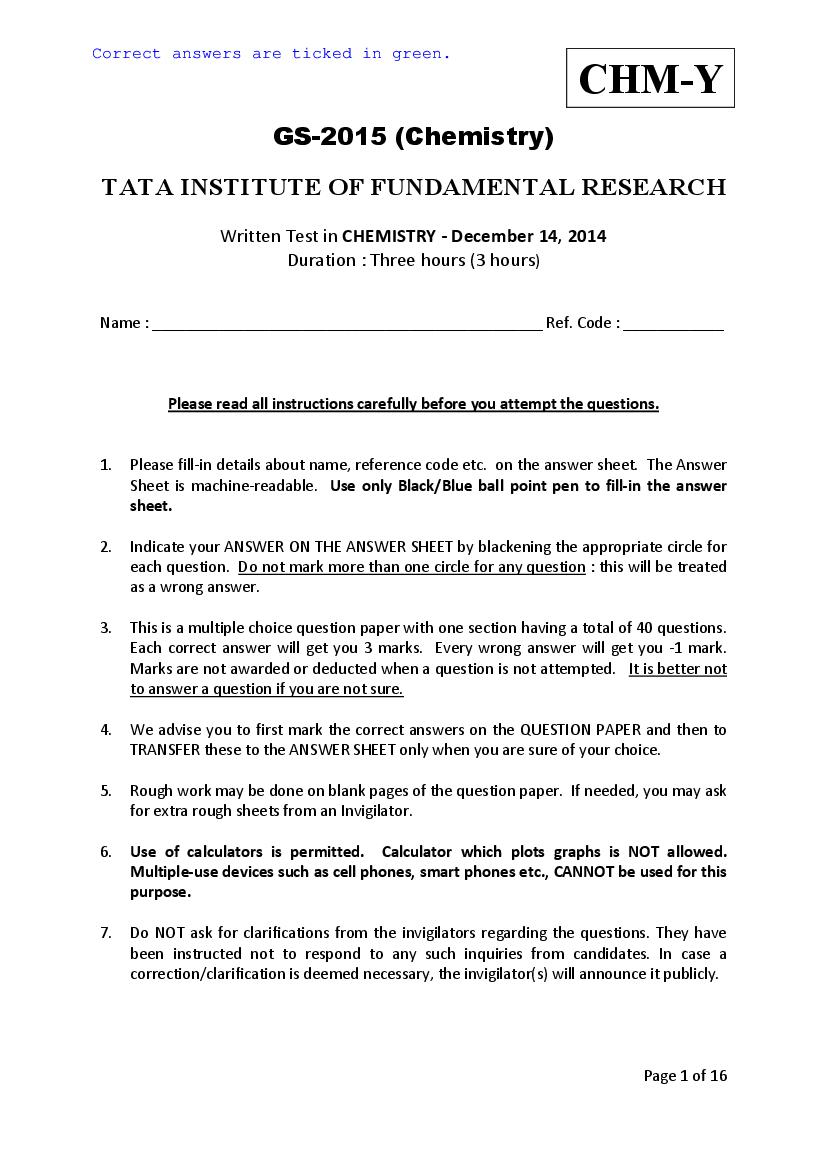
CHM-Y
GS-2015 (Chemistry)
TATA INSTITUTE OF FUNDAMENTAL RESEARCH
Written Test in CHEMISTRY - December 14, 2014
Duration : Three hours (3 hours)
Name : _______________________________________________ Ref. Code : ____________
Please read all instructions carefully before you attempt the questions.
1. Please fill-in details about name, reference code etc. on the answer sheet. The Answer
Sheet is machine-readable. Use only Black/Blue ball point pen to fill-in the answer
sheet.
2. Indicate your ANSWER ON THE ANSWER SHEET by blackening the appropriate circle for
each question. Do not mark more than one circle for any question : this will be treated
as a wrong answer.
3. This is a multiple choice question paper with one section having a total of 40 questions.
Each correct answer will get you 3 marks. Every wrong answer will get you -1 mark.
Marks are not awarded or deducted when a question is not attempted. It is better not
to answer a question if you are not sure.
4. We advise you to first mark the correct answers on the QUESTION PAPER and then to
TRANSFER these to the ANSWER SHEET only when you are sure of your choice.
5. Rough work may be done on blank pages of the question paper. If needed, you may ask
for extra rough sheets from an Invigilator.
6. Use of calculators is permitted. Calculator which plots graphs is NOT allowed.
Multiple-use devices such as cell phones, smart phones etc., CANNOT be used for this
purpose.
7. Do NOT ask for clarifications from the invigilators regarding the questions. They have
been instructed not to respond to any such inquiries from candidates. In case a
correction/clarification is deemed necessary, the invigilator(s) will announce it publicly.
Page 1 of 16
Page 2
Avogadro number = 6.021023 mol1 e = 1.61019 C
RT/F = 0.0257 V at 25C h = 6.6261034 J s
Faraday constant = 96500 C/mol c = 3108 m s1
Boltzmann constant k = 1.381023 J K1 R = 8.314 J K1 mol1
Z2
En = a.u. for hydrogen like atom
2n 2
Mass of an electron = 9.1091031 kg
8kT
Average velocity =
m
For H3PO4, pK1 = 2.16, pK2 = 7.21, pK3 = 12.32
1. Thiols are important molecular species present in cells and can mediate cell signaling
processes. A procedure for detecting thiols has been recently reported based on the
following reaction. Predict the structures of reaction products.
2. Free water pKa is 15.7 at 25oC. Based on the free water pKa benchmark, arrange the
acidity of the “bound” water molecules in increasing order within the following metal‐
aqua complexes: [Mn(H2O)6]2+, [Cu(H2O)5]2+, [Ca(H2O)8]2+, [Sr(H2O)8]2+
A) Ca2+ < Mn2+ < Cu2+ < Sr2+
B) Mn2+ < Cu2+ < Sr2+ < Ca2+
C) Sr2+ < Ca2+ < Mn2+ < Cu2+
D) All have same acidities
Page 2 of 16
Page 3
various hypothetical paths, as shown below. The total amount of the gas remains
constant. Which of the following paths are physically realizable?
A A A
(i) (ii) (iii)
P P B P
B B
V V V
A
(iv) A
(v)
P P
B B
V V
A) All of them
B) Only (i), (ii) and (iii)
C) Only (iii) and (v)
D) Only (i) and (iii)
4. An electron can transfer from state D to state A with a rate kDA. The intrinsic (in the
absence of any charge transfer between states D and A) lifetimes of charge transfer
states D and A are D and A, respectively. Assuming that initially the electron is in state
D, under what conditions would kDA be completely determined in terms of the overall
rate at which the electron leaves the combined D+A system.
A) kDA >> 1/D and kDA >> 1/A
B) kDA >> 1/D and kDA << 1/A
C) kDA << 1/D and kDA >> 1/A
D) kDA << 1/D and kDA << 1/A
5. If Ψ(x,t) can be expressed as a product of two functions f(t)g(x), where f(t) has the form
exp[‐(iEt/ħ)] then it can be shown that the probability of finding the particle between x
and (x + dx)
A) Equal to 1
B) Is independent of time
C) Can be obtained by solving Time Dependent Schrodinger Equation
D) Can be obtained by solving Time Independent Schrodinger Equation
Page 3 of 16
Page 4
Which of the following statements is true about this solution?
A) It can act as a buffer solution around pH ≈ 7.0
B) It can act as a buffer solution around pH = 12
C) Its pH will approximately equal to 6.9
D) Both A and C
cos A sin A 1
7. Consider the trigonometric function . It can be simplified as
cos A sin A 1
1 sec A tan A
A)
1 sec A tan A
B) cosec A cot A
C) 1 /( cosec A cot A)
D) All of the above
8. For a harmonic oscillator in its ground state i.e. v = 0 state, the energy is given by
E= ½h, where is the vibrational frequency. This is due to its
A) Kinetic energy
B) Potential energy
C) Sum of kinetic and potential energy
D) Heat of formation
9. If the peak in the mass spectrum of C2F6 at mass number 138 is 100 units tall, what will be
the heights of the peaks at mass numbers 139 and 140.
(Isotopic abundances: 12C, 98.89%; 13C, 1.11%; 19F, 100%)
A) 2.24 and 0.0126
B) 1.12 and 0.0126
C) 50 and 25
D) 2.24 and 0.025
10. The molar absorption coefficient of sea water in the visible region is 6.2 x 10‐5 M‐1cm‐1.
What will be depth from the sea surface at which the intensity of light becomes one‐
tenth of that at the surface?
A) 2.9 m
B) 0.9 m
C) 1.1 m
D) 8.0 m
Page 4 of 16
Page 5
whenever the ratio of the oxidized and the reduced species changes by a factor of 10
at 25 C. What would be the corresponding change in the electrode potential if the
experiment is carried out at 30 C?
A) 59.2 mV
B) 71.0 mV
C) 60.2 mV
D) None of the above
12. Consider the following reaction:
Au + O2 + 3F2 → [O2]+ + [AuF6]–
Which statement is correct about the redox changes in this reaction?
A) Au is oxidized; O is oxidized; F is reduced
B) Au is reduced; O is oxidized; F is reduced
C) Au is oxidized; O does not undergo a redox change; F is reduced
D) Au is reduced; O is oxidized; F does not undergo a redox change
13. For a particle undergoing quantum tunneling through a barrier, which of the following is
NOT true:
A) The amplitude of particle wave function after passing the barrier decreases with
an increase in tunneling distance
B) The probability of finding the particle after passing the barrier decreases with
increase in tunneling barrier height
C) The energy of the particle after crossing the barrier decreases with increase in
tunneling distance
D) The change in the phase of the particle wave function upon transmission is
proportional to the tunneling distance
14. A common characteristic of conducting polymers, such as polypyrrole and
polythiophene, which make them conduct electricity is
A) The presence of stereogenic centers of the same configuration
B) A monodisperse distribution in molecular weight
C) Conjugation throughout the polymer chain
D) A very low glass transition temperature
Page 5 of 16
Page 6
k1 k2
X Y Z
k1 k2
An experimentalist wants to verify the above scheme, but can observe and measure the
concentration of only X or Z. Is it possible that under certain conditions, the
measurements of [X] or [Z] as function of time would lead the experimenter to conclude
that the kinetic scheme is as given below, and that the species Y is absent?
kobs
X Z
kobs
A) No, that is not possible
B) Yes, if k1 >> k1 and k2 >> k2
k1 k
C) Yes, if 2
k 1 k 2
D) Yes, if [Y] attains a steady‐state concentration during the experiment
16. A catalyst:
A) Participates in the reaction
B) Does not affect a reaction energy path
C) Always decreases the rate for a reaction
D) Always increases the activation energy for a reaction
17. For Co in oxidation state II, predict the overall charges of the coordination complexes
shown in the reactions below:
A) z = +2; x = ‐2; y = +2
B) z = 0; x = +2; y = ‐2
C) z = 0; x = +2; y = +2
D) z = ‐2; x = +2; y = ‐2
Page 6 of 16
Page 7
A) i B) ii C) iii D) iv
19. NaCl, KCl, NaBr and KBr crystallize in FCC lattices. Their anion and cation touch along the
edge of the unit cell. The dimensions of their unit cells are 562.8 pm, 627.7 pm, 596.2
pm, and 658.6 pm, respectively. From these data, what can you say about the size of
the ionic radii (within an error of about 5%)?
A) Ionic radii of the cations depend on the nature of the anions
B) Ionic radii of the anions depend on the nature of the cations
C) Both (A) and (B)
D) Ionic radii are independent of the counter ions
20. How many normal modes does the CO2 molecule have? What if the C and the O atoms
were constrained to move in one dimension?
A) 4 normal modes for free CO2 and 4 for constrained CO2
B) 3 normal modes for free CO2 and 2 for constrained CO2
C) 3 normal modes for free CO2 and 3 for constrained CO2
D) 4 normal modes for free CO2 and 2 for constrained CO2
Page 7 of 16
Page 8
organic structures. Name the reagents X, Y and Z that would be necessary to make the
C3 symmetric product?
A)
B)
C)
D)
22. Which of the following cannot act as a chelating agent?
A) HC(CH2CH2NH2)3
B) CH3NHCH2CH2CH3
C) N(CH2CH2NH2)3
D) H2NCH2CH2CH2NH2
Page 8 of 16
Page 9
A) i B) ii C) iii D) iv
24. The combustion of ethane (C2H6) is represented by the following reaction:
2 C2H6(g) + 7 O2(g) 4 CO2(g) + 6 H2O(l)
Which of the following is TRUE for the above reaction?
A) The rate of consumption of ethane is seven times faster than the rate of
consumption of oxygen
B) Water is formed at a rate equal to two‐thirds the rate of formation of CO2
C) The rate of consumption of oxygen equals the rate of formation of water
D) CO2 is formed twice as fast as ethane is consumed
Page 9 of 16
Page 10
diagram is shown below.
E F
P D
C
A B
T
Which of the following statements is correct about the above diagram?
A) The diagram is correct in all respects
B) The diagram is wrong as it has more than one triple point
C) A phase diagram cannot have an island, such as D
D) The point cannot be present in any phase diagram
26. Which of the following plots represent(s) the Arrhenius rate equation, k = Ae‐Ea/RT with A
= 3x10⁷ s‐1 and Ea = 3x10⁴ J/mol.
A) i
B) ii
C) iii
D) i and ii
Page 10 of 16
Page 11
28. Molecular knots have been observed in DNA and proteins. Although synthetically
challenging, a few purely organic molecular knots have also been reported in the
literature. One such elusive knot is the trefoil knot. An organic trefoil knot was
prepared by reacting two structurally distinct components X and Y. The reaction
mixture contained four products as shown in the figure below:
Which spectra will afford distinguishable spectral features for (1) C and D? and (2) E and F?
A) Circular Dichroism Spectra for C and D; 1H‐NMR for E and F
B) 1H‐NMR and 13C‐NMR Spectra for C and D; Circular Dichroism for E and F
C) Absorbance and Emission spectra for C and D; Circular Dichroism for E and F
D) Infra‐Red Spectra for C and D; Circular Dichroism for E and F
Page 11 of 16
Page 12
shown below. What can you say about the nature of this spectrum?
Signal
Magnetic field
A) It is a continuous‐wave NMR spectrum
B) It is a Fourier transform NMR spectrum
C) It is an ESR spectrum
D) None of the above
30. Indicate which of the following is/are “acceptable” wave function(s) in quantum
mechanics in the range ‐∞ < x < +∞
i) = x ii) = x2 iii) = sin x iv) = exp(‐x) v) = exp(‐x2)
A) iii and v
B) iv only
C) iv and v
D) i and iii
31. Which of the following statements are true?
i) For a harmonic oscillator potential, the spacing between between adjacent energy
levels remain constant with increasing the quantum number
ii) For a Morse oscillator potential, the spacing between adjacent energy levels
increases with increasing the vibrational quantum number.
iii) Harmonic oscillators are be used to explain the bond dissociation
iv) Morse oscillators can be used to explain the vibration of molecules
A) i, ii and iii only
B) i and iv only
C) i, ii and iv only
D) i, ii, iii and iv
Page 12 of 16
Page 13
as shown below:
5’ AGCT 3’
3’ TCGA 5’
What fragments of DNA do you expect to recover from the reaction mixture if the
following DNA sequence
5’ CGACTAGCTACTGAGCTAAA 3’
3’ GCTGATCGATGACTCGATTT 5’
is partially digested with Alu1. Partially digested means that the reaction is not
allowed to proceed to completion, say only to 50%.
i) 5’ CGACTAG 3’ and 5’ CTACTGAGCTAAA 3’
3’ GCTGATC 5’ 3’ GATGACTCGATTT 5’
ii) 5’ CGACTAGCTACTGAG 3’ and 5’ CTAAA 3’
3’ GCTGATCGATGACTC 5’ 3’ GATTT 5’
iii) 5’ CGACTAG 3’ and 5’ CTACTGAG 3’ and 5’ CTAAA 3’
3’ GCTGATC 5’ 3’ GATGACTC 5’ 3’ GATTT 5’
iv) 5’ CGACTAGCTACTGAGCTAAA 3’
3’ GCTGATCGATGACTCGATTT 5’
A) Only i and ii
B) Only I and iii
C) Only iii and iv
D) i, ii, iii and iv
33. Which of the following statement(s) is/are true?
i) The state function Ψ(x,t) is always equal to a function of time multiplied by a
function of the coordinates
ii) If f1 and f2 are eigenfunctions of an operator B, then c1f1 + c2f2 must always be an
eigenfunction of B, where c1 and c2 are constants
iii) The operator L2 commutes with Lx+Ly
A) i and ii
B) i and iii
C) ii and iii
D) Only iii
Page 13 of 16
Page 14
absorptivity
Molar
B
A
A B
Frequency Frequency
In a solution, these two species are dissolved, and they are moving freely. Using a
tunable laser, when the solutuion is excited at A, a single fluorescence band is seen
around frequency F1. When the laser frequency is changed to B, two fluorescence
bands are seen around frequencies F1 and F2. Which of the following figures can
qualitatively describe the correct relative positions of the frequencies A, B, F1 and F2?
The continuous line shows absorption and the dashed line shows fluorescence emission
spectra.
or emission
Absorption
intensity
A) B
A
A F1 B F2
Frequency
or emission
Absorption
intensity
B) A B
F1 A F2 B
Frequency
or emission
Absorption
intensity
or emission
Absorption
intensity
C) B
A D) B A
F1 A F2 B A
F2 B F1
Frequency Frequency
Page 14 of 16
Page 15
is
A) 127
B) 128
C) 129
D) None of the above
36. In the following setup, two chambers 1 and 2 are enclosed by a thermally insulated
material. Chamber 1 contains an ideal gas at 100 atm. Chambers 2 is completely
1 2
Seal
evacuated. The two chambers are separated by a breakable seal. Before the seal is
broken, the temperature of the chamber 1 is T1, initial. Then the seal is broken, and the
gas is allowed to rush to chamber 2. The volume of chamber 2 is 100 times the
volume of chamber 1. When the pressure in the two chambers becomes equal, their
respective temperature is T1, final and T2, final. Which of the following statements is true?
A) T1, final = T2, final = T1, initial
B) T2, final = T1, final < T1, initial
C) T2, final < T1, initial , T1, final = T1, initial
D) Only a very small drop in temperature is expected. So T1, final, T2, final will be
approximately equal to T1, initial
37. Which of the following statements is TRUE regarding the electrical conductivity of HCl in
aqueous solution, HCl as a gas and HCl in benzene?
A) All three conduct electricity because HCl is a strong acid
B) HCl in aqueous solution only conducts electricity because it is ionized but not HCl
gas and HCl in benzene
C) HCl in benzene is not conducting because benzene is a non‐polar solvent and but
HCl gas and HCl in aqueous solution conduct electricity
D) HCl in aqueous solution and HCl in benzene are conducting because they are
solutions but not HCl gas
Page 15 of 16
Page 16
methyl‐cyclohexanone if we consider that torsional effects play a significant role in the
reaction outcome?
A) X:Y = 80:20
B) X:Y = 50:50
C) X:Y = 20:80
D) X:Y = 1: 99
39. What is the point group of Fe2(CO)9 ?
A) C3h
B) D3h
C) C3v
D) D3d
40. Two containers X and Y have equal fixed number of particles. Container X is maintained
at constant temperature while container Y is maintained at constant temperature and
pressure. What statistical ensemble will you use to best describe the properties of
particles in the two containers?
A) Canonical ensemble for both X and Y
B) Microcanonical ensemble for X and canonical for Y
C) Canonical ensemble for X and grand canonical ensemble for Y
D) Microcanonical ensemble for both X and Y
The following question does NOT carry any marks and is given to collect
information only:
41. How much time did you take to complete this chemistry exam?
A) Less than 1 hour
B) Between 1 to 2 hours
C) Between 2 to 3 hours
D) Insufficient time was given
Page 16 of 16
Document Details
| Board / Org | Default |
| Exam | TIFR GS |
| Type | Question Paper |
| Pages | 16 |
| Updated | 22 Jul 2026 |