ISC Class 12 Syllabus 2023 Political Science (Revised)
Finished viewing? Save it for later —
Download ISC Class 12 Syllabus 2023 Political Science (Revised) (PDF · 6 pages)About ISC Class 12 Syllabus 2023 Political Science (Revised)
ISC Class 12 Syllabus 2023 Political Science (Revised) is available here for free download. Published by CISCE for Class 12, this syllabus can be viewed online or downloaded as a PDF (6 pages). Candidates preparing for Class 12 can use ISC Class 12 Syllabus 2023 Political Science (Revised) to understand the exam pattern, the type of questions asked, and the overall difficulty level.
Frequently Asked Questions
How can I download ISC Class 12 Syllabus 2023 Political Science (Revised)?
Open this page and click the Download button to save ISC Class 12 Syllabus 2023 Political Science (Revised) as a PDF. It is completely free on AglaSem Docs.
Is ISC Class 12 Syllabus 2023 Political Science (Revised) free to download?
Yes. ISC Class 12 Syllabus 2023 Political Science (Revised) can be viewed online and downloaded as a PDF free of cost on AglaSem Docs.
How many pages does ISC Class 12 Syllabus 2023 Political Science (Revised) have?
ISC Class 12 Syllabus 2023 Political Science (Revised) contains 6 pages, which you can read online or download together as a single PDF.
Where can I find more Class 12 study material?
You can find more Class 12 question papers, sample papers, syllabus, and answer keys on AglaSem Docs.
ISC Class 12 Syllabus 2023 Political Science (Revised) – Text
Read the full text of this syllabus below — useful to quickly search, copy and reference the content online without downloading the PDF.
📄 View text version (6 pages)
Page 1
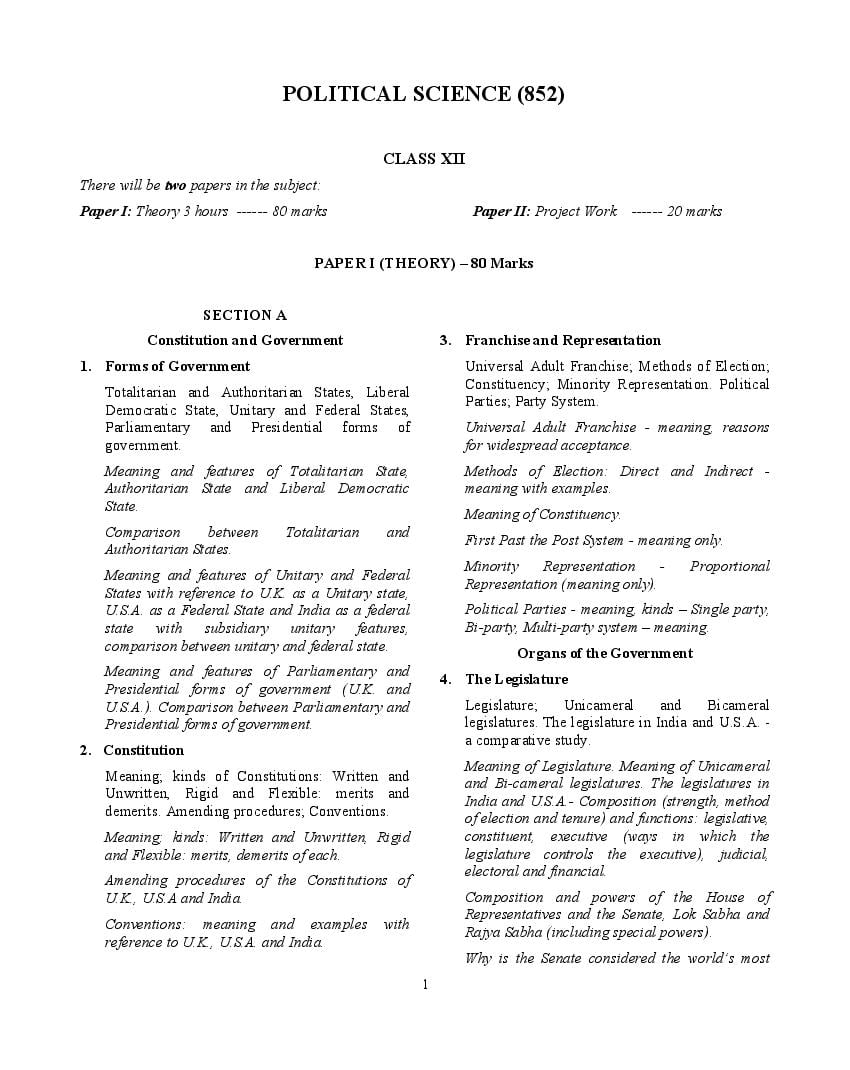
CLASS XII
There will be two papers in the subject:
Paper I: Theory 3 hours ------ 80 marks Paper II: Project Work ------ 20 marks
PAPER I (THEORY) – 80 Marks
SECTION A
Constitution and Government 3. Franchise and Representation
1. Forms of Government Universal Adult Franchise; Methods of Election;
Constituency; Minority Representation. Political
Totalitarian and Authoritarian States, Liberal
Parties; Party System.
Democratic State, Unitary and Federal States,
Parliamentary and Presidential forms of Universal Adult Franchise - meaning, reasons
government. for widespread acceptance.
Meaning and features of Totalitarian State, Methods of Election: Direct and Indirect -
Authoritarian State and Liberal Democratic meaning with examples.
State.
Meaning of Constituency.
Comparison between Totalitarian and
First Past the Post System - meaning only.
Authoritarian States.
Minority Representation - Proportional
Meaning and features of Unitary and Federal
Representation (meaning only).
States with reference to U.K. as a Unitary state,
U.S.A. as a Federal State and India as a federal Political Parties - meaning, kinds – Single party,
state with subsidiary unitary features, Bi-party, Multi-party system – meaning.
comparison between unitary and federal state. Organs of the Government
Meaning and features of Parliamentary and 4. The Legislature
Presidential forms of government (U.K. and
U.S.A.). Comparison between Parliamentary and Legislature; Unicameral and Bicameral
Presidential forms of government. legislatures. The legislature in India and U.S.A. -
a comparative study.
2. Constitution
Meaning of Legislature. Meaning of Unicameral
Meaning; kinds of Constitutions: Written and and Bi-cameral legislatures. The legislatures in
Unwritten, Rigid and Flexible: merits and India and U.S.A.- Composition (strength, method
demerits. Amending procedures; Conventions. of election and tenure) and functions: legislative,
Meaning; kinds: Written and Unwritten, Rigid constituent, executive (ways in which the
and Flexible: merits, demerits of each. legislature controls the executive), judicial,
electoral and financial.
Amending procedures of the Constitutions of
U.K., U.S.A and India. Composition and powers of the House of
Representatives and the Senate, Lok Sabha and
Conventions: meaning and examples with
Rajya Sabha (including special powers).
reference to U.K., U.S.A. and India.
Why is the Senate considered the world’s most
1
Page 2
Emergency powers; Special provisions for
Comparison of the Rajya Sabha and the U.S.
Schedule castes and Schedule tribes.
Senate; Lok Sabha with the U.S. House of
Representatives.
8. Fundamental Rights and Directive Principles
5. The Executive
Fundamental Rights and Directive Principles of
Difference between the Political Executive and State Policy.
the Permanent Executive. Political Executive in
Fundamental Rights: meaning; detailed study of
India and U.S.A. - a comparative study.
all Fundamental Rights in India.
Meaning of the Executive.
Directive Principles of State Policy: meaning and
Difference between the Political and Permanent classification.
Executive in India. Political Executive in India
9. Local self-government
and U.S.A. - a comparative study. Powers and
functions of executive heads of India (President 73rd and 74th Constitutional Amendment Acts.
and Prime Minister) and U.S.A. (President). Key features of the 73rd and 74th Amendments. 11th
6. The Judiciary and 12th schedules in brief.
Meaning and functions of Judiciary. Conditions Composition and functions of Zila Parishad and
of Independence of Judiciary. Judiciary in India Municipal Corporation.
and U.S.A. - a comparative study. Judicial 10. Democracy in India – a perspective of the
Review. challenges faced
Meaning and functions of judiciary; conditions of Challenges faced by the Indian Democracy:
independence of judiciary with reference to India Caste, Communalism and Regionalism.
and U.S.A. The Judiciary in India and U.S.A. – Strengthening Indian Democracy.
composition and powers of Indian Supreme
Court and American Supreme Court. Judicial Caste: meaning, role of caste in Indian Politics.
Review – meaning, principles (maxims). Meaning Communalism: meaning only.
of Judicial Activism and Judicial Restraint.
Comparative study of Indian and US Supreme Regionalism: meaning, forms of
Courts. regionalism/kinds of regional aspirations
(language issues, sons-of-the-soil policies, river
SECTION B water disputes, demand for new states,
Indian Democracy secessionist demands).
Strengthening Indian Democracy: measures to
7. Indian Constitution overcome the challenges faced by Indian
(i) Preamble Democracy.
Preamble and its importance. Meaning of the PAPER II (PROJECT WORK) – 20 MARKS
key words contained in the Preamble.
Candidates will be required to undertake one project
(ii) Salient features of the Indian Constitution. which may be any one of the following:
Written and Comprehensive; a Constitution
(i) A case study.
drawn from several sources; Federal structure
with Unitary spirit; Partly rigid and Partly (ii) Survey study with a questionnaire.
flexible; Fundamental Rights and Duties; (iii) Research based project with in-depth analysis.
Directive Principles of State Policy;
Parliamentary form of Government; Single (iv) Local/ national/ global political issue.
Citizenship; Bi-cameral legislature; Universal
Adult Franchise; Single Integrated and
2
Page 3
posters/ newspapers/ advertisements/ cartoons of evidence to
and art. present reasoned,
The project must not be based primarily on the substantiated
syllabus; students must be encouraged to produce arguments/
original, creative and insightful perspectives on an statement.
allied aspect of the topic. 3. Presentation Overall format, 3
For example, if the theme is Fundamental Rights, the referencing
project could deal with violation, protection, court (footnotes &/or
verdicts, Public Interest Litigations (PILs), etc. bibliography),
related to socially relevant issues. within word limit
of 2000 words,
The project will be assessed by the teacher and a title page,
Visiting Examiner appointed locally and approved header/footer, etc.
by the Council.
TOTAL 10
Assessment of Project Work will be done as
follows:
Internal Evaluation by Evaluation by the Visiting Examiner
1.
Teacher 10 Marks S. Assessment Criteria Marks
No. objective
Evaluation by Visiting
2. 10 Marks 1. Choice of Overall format, 4
Examiner
Technique/ referencing
TOTAL 20 Marks Detailed (footnotes &/or
procedure bibliography), title
& page,
Internal Evaluation by Teacher Presentation header/footer, etc.
S. Assessment 2. Analysis and Candidate should 3
Criteria Marks
evaluation be able to:
No. objective
Interpret, analyze
1. Process Candidates should 3 and evaluate
be able to: critically a range of
evidence to present
Identify the topic. reasoned,
Plan and detail a substantiated
research project. arguments/
Select and use statement.
appropriate 3. Viva Range of questions 3
research methods. based on the
project only.
TOTAL 10
2. Understanding Candidates should 4
application of be able to:
knowledge
Explain issues and
and Analysis
themes clearly and
in context.
Interpret, analyse
and evaluate
3
Page 4
Given below is a list of suggested topics for Project analysed with reference to the role of regional
work, along with guidelines. parties in coalition era.
• Few examples to be explained with the help of
1. Judicial Activism – two case studies in which the
statistical information.
Judiciary has safeguarded the environment or
human rights. • Student’s vision of rapidly evolving Party
system in India.
• Reason for selection of the topic.
4. Examine one Supreme Court case dealing with
• Framing the Research Question. Fundamental Rights. Identify the issues of the
• Hypothesis. case and analyse the final ruling.
• Reason for selection of the topic
• Define Judicial Activism and the need for
Judiciary to intervene in the work of • Framing the Research Question.
Legislature and Executive and other matters of • Hypothesis.
social concerns.
• Nature and reasons of violation of Fundamental
• Positive role played by Judiciary in this Rights to be explained.
direction to be highlighted with the help of two • A case study of violation and protection of
case studies based on environmental protection Fundamental Rights in the light of the ruling
or safeguarding human rights. given by the apex court to be analysed.
• Student’s perception of the concept. • Remedial steps to be taken to prevent this
• Valid suggestions for reforms in Judiciary. problem to be suggested.
2. Public accountability of Civil Servants in India – 5. Role of Local Self Government institutions in
Is it a myth or a reality? women empowerment.
• Reason for selection of the topic.
• Reason for selection of the topic.
• Framing the Research Question.
• Framing the Research Question.
• Hypothesis.
• Hypothesis.
• Need for women empowerment to be explained
• Meaning of Public accountability of Civil with reference to a few examples.
Servants to be explained. • Positive role played by local self-governments
• Positive and crucial role of public servants in a to be stated.
democracy. • Collection of data based on statistics and
• Loopholes in the existing bureaucratic set up. analysis.
• Inferences can be drawn about Public • The project could be in the form of a case study
accountability being a myth or reality from for example - a film review, book review,
various sources like print/electronic media, advertisements, T.V. serials, documentaries,
film review, documentaries. newspaper articles, journals.
• Student’s suggestions for more active
3. Party System in India – changing phases.
participation of women in Indian electoral
• Reason for selection of the topic. politics.
• Framing the Research Question. 6. Explore the controversies around the
• Hypothesis. development of a Uniform Civil Code mentioned
in the Directive Principles.
• A brief timeline of Party Systems since
independence to be prepared. • Reason for selection of the topic.
• Strengths and limitations of different systems • Framing the Research Question
to be highlighted. • Hypothesis
4
Page 5
Code with instances from world constitutions. • Parliamentary debates leading to the enactment
• Need for a Uniform Civil Code with reference of the right.
to Constituent Assembly Debates, historical • A case study of a slum area based on a survey.
perspective (parliamentary debates and judicial
• Student’s inferences.
pronouncements), the present socio-political
scenario and the stand of various political 10. Role of National Human Rights Commission in
parties. safeguarding the rights of the under-privileged.
• Controversies and reasons for non-adoption. • Reason for selection of the topic.
• Student’s view point and position on the issue. • Framing the Research Question.
Alternately this project could also be undertaken • Hypothesis.
survey method or any other method. • United Nations Universal Declaration of
7. Identify and explain the electoral reforms that are Human Rights (1948).
urgently needed in India. • Constitutional provisions.
• Reason for selection of the topic. • Formation of National Human Rights
• Framing the Research Question. Commission.
• Hypothesis. • Its composition and functions.
• Define electoral reforms. • Identifying the under-privileged and
understanding their plight.
• Urgency for electoral reforms.
• Efforts made by the NHRC (a minimum of two
• Efforts made in the past. case studies).
• Parliamentary debates on this issue. • Student’s viewpoint.
• Role of the Election Commission.
• Stand of various political parties. GUIDELINES FOR TEACHERS:
• Judicial pronouncements. 1. It must be emphasized that the process of doing
• Student’s observations. the project is as important as the final project.
8. Discrimination faced by a girl child. 2. Once the project/projects are chosen, there
• Reason for selection of the topic. should be a process of brainstorming to
• Framing the Research Question. encourage students to make out a draft/structure
for the project before embarking on research.
• Hypothesis.
3. During the brainstorming/discussion, the teacher
• Gender as an identity.
should discuss the assessment criteria with the
• Collection of data based on statistics and students.
analysis.
4. The teacher should discuss the draft with the
• The project could be in the form of a case study student with regard to the central question and
for example a film review, book review, the type of sources to be used.
advertisements, T.V. serials, documentaries
• Inferences drawn. 5. The students should be guided on doing the
research and looking at different types of
9. Right to Education: To what extent has it evidence.
benefited the slum children?
6. Books and suitable reference material could be
• Reason for selection of the topic.
suggested by the teachers and made available to
• Framing the Research Question. the students.
• Hypothesis. 7. Internet sites could be suggested, but care must
5
Page 6
8. Students must be cautioned against plagiarism
and be penalized for the same.
9. Marks to be awarded for the content and
originality and not for decorative elements and
embellishments.
10. Projects must be the original work of the student.
6
Document Details
| Board / Org | CISCE |
| Exam | Class 12 |
| Type | Syllabus |
| Pages | 6 |
| Language | english |
| Updated | 22 Jul 2026 |