WBCHSE Class 12 Syllabus for History
Finished viewing? Save it for later —
Download WBCHSE Class 12 Syllabus for History (PDF · 4 pages)About WBCHSE Class 12 Syllabus for History
WBCHSE Class 12 Syllabus for History is available here for free download. Published by West Bengal Board for Class 12, this syllabus can be viewed online or downloaded as a PDF (4 pages). Candidates preparing for Class 12 can use WBCHSE Class 12 Syllabus for History to understand the exam pattern, the type of questions asked, and the overall difficulty level.
Frequently Asked Questions
How can I download WBCHSE Class 12 Syllabus for History?
Open this page and click the Download button to save WBCHSE Class 12 Syllabus for History as a PDF. It is completely free on AglaSem Docs.
Is WBCHSE Class 12 Syllabus for History free to download?
Yes. WBCHSE Class 12 Syllabus for History can be viewed online and downloaded as a PDF free of cost on AglaSem Docs.
How many pages does WBCHSE Class 12 Syllabus for History have?
WBCHSE Class 12 Syllabus for History contains 4 pages, which you can read online or download together as a single PDF.
Where can I find more Class 12 study material?
You can find more Class 12 question papers, sample papers, syllabus, and answer keys on AglaSem Docs.
WBCHSE Class 12 Syllabus for History – Text
Read the full text of this syllabus below — useful to quickly search, copy and reference the content online without downloading the PDF.
📄 View text version (4 pages)
Page 1
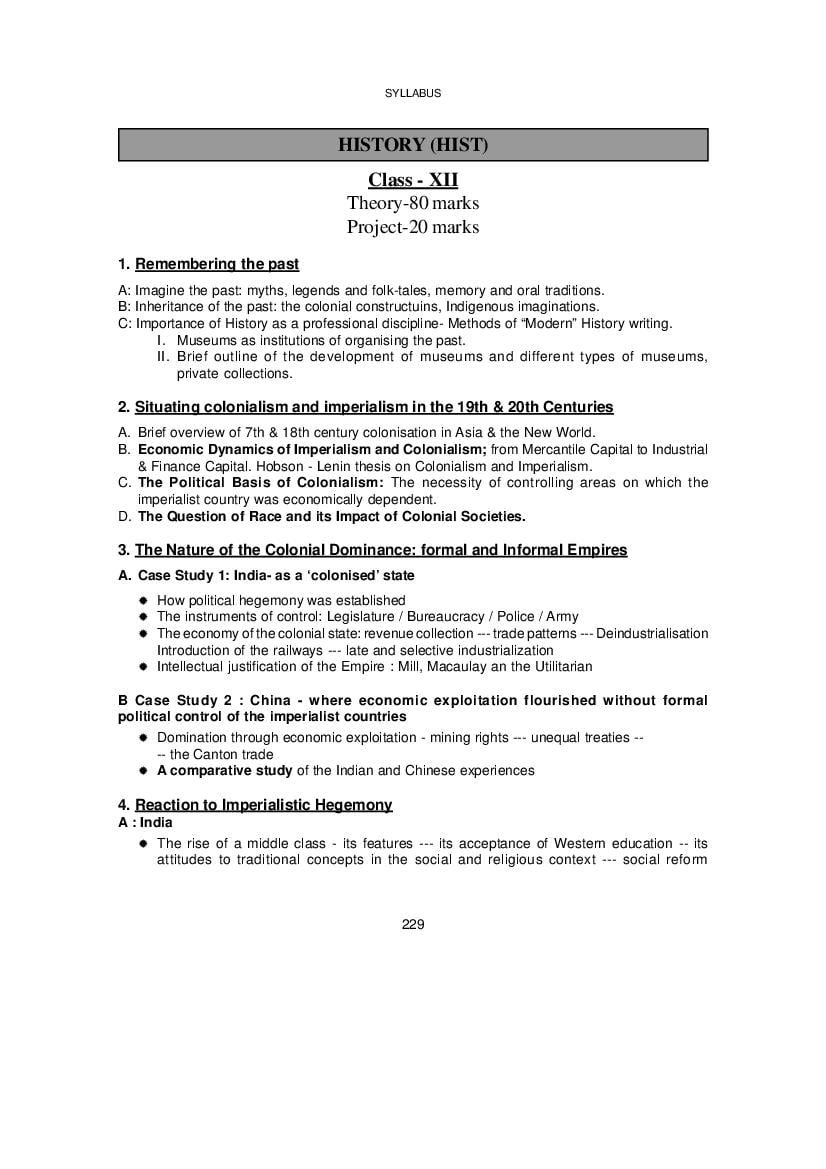
Class - XII
Theory-80 marks
Project-20 marks
1. Remembering the past
A: Imagine the past: myths, legends and folk-tales, memory and oral traditions.
B: Inheritance of the past: the colonial constructuins, Indigenous imaginations.
C: Importance of History as a professional discipline- Methods of “Modern” History writing.
I. Museums as institutions of organising the past.
II. Brief outline of the development of museums and different types of museums,
private collections.
2. Situating colonialism and imperialism in the 19th & 20th Centuries
A. Brief overview of 7th & 18th century colonisation in Asia & the New World.
B. Economic Dynamics of Imperialism and Colonialism; from Mercantile Capital to Industrial
& Finance Capital. Hobson - Lenin thesis on Colonialism and Imperialism.
C. The Political Basis of Colonialism: The necessity of controlling areas on which the
imperialist country was economically dependent.
D. The Question of Race and its Impact of Colonial Societies.
3. The Nature of the Colonial Dominance: formal and Informal Empires
A. Case Study 1: India- as a ‘colonised’ state
How political hegemony was established
The instruments of control: Legislature / Bureaucracy / Police / Army
The economy of the colonial state: revenue collection --- trade patterns --- Deindustrialisation
Introduction of the railways --- late and selective industrialization
Intellectual justification of the Empire : Mill, Macaulay an the Utilitarian
B Case Study 2 : China - where economic exploitation flourished without formal
political control of the imperialist countries
Domination through economic exploitation - mining rights --- unequal treaties --
-- the Canton trade
A comparative study of the Indian and Chinese experiences
4. Reaction to Imperialistic Hegemony
A : India
The rise of a middle class - its features --- its acceptance of Western education -- its
attitudes to traditional concepts in the social and religious context --- social reform
229
Page 2
Bengal, Sir S.A. Khan and the Aligarh movement.
Change and transformation in society as a result of the above factors.
Proliferation of the rural elite: Patidars, Sahukars, money-lenders and middlemen-greater
fragmentation of rural classes due to economic reasons.
The emergence of a new rural elite: patidars, Sahukars, money-lenders and middlemen-
greater fragmentation of rural classes due to economic reasons.
The emergence of an industrial force
Subaltern groups : Adivasis, Dalits.
Western ideas and the Indian response:
a. The aspiration of the middle coass and its fall outs.
b. Regional cultural responses, in partivular, the ‘Bengal Renaissance’
c. How Western concepts of ‘time’, ‘health and ‘labour for wages’ brought
about a change in Indian society and the local mindset.
B: China
Emergence of a Western educated class- the influence of Christianity --- the scholars’
response- May Fourth Movement.
C: Migration of indentured labourers: formation of the Indian and Chinese Diaspora.
5. Governing the Colonial State India
z Govt. of India Acts of 1909, 1919, and 1935 at tools for limiting franchise, introducing
communal electorates, maintaining administrative control and British hegemony
z The state machinery for suppressing freedom of expression e.g. the Rowlett Act and
military / police control:
z The Jalianwala Bagh incident / the Meerut Conspiracy Case
z Divide and Rule policy: using community/caste/perceived/ ethnic groupings to divide and
anti-colonial movement, e.g., supporting the demands of the Muslim League; the
Communal Award of 1932; interfering in caste politics such as the temple entre issue
z The Princely states and the British Government: the creation of an alternative loyalist base
z Economic policies from 1914 to 1945 e.g. limited industrialisation; currency regulation after
the First World War; high taxation even in famine conditions: (Gujarat, 1918,1928): the
Bengal Famine
6. The Second World War and the Colonies
A: India, 1940-46
Linlithgow Offer --- Cripps Mission --- the Indian response and the Quit India Movement-
Subhas Bose and the INA - INA Trials --- RIN Revolt - the backdrop to the Transfer of
Power: The British government’s role: Cabinet Mission - Constituent Assembly -
Mountbatten’s negotiations - Mountbatten Award - Transfer of power - The Indian
response.
230
Page 3
‘Asia for Asians”--- Japan and China - Japanese advance through South-East Asia and
the consequent linking up with the INA.
C: Changed situation in the European colonial in S.E. Asia, e.g. Indochina and Indonesia.
7. The Era of the Cold War
A: The Cold War
Theoretical basis --- inception---developments from 1942 to 1948 --- the Truman Doctrine and the
Marshall Plan --- the military alliances --- Impact---the Berlin Crisis---Eastern Europe under the
U.S.S.R. ---Suez Crisis---Cuban Missile Crisis---Korea and Vietnam
B: The Nuclear Arms Race and Peace Initiatives
C: Non-Alignment
The Political Background ---its principles ---building up the movement ---Bandung, Belgrade and
subsequent conference ---an evaluation
D: The Arab World: Israel vs. the Arab World ---Oil Diplomacy
E: People’s Republic of China: Its rise and plae in World Politics.
8. Decolonisation
A: Defination of the term; social, political and economic implications manifestations; develop-
ment programmes and Nation building.
B: Africa: case study - Algeria.
C: South-east Asia: case study - Indonesia.
D: Nation building in South Asia
z Varying political experiences in South Asia - Emergence of Bangladesh - a brief study of
political systems in India, Pakistan and Bangladesh.
z The economic organisation of India - economic planning - heavy industries and
technological advances - socialist underpinnings of economic planning - liberalisation,
how succssful.
z Regional co-operation - SAARC.
9. The New World
(For Project Work-on any one topic, 750-800 words)
A: Interactionof Centripetal and Centrifugal Forces:
Transition from a bi-polar to a unipolar world - its political fallouot---Globalisation---the “Clash of
Civilisations”
231
Page 4
z The Peace Movements: the students’ movements of the ‘60s and others
z Democratic and Civil Right Movements: USA/anti-apartheid movement in South Africa/
movements for universal adult franchise / present-day turmoil in the Arab world, Libya,
Egypt etc.
z The movement for women’s rights
z Environmental movements ---Chipko, Tehri-Garhwal, Narmada Banchao. Keeping alive
the conflict between the First and Third Worlds over environmental issues.
z New Social Movements.
z The new economic order (the depression of 2008-11- a crisis of capitalism? ---the emer-
gence of BRIC.)
232
Document Details
| Board / Org | West Bengal Board |
| Exam | Class 12 |
| Type | Syllabus |
| Pages | 4 |
| Updated | 22 Jul 2026 |