WBCHSE Class 12 Syllabus for Home Management and Family Resources Management
Finished viewing? Save it for later —
Download WBCHSE Class 12 Syllabus for Home Management and Family Resources Management (PDF · 5 pages)About WBCHSE Class 12 Syllabus for Home Management and Family Resources Management
WBCHSE Class 12 Syllabus for Home Management and Family Resources Management is available here for free download. Published by West Bengal Board for Class 12, this syllabus can be viewed online or downloaded as a PDF (5 pages). Candidates preparing for Class 12 can use WBCHSE Class 12 Syllabus for Home Management and Family Resources Management to understand the exam pattern, the type of questions asked, and the overall difficulty level.
Frequently Asked Questions
How can I download WBCHSE Class 12 Syllabus for Home Management and Family Resources Management?
Open this page and click the Download button to save WBCHSE Class 12 Syllabus for Home Management and Family Resources Management as a PDF. It is completely free on AglaSem Docs.
Is WBCHSE Class 12 Syllabus for Home Management and Family Resources Management free to download?
Yes. WBCHSE Class 12 Syllabus for Home Management and Family Resources Management can be viewed online and downloaded as a PDF free of cost on AglaSem Docs.
How many pages does WBCHSE Class 12 Syllabus for Home Management and Family Resources Management have?
WBCHSE Class 12 Syllabus for Home Management and Family Resources Management contains 5 pages, which you can read online or download together as a single PDF.
Where can I find more Class 12 study material?
You can find more Class 12 question papers, sample papers, syllabus, and answer keys on AglaSem Docs.
WBCHSE Class 12 Syllabus for Home Management and Family Resources Management – Text
Read the full text of this syllabus below — useful to quickly search, copy and reference the content online without downloading the PDF.
📄 View text version (5 pages)
Page 1
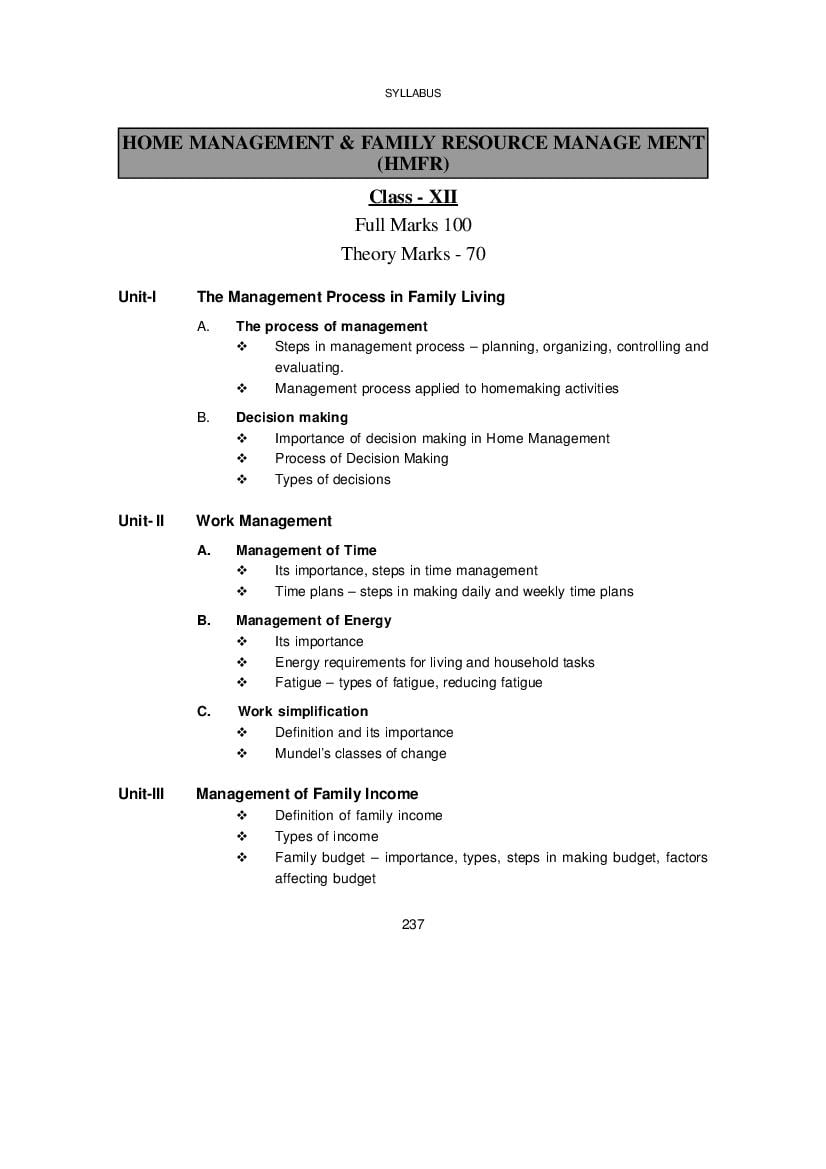
(HMFR)
Class - XII
Full Marks 100
Theory Marks - 70
Unit-I The Management Process in Family Living
A. The process of management
Steps in management process – planning, organizing, controlling and
evaluating.
Management process applied to homemaking activities
B. Decision making
Importance of decision making in Home Management
Process of Decision Making
Types of decisions
Unit- II Work Management
A. Management of Time
Its importance, steps in time management
Time plans – steps in making daily and weekly time plans
B. Management of Energy
Its importance
Energy requirements for living and household tasks
Fatigue – types of fatigue, reducing fatigue
C. Work simplification
Definition and its importance
Mundel’s classes of change
Unit-III Management of Family Income
Definition of family income
Types of income
Family budget – importance, types, steps in making budget, factors
affecting budget
237
Page 2
A. Savings
Objectives of savings
Types of savings – compulsory (GPF, CPF) and voluntary (PPF, P.O,
savings, banks, LIC policies, LIC schemes, bonds, UTI schemes etc.)
B. Investments
Types of investment
Principles involved in investments
C. Fundamentals of banking
Opening and operating a bank account, types of cheques, fillings a
deposit slip, procedure for making a Demand Draft, use of ATM, debit
& Credit cards
D. Credit
Meaning and sources
Types – charge account, mortgage, instalment, sales contract
Wise use of credit
Unit- IV Adolescence & Adulthood
Physical development during adolescence. Physical development during
puberty and adolescenes; changes in body proportions and its effects;
influence of sports and exercise on physical fitness.
Cognitive development and language. Language and communication
– development of language; influence on language development;
development of ways in which adolescents obtain information,
remember it and utilize it for problem solving and reasoning.
Social and emotional. Socio-cultural influences on the adolescents –
teenagers are influenced by social relationships in the family,
neighbourhood, community, country and the world.
The family and socialisation – patterns of parenting, parental control
techniques; role of siblings and grand parents. Development of peer
relationship and friendship patterns.
Development of gender roles and stereotypes. Role of school and
teachers on the social and emotional development of the teenager.
Some problem of adolescence; awkwardness due to growth spurt,
freedom and control; depression, alcohol, drugs and smoking,
238
Page 3
prevention of HIV/AIDS and other sexually transmitted diseases.
Perspectives on Adult Development: meaning of adulthood. Transition
to adulthood and accepting related responsibilities, dimensions of
adulthood (premarital counselling, interpersonal relationship in a family
life, concept of family planning and personal health),
Issues of increasing life expectancy, sensitizing students to the needs
and care of the elderly.
Unit – V Meal planning for the family
Objection of meal planning. Nutritional adequacy, food groups. Self –
explanatory.
Factors affecting food selection. An understanding of how food
consumption varies from one family to another; how food selected by
families is affected by various factors like age, occupation, gender,
physiological conditions, personal likes and dislikes, tradition, seasonal
availability, economic considerations, religious beliefs, family size and
composition.
Balance diet.
Meal planning for various age groups; preschool children, school- age
children, adolescents, pregnant and lactating women, old age. Making
meal plans for these age groups based on their nutritional requirement
and RDA.
Developing good food habits- importance of breakfast, following regular
meal patterns, avoiding junk food and skipping of meal.
Unit- VI Clothing Management
Selection of clothing: clothing and its relation to personality; elements
of line , colour, texture; elements of design – balance, rhythm, proportion,
harmony, emphasis, age, climate, occupation, figure, occasion, fashion,
purpose, quality, cost, season, reliable shop.
Care of clothes: general principles and precautions to the followed while
removing stains and washing: dry cleaning agents: soaps and detergents
(basic differences).
Storage of clothes.
239
Page 4
Daily, weekly and periodic cleaning
List of cleaning equipment and materials
The operation, maintenance and care of household equipment- solar
cooker, pressure cooker, toasters, mixers, oven, iron, refrigerators.
House pests and their control
Unit- VIII Family Housing
Need and importance of Housing
Factors influencing choice of a house
Choice of furnishing materials for interiors: curtains, carpets & rugs,
upholstery, bed, table linen.
Materials used for furniture (wood, its derivatives, metals, glass, plastic,
wicker etc.)
The arrangement of furniture in different rooms
Accessories in interiors: Importance and types (floor, wall and table
top)
Unit- IX Consumer and Extension Education
A. Consumer Education
Meaning, problems faced by consumers
Consumer protection Act and Services
Consumer Aids – Labels, Standards, Advertising, Guidebooks, Leaflets
Consumer Redressal Forum
B. Extension Education
Methods of communication – individual, group and mass contacts.
Individual – verbal and written
Group – discussions, demonstrations, fieldtrips.
Mass – Print and Electronic.
Role of audio visual aids in Communication & Extension.
240
Page 5
(HMFR)
Class - XII
Practical Marks : 30
1. Preparing a chart on:
a) Activities carried out in a day by a working and non working homemaker.
b) To prepare a daily and weekly time schedule for self.
2. A) To collect account opening forms (savings, current, recurring) and pay – in –
slips and to learn filling up process.
B) To learn about writing of cheques, withdrawal forms.
3. To prepare family budget of different income groups.
4. Methods of keeping household accounts.
5. Preparing reading materials i.e. colour books, alphabet books,
Counting books, nursery rhymes books, building blocks etc. In the laboratory.
6. Plan a balance meal for yourself.
7. a) Removal of stains from fabrics.
b)Principles of simple method of dyeing or printing textile in the laboratory.
8. Cleaning and polishing of articles – metals, glass, leather.
9. Making furniture/floor layout for living room, dining room, bedroom, Bathroom
and kitchen.
10. Collect and analyze labels of various food products, medicines and anyone
household equipment.
Marks Allotment:
Practical 15
Viva 05
Record Book 10
241
Document Details
| Board / Org | West Bengal Board |
| Exam | Class 12 |
| Type | Syllabus |
| Pages | 5 |
| Updated | 30 Apr 2026 |