TIFR GS 2016 Question Paper Biology M.Sc Wildlife and Conservation
Finished viewing? Save it for later —
Download TIFR GS 2016 Question Paper Biology M.Sc Wildlife and Conservation (PDF · 22 pages)About TIFR GS 2016 Question Paper Biology M.Sc Wildlife and Conservation
TIFR GS 2016 Question Paper Biology M.Sc Wildlife and Conservation is available here for free download. Published by TIFR for TIFR GS, this question paper can be viewed online or downloaded as a PDF (22 pages). Candidates preparing for TIFR GS can use TIFR GS 2016 Question Paper Biology M.Sc Wildlife and Conservation to understand the exam pattern, the type of questions asked, and the overall difficulty level.
Frequently Asked Questions
How can I download TIFR GS 2016 Question Paper Biology M.Sc Wildlife and Conservation?
Open this page and click the Download button to save TIFR GS 2016 Question Paper Biology M.Sc Wildlife and Conservation as a PDF. It is completely free on AglaSem Docs.
Is TIFR GS 2016 Question Paper Biology M.Sc Wildlife and Conservation free to download?
Yes. TIFR GS 2016 Question Paper Biology M.Sc Wildlife and Conservation can be viewed online and downloaded as a PDF free of cost on AglaSem Docs.
How many pages does TIFR GS 2016 Question Paper Biology M.Sc Wildlife and Conservation have?
TIFR GS 2016 Question Paper Biology M.Sc Wildlife and Conservation contains 22 pages, which you can read online or download together as a single PDF.
Where can I find more TIFR GS study material?
You can find more TIFR GS question papers, sample papers, syllabus, and answer keys on AglaSem Docs.
TIFR GS 2016 Question Paper Biology M.Sc Wildlife and Conservation – Text
Read the full text of this question paper below — useful to quickly search, copy and reference the content online without downloading the PDF.
📄 View text version (22 pages)
Page 1
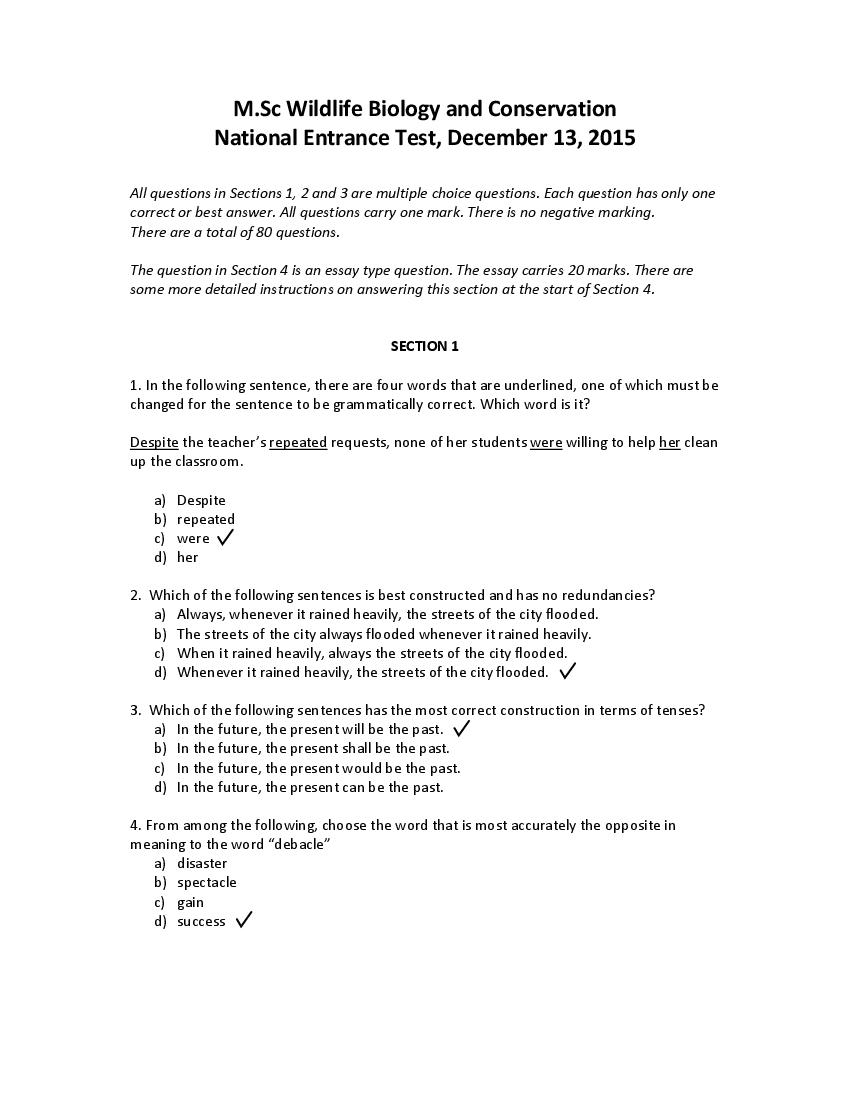
National Entrance Test, December 13, 2015
All questions in Sections 1, 2 and 3 are multiple choice questions. Each question has only one
correct or best answer. All questions carry one mark. There is no negative marking.
There are a total of 80 questions.
The question in Section 4 is an essay type question. The essay carries 20 marks. There are
some more detailed instructions on answering this section at the start of Section 4.
SECTION 1
1. In the following sentence, there are four words that are underlined, one of which must be
changed for the sentence to be grammatically correct. Which word is it?
Despite the teacher’s repeated requests, none of her students were willing to help her clean
up the classroom.
a) Despite
b) repeated
c) were
d) her
2. Which of the following sentences is best constructed and has no redundancies?
a) Always, whenever it rained heavily, the streets of the city flooded.
b) The streets of the city always flooded whenever it rained heavily.
c) When it rained heavily, always the streets of the city flooded.
d) Whenever it rained heavily, the streets of the city flooded.
3. Which of the following sentences has the most correct construction in terms of tenses?
a) In the future, the present will be the past.
b) In the future, the present shall be the past.
c) In the future, the present would be the past.
d) In the future, the present can be the past.
4. From among the following, choose the word that is most accurately the opposite in
meaning to the word “debacle”
a) disaster
b) spectacle
c) gain
d) success
Page 2
similar to that between mother and child
a) Horse and pony
b) Cow and calf
c) Adult and Juvenile
d) Frog and Tadpole
6. Five horses ran in a race. Deccan Queen finished after Jhansi. Deccan Queen came in
ahead of Annapoorna. Plateau King beat Jhansi but finished after Rani Thema. Where did
Plateau King and Deccan Queen finish?
a) 1st and 3rd
b) 2nd and 4th
c) 3rd and 5th
d) 4th and 5th
7. Shreya is double the age of Norgei and one third as old as Deepak who will be 44 years
old in 8 years. How old is Norgei?
a) 6
b) 12
c) 36
d) 24
8. I have 24 cricket balls. I give you 8 of them. You now have twice the number of cricket
balls that I do. How may cricket balls did you have to begin with?
a) 8
b) 16
c) 24
d) 32
9. You are standing facing North. You walk 20 meters and then turn 90 degrees clockwise.
You then walk another 10 meters and then turn 45 degrees anticlockwise. You now walk 15
meters and then turn 135 degrees clockwise and walk another 5 meters. In which direction
are you now facing?
a) North
b) South
c) East
d) West
10. All the trees in the park are flowering. Some of the trees in the park are Gulmohar trees.
There are also some Cassia trees in the park. Which of the following is correct?
a) Some Cassia and all Gulmohar trees in the park are flowering.
b) Some Gulmohar and all Cassia trees in the park are flowering.
c) All Gulmohar trees in the park are flowering.
d) Some Gulmohar and some Cassia trees in the park are flowering.
Page 3
In a triathlon, athletes compete in a three stage race which starts with swimming for 1.5 km
followed by cycling for 40 km and followed by running for 10 km. The following table
contains the timings (in minutes) of four athletes for each stage of a triathlon. Answer the
following three questions using the information in the table below:
Swimming Cycling Running
A 19 75 44
B 22 74 46
C 21 70 41
D 25 65 43
11. What was the order (from first to last) of the four athletes at the end of the cycling
stage?
a) A, B, C, D
b) B, A, C, D
c) D, C, A, B
d) C, A, D, B
12. Do the timings in any one stage perfectly predict the final result of the race? Choose
from among the following:
a) Cycling
b) Running
c) Swimming
d) None
13. What are the minimum number of overtakings that must have taken place in the running
stage?
a) 0
b) 1
c) 2
d) 3
14. What is the x‐value where the quadratic function 3 + 5x – 0.5 x2 reaches its maximum?
a) 3
b) 5
c) 4.5
d) 2.5
15. A fair coin (which gives heads and tails with equal probability) is tossed into the air 9
times. In all of the nine instances, the coin lands with the head facing up. What is the
probability that the 10th coin toss will also land with the head facing up?
a) (1/2)9
b) 0
c) (1/2)
d) 1
Page 4
be uniquely identifiable. You have bands of the following colours: red, green, blue, yellow
and black. You place two colour bands on a single leg of the crow (left or right), one above
the other. The other leg of that crow receives no band. After the bird has been released, you
can see which leg the bands are on, as well as separately note the colour of the band above
and that below. With this protocol, how many individual crows can you mark with a unique
combination?
a) 5
b) 25
c) 50
d) 100
17. Which is the one function that the plot below can NOT possibly depict? Note: a and b are
constants, loge is the natural logarithm.
a) f ( x) log e ( x)
1
b) f ( x)
x
ax
c) f ( x)
bx
d) f ( x) axb , where 0 < b < 1
Page 5
w released into the po ond behind
the NCBSS cafeteria in n 2013. Baseed on previou w know thatt population growth of
us studies we
the speciies can be deescribed by the geometrric growth model m (at leaast for the initial few
years): Nt = λtN0, wheere Nt is pop pulation size at year t (e.g. N3 is popu ulation size at
a year 3), N0
is the inittial population size at ye
ear 0, λ is thee finite rate of increase (the
( ratio of population
sizes for two
t successive years Nt++1/Nt). Previo ous research h also tells us that the finnite rate of
increase for the speccies λ is 1.1. If the populaation size N2 in 2015 is estimated
e to
o be 242
individuaals, what was N0, the number of indiividuals initially released d into the poond in 2013??
a) 147
b) 240
c) 200
d) 220
19. You are
a doing a butterfly
b survvey in a sancctuary, recorrding speciess as you com
me across
them. Ass you spend more time, you
y plot thee total (cumu ulative) number of species against
the numb ber of days you
y have speent in the fieeld. What doo you expectt this graph to
t look like?
Choose a,
a b, c or d frrom the follo
owing graphss:
20. For a unimodal distribution, if the median < mean
a) The distribution haas a long right tail
b) The distribution has a long lefft tail
c) The disstribution is perfectly Gaaussian
d) The mode must be e more than the median
n
Page 6
rates of the Nilgiri marten Martes gwatkinsii in Brahmagiris WLS are density dependent,
which is to say that values of these two rates vary depending on population size. The plot
below shows that per capita death rate d’ (squares) increases linearly with population size,
while per capita birth rate b’(triangles) increases initially, and then declines when population
size exceeds about 30 individuals. Keep in mind that when death rate is greater than birth
rate, the population declines; when birth rate is greater than death rate, the population
increases. Which one of the following statements about the population’s behaviour can NOT
be inferred from the plot? (Do not worry about exact numbers)
a) When population size is at 6 individuals or at 34 individuals, the population will neither
grow nor decline.
b) When population size is below 6 individuals, the population will decline till it goes locally
extinct
c) When population is above 34 individuals, the population will decline till it goes locally
extinct.
d) If population size is between 6 and 34 individuals, the population will grow till it reaches
an abundance of 34.
Page 7
Match the histogram to the corresponding boxplot. Remember that the boxplots show the
1st and 3rd quartiles, with the thick line within being the median.
a) a‐iii, b‐i, c‐ii
b) a‐ii, b‐iii, c‐i
c) a‐i, b‐iii, c‐ii
d) a‐iii, b‐ii, c‐i
23. I estimate the density of mouse‐deer in areas with different levels of grass growth. I find
that where grass biomass is 0.5 Kg/m2, mouse‐deer density is 1 individual per hectare.
Where grass biomass is 2.5 Kg/m2, mouse‐deer density is 2 individuals per hectare. Imagine
that you want to draw this information on a graph. What is the equation of the line that
describes the relationship between mouse‐deer density and grass biomass in the form
y = a + b.x, where y is mouse‐deer density, x is grass biomass, a is the intercept and b is the
slope of the line?
a) a = 0.75, b = 0.5
b) a = 0.5, b = 0.75
c) a = 0.5, b = 2
d) a = 2, b = 0.5
Page 8
e daily probaability of survvival of a bulbul nest (i.e
e. the probab
bility that it escapes
predation n) is 90%, ho
ow do you exxpect the nu umber of surrviving nestss to change over
o time
(number of days)?
Choose a,
a b, c or d frrom the follo
owing figuress.
25. The figure
f below shows the estimated
e reelationship between
b vigilance rate and group sizze
(log10 – transformed)) of an antelope species. According tot this graphh, what is the vigilance
rate of so
olitary individuals?
a) 0
b) 14
c) 17.5
d) 20
Page 9
(Platacanthomys lasiurus) in a forest fragment. She traps 100 of them, puts tags on their
ears and releases them back into the forest. After a week she goes back and sets out traps in
the fragment again. This time she captures 75 of which 25 were the ones she had trapped
earlier. Using this information, which of the formulas given below will you use to estimate
the population size (N) of dormouse in the fragment. You can assume that the population is
closed (i.e. no births, deaths, immigration or emigration occurred between the two trapping
events) and the chance of being caught was the same for all individuals at all times.
a) N = 100*75/25
b) N = 25*100/75
c) N = 100+75‐25
d) N = 100*(75‐25)
27. You are given the following facts: i) C3 plants will be positively affected, whereas C4
plants will not be affected by a doubling of current CO2 concentrations in the atmosphere; ii)
C3 plants will be negatively affected, while C4 plants will be positively affected by a 5 degree
Celsius increase in mean air temperature. Given a future climate with double atmospheric
CO2 concentration and a 5 degree Celsius increase in mean air temperatures, which of the
following statements are true:
a) C4 plants will perform better and replace all C3 plants.
b) C3 plants will perform better and dominate.
c) There will be no change in the performance or abundance of either C3 or C4 plants
d) There is not enough information to make any prediction about the relative abundance of
C3 and C4 plants
28. Measures of species diversity incorporate two quantities: species richness, which is a
count of species, and evenness, which is a measure of how similar the abundances of
different species are. More species rich and more even communities are considered more
diverse than communities having fewer species and less evenness.
Based on the abundances of species in different communities provided below, indicate
which of the following statements is true.
Spec. A Spec. B Spec. C Spec. D
Community 1: 70 10 10 10
Community 2: 50 50 50 50
Community 3: 30 30 30 30
Community 4: 35 5 5 5
a) Community 1 has highest diversity
b) All four communities have the same diversity
c) Diversity of Community 2 > Community 3 > Community 1 > Community 4
d) Diversity of Community 2 = Community 3 > Community 1 = Community 4
Page 10
accessible exclusively to them (C) and those they shared with wild herbivores but not mega‐
herbivores (WC; Note: Mega‐herbivores are herbivores that weigh more than 1000 kg on
average) or those that they shared with wild herbivores and mega‐herbivores (MWC) during
the dry season (A) and during the wet season (B). Error bars are standard errors (n = 3
experimental blocks). When the P values over WC and MWC bars are <0.05, this means that
weight gain in those treatments is significantly different from the C treatment. [from Odadi
et al. Science 23 September 2011:vol. 333 no. 6050 1753‐1755]
Which of the following statements about the above figure is true?
a) Cattle do not compete with wild herbivores in either season
b) Cattle compete with wild herbivores in the dry season but not in the wet season
c) Cattle do not compete with wild herbivores in the dry season
d) Cattle do not compete with mega‐herbivores in the dry season
30. You are interested in finding out whether the addition of small amounts of inorganic
Nitrogen to Himalayan meadows affects the biomass and diversity of herbs. To do this you
decide to add Nitrogen fertilizer to a series of 10x10m plots, each of which is paired with an
adjoining 'control' plot that has no Nitrogen added. You decide to align the pairs in an East‐
West line; within each pair, one plot is to the North of the other. How should you best
arrange the control and Nitrogen‐treated plots in each pair?
a) Nitrogen‐treated plot to the North of the control plot in 100% of pairs
b) Nitrogen‐treated plot to the North of the control plot in 75% of pairs, rest to the
South of the control plot
c) Nitrogen‐treated plot to the North of the control plot in 50% of pairs, rest to the
South of the control plot
d) Nitrogen‐treated plot to the North of the control plot in 25% of pairs, rest to the
South of the control plot
Page 11
c species show twwo types of horn phenotyypes: large‐h horned or
small‐horned. The avverage matin ng success of the two diffferent horned phenotypes at
different ages is show
wn below. Errror bars rep present standdard errors. When the characters
c
over the bars are diffferent, it meeans that tho
ose means are significanntly differentt. Which of
the follow
wing statements about thist figure is INCORRECTT?
Among small‐‐horned males, mean m
a) A males is greater than
mating successs of older m
yoounger malees
b) Mean
M matingg success of old,
o small‐ho orned maless is lower thaan that of old, large
horned maless
c) Laarge‐horned
d males conssistently havee greater me
ean mating success
s thann small‐
horned maless
d) Mean
M matingg success of the
t two diffeerent hornedd morphs ch hanges with age in the
saame manner
32. You want
w to test whether gup ppy fish redu
uce their mo
ovement in the
t presence e of a
predator.
r. To do this, you have tw
wo tanks, onee with a carn
nivorous fish
h and one wiith a
herbivoro o these tankks, you want to place 10 guppies eacch from a holding tank
ous fish. Into
that has 20 guppies. What is the best way to o choose whiich guppies to
t put into which
w
experimeental tank in order to answer your question:
a) Assign each gupp py a numberr and flip a co
oin to decidee whether each guppy goes
g into thee
predaator or the non‐predato
n r tank.
b) Catch
h 10 guppiess and put theem into the predator tan nk, then catcch the rest and place
them
m in the non‐‐predator tan nk
c) Catch
h 10 guppiess and put theem into the non‐predato or tank, then
n catch the rest
r and placce
them
m in the predator tank
d) Catch
h 5 guppies and
a put them m in the nonn‐predator taank, catch th
he next 5 and put them in i
the predator
p than
nk, catch thee next 5 and put them inn the non‐prredator tank, and place
i the predator tank.
the reemaining 5 in
Page 12
geographic sites at which a species of moth was caught) and the abundance (expressed as
log mean density for a species across all sites) for 263 species of British moths (the black
dots are noctuid moth species while the white dots are sphingid moth species; Gaston, K.J.
& Lawton, J.H., 1988, Nature). Which of the following sentences best describes the
relationship between the distribution and abundance?
a) Species with abundances below 0.6 tend to be widely distributed.
b) On average, species with wider distributions are also more abundant.
c) All species that are distributed across more than 40 sites tend to be highly abundant.
d) Narrowly distributed species are also more variable in their abundance.
34. In a study researchers found that poaching in protected areas exhibited a significant
negative relationship with the number of forest guards in these areas (Pearson's correlations
coefficient, r=0.786, p < 0.001). Solely based upon these results, we can correctly infer that:
a) Managers assign fewer guards to protected areas with higher poaching
b) Lower number of guards in protected areas result in increased poaching
c) There is no relationship between poaching and number of guards in protected areas
d) Protected areas with more guards are associated with less poaching.
Page 13
f the do nt four biomes (distinct vvegetation types) that
ots represen
occur under distinct combination ns of mean aannual tempperature andd mean annu ual
precipitation. Carefully examine these dots aand visualizee in your min
nd the biome es they migh
ht
represennt. Which off these biomes is likely too have the highest biodiversity?
a) L
b) K
c) M
d) J
Page 14
36. What is the name of the ministry in the Indian government responsible for India's
environmental and forestry policies and programmes?
a) Ministry of Environment
b) Ministry of Environment, Forest and Climate Change
c) Ministry of Environment and Forests
d) Ministry of Forests and Wildlife
37. Rank the following category of protected areas in India in terms of the increasing
restrictions on permitted human activities:
A. Wildlife sanctuary B. National park C. Reserve Forest D. Conservation reserves
a) D‐C‐A‐B
b) A‐B‐C‐D
c) B‐D‐C‐A
d) B‐A‐C‐D
38. Which one of the following species is endemic to India (i.e. it is not found in the wild in
any other country)?
a) Bonnet Macaque
b) Snow Leopard
c) Great Hornbill
d) King Cobra
39. Which of the following protected areas would you have to visit to see an ecosystem
comprising montane grasslands interspersed with forests patches called ‘Sholas’?
a) Kaziranga NP, Assam
b) Kedarnath WLS, Uttaranchal
c) Eravikulam NP, Kerala
d) Kanha NP, Madhya Pradesh
40. Which endangered species has been in the news in recent years due to concerns over a
proposed Indian military radar facility affecting its habitat?
a) Desert Fox
b) Lesser Flamingo
c) Narcondam Hornbill
d) Himalayan Ibex
41. A significant climate change‐related landmark was established in the year 2012 when, for
the first time in a million years, mean global atmospheric CO2 concentrations exceeded:
a) 4 parts per billion
b) 400 parts per million
c) 4,000 parts per million
d) 4,00,000 parts per million
Page 15
species according to the IUCN (International Union for the Conservation of Nature) Red
Listing protocol:
a) Absolute geographic range
b) Change in population size
c) Sex ratio of adult individuals
d) Absolute population size
43. Which of the following habitats is the Dipterocarpaceae plant family most strongly
associated with?
a) Arid grasslands
b) Subtropical pine forests
c) Tidal mangrove forests
d) Lowland rainforests
44. The Atlas Mountains are a mountain range in which continent?
a) Africa
b) Europe
c) North America
d) Australia
45. Which of the following statements about the geological ages of the Himalayas and the
Western Ghats is true?
a) The Himalayas are older than the Western Ghats
b) The Himalayas are younger than the Western Ghats
c) The Himalayas are of comparable age to the Western Ghats
d) The relative ages of the Himalayas and the Western Ghats are not known
46. Which of the following tree species is not native to India?
a) Peepal
b) Sal
c) Teak
d) Tamarind
47. Tides are the periodic rise and fall of large bodies of water on earth, caused by the
gravitational pull of the sun and the moon. A spring tide (with the highest high and lowest
low tide) occurs when:
a) the sun exerts its maximum gravitational pull
b) the sun is closest to earth
c) the sun, moon and earth are aligned in a straight line
d) snow melt from rising spring temperatures is maximum.
48. Which of the following is not a greenhouse gas?
a) CO2
b) CH4
c) N2
d) N2O
Page 16
recorded from many locations on the Himalayas, including some of the highest peaks. Which
of the following statements is a correct explanation for this observation?
a) Himalayas were formed by volcanic activity
b) A large part of the Himalayas have been formed due to upliftment of the seafloor
c) Sea levels have fallen substantially (by more than 20,000 feet since) since the
fossilization of these organisms
d) Ancestors of many marine organisms came from land
50. A population of the Indus River Dolphin has been recently discovered in the one of the
following rivers in India.
a) Kosi
b) Teestaa
c) Chambal
d) Beas
51. If the mouth of a river dwelling fish species is on the ventral side of its body and has a
sucker‐like structure, which of the following inferences about this fish is most likely to be
true?
a) This fish is a blood‐sucking species
b) This fish is a bottom‐dwelling species
c) This fish has exceptional swimming ability
d) This fish can swim upstream with ease
52. The closest relatives of hedgehogs, out of the following, are:
a) Porcupines
b) Armadillos
c) Shrews
d) Mice
53. The 10th Conference of the Parties to the Convention on Biological Diversity (CoP 10)
held in Japan in 2010 set a series of goals pertaining to biodiversity conservation. These are
known as:
a) The Millennium Development Goals
b) The Kyoto Targets
c) The Aichi Targets
d) The Sustainable Development Goals
54. Match the following authors to their books: A. Ghazala Shahabuddin B. Jim Corbett C.
Valmik Thapar D. George Schaller 1. Jungle Lore 2. Stones of Silence 3. Conservation at the
Crossroads 4. Land of theTiger.
a) A‐2, B‐1, C‐4, D‐3
b) A‐4, B‐3, C‐1, D‐2
c) A‐3, B‐1, C‐4, D‐2
d) A‐3, B‐4, C‐1, D‐2
Page 17
productivity (NPP) and gross primary productivity (GPP)? [Note: Rtotal = Total respiration,
Rnight = night‐time respiration]
a) NPP = GPP + Rtotal
b) GPP = NPP + Rtotal
c) GPP = NPP – Rnight
d) NPP = GPP – Rnight
56. Birds are more closely related to:
a) Mammals than to all extant reptiles
b) Crocodiles than to other extant reptiles
c) Fish than to mammals
d) Duck‐billed Platypus than to cows
57. Match (i) Jane Goodall, (ii) Dianne Fossey, and (iii) Birute Galdikas to the following: (1)
Gorilla, (2) Chimpanzee, (3) Orangutan.
a) i‐1, ii‐2, iii‐3
b) i‐2, ii‐3, iii‐1
c) i‐3, ii‐2, iii‐1
d) i‐2, ii‐1, iii‐3
58. According to the equilibrium model of island biogeography, also known as the
MacArthur‐Wilson model, the number of species on an island represents a balance
between:
a) speciation rate on the mainland and extinction rate on the island
b) speciation rate on the island and emigration rate away from the island
c) immigration rate to the island and extinction rate on the island
d) immigration rate to the island and emigration rate away from the island
59. X visited a protected area and saw the following species in the wild:Tiger (Panthera
tigris), Indian Rhinoceros (Rhinoceros unicornis), Asian Elephant (Elephas maximus) and
Swamp Deer (Rucervus duvaucelii). Which of these protected areas could X have possibly
visited?
a) Periyar Tiger Reserve
b) Kanha National Park
c) Corbett National Park
d) Kaziranga National Park
60. The cattle egret (Bubulcus ibis) is often found following cattle in fields. As the cattle
graze, their movement stirs up insects, which the egret then feeds on. The cattle themselves
seem unaffected by the egret's behaviour. Based on this information, which term do you
think best describes this interaction between egret and cattle?
a) Mutualism
b) Predation
c) Commensalism
d) Parasitism
Page 18
a) Lichens
b) Rhizobia and leguminous plants
c) Corals and zooxanthellae
d) Barnacles and whales
62. A cost commonly associated with group living in animals is:
a) less competition for food
b) higher exposure to disease and parasites
c) better access to mates
d) decreased per capita risk of predation
63. If the per capita growth rate of a species is a positive constant, then
a) The population size grows linearly
b) The population size grows exponentially
c) The population size is constant
d) The population size grows logarithmically
64. The last glacial maxima or the last ice age ended 18,000 years ago. At this time
a) The area of landmass on the Indian subcontinent was lower
b) Sri Lanka and India were connected by a landbridge
c) India was covered by an ice sheet
d) India was still part of Africa
65. Which of the following was not a part of Darwin’s theory of natural selection?
a) Evolution is a gradual process and occurs over many generations
b) More individuals are born than will survive
c) Variation occurs between individuals in a population
d) Mutation is the ultimate source of variation
66. In a diploid organism, the coefficient of relatedness, r, between father and daughter is:
a) 1
b) 0.5
c) 0.25
d) 0.125
67. In humans, the genes that cause haemophilia are sex‐linked and occur on the X
chromosome. A human male has a recessive allele of this gene. What is the likelihood that
his son will inherit this allele?
a) 0%
b) 25%
c) 50%
d) 100%
Page 19
gene was eliminated by mutation. All females of this mutant strain showed a defect in one
maternal behavior: they did not crouch protectively over their pups as normal mice mothers
did. One may conclude that:
a) All maternal behaviour is controlled by a single gene
b) All maternal behaviour is genetically pre‐programmed
c) Maternal behaviour is too complex to be under genetic control
d) Alteration in a single gene can change a maternal behaviour
69. A species of mice can have gray or black fur and long or short tails. A cross between
black‐furred, long‐tailed mice and gray‐furred, short‐tailed mice produce all black‐furred,
long‐tailed offspring. Using the gene symbols G for black, g for gray, S for long and s for
short, what would be the genotype of a gray‐furred, short‐tailed mouse?
a) GGSS
b) ggSS
c) ggss
d) GgSs
70. The legless condition that is observed in several groups of extant reptiles is the result of:
a) their common ancestor having been legless.
b) a shared adaptation to an arboreal (living in trees) lifestyle.
c) several instances of the legless condition arising independently of each other.
d) individual lizards adapting to a fossorial (living in burrows) lifestyle during their lifetimes.
71. Fossils of which one of these animals have been found in India?
a) Polar Bear
b) Kangaroo
c) Hippopotamus
d) Capybara
72. Choose the odd one out
a) Eohippus
b) Sabre‐toothed cat
c) Woolly Mammoth
d) Archaeopteryx
73. Choose the odd one out
a) Opossum
b) Hyaena
c) Kangaroo
d) Tasmanian Devil
74. Which of these ecosystems has the highest primary production per square meter?
a) an open ocean
b) a tropical evergreen forest
c) a grassland
d) a salt marsh
Page 20
m tropical rrainforests (altthough they
include lesss productive drry evergreen fo
orests), both b and d have beeen allowed as correct answeers for
question 744. Salt marshes and tropical rainforests aree both highly productive.
75. In recent media coverage of environmenntal issues an
nd recent sccientific literaature, there
has beenn much talk, discussion and
a debate aabout the “TThe Anthropo ocene”. Thiss refers to:
a) The sixth
s human‐‐driven masss extinction event through which wee are now livving.
b) A tipp
ping point in
n the earth system
s wherre human acttivities push atmospheric carbon
dioxid
de concentraation past 450ppm.
c) The current
c epocch where human activitiees have significantly alteered earth syystem
proceesses.
d) The period
p of tim
me since Hommo Sapiens evolved
e as a distinct species.
Note: On
nly Q 1 to Q 75 were sco
ored. Q 76 to
o Q 80 were not scored..
76. In thee months leaading up to this
t examinaation, an eve ent with the ability to drramatically
alter eartth’s atmosphhere has beeen taking plaace. This is:
a) The approach
a of near‐earth asteroid
a Eross to a point much closerr to the earth h’s
atmo ospheric bouundary than ever before..
b) The smoldering
s o wildfires across
of a vast trracts of peatt forests in In
ndonesia, Boorneo and
Malaysia.
c) The billowing
b of smoke
s plum
mes from Indo onesia’s Mount Krakatoaa as it acceleerates
towards its predicted eruptioon before the end of the e year.
d) The recent
r comm
mencement of o drilling for fossil fuels beneath thee Arctic sea ice by G8
natio
ons.
77. A plant species arrives on an island for th
he first time,, where it is exposed to a new set off
pollinato
ors. Over the course of 20 generation ns, the charaacteristics off its flowers change. Thee
figure beelow shows the
t distribution of petal length in the original po opulation (Fiigure 1) and
opulation after 20 generaations (Figurre 2). Examin
in the po ne the two figures carefu ully. Which of
o
the followwing explanaations is con
nsistent with
h the observaations:
Page 21
nators on thiis island preffer flowers with
w longer petals
p
b) Pollin
nators on thiis island preffer flowers w
with shorten
n petals
c) Pollin
nators on thiis island preffer flowers with
w extremeely long or eextremely short petals
d) Pollin
nators on thiis island preffer flowers with
w intermeediate sized ppetals
78. Biodiversity decre
eases from the
t equator to the poless. Which of tthe followingg is not a
possible explanation for the underlying mechanism for this
t pattern:
a) Higher abiotic stress
s at high
her latitudess
b) Incrreased temp peratures and productiviity at lower latitudes
c) Low wer rates of speciation
s att lower latitu
udes
d) Higher rates of extinction at a the poles
m likely seequence for evolution o
79. The most of life on eartth is:
a) aerobiic prokaryotees‐photosyn
nthetic prokaaryotes‐anaeerobic prokaryotes‐eukaaryotes‐
multicellular organisms.
b) photossynthetic prokaryotes‐anaerobic pro okaryotes‐aeerobic prokaaryotes‐eukaaryotes‐
multicellular organisms.
obic prokaryotes‐photossynthetic pro
c) anaero okaryotes‐ae erobic prokaryotes‐eukaryotes‐
multicellular organisms.
d) eukaryyotes‐anaeroobic prokaryyotes‐photossynthetic pro
okaryotes‐aeerobic prokaaryotes‐
multicellular organisms.
80. The taxa J, K and L, show the presence (YY) or absence
e (N) of fourr traits as listted in the
table below.
1 2 3 4
J Y Y Y N
K N Y Y N
L N N Y Y
Based onn this information, you are asked to build a phylo
ogeny (a hyp
pothesis abo out the
evolution
nary relatedness betweeen the speciees). Based on the informmation in thee table abovee,
which of the followinng possible phylogenies
p is the most likely? Choo
ose a, b, c or d.
Page 22
Write an essay, in English, of not more than 700 words on ONE of the following questions.
Only the first 700 words of the essay will be evaluated, so please follow this word limit.
Please use the allotted sheets for this work. Extra sheets will not be given.
(Please note that your essay will only be evaluated if you score the minimum qualifying
scores in each of Sections 1, 2, and 3)
In several places in India, elephants come out of the forests to raid agricultural crops causing
substantial loss to households who can ill afford it. This has been a major reason for a
negative perception among people about elephants in particular, and wildlife in general.
What do you think are the major reasons for this situation? And how would you attempt to
resolve this?
OR
Across India, feral dogs in rural areas are known to hunt native wildlife. In urban areas,
where they are more commonly referred to as stray dogs, they are known to form packs at
night, and sometimes attack humans. Consider the potential causes and consequences of
these behaviors. Should we worry about wildlife in areas where feral dogs occur? Or human
safety in areas where stray dogs occur? Should feral and stray dogs be culled?
Document Details
| Board / Org | TIFR |
| Exam | TIFR GS |
| Type | Question Paper |
| Pages | 22 |
| Updated | 23 Oct 2026 |