WBCHSE Class 12 Syllabus for Maths
Finished viewing? Save it for later —
Download WBCHSE Class 12 Syllabus for Maths (PDF · 4 pages)About WBCHSE Class 12 Syllabus for Maths
WBCHSE Class 12 Syllabus for Maths is available here for free download. Published by West Bengal Board for Class 12, this syllabus can be viewed online or downloaded as a PDF (4 pages). Candidates preparing for Class 12 can use WBCHSE Class 12 Syllabus for Maths to understand the exam pattern, the type of questions asked, and the overall difficulty level.
Frequently Asked Questions
How can I download WBCHSE Class 12 Syllabus for Maths?
Open this page and click the Download button to save WBCHSE Class 12 Syllabus for Maths as a PDF. It is completely free on AglaSem Docs.
Is WBCHSE Class 12 Syllabus for Maths free to download?
Yes. WBCHSE Class 12 Syllabus for Maths can be viewed online and downloaded as a PDF free of cost on AglaSem Docs.
How many pages does WBCHSE Class 12 Syllabus for Maths have?
WBCHSE Class 12 Syllabus for Maths contains 4 pages, which you can read online or download together as a single PDF.
Where can I find more Class 12 study material?
You can find more Class 12 question papers, sample papers, syllabus, and answer keys on AglaSem Docs.
WBCHSE Class 12 Syllabus for Maths – Text
Read the full text of this syllabus below — useful to quickly search, copy and reference the content online without downloading the PDF.
📄 View text version (4 pages)
Page 1
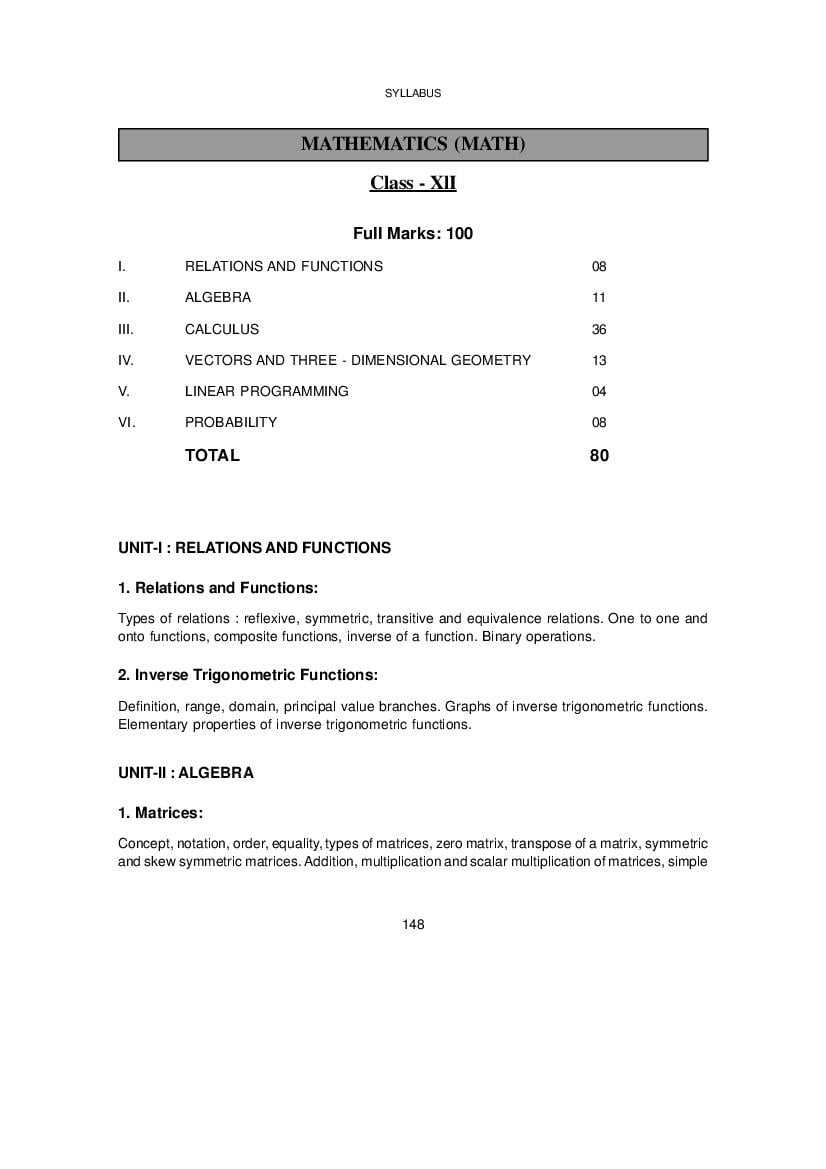
Class - XlI
Full Marks: 100
I. RELATIONS AND FUNCTIONS 08
II. ALGEBRA 11
III. CALCULUS 36
IV. VECTORS AND THREE - DIMENSIONAL GEOMETRY 13
V. LINEAR PROGRAMMING 04
VI. PROBABILITY 08
TOTAL 80
UNIT-I : RELATIONS AND FUNCTIONS
1. Relations and Functions:
Types of relations : reflexive, symmetric, transitive and equivalence relations. One to one and
onto functions, composite functions, inverse of a function. Binary operations.
2. Inverse Trigonometric Functions:
Definition, range, domain, principal value branches. Graphs of inverse trigonometric functions.
Elementary properties of inverse trigonometric functions.
UNIT-II : ALGEBRA
1. Matrices:
Concept, notation, order, equality, types of matrices, zero matrix, transpose of a matrix, symmetric
and skew symmetric matrices. Addition, multiplication and scalar multiplication of matrices, simple
148
Page 2
of matrices and existence of non-zero matrices whose product is the zero matrix (restrict to
square matrices of order 2). Concept of elementary row and column operations. Invertible matrices
and proof of the uniqueness of inverse, if it exists; (Here all matrices will have real entries).
2. Determinants:
Determinant of a square matrix (up to 3 x 3 matrices), properties of determinants, minors, cofactors
and applications of determinants in finding the area of a triangle.
Adjoint and inverse of a square matrix. Consistency, inconsistency and number of solutions of
system of linear equations by examples, solving system of linear equations in two or three variables
(having unique solution) using inverse of a matrix. Cramer's Rule and its applications.
UNIT-III : CALCULUS
1. Continuity and Differentiability:
Continuity and differentialiabity, derivative of composite functions, chain rule, derivates of inverse
trigonometric functions, derivate of implicit functions, concept of exponential and logarithmic
functions to the base e. Logarithmic functions as inverse of exponential functions.
lim 1/x, lim 1/x, lim (1+1/x)x, lim (1+x)1/x, lim log(1+x), lim ex-1
x->0 x-> à x-> à x->0 x->0 x x->0 x
Derivatives of logarithmic and exponential functions. Logarithmic differentiation, derivative of
functions expressed in parametric forms. Second order derivatives. Rolle's and Lagranges's
Mean value theorems (without proof) and their geometric interpretation and simple applications.
2. Applications of Derivatives:
Applications of derivatives: rate of change, increasing/decreasing functions, tangents and normals,
approximation, maxima and minima (first derivative test motivated geometrically and second
derivative test given as a provable tool). Simple problems (that illustrate basic principles and
understanding of the subject as well as real-life situations),
3. Integrals:
Integration as inverse process of differentiation. Integration of a variety of functions by substitution,
by partial fractions and by parts, only simple integrals of the type to be evaluated.
149
Page 3
properties of definite integrals and evaluation of definite integrals.
4. Applications of the Integrals:
Applications in finding the area under simple curves, especially lines, areas of circles/parabolas/
ellipses (in standard form only), Area under the curve y=sin x, y=cos x, area between the two
above said curves (the region should be clearly identifiable)
5. Differential Equations:
Definition, order and degree, general and particular solutions of a differential equation. Formation
of differential equation whose general solution is given.
Solution of differential equations by method of separation of variables, homogeneous, differential
equations of first order and first degree. Solutions of linear differential equation of the type:
dy + py = q, where p and q are functions of x and
dx
dx + px = q, where p and q are function of y
dy
UNIT-IV : VECTORS AND THREE-DIMENSIONAL GEOMETRY
1. Vectors:
Vectors and scalars, magnitude and direction of a vector. Direction cosines/ratios of vectors.
Types of vectors (equal, unit, zero, parallel and collinear vectors), Position vector of a point,
negative of a vector, components of a vector, addition of vectors, multiplication of a vector by a
Scalar, position vector of a point dividing a line segment in a given ratio. Scalar (dot) product of
vectors, projection of a vector on a line. Vector (cross) product of vectors.
Scalor triple product.
150
Page 4
Direction cosines/ratios of a line joining two points. Cartesian and vector equation of a line,
coplanar and skew lines, shortest distance between two lines. Cartesian and vector equation of
a plane. Angle between (i) two lines (ii) two planes (iii) a line and a plane. Distance of a point from
a plane.
UNIT-V : LINEAR PROGRAMMING
1. Linear Programming:
Introduction, definition of related terminology such as constraints, objective function, optimization,
different types of linear programming (L.P.) problems, mathematical formulation of L.P. problems,
graphical method of solution for problems in two variables, feasible and infeasible regions, feasible
and infeasible solutions, optimal feasible solutions (up to three non-trivial constraints).
UNIT-VI : PROBABILITY
1. Probability:
Multiplication theorem on probability Conditional probability, independent events, total probability,
Baye's theorem, Random variable and its probability distribution mean and variance of random
variable. Repeated independent (Bernoulli) trials and Binomial distribution.
Project : 20 Marks
151
Document Details
| Board / Org | West Bengal Board |
| Exam | Class 12 |
| Type | Syllabus |
| Pages | 4 |
| Updated | 22 Jul 2026 |