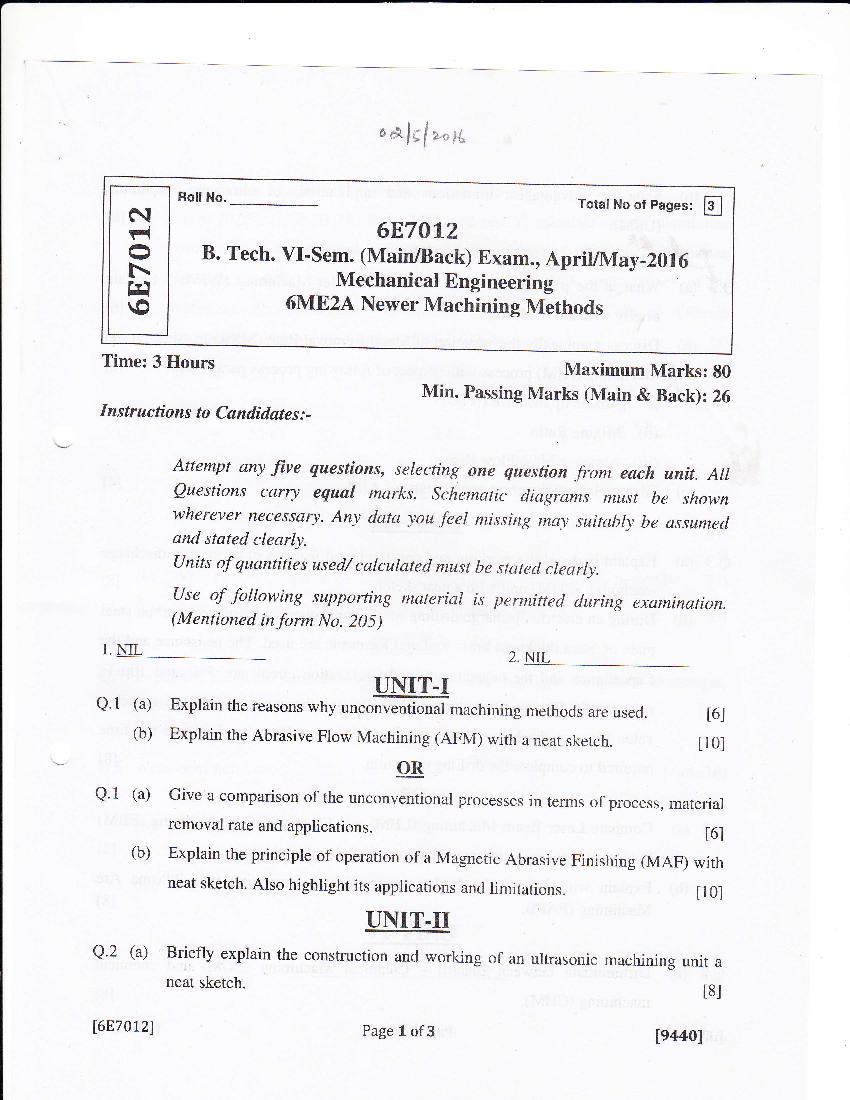
RTU 2016 Question Paper Semester VI Mechanical Engineering Newer Machining Methods
Finished viewing? Save it for later —
Download RTU 2016 Question Paper Semester VI Mechanical Engineering Newer Machining Methods (PDF · 3 pages)About RTU 2016 Question Paper Semester VI Mechanical Engineering Newer Machining Methods
RTU 2016 Question Paper Semester VI Mechanical Engineering Newer Machining Methods is available here for free download. Published by Default for Semester Exams, this question paper can be viewed online or downloaded as a PDF (3 pages). Candidates preparing for Semester Exams can use RTU 2016 Question Paper Semester VI Mechanical Engineering Newer Machining Methods to understand the exam pattern, the type of questions asked, and the overall difficulty level.
Frequently Asked Questions
How can I download RTU 2016 Question Paper Semester VI Mechanical Engineering Newer Machining Methods?
Open this page and click the Download button to save RTU 2016 Question Paper Semester VI Mechanical Engineering Newer Machining Methods as a PDF. It is completely free on AglaSem Docs.
Is RTU 2016 Question Paper Semester VI Mechanical Engineering Newer Machining Methods free to download?
Yes. RTU 2016 Question Paper Semester VI Mechanical Engineering Newer Machining Methods can be viewed online and downloaded as a PDF free of cost on AglaSem Docs.
How many pages does RTU 2016 Question Paper Semester VI Mechanical Engineering Newer Machining Methods have?
RTU 2016 Question Paper Semester VI Mechanical Engineering Newer Machining Methods contains 3 pages, which you can read online or download together as a single PDF.
Where can I find more Semester Exams study material?
You can find more Semester Exams question papers, sample papers, syllabus, and answer keys on AglaSem Docs.
RTU 2016 Question Paper Semester VI Mechanical Engineering Newer Machining Methods – Text
Read the full text of this question paper below — useful to quickly search, copy and reference the content online without downloading the PDF.
📄 View text version (3 pages)
Page 1
RollNo.
N Total No of Pages:
tr
t-{ 6E.70L2
o
r\ B. Tech. Vf-Sem. (Main/Back) Exam., ApriUM ay-2016
Mechanical Engineering
H
\o 6ME2A Newer Machining Methods
Time: 3 Hours Maximum Marks: 80
Min. Passing Marks (Main & Back): 26
I nstructions to Candidate s : -
Attempt any five questions, selecting one question
from each unit. All
Questions carry equal rnarks. schematic diagrams must be shown
wherever necessary. Any data you feel missing may switably be
assumed
and stated clearly.
Units of quantities used./ calculated must be stated clearly.
use of following supporting material is permitted during examination.
(Mentioned inform No. 205)
1. NIL
2. NIL
UNIT.I
Q' l (a) Explain the reasons why unconventional machining methods are used.
t6l
(b) Explain the Abrasive Flow Machining (AFM) with a neat sketch.
t10l
OR
Q.l (a) Give a comparison of the unconventional processes in terms of process, material
removal rate and applications.
t6l
(b) Explain the principle of operation of a Magnetic Abrasive Finishing (MAF) with
neat sketch. Also highlight its applications and limitations.
t10l
Q.2 (a) Briefly explain the construction and working of an ultrasonic machining unit a
neat sketch.
t8l
168701,21 Page 1 of3
Page 2
zantages' r:_-:..
Iimitations
(usM). and applications of
ulkasonic machining
Q2 @) What is rhe principal q t8l
of operafion of
briefly with a neat Warer Jet Machining
sketch. (WJM) ? Explain
(b) Discuss graphically
the variador of Mer.r n t6l
Machining (AJM) (MRR) in Abrasive
(i)
:i) Nozzle trp
process *irr,
tip distance
distance (NTO;
/NrTnr
;'r,,ilil::::T:L,;"::
*"o.f^Il'l'.1t*"*'Rate Jer
l6l
(ii) Mixing Rario
(iii) Abrasive Mass
Flow Rate.
(c) Give typical engineering
applications of
AJM.
uNrT'[r t41
e.3 (a) Exprain in derair
the wor,
machi "' "nar fe ature s of an erec tri c di ch arge
(b) r,d:;1'#, ;J :;:,':I s
;::,#T:dritlins or a rorr
prareor,r* ;;',';;;rarge
Capacirance ;"::T;;: :J:'' "*0"""'j"
respectivery.
and *" .,0,r,;.:'
The ,uppry *rru*"
fl:;:f circuir _" ;;::;l::
is 200vorts ;ation
value that the the gap is maintained
discharge (sparing) at such a
required to complete
tut". ptu",'dat I50
volts' Estimate
the drirling operadon the time
Q': (a) Compare Lase, Roo* r, q t'i
(LBM) and Electron
in terms of process Beam Macrunrns
'
ru.u*"r"'"tng
equipmenr and @BM)
(b) Exprain ;# :":::.ara]neters, appricarions.
sketch the consruction
n r"n,r,rl'$oiliiat and working prasm, of a ;:'
UNIT-IV 18l
Q.4 @) Differenfiate
berween Electro - Chemical
machining (CHM). Machining
@CM) and chemical
[687012]
Page 2 of3 t8l
le4401
Page 3
Ni = 70.07o, Cr = 20.OVo, Fe = 5.0Vo and rest Ti calculate rate of dissolution
1mm3/min; if the area tool is l200mm2 and a current of 15004 is being passed
through the cell. Assume dissolution to take place at lowest valiancy
of the
elements. Atomic weight (A), density (p), and valiancy (v) of different
constituents of super alloy are as mentioned below:
t8l
ANi = 58.71 Pui = 8.9 VNi = 2
Ac, = 51.99 Pc, = 7.19 Vc, = 2
Ap" = 55.85 Pp" = 7.86 Vr" = 2
Ari = 47.9 Pri = 4.51 Vri = a
-1
OR
Q.4 (a) Explain briefly the process parameters that affect the metal removal rate (MRR)
and surface euality in ECM.
t8l
(b) what factors should be considered is selecting the tool materials in ECM?
14)
(c) State the advantages, limitations and applications of ECM.
l4t
UNIT-V
Q.5 Explain in detail the nanoscale cutting process. Also highlight the typical advantages,
applications and limitations of the process.
tl6l
OR
Q.5 Write brief notes on: l4x4=l6l
(a) Micro turning
(b) Micro drilling
(c) Micro milling
(d) Micro grinding
[6870121 Page 3 of3
Document Details
| Board / Org | Default |
| Exam | Semester Exams |
| Type | Question Paper |
| Pages | 3 |
| Updated | 30 Apr 2026 |