Karnataka MPT 2022 Question Paper
Finished viewing? Save it for later —
Download Karnataka MPT 2022 Question Paper (PDF · 18 pages)About Karnataka MPT 2022 Question Paper
Karnataka MPT 2022 Question Paper is available here for free download. Published by AglaSem for Others, this question paper can be viewed online or downloaded as a PDF (18 pages). Candidates preparing for Others can use Karnataka MPT 2022 Question Paper to understand the exam pattern, the type of questions asked, and the overall difficulty level.
Frequently Asked Questions
How can I download Karnataka MPT 2022 Question Paper?
Open this page and click the Download button to save Karnataka MPT 2022 Question Paper as a PDF. It is completely free on AglaSem Docs.
Is Karnataka MPT 2022 Question Paper free to download?
Yes. Karnataka MPT 2022 Question Paper can be viewed online and downloaded as a PDF free of cost on AglaSem Docs.
How many pages does Karnataka MPT 2022 Question Paper have?
Karnataka MPT 2022 Question Paper contains 18 pages, which you can read online or download together as a single PDF.
Where can I find more Others study material?
You can find more Others question papers, sample papers, syllabus, and answer keys on AglaSem Docs.
Karnataka MPT 2022 Question Paper – Text
Read the full text of this question paper below — useful to quickly search, copy and reference the content online without downloading the PDF.
📄 View text version (18 pages)
Page 1
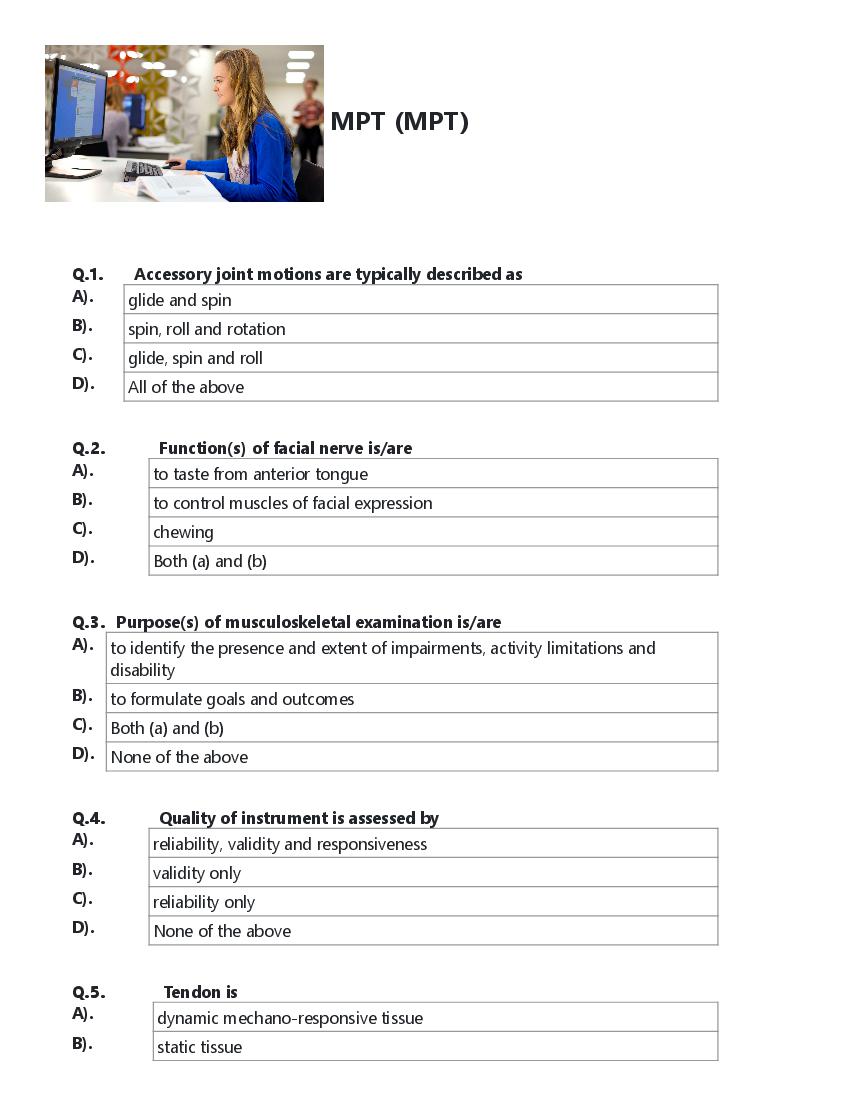
Q.1. Accessory joint motions are typically described as
A). glide and spin
B). spin, roll and rotation
C). glide, spin and roll
D). All of the above
Q.2. Function(s) of facial nerve is/are
A). to taste from anterior tongue
B). to control muscles of facial expression
C). chewing
D). Both (a) and (b)
Q.3. Purpose(s) of musculoskeletal examination is/are
A). to identify the presence and extent of impairments, activity limitations and
disability
B). to formulate goals and outcomes
C). Both (a) and (b)
D). None of the above
Q.4. Quality of instrument is assessed by
A). reliability, validity and responsiveness
B). validity only
C). reliability only
D). None of the above
Q.5. Tendon is
A). dynamic mechano-responsive tissue
B). static tissue
Page 2
D). None of the above
Q.6. Which modality is a stimulator of bone repair?
A). IFT
B). TENS
C). Ultrasound
D). All of the above
Q.7. Special test(s) for ACC injury is/are
A). anterior drawers test
B). lachman test
C). posterior drawers test
D). Both (a) and (b)
Q.8. Orthostatic hypotension refers to
A). sudden drop in blood pressure when movement is done to upright posture
(sitting/standing)
B). venous return and cardiac outputs reduction
C). Both (a) and (b)
D). high blood pressure
Q.9. Most common method of gait analysis used in clinical settings is
A). qualitative gait analysis
B). quantitative gait analysis
C). footprint method
D). None of the above
Q.10. Type(s) of dressing used in management of ideal stump is/are
A). shrinkers
B). IPOP
C). elastic roller bandage
D). All of the above
Q.11. Acute phase reactant that indicates presence of active inflammation is
Page 3
B). CBC
C). HLA-B27
D). None of the above
Q.12. Hand osteoarthritis grading criterion/criteria is/are
A). presence of Heberden’s nodes and joint space narrowing
B). family history of nodes
C). Both (a) and (b)
D). crepitus
Q.13. Dynamic stabilizers of glenohumeral joint are
A). rotator cuff muscles
B). supraspinatus and teres major
C). infraspinatus and teres major
D). None of the above
Q.14. Full thickness burn is characterized by
A). both dermis and epidermis destroyed completely
B). destroyed dermis only
C). destroyed epidermis only
D). completely destroyed dermis, epidermis and sub-cutaneous fat
Q.15. Non-pathological type(s) of personalities is/are
A). type-A personality
B). perfectionistic
C). authoritative and passive-aggressive
D). All of the above
Q.16. Right-left discrimination disorder is seen in which part of the lesion in
brain?
A). Frontal lobe of hemisphere
B). Parietal lobe of either hemisphere
C). Both (a) and (b)
D). Occipital lobe
Page 4
A). posterior shoulder stiffness
B). GIRD
C). Both (a) and (b)
D). deltoid stiffness
Q.18. Long thoracic nerve injury leads to
A). scapular winging
B). difficulty in lifting
C). Both (a) and (b)
D). posterior chain stiffness
Q.19. Central cord syndrome refers to
A). hyperextension injuries to cervical spine
B). extension injuries to cervical spine
C). injury to lateral cord and anterior cord
D). All of the above
Q.20. Autonomic dysreflexia occurs in
A). lesions above C8
B). lesions above T6
C). lesions below T6
D). lesions above L3
Q.21. Important screening test(s) for individuals with arterial disease is/are
A). ankle brachial index
B). squeeze test
C). Both (a) and (b)
D). compression test
Q.22. Tendons that get affected in De Quervain’s tenosynovitis are
A). abductor pollicis longus and extensor pollicis brevis
B). adductor pollicis longus and extensor pollicis longus
C). adductor pollicis brevis and extensor pollicis brevis
D).
Page 5
Q.23. Most common feature(s) of middle cerebral artery syndrome is/are
A). contralateral spastic hemiparesis
B). sensory loss of face
C). homonymous hemianopia
D). All of the above
Q.24. Kienbock’s disease refers to
A). avascular necrosis of scaphoid
B). avascular necrosis of lunate
C). avascular necrosis of hammate
D). None of the above
Q.25. Avulsion of flexor digitorum profundus is seen in
A). bowler’s thumb
B). jersey finger
C). boxer’s hand
D). AFL thumb
Q.26. Non-motor symptom(s) of Parkinson's disease is/are
A). rapid eye movement
B). cognition and mood related
C). spasticity
D). Both (a) and (b)
Q.27. Complications associated with mechanical ventilation are
A). tracheal lesions, septicaemia and alkalosis
B). tracheal lesions and acidosis
C). hyperacidosis and injury
D). None of the above
Q.28. Pacemakers are indicated in subjects with
A). heart rate that is too low
B). chronotropic incompetence
Page 6
D). All of the above
Q.29. Important screening test(s) to evaluate autonomic function in peripheral
nerve injury is/are
A). ninhydrin test and Q-sweat
B). galvanic skin resistance test
C). Both (a) and (b)
D). thermal regulation
Q.30. Levine’s sign refers to
A). diagnose angina and ischemia
B). diagnose CHF
C). diagnose indigestion
D). All of the above
Q.31. The technique which stimulates primitive movement patterns of synergistic
movement pattern observed in fetal life and after pyramidal lesion is
known as
A). Rood’s approach
B). Brunnstrom approach
C). bio feedback
D). None of the above
Q.32. Oxygen cost is expressed as
A).
B). newton per meter square
C). Both (a) and (b)
D). None of the above
Q.33. Environmental factors that interfere with optimal function and create
disability are known as
A). facilitators
B). barriers
C). contextual factors
Page 7
Q.34. Normalcy index refers to
A). quantify the postural deviations
B). quantify the gait deviations
C). Both (a) and (b)
D). quantify the gait and postural deviations in stroke
Q.35. Physiological jaundice occurs due to
A). liver failure in newborn
B). low birth height
C). breakdown of fetal haemoglobin
D). None of the above
Q.36. Score of Glasgow Coma Scale lies between
A). 5 and 15
B). 6 and 15
C). 3 and 15
D). 4 and 15
Q.37. Tetralogy of fallot refers to
A). VSD and Rt ventricular obstruction
B). Overriding of aorta and Rt. ventricular hypertrophy
C). VSD and ASD and transposition of great arteries
D). Both (a) and (b)
Q.38. H-Reflex is a diagnostic measure of
A). radiculopathy and peripheral neuropathy
B). myopathy
C). inflammatory disorders
D). None of the above
Q.39. Resisted isometric testing evaluates
A). lesion in boney tissue
B). lesion in soft tissue
Page 8
D). lesion in contractile, non-contractile and inert tissues
Q.40. Sinus tarsi syndrome occurs as a result of
A). over-use injury
B). acute injury
C). chronic injury
D). None of the above
Q.41. Test used to assess cutaneous sensation is called
A). pin prick test
B). heel-shin test
C). two-point discrimination test
D). biothesiometer
Q.42. Meissner's corpuscles are found in
A). finger tips, lips and toes
B). axial skeleton
C). joint articulating surfaces
D). All of the above
Q.43. Stridor is
A). harsh, high-pitched sound
B). low-pitched sound
C). coarse low pitched sound
D). choking sound
Q.44. Pulse oximetry measures
A). venous blood oxygenation
B). arterial blood oxygenation
C). Both (a) and (b)
D). general oxygenation
Q.45. Allodynia refers to
A). pain due to a stimulus that does not normally provoke pain
Page 9
C). pain due to chemical stimulus
D). pain due to external stimuli that provoke pain
Q.46. Splint used in brachial plexus injury is/are
A). Thomas splint
B). shoulder extension splint
C). aeroplane splint
D). All of the above
Q.47. Triple Arthrodesis refers to
A). surgical fusion of three joints
B). surgical fusion of more than three joints
C). Both (a) and (b)
D). fusion of knee joint
Q.48. Bicycle stress test is used in diagnosis of
A). lumbar spondylosis
B). lumbar canal stenosis
C). intervertebral disc prolapse
D). All of the above
Q.49. Components of APGAR score are
A). color, heart rate, reflexes, muscle tone and respiration
B). pulse rate, blanching of skin, pale lips, hypertonia and respiratory rate
C). Both (a) and (b)
D). warmth, cry, heart rate, hypotonia, respiration
Q.50. Heterotopic ossification refers to
A). abnormal development of bone in areas of soft tissue
B). abnormal development of soft tissue mass
C). abnormal development of osteophytes
D). None of the above
Q.51. Measurement of angle of pelvic inclination is done by
Page 10
B). pelvic inclinometer
C). inch tape
D). All of the above
Q.52. Exercises performed in inner range help to
A). maintain movement of a joint in the direction of muscle pull
B). gain strength in the opposite direction of muscle pull
C). Both (a) and (b)
D). maintain movement of a joint in the direction opposite to muscle pull and joint
angle
Q.53. Gutter crutches are used for
A). forearm fractures
B). hip fracture
C). shoulder fractures
D). All of the above
Q.54. Iontophoresis refers to
A). transfer of ions of drugs into the body by use of constant direct current
B). transfer of ions into the body by use of indirect current
C). transfer of drugs into the body by use of Russian current
D). None of the above
Q.55. Electrodiagnostic test(s) used in the assessment of Bell’s palsy is/are
A). measurement of nerve excitability
B). measurement of NCV
C). SD curve
D). All of the above
Q.56. Physiological effect of shock up to 20 mA is
A). labored breathing and painful
B). labored breathing and painless
C). breathing upset and painless
D). None of the above
Page 11
A). efferent impulses from pain receptors
B). afferent impulses from pain receptors
C). Both (a) and (b)
D). efferent impulses from mechanoreceptors
Q.58. Lewis hunting response refers to
A). sudden vasodilatation due to intense cold application
B). sudden vasoconstriction
C). sudden vasodilatation by hot application
D). All of the above
Q.59. Faradic current does not stimulate
A). innervated muscles
B). denervated muscles
C). active muscles
D). None of the above
Q.60. Lumbago refers to
A). pain in lumbar region localized to latissimus dorsi and erector spinae
B). pain in lumbar and gluteal region localized to latissimus dorsi and erector spinae
C). pain in gluteal region and erector spinae only
D). pain in lumbar region and localized to latissimus dorsi only
Q.61. Still’s disease refers to
A). arthritis that occurs in children under 8 years of age
B). arthritis that occurs in adults of 18-23 years of age
C). inflammatory and infectious arthritis in children of 12 years age
D). None of the above
Q.62. Metatarsalgia refers to
A). loss of entire anterior arch of foot
B). loss of medial arch of foot
C). loss of lateral arch of foot
D).
Page 12
Q.63. Role of UVR in psoriasis is
A). to decrease RNA synthesis in the cells
B). to decrease DNA synthesis in the cells
C). to increase DNA synthesis in the cells
D). to increase RNA synthesis in the cells
Q.64. Low frequency currents range between
A). 2 Hz to 2000 Hz
B). 1 Hz to 1000 Hz
C). 1 Hz to 2000 Hz
D). All of the above
Q.65. Rheobase uses the pulses of
A). 100 or 300 ms duration
B). 200 or 300 ms duration
C). 100 or 200 ms duration
D). None of the above
Q.66. Sequestrum refers to
A). dead bone
B). brittle bone
C). fractured bone
D). ossified bone
Q.67. hexadactyly means
A). fusion of all fingers
B). fusion of all toes
C). presence of an extra digit
D). absence of a digit
Q.68. First bone that is ossified in foetal life is
A). clavicle
B). pelvic bone
Page 13
D). vertebra
Q.69. Dissociative sensory loss occurs in
A). tuberculosis of spine
B). disc prolapse
C). tabes dorsalis
D). syringomyelia
Q.70. QRS complex in ECG represents
A). atrial depolarization
B). ventricular repolarization
C). atrial repolarization
D). ventricular depolarization
Q.71. Waddling gait occurs due to
A). bilateral hip abductor muscle weakness
B). para vertebral muscle weakness
C). obturator nerve palsy
D). adductor muscle weakness
Q.72. Obstruction of common bile duct is known as
A). bilirubinitis
B). ascites
C). hepatitis
D). jaundice
Q.73. Marble bone disease occurs due to
A). defective function in osteoblasts
B). defective function in osteoclasts
C). imbalance between osteoblasts and osteoclasts
D). None of the above
Q.74. Radiological findings of a dead bone is
A). radiolucent
Page 14
C). highly radio opaque
D). non-visualized
Q.75. Inability of a subject to perform a gesture with a limb on verbal commands
is known as
A). ideational apraxia
B). constructional apraxia
C). ideomotor apraxia
D). apraxia
Q.76. Night splint used in B/L CTEV deformity is
A). Dennis-Brown splint
B). CTEV shoes
C). reverse foot drop splint
D). closed toe boot
Q.77. Disc desiccation refers to
A). disc dehydration
B). herniated disc
C). ruptured disc
D). extruded disc
Q.78. Serum uric acid levels are increased in which disease?
A). Charcot joint and OA knee
B). Periarthritis
C). Gouty arthritis
D). Polyarteritis
Q.79. Common nerve that is trapped in tarsal tunnel syndrome is
A). anterior tibial nerve
B). posterior tibial nerve
C). common peroneal nerve
D). medial popliteal nerve
Page 15
A). Acute iritis
B). Aortic incompetence
C). Pulmonary insufficiency
D). Prostatitis
Q.81. Tinel’s sign is performed to diagnose
A). Wallerian degeneration
B). extent of regeneration of the nerve
C). nerve conduction velocity
D). action potential
Q.82. Spurt and shunt muscles demonstrate
A). direction of movement of the bone
B). action opposite to the direction of force
C). action along the mechanical pull
D). None of the above
Q.83. Common exercise preferred for cerebellar ataxia is
A). Codman’s pendulum exercises
B). DeLorme technique
C). Buerger-Allen exercises
D). Frenkel's exercises
Q.84. Active and passive insufficiency occurs in
A). single joint muscle
B). multi-joint muscle
C). Both (a) and (b)
D). biceps muscle
Q.85. Components of exercise prescription are
A). type, intensity duration and frequency
B). type, intensity, repetition and frequency
C). mode, type, number and duration
D). All of the above
Page 16
A). peripheral artery disease
B). peripheral vascular disease
C). peripheral nerve injury
D). occlusion injury
Q.87. Intrinsic plus hand refers to
A). contracture of intrinsic hand muscles with flexion at MCP extension at IP joints
B). contracture of intrinsic hand muscles with extension at MCP and flexion at IP
joints
C). contracture of interosseous muscle with flexion at MCP joints
D). None of the above
Q.88. Three-point pressure principle helps in
A). orthotic design to promote linear movement
B). prosthetic design to promote linear movement
C). orthotic design to control angular movement
D). prosthetic design to control angular movement
Q.89. Rood’s approach utilizes
A). sensory stimuli
B). motor stimuli
C). mechanical stimuli
D). All of the above
Q.90. Type(s) of shunts used to treat hydrocephalus is/are
A). A-P shunt
B). VP shunt
C). Both A-P and VP shunts
D). reverse shunt
Q.91. Crocodile eye tear syndrome is seen in
A). Bell’s palsy
B). facial palsy
C). stroke
Page 17
Q.92. Type of breathing exercise used in Bronchial Asthma patients is
A). glossopharyngeal breathing
B). pursed lip breathing
C). inspiratory breathing
D). All of the above
Q.93. In which type of stretching injury, risk is more?
A). Static stretching
B). Mechanical stretching
C). Ballistic stretching
D). PNF stretching
Q.94. The ability of brain to change its structure and function in response to
experience is known as
A). neural plasticity
B). neural syndrome
C). neural elasticity
D). muscle elasticity
Q.95. The type of stretch training performed to improve isometric strength is
A). static stretching
B). ballistic stretch training
C). dynamic stretch training
D). PNF stretch training
Q.96. Precautions following total hip replacement are
A). adduction and internal rotation to be avoided
B). abduction and internal rotation to be avoided
C). adduction and internal rotation with hip flexion to be avoided
D). None of the above
Q.97. Which glide is given to improve shoulder abduction in periarthritis?
A). Anterior glide
Page 18
C). Medial glide
D). Inferior glide
Q.98. Which technique reduces spasticity in stroke?
A). Facilitation technique
B). Weight bearing technique
C). Both (a) and (b)
D). Electrical stimulation
Q.99. Elements of health components in community based rehabilitation are
A). health promotion, prevention and rehab
B). medical leave, rehab prevention
C). Both (a) and (b)
D). rehabilitation and prevention
Q.100. Effective method to manage phantom limb pain is/are
A). mirror therapy techniques
B). ultrasound
C). motor imagery techniques
D). Both (a) and (c )
Document Details
| Board / Org | Aglasem |
| Exam | Others |
| Type | Question Paper |
| Pages | 18 |
| Updated | 09 Jun 2026 |