Karnataka M.Sc Nursing 2022 Question Paper
Finished viewing? Save it for later —
Download Karnataka M.Sc Nursing 2022 Question Paper (PDF · 18 pages)About Karnataka M.Sc Nursing 2022 Question Paper
Karnataka M.Sc Nursing 2022 Question Paper is available here for free download. Published by AglaSem for Others, this question paper can be viewed online or downloaded as a PDF (18 pages). Candidates preparing for Others can use Karnataka M.Sc Nursing 2022 Question Paper to understand the exam pattern, the type of questions asked, and the overall difficulty level.
Frequently Asked Questions
How can I download Karnataka M.Sc Nursing 2022 Question Paper?
Open this page and click the Download button to save Karnataka M.Sc Nursing 2022 Question Paper as a PDF. It is completely free on AglaSem Docs.
Is Karnataka M.Sc Nursing 2022 Question Paper free to download?
Yes. Karnataka M.Sc Nursing 2022 Question Paper can be viewed online and downloaded as a PDF free of cost on AglaSem Docs.
How many pages does Karnataka M.Sc Nursing 2022 Question Paper have?
Karnataka M.Sc Nursing 2022 Question Paper contains 18 pages, which you can read online or download together as a single PDF.
Where can I find more Others study material?
You can find more Others question papers, sample papers, syllabus, and answer keys on AglaSem Docs.
Karnataka M.Sc Nursing 2022 Question Paper – Text
Read the full text of this question paper below — useful to quickly search, copy and reference the content online without downloading the PDF.
📄 View text version (18 pages)
Page 1
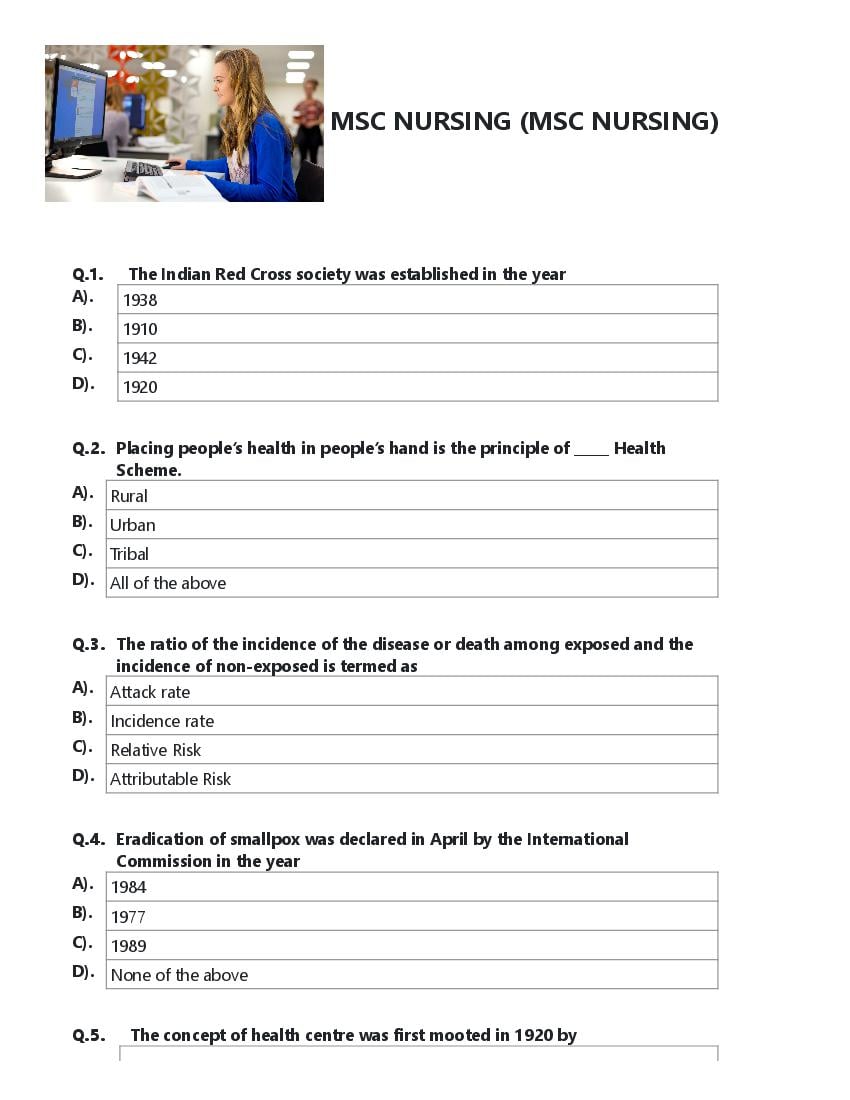
Q.1. The Indian Red Cross society was established in the year
A). 1938
B). 1910
C). 1942
D). 1920
Q.2. Placing people’s health in people’s hand is the principle of _____ Health
Scheme.
A). Rural
B). Urban
C). Tribal
D). All of the above
Q.3. The ratio of the incidence of the disease or death among exposed and the
incidence of non-exposed is termed as
A). Attack rate
B). Incidence rate
C). Relative Risk
D). Attributable Risk
Q.4. Eradication of smallpox was declared in April by the International
Commission in the year
A). 1984
B). 1977
C). 1989
D). None of the above
Q.5. The concept of health centre was first mooted in 1920 by
Page 2
B). John Dey
C). Mac Mohan
D). Winslow
Q.6. Committee on basic health service is
A). Mudaliar Committee
B). Kartar Singh Committee
C). Chadha Committee
D). Mukerji Committee
Q.7. The key person responsible for transforming the economic and social life of
people in rural area is
A). Anganwadi Worker
B). Gram Sevika
C). Medical Officer
D). Public Health Nurse
Q.8. WHO had its origin in the year
A). 1943
B). 1945
C). 1947
D). 1949
Q.9. Which of these committees examined the need for multipurpose health
workers in the year 1972?
A). Chadha Committee
B). Mukerji Committee
C). Kartar Singh Committee
D). Shrivastav Committee
Q.10. The fundamental functions of healthcare system is to provide a sound
A). Referral System
B). Healthcare System
C). Participatory System
D).
Page 3
Q.11. Kata thermometer is a/an
A). water thermometer
B). mercury thermometer
C). alcohol thermometer
D). All of the above
Q.12. The stage that starts from neural phase of the infection with symptoms and
signal of meningeal irritation is
A). Prodromal stage
B). Presumptive stage
C). Pre-paralytic stage
D). Eruptive stage
Q.13. India was declared small pox free in the year
A). 1964
B). 1975
C). 1972
D). None of the above
Q.14. “Koplik’s spot” is a typical clinical feature of
A). Diphtheria
B). Pertussis
C). Measles
D). Mumps
Q.15. Incubation period of chicken pox is
A). 7–10 days
B). 14–21 days
C). 8–16 days
D). 12–18 days
Q.16. “Schmutzdecke” is seen in which layer of the biological filter?
A). Supernatant raw water
Page 4
C). Bed of graded sand
D). Filter control system
Q.17. Modified plan of operation was set by the Government of India in the year
1977 for reduction of
A). Malaria
B). Cholera
C). Dengue
D). Tuberculosis
Q.18. The committee on health, manpower planning, production and
management is
A). Mehta Committee
B). Balaji Committee
C). Kartar Singh Committee
D). Mudaliar Committee
Q.19. Grit Chamber is which type of modern sewage treatment plant?
A). Primary
B). Secondary
C). Tertiary
D). All of the above
Q.20. The ratio between the incidence among exposed with ratio of non-exposed
is called
A). Relative Risk
B). Attributive Risk
C). Exposure Risk
D). Attack Risk
Q.21. Chicken pox is caused by
A). Salmonella
B). Rotavirus
C). Pneumococci
D). Varicella-zoster virus
Page 5
A). ventricular septal defect
B). atrial septal defect
C). patent ductus arteriosus
D). tricuspid atresia
Q.23. Meningomyelocele is the sub-type of
A). Meningitis
B). Encephalitis
C). Spina Bifida
D). Migraine
Q.24. Ventriculoperitoneal shunt drains
A). plasma
B). blood
C). CSF
D). serum
Q.25. Cretinism is caused by deficiency of which of these hormones?
A). Pituitary Hormone
B). Thyroid Hormone
C). Adrenal Hormone
D). Parathyroid Hormone
Q.26. Which of the following drugs is used for the closure of patent ductus
arteriosis?
A). Indomethacin
B). Dopamine
C). Phenobarbitone
D). Immunoglobulin
Q.27. Thrombocytopenia is a condition where there is
A). increased number of platelets
B). decreased number of platelets
C). no production of platelets
Page 6
Q.28. Site of lesion in poliomyelitis is
A). peripheral horn of spinal cord
B). dorsal horn of spinal cord
C). all muscles
D). ventral horn of spinal cord
Q.29. Total lung capacity in a newborn is
A). 500 mL
B). 100 mL
C). 150 mL
D). 350 mL
Q.30. Colour codes used in IMNCI are
A). pink, green and yellow
B). blue, black and green
C). green, black and red
D). black, ash and orange
Q.31. Newborn baby may have blush-black mark on the lower back or bottom
known as
A). Koplik spot
B). Mongolian spot
C). Karposi spot
D). Blind spot
Q.32. Hirschsprung disease is also called as
A). Aganglionic colon
B). Aganglionic meso colon
C). Aganglionic micro colon
D). Aganglionic megacolon
Q.33. In Babinski reflex, the movement of great toe undergoes
A). dorsi extension
Page 7
C). plantar flexion
D). plantar extension
Q.34. The most commonly seen anaemia in children is
A). Hemolytic anaemia
B). Sickle cell anaemia
C). Iron deficiency anaemia
D). Pernicious anaemia
Q.35. All are the examples of combined vaccines, except
A). BCG
B). DPT
C). MMR
D). DTT
Q.36. Macrosomia means
A). baby with large head
B). baby with large legs
C). baby with large size
D). baby with large colon
Q.37. At birth, baby may have a thick cheese-like covering and it’s called as
A). Meconium
B). Milia
C). Lanugo
D). Vernix caseosa
Q.38. Abnormal accumulation of cerebrospinal fluid in the intracranial spaces is
called as
A). Myeloma
B). Spina bifida
C). Cerebral Palsy
D). Hydrocephalous
Page 8
age of
A). 3 years
B). 5 years
C). 7 years
D). 9 years
Q.40. Formation of a tight seal of the infant’s lips around the nipple and a
sufficient portion of the surrounding areola is called
A). Kangaro care
B). Rooming in
C). Breast feeding
D). Latching on
Q.41. Haloperidol is a/an _____ drug.
A). anti-psychiatric drug
B). mood stabilizer drug
C). anti-depressant drug
D). anti-convulsive drug
Q.42. Autonomic side effects of drugs are
A). dry mouth, constipation, cycloplegia
B). weight gain, jaundice, dermatitis
C). photosensitivity, renal failure, jaundice
D). agranulocytosis, tachycardia, hypotension
Q.43. A patient has been taking lithium carbonate for his hypomania. While
taking this drug, which mineral would you recommended in adequate
quantities?
A). Sodium
B). Iron
C). Iodine
D). Calcium
Q.44. Which of the following defense mechanisms is commonly used by OCD
patients?
Page 9
B). Projection
C). Denial
D). Undoing
Q.45. Bestiality is also referred to as
A). pedophilia
B). zoophilia
C). voyeurism
D). fetishism
Q.46. Kleine-Levin syndrome is characterized by
A). hypersomnia
B). hyperphagia
C). hypersexuality
D). hyperesthesia
Q.47. A child with 30 IQ score, has which category of degree of mental
retardation?
A). Mild
B). Moderate
C). Severe
D). Profound
Q.48. Craving and eating of non-food substances such as paint and clay is termed
as
A). Binge
B). Polyphagia
C). Verbizeration
D). Pica
Q.49. The most common cause of dementia is
A). multiple sclerosis
B). Alzheimer’s disease
C). multi-infarct lesion
D).
Page 10
Q.50. Clouding of consciousness is a characteristic of _____ condition.
A). schizophrenia
B). dementia
C). hysteria
D). delirium
Q.51. General Adaptation Syndrome (GAS) is a response to
A). poor intelligence
B). wrong perception
C). stress
D). poor nutrition
Q.52. The Indian Lunacy Act was passed in the year
A). 1910
B). 1912
C). 1920
D). 1987
Q.53. The word Schizophrenia was coined by
A). Eugen Bleuer
B). Emil Kraepelin
C). Sigmund Freud
D). Schneider
Q.54. Which of the following is a positive symptom of schizophrenia?
A). Delusion
B). Apathy
C). Ambivalence
D). Irritability
Q.55. Which of the following is a technique used in hypnosis?
A). Flooding
B). Questioning
Page 11
D). Desensitization
Q.56. Which of the following is an ineffective non-therapeutic communication?
A). Judgemental attitude
B). Silence
C). Focusing
D). Informing
Q.57. Which of the following is a barrier to therapeutic communication?
A). Listening
B). Giving advice
C). Focusing
D). Restating
Q.58. The part of the brain that regulates higher levels of cognitive functions is
A). Cerebellum
B). Cerebrum
C). Limbic system
D). None of the above
Q.59. All of the following are components of MSR, except
A). General appearance and behavior
B). Speech
C). Mood
D). Language
Q.60. The junction between two neurons is called
A). Neurotransmitter
B). Synapse
C). Nerve impulse
D). Cell membrane
Q.61. Bell’s palsy is a disorder of which cranial nerve?
A). Cranial nerve IV
Page 12
C). Cranial nerve IX
D). Cranial nerve XII
Q.62. The most common early manifestation of myasthenia gravis is
A). paresthesia of lower extremities
B). absence of papillary reflex
C). ptosis
D). dysphagia
Q.63. What is the lifespan of normal platelets?
A). 1–3 days
B). 4–6 days
C). 8–10 days
D). 10–14 days
Q.64. The test most often done to detect cervical cancer is
A). Schiller’s test
B). Pap smear
C). Heller’s test
D). None of the above
Q.65. Acromegaly is caused by excessive secretion of _____ hormone.
A). somatotropin
B). adrenalin
C). calcitonin
D). insulin
Q.66. What is the contraindication for chest physiotherapy?
A). Bronchitis
B). COPD
C). Asthma
D). Pneumonia
Q.67. What is the normal sodium level in blood?
Page 13
B). 135–145 mEq/Litre
C). 140–150 mEq/Litre
D). 120–130 mEq/Litre
Q.68. What should you do immediately after a needle stick injury?
A). Squeeze the injury site
B). Cover with sterile gauze
C). Wash with soap and running water
D). Apply antiseptic ointment
Q.69. The most preferred intramuscular injection site for infants is
A). deltoid site
B). dorsogluteal site
C). ventrogluteal site
D). vastus lateralis
Q.70. Oliguria is defined as
A). urinary output 100–500 ml/24 hours
B). urinary output below 50 ml/24 hours
C). urinary output below 20 ml/hour
D). urinary output above 1000 ml/24 hours
Q.71. What is the range of normal pH of blood?
A). 7·25–7·30
B). 7·35–7·45
C). 7·45–7·50
D). None of the above
Q.72. How many joules are there in a monophasic defibrillator?
A). 120 joules
B). 200 joules
C). 260 joules
D). 360 joules
Page 14
shock?
A). Clammy skin
B). Thready pulse
C). Hypotension
D). Hypertension
Q.74. What is the position to treat shock?
A). Sims position
B). Dorsal position
C). Trendelenburg position
D). Lithotomy position
Q.75. The most widely used technique of communication in laryngeal cancer is
A). Esophageal speech
B). Electrical larynx speech
C). Tracheoesophageal puncture
D). All of the above
Q.76. The most conclusive diagnostic study for Crohn’s disease is
A). stool examination
B). barium study of gastrointestinal tract
C). serum chemistry
D). abdominal X-ray
Q.77. The commonest side effect of the thrombolytic therapy is
A). acute renal failure
B). bleeding
C). metabolic abnormalities
D). compartment syndrome
Q.78. Which of the following are physiological outcomes of immobility?
A). Increased metabolism
B). Reduced cardiac work load
C). Decreased lung expansion
Page 15
Q.79. When obtaining a wound culture to determine the presence of a wound
infection, from where should the specimen be taken?
A). Necrotic tissue
B). Wound drainage
C). Wound circumference
D). Cleaned wound
Q.80. The nurse evaluates which laboratory values to assess a patient’s potential
for wound healing?
A). Fluid status
B). Potassium
C). Lipids
D). Nitrogen balance
Q.81. Bartholin’s glands are present at
A). posterior region of labia majora
B). the perineum
C). the bladder
D). None of the above
Q.82. The nervous system of the fetus is formed from the
A). ectoderm
B). mesoderm
C). endoderm
D). amnion
Q.83. Ductus arteriosus is functionally closed
A). after birth
B). 12 hours after birth
C). after one week of age
D). after one month of age
Q.84. Placenta is formed by the fusion of the
A).
Page 16
B). chorion laeve and decidua vera
C). villi and parametrium
D). amnion and chorion
Q.85. The danger of placenta succenturiate is
A). ante partum haemorrhage
B). post partum haemorrhage
C). intra partum haemorrhage
D). None of the above
Q.86. The outer layer of the chorionic villi is termed as
A). cytotrophoblast
B). syncytiotrophoblast
C). trophoblast
D). blastocyst
Q.87. A cystic degeneration of chorionic villi occurs in
A). hyperemesis gravidarum
B). hydramnios
C). hypertension
D). hydatidiform mole
Q.88. The umbilical cord contains
A). two veins and one artery
B). two arteries and two veins
C). two arteries and one vein
D). one artery and one vein
Q.89. The umbilical cord or funis is protected by
A). blood vessels
B). meconium
C). Wharton’s jelly
D). funis
Page 17
A). uterine contractions
B). bluish discoloration of vagina
C). softening of isthmus
D). quickening
Q.91. Puerperium lasts for
A). 2 weeks
B). 4 weeks
C). 6 weeks
D). 8 weeks
Q.92. In placenta previa, vaginal examination is not done to avoid
A). infection
B). discomfort
C). haemorrhage
D). precipitate labour
Q.93. Abruptio placenta means premature separation of
A). normally situated placenta
B). abnormally situated placenta
C). abnormal placenta
D). foetal part of placenta
Q.94. Lightening takes place at
A). 2–3 days before labour
B). 6 days after dilation of cervix
C). 2–3 weeks before the onset of labour
D). All of the above
Q.95. In vasa previa, bleeding is likely to occur from
A). foetal blood vessel
B). maternal blood vessel
C). placental site
D). marginal site
Page 18
known as
A). breast feeding
B). weaning
C). formula feed
D). All of the above
Q.97. In severe PIH (Pregnancy-induced hypertension), the blood pressure will be
A). 160/110 mm of Hg
B). 150/100 mm of Hg
C). 260/100 mm of Hg
D). None of the above
Q.98. Pre-eclampsia clonic stage lasts for
A). 10 seconds
B). 5 seconds
C). 30–90 seconds
D). None of the above
Q.99. HELLP Syndrome is observed in pregnancy during
A). 20–24 weeks
B). 28–30 weeks
C). 26–40 weeks
D). None of the above
Q.100. Burns-Marshall technique is used to deliver the
A). placenta
B). leg
C). after-coming head
D). head
Document Details
| Board / Org | Aglasem |
| Exam | Others |
| Type | Question Paper |
| Pages | 18 |
| Updated | 22 Jul 2026 |