WBCHSE Class 12 Syllabus for Philosophy
Finished viewing? Save it for later —
Download WBCHSE Class 12 Syllabus for Philosophy (PDF · 3 pages)About WBCHSE Class 12 Syllabus for Philosophy
WBCHSE Class 12 Syllabus for Philosophy is available here for free download. Published by West Bengal Board for Class 12, this syllabus can be viewed online or downloaded as a PDF (3 pages). Candidates preparing for Class 12 can use WBCHSE Class 12 Syllabus for Philosophy to understand the exam pattern, the type of questions asked, and the overall difficulty level.
Frequently Asked Questions
How can I download WBCHSE Class 12 Syllabus for Philosophy?
Open this page and click the Download button to save WBCHSE Class 12 Syllabus for Philosophy as a PDF. It is completely free on AglaSem Docs.
Is WBCHSE Class 12 Syllabus for Philosophy free to download?
Yes. WBCHSE Class 12 Syllabus for Philosophy can be viewed online and downloaded as a PDF free of cost on AglaSem Docs.
How many pages does WBCHSE Class 12 Syllabus for Philosophy have?
WBCHSE Class 12 Syllabus for Philosophy contains 3 pages, which you can read online or download together as a single PDF.
Where can I find more Class 12 study material?
You can find more Class 12 question papers, sample papers, syllabus, and answer keys on AglaSem Docs.
WBCHSE Class 12 Syllabus for Philosophy – Text
Read the full text of this syllabus below — useful to quickly search, copy and reference the content online without downloading the PDF.
📄 View text version (3 pages)
Page 1
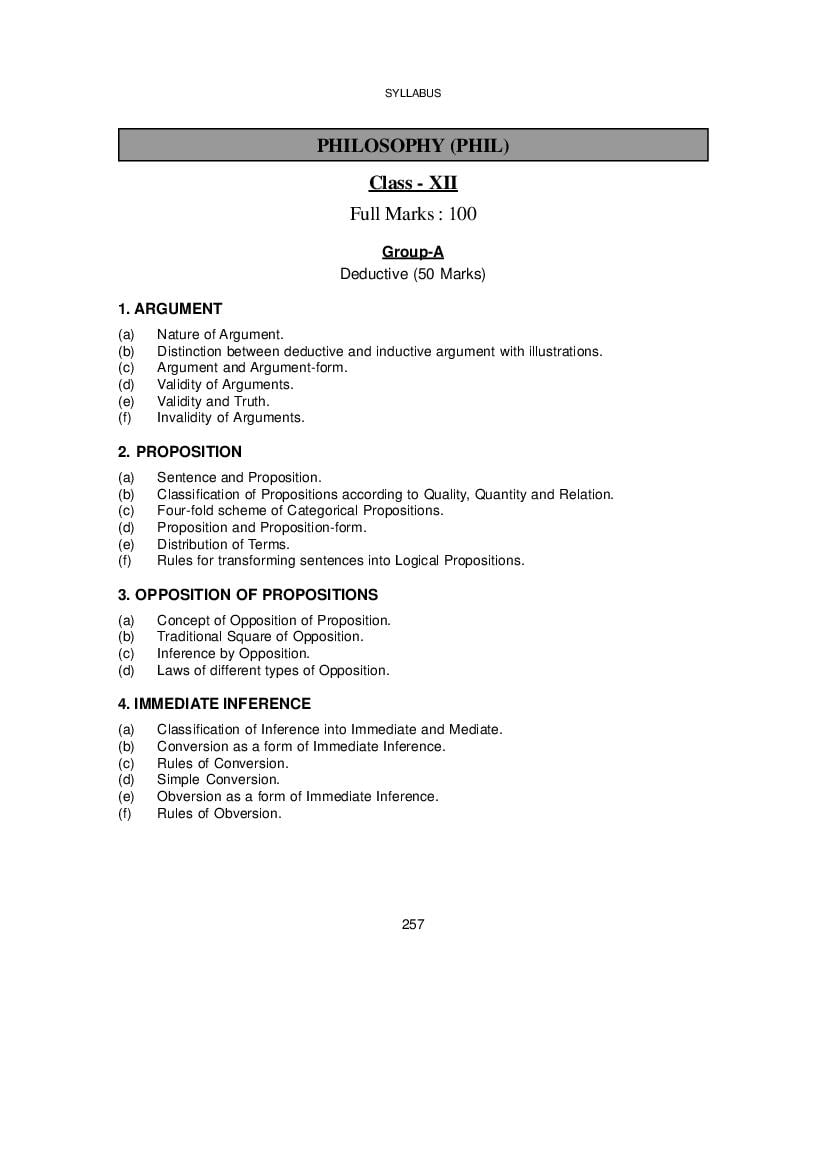
Class - XII
Full Marks : 100
Group-A
Deductive (50 Marks)
1. ARGUMENT
(a) Nature of Argument.
(b) Distinction between deductive and inductive argument with illustrations.
(c) Argument and Argument-form.
(d) Validity of Arguments.
(e) Validity and Truth.
(f) Invalidity of Arguments.
2. PROPOSITION
(a) Sentence and Proposition.
(b) Classification of Propositions according to Quality, Quantity and Relation.
(c) Four-fold scheme of Categorical Propositions.
(d) Proposition and Proposition-form.
(e) Distribution of Terms.
(f) Rules for transforming sentences into Logical Propositions.
3. OPPOSITION OF PROPOSITIONS
(a) Concept of Opposition of Proposition.
(b) Traditional Square of Opposition.
(c) Inference by Opposition.
(d) Laws of different types of Opposition.
4. IMMEDIATE INFERENCE
(a) Classification of Inference into Immediate and Mediate.
(b) Conversion as a form of Immediate Inference.
(c) Rules of Conversion.
(d) Simple Conversion.
(e) Obversion as a form of Immediate Inference.
(f) Rules of Obversion.
257
Page 2
(a) Nature of Categorical Syllogism.
(b) Structure of Categorical Syllogism.
(c) Figures of Categorical Syllogism.
(d) Moods of Categorical Syllogism.
(e) General rules of Syllogism.
(f) Fallacies: 1) Illicit Major
2) Illicit Minor
3) Undistributed Middle
4) Fallacy of Four Terms (ambiguous terms excluded)
5) Fallacy of Negative Premises.
(g) Enthymeme
(h) Testing the validity of Syllogism.
6. HYPOTHETICAL AND DISJUNCTIVE SYLLOGISM
(a) Compound Arguments.
(b) Hypothetical-Categorical Syllogism.
(c) Rules of Hypothetical-Categorical Syllogism.
(d) Testing the validity of Hypothetical-Categorical Syllogism.
(e) Disjunctive-Categorical Syllogism.
(f) Rules of Disjunctive-Categorical Syllogism (Strong sense of disjunction included).
(g) Testing the validity of Disjunctive-Categorical Syllogism.
7. BOOLEAN INTERPRETATION AND VENN DIAGRAM
(a) Boolean Interpretation of Categorical Proposition.
(b) Venn Diagram of Categorical Proposition.
8. TRUTH FUNCTIONS
(a) Variable and Constant.
(b) Truth Functional Propositions: Negation, Conjunction, Disjunction, Material Equivalence.
(c) Truth Values: Tautology, Self-Contradictory, Contingent.
(d) Truth table method for testing Proposition-forms and Argument-forms (Not more than 2
variables).
Group-B
Inductive (30 Marks)
1. NATURE OF INDUCTION
(a) Grounds of Induction: 1) Formal Grounds—Law of Uniformity, Law of Causation
2) Material Grounds—Observation, Experiment.
258
Page 3
(c) Analogical Argument—Criteria for Evaluating Analogical Arguments.
2. CAUSE
(a) Nature of Cause.
(b) Cause as necessary condition.
(c) Cause as sufficient condition.
(d) Cause as necessary and sufficient condition.
(e) Doctrine of Plurality of Causes—Evaluation of the view.
3. MILL’S METHOD OF EXPERIMENTAL ENQUIRY
(a) Principle of Elimination.
(b) Method of Agreement, Method of Difference, Joint Method of Agreement and Difference,
Method of Concomitant variation—Definition and Explanation, Symbolic and Concrete
Instances, Characteristics, Advantages, Disadvantages.
(c) Testing the Inductive Arguments by applying Mill’s those methods.
4. INDUCTIVE FALLACIES
(a) Illicit Generalisation.
(b) Post hoc ergo propter hoc.
(c) Taking co-effects of the same cause as causes of one another.
(d) Taking a necessary condition as the whole cause.
(e) Taking an irrelevant factor as a cause.
(f) Bad Analogy.
(g) Testing Inductive Fallacies.
Group-C
Project Work (20 Marks)
1. Categorical Syllogism.
2. Cause.
3. Mill’s Methods of Experimental Enquiry (Method of Residues excluded).
4. Inductive Fallacies.
259
Document Details
| Board / Org | West Bengal Board |
| Exam | Class 12 |
| Type | Syllabus |
| Pages | 3 |
| Updated | 22 Jul 2026 |