Class 10 Maths Extra Questions Chapter 5 Arithmetic Progressions
Finished viewing? Save it for later —
Download Class 10 Maths Extra Questions Chapter 5 Arithmetic Progressions (PDF · 17 pages)About Class 10 Maths Extra Questions Chapter 5 Arithmetic Progressions
Class 10 Maths Extra Questions Chapter 5 Arithmetic Progressions is available here for free download. Published by AglaSem for Class 10, this question bank can be viewed online or downloaded as a PDF (17 pages). Candidates preparing for Class 10 can use Class 10 Maths Extra Questions Chapter 5 Arithmetic Progressions to understand the exam pattern, the type of questions asked, and the overall difficulty level.
Frequently Asked Questions
How can I download Class 10 Maths Extra Questions Chapter 5 Arithmetic Progressions?
Open this page and click the Download button to save Class 10 Maths Extra Questions Chapter 5 Arithmetic Progressions as a PDF. It is completely free on AglaSem Docs.
Is Class 10 Maths Extra Questions Chapter 5 Arithmetic Progressions free to download?
Yes. Class 10 Maths Extra Questions Chapter 5 Arithmetic Progressions can be viewed online and downloaded as a PDF free of cost on AglaSem Docs.
How many pages does Class 10 Maths Extra Questions Chapter 5 Arithmetic Progressions have?
Class 10 Maths Extra Questions Chapter 5 Arithmetic Progressions contains 17 pages, which you can read online or download together as a single PDF.
Where can I find more Class 10 study material?
You can find more Class 10 question papers, sample papers, syllabus, and answer keys on AglaSem Docs.
Class 10 Maths Extra Questions Chapter 5 Arithmetic Progressions – Text
Read the full text of this question bank below — useful to quickly search, copy and reference the content online without downloading the PDF.
📄 View text version (17 pages)
Page 1
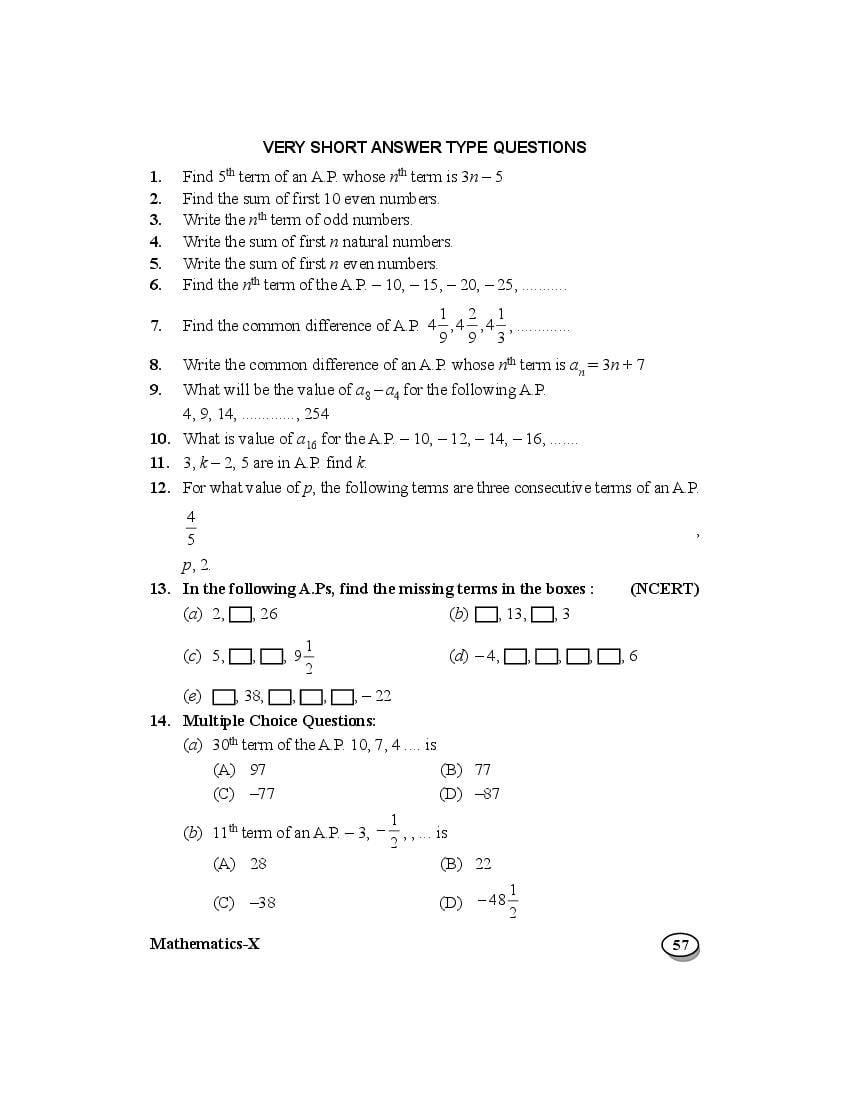
1. Find 5th term of an A.P. whose nth term is 3n – 5
2. Find the sum of first 10 even numbers.
3. Write the nth term of odd numbers.
4. Write the sum of first n natural numbers.
5. Write the sum of first n even numbers.
6. Find the nth term of the A.P. – 10, – 15, – 20, – 25, ...........
1 2 1
7. Find the common difference of A.P. 4 , 4 , 4 , .............
9 9 3
8. Write the common difference of an A.P. whose nth term is an = 3n + 7
9. What will be the value of a8 – a4 for the following A.P.
4, 9, 14, ............., 254
10. What is value of a16 for the A.P. – 10, – 12, – 14, – 16, .......
11. 3, k – 2, 5 are in A.P. find k.
12. For what value of p, the following terms are three consecutive terms of an A.P.
4
,
5
p, 2.
13. In the following A.Ps, find the missing terms in the boxes : (NCERT)
(a) 2, , 26 (b) , 13, ,3
1
(c) 5, , ,9 (d) – 4, , , , ,6
2
(e) , 38, , , , – 22
14. Multiple Choice Questions:
(a) 30th term of the A.P. 10, 7, 4 .... is
(A) 97 (B) 77
(C) –77 (D) –87
1
(b) 11th term of an A.P. – 3, , , ... is
2
(A) 28 (B) 22
1
(C) –38 (D) 48
2
Mathematics-X 57
Page 2
(A) 6 (B) 7
(C) 120 (D) 28
(d) The first three terms of an A.P. respectively are 3y – 1, 3y + 5 and 5y + 1
then y equals: (CBSE 2014)
(A) –3 (B) 4
(C) 5 (D) 2
(e) The list of numbers – 10, – 6, – 2, 2, ... is
(A) An A.P. with d = – 16 (B) An A.P. with d = 4
(C) An A.P. with d = – 4 (D) Not an A.P.
th
(f) The 11 term from the last term of an A.P. 10, 7, 4, ...., – 62 is (NCERT)
(A) 25 (B) –32
(C) 16 (D) 0
(g) The famous mathematician associated with finding the sum of the first
100 natural numbers is
(A) Pythagoras (B) Newton
(C) Gauss (D) Euclid
(h) What is the common difference of an A.P. in which a18 – a14 = 32 ?
(A) 8 (B) – 8
(C) – 4 (D) 4
(i) The nth term of the A.P. 1 3 , 1 2 3 , 1 3 3 , .... is
(A) 1 + n 3 (B) n + 3
(C)
n 1 3 (D) n 3
(j) The common difference of the A.P. 2 , 2 2 , 3 2 , 4 2 ...... is
(A) 2 (B) 1
(C) 2 2 (D) – 2
(k) The first term of an A.P. is p and the common difference is q, then its 10th
term is
(A) a + 9p (B) p – 9q
(C) p + 9q (D) 2p + 9q
58 Mathematics-X
Page 3
Column A Column B
ac
(a) a = – 18, n = 10, d = 2 then an of A.P. (a)
2
(b) a, b and c are in A.P. then their Arithmetic mean is (b) 0
(c) If 2, 4, 6, are in A.P. then 4, 8, 12 will also be an (c) – 41
(d) If an = 9 – 5 n of an A.P. then a10 will be (d) 8
(e) If d = – 2, n = 5 and an = 0 in A.P. then a is (e) A.P.
16. State True/False and justify
(a) 301 is a term of an A.P. 5, 11, 17, 23 .... (NCERT)
th th
(b) Difference of m and n term of an A.P. = (m – n) d.
(c) 2, 5, 9, 14, .... is an A.P.
(d) Sum of first 20 natural numbers is 410.
(e) nth term of an A.P. 5, 10, 15, 20 .... n terms and nth term of A.P. 15, 30, 45,
60, ... n terms are same.
SHORT ANSWER TYPE QUESTIONS-I
17. Is 144 a term of the A.P. 3, 7, 11, ......... ? Justify your answer.
18. Show that (a – b)2, (a2 + b2) and (a + b2) are in A.P.
19. Which term of the A.P. 5, 15, 25, ....... will be 130 more than its 31 st term?
20. The first term, common difference and last term of an A.P. are 12, 6 and 252
respectively, Find the sum of all terms of this A.P.
21. Find the sum of first 15 multiples of 8.
22. Is the sequence formed in the following situations an A.P.
(i) Number of students left in the school auditorium from the total strength of
1000 students when they leave the auditorium in batches of 25.
(ii) The amount of money in the account every year when Rs. 100 are deposit
annually to accumulate at compound interest at 4% per annum.
23. Find the sum of even positive integers between 1 and 200.
24. If 4m + 8, 2m2 + 3m + 6, 3m2 + 4m + 4 are three consecutive terms of an A.P.
find m.
25. How many terms of the A.P. 22, 20, 18, ....... should be taken so that their sum
is zero.
26. If 10 times of 10th term is equal to 20 times of 20th term of an A.P. Find its 30th
term.
Mathematics-X 59
Page 4
28. Find whether (– 150) is a term of A.P. 11, 8, 5, 2, ..... ? (NCERT)
29. Find how many two digit numbers are divisible by 6? (CBSE 2011)
1 1 1
30. If , and are in A.P. find x. (CBSE 2011)
x2 x3 x5
31. Find the middle term of an A.P. – 6, – 2, 2, .... 58. (CBSE 2011)
32. In an A.P. find Sn, where an = 5n – 1. Hence find the sum of the first 20 terms.
(CBSE 2011)
33. Which term of A.P. 3, 7, 11, 15 .... is 79? Also find the sum 3 + 7 + 11 + ... + 79.
(CBSE 2011C)
34. Which term of the A.P. : 121, 117, 113 ... is the first negative terms ?
(NCERT)
35. Find the 20th term from the last term of the A.P. 3, 8, 13, ... 253. (NCERT)
SHORT ANSWER TYPE QUESTIONS-II
36. Find the middle terms of the A.P. 7, 13, 19, ......., 241.
37. Find the sum of integers between 10 and 500 which are divisible by 7.
38. The sum of 5th and 9th terms of an A.P. is 72 and the sum of 7th and 12th term is
97. Find the A.P.
1 1
39. If the mth term of an A.P. be and nth term be , show that its (mn)th is 1.
n m
40. If the pth term A.P. is q and the qth term is p, prove that its nth term is (p + q – n).
41. Find the number of natural numbers between 101 and 999 which are divisible
by both 2 and 5.
42. The sum of 5th and 9th terms of an A.P. is 30. If its 25th term is three times its 8th
term, find the A.P.
43. If Sn, the sum of first n terms of an A.P. is given by Sn = 5n2 + 3n, then find its
nth term and common difference.
44. Which term of the A.P. 3, 15, 27, 39 .... will be 120 more than its 21 st term?
(CBSE 2018)
60 Mathematics-X
Page 5
term.
(CBSE 2018)
46. In a flower bed, there are 23 rose plants in the first row, 21 in the second, 19 in
the third and so on. There are 5 rose plants in the last row. How many rows are
there in the flower bed? (NCERT)
47. For what value of n, are the nth term of two A.P’s 63, 65, 67 ......... and 3, 10, 17
..... are equal ? (NCERT)
th th th
48. The 17 term of an A.P. is 5 more than twice its 8 term. If the 11 term of the
A.P. is 43, then find the nth term of the A.P. (CBSE 2020)
(NCERT)
49. If the sum of the first 14 terms of an A.P. is 1050 and its fourth term is 40, find
its 20th term. (CBSE 2020)
50. Find the sum of odd numbers between 0 and 50. (NCERT)
2
51. If Sn = 4n – n in an A.P. find the A.P. (NCERT)
52. How many terms of the A.P. 9, 17, 25, ..... must be taken to give a sum of 636?
(NCERT)
LONG ANSWER TYPE QUESTIONS
53. The sum of third and seventh terms of an A.P. is 6 and their product is 8. Find
the sum of first 16 terms of the A.P.
54. Determine the A.P. whose 4th term is 18 and the difference of 9th term from the
15th term is 30.
55. The sum of first 9 terms of an A.P. is 162. The ratio of its 6 th term to its 13th
term is 1:2. Find the first and fifteenth terms of the A.P.
56. The sum of the first 9 terms of an A.P. is 171 and the sum of its first 24 terms is
996. Find the first term and common difference of the A.P. (CBSE 2020)
57. The sum of first 7 terms of an A.P. is 63 and the sum of its next 7 term is 161.
Find the 28th term of this A.P.
58. The sum of first 20 terms of an A.P. is one third of the sum of next 20 term. If
first term is 1, find the sum of first 30 terms of this A.P.
59. If the sum of the first four terms of an AP is 40 and the sum of the first fourteen
terms of an AP is 280. Find the sum of first n terms of the A.P. (CBSE 2018)
Mathematics-X 61
Page 6
saved 100 in the first week and increased her weekly savings by 20 every
week. Find wheather she will be able to send her daughter to school after 12
weeks.
(CBSE 2015)
61. In an AP of 50 terms, the sum of first 10 terms is 210 and the sum of last 15
terms is 2565. Find the A.P. (CBSE 2014)
62. The sum of first n terms of an A.P. is 5n2 + 3n. If the mth term is 168, find the
value of m. Also find the 20th term of the A.P. (CBSE 2013)
63. If the sum of the first seven terms of an A.P. is 49 and the sum of its first 17
terms is 289. Find the sum of first n terms of an A.P. (CBSE 2016)
64. If the 4th term of an A.P. is zero, prove that the 25th term of the A.P. is three
times its 11th term. (CBSE 2016)
65. In an A.P. if S5 + S7 = 167 and S10 = 235. Find the A.P., where Sn denotes the
sum of its first n terms. (CBSE 2015)
66. In an AP prove S12 = 3 (S8 – S4) where Sn represent the sum of first n terms of an
A.P. (CBSE 2015)
67. The sum of four consecutive numbers in A.P. is 32 and the ratio of the product
of the first and last term to the product of two middle terms is 7 : 15. Find the
numbers.
68. Find the sum of first 16 terms of an Arithmetic Progression whose 4 th and 9th
terms are –15 and –30 respectively. (CBSE 2020)
ANSWERS AND HINTS
VERY SHORT ANSWER TYPE QUESTIONS-I
1. an = 3n – 5 a5 = 10
10
2. Sn = [2 × 2 + 9 × 2] = 110
2
3. 1, 3, 5, ......
an = 1 + (n – 1)2 = 2n – 1.
n
4. 1 + 2 + ........ + n = [1 + n]
2
62 Mathematics-X
Page 7
5. 2 + 4 + 6 + ... + 2n = [2 + 2n] = n(n + 1)
2
6. an = a + (n – 1)d = – 5(n + 1)
1
7. d = a2 – a1 =
9
8. a1 = 3 + 7 = 10, a2 = 6 + 7 = 13, d = 3
9. (a + 7d) – (a + 3d) = 4d = 20
10. a16 = a + 15d = – 40
11. 3, k – 2, 5 are in A.P.
35
k–2= =4 k=6
2
7
12. p = (same as Q.11)
5
13. (a) 14 (b) 18 , 8
1
(c) 6 , 8 (d) 2 , 0 , 2 , 4
2
(e) 53 , 23 , 8 , 7
14. (a) C (b) B
(c) D (d) C
(e) B (f) B
(g) C (h) A
(i) A (j) A
(k) C
15. (a) (b) (b) (a)
(c) (e) (d) (c)
(e) (d)
16. (a) False, 301 = 5 + (n – 1) 6
151
Solving we get n = which is not a natural number..
3
301 is not a term of this A.P.
(b) True [a + (m – 1) d] – [a + (n – 1) d] = (m – n) d
Mathematics-X 63
Page 8
a3 – a2 = 9 – 5 = 4
n( n 1) 20 21
(d) False Sn = = = 210
2 2
(e) False (If a, b, c, d ... are in AP then ka, kb, kc, kd ..... are in AP)
k 0, nth term = k times nth term of original A.P. of new A.P.
17. 144 = 3 + (n – 1) 4
141
1 = n which is not possible
4
18. a1 = (a – b)2 a2 = a2 + b2 a3 = (a + b)2
a2 – a1 = a2 + b2 – (a – b)2
= 2ab
a3 – a2 = (a + b)2 – (a2 + b2)
= 2ab
a2 – a1 = a3 – a2
in A.P.
19. Let an = 130 + a31
Solve to get n = 44
Ans. 44th term
20. a = 12, d = 6, an = 252 n = 41
n
Find S41 = 5412, use Sn = [2a + (n – 1) d]
2
15
21. S15 = [2a + 14d]
2
where a = 8, d = 8
Ans. 960
22. (i) Yes (1000, 975, 950, 925 .....)
(ii) No (104, 108.16, 112.48 .....)
23. 2 + 4 + 6 + .... + 198
a = 2, d = 2, an = 198 n = 99
n
Sn = [ a l ] = 9900
2
64 Mathematics-X
Page 9
24. b =
2
4m 8 3m 2 4m 4
2m2 + 3m + 6 =
2
Solve to get m2 – 2m = 0
m = 0, 2
n
25. Sn = 0 [44 + (n – 1) (– 2)] = 0.
2
Solve n = 23
26. ATQ 10 a10 = 20 a20
a10 = 2a20
a + 9d = 2a + 38d
a = – 29d ...(1)
a30 = a + 29d
Substitute a from (1)
Ans. a30 = 0
27. a = 1, d = 3, an = x
Sn = 287
n
287 = 2 1 (n 1)3
2
3n2 – n – 574 = 0
–41
n = 14, (rejected)
3
n = 14
x = a14 = 40
28. Let an = –150
11 + (n – 1) (– 3) = – 150
164
Solve and get n is not a natural number. n
3
Ans. No.
Mathematics-X 65
Page 10
a2 – a1 = a3 – a2 = 6
A.P., an = 96 n = 15
2 1 1
30. = (2b = a + c)
x3 x2 x5
Solve to get x = 1.
31. an = a + (n – 1) d
58 = – 6 + (n – 1) 4
find n = 17
Find Middle term using concept of median
th
n 1
= term = 9th term
2
a9 = – 6 + 8(4) = 26
32. an = 5n – 1
Find A.P. a1 = 4, a2 = 9, a3 = 14
4, 9, 14, ....
a2 – a1 = 5 = a3 – a2
n n
Sn = [2a + (n – 1)d] = [8 + (n – 1) 5]
2 2
n
= [5n + 3]
2
20
S20 = [100 + 3] = 10 × 103 = 1030
2
33. 79 = 3 + (n – 1) 4
n = 20
20
S20 = [3 + 79] = 10[82]
2
S20 = 820
34. Let an < 0
121 + (n – 1) (– 4) < 0
121 – 4n + 4 < 0
125 < 4n
66 Mathematics-X
Page 11
n>
4
n = 32
32nd term will be first negative term.
35. 20th term from end using [l – (n – 1) d]
= 253 – 19 × 5
= 253 – 95 = 158
SHORT ANSWER TYPE QUESTIONS-II
36. Same as Q.27, n = 40 Middle terms are a20, a21
Ans. 121, 127
37. Numbers between 10 and 500 which are divisible by 7, 14, 21, 28 ..., 497
n
Find n, using an = a + (n – 1) d , then use Sn = [2a + (n – 1) d]
2
Ans. Sn = 17885. (n = 70)
38. a5 + a9 = 72
a7 + a12 = 97
Solve these equations to get a and d, a = 6, d = 5
A.P., 6, 11, 16, 21, 26, .......
1 1
39. am = a + (m – 1)d =
n n
1 1
an = a + (n – 1)d =
m m
– – –
––––––––––––––
1 1 mn
(m – n) d = =
n m mn
1 1
d= , find a =
mn mn
amn = a + (mn – 1) d
1 1
= (mn 1)
mn mn
amn = 1.
Mathematics-X 67
Page 12
Solve to get a and d, a = q + p – 1, d = – 1
an = p + q – n
41. Numbers divisible by both 2 and 5
Numbers divisible by 10.
Numbers between 101 and 999 divisible by 2 and 5 both 110, 120, 130, 140, ...,
990.
Use an = 990 to get n = 89.
42. ATQ a5 + a9 = 30
a25 = 3 a8
Solve to get a = 3, d = 2
A.P. 3, 5, 7, 9, ...
43. Sn = 5n2 + 3n
Find an = Sn – Sn – 1 = 10 n – 2
Use it to get d = 10
44. Let an = 120 + a21
3 + (n – 1)d = 120 + [3 + 20d]
3 + (n – 1)12 = 120 + [3 + 20 × 12]
= 120 + 243
(n – 1)12 = 363 – 3 = 360
n = 31
45. Sn = 3n2 – 4n
an = Sn – Sn–1
= (3n2 – 4n) – [3(n – 1)2 – 4(n – 1)]
= (3n2 – 4n) – [3n2 + 3 – 6n – 4n + 4]
= – [7 – 6n]
an = 6n – 7
46. 23, 21, 19, ... 5
an = a + (n – 1) d
5 = 23 + (n – 1) (– 2)
n = 10
68 Mathematics-X
Page 13
an = 63 + (n – 1) 2 = 61 + 2n
3, 10, 17, ....
an = 3 + (n – 1) 7
= 7n – 4
61 + 2n = 7n – 4
65 = 5n
n = 13
48. ATQ,
a17 = 5 + 2 × a8
a + 16d = 5 + 2a + 14 d
a – 2d = – 5 ...(1)
a11 = a + 10d = 43 ....(2)
Solving (1) & (2), we get
a = 3, d = 4
an = 4n – 1
49. S14 = 1050, a4 = 40
14
S14 = [2 × a + 13d]
2
1050
= 2a + 13d
7
Solve 2a + 13d = 150 and a + 3d = 40 to get a = 10, d = 10
a20 = a + 19d = 10 + 190 = 200
50. Odd numbers between 0 to 50
1, 3, 5, 7, ..., 49
an = 49
a + (n – 1)d = 49
1 + (n – 1)2 = 49
n = 25
n
Sn = [a + l]
2
25
S25 = [1 + 49] = 25 × 25 = 625
2
Mathematics-X 69
Page 14
S1 = a1 = 4 – 1 = 3
S2 = a1 + a2 a2 = 1 A.P. 3, 1, – 1, ...
S3 = a1 + a2 + a3 a3 – 1
53
52. n = 12, n = (NCERT)
4
LONG ANSWER TYPE QUESTIONS
53. a3 + a7 = 6, a3 × a7 = 8
On Solving
1
a = 1, d= Sn = 16
2
1
a = 5, d = Sn = 20
2
Ans. 76, 20
54. ATQ a4 = 18 ...(1), a15 – a9 = 30 ...(2)
equation (2) will give d = 5
Substitute d = 5 in (1) to get a = 3
A.P. 3, 8, 13, ....
9
55. ATQ S9 = 162 [2a + 8d] = 162 ...(1)
2
a6 1
ATQ = solve and get a = 2d
a13 2
Sub a = 2d in (1) to get d = 3, a = 6
a15 = a + 14d
Ans. a15 = 48, a = 6
56. S9 = 171, S24 = 996
a + 4d = 19, 2a + 23d = 83
Solve to get,
d = 3, a = 7
57. ATQ S7 = 63, ...(1)
Sum of next 7 terms = S14 – S7 = 161 ...(2)
n
Use Sn = [2a + (n – 1) d]
2
70 Mathematics-X
Page 15
a = 3, d = 2
Ans. a28 = 57
1
58. ATQ S20 = (S40 – S20), a = 1
3
n
Use Sn = [2a + (n – 1) d] and a = 1 to find d, d = 2
2
then find S30.
Ans. 900
4
59. S4 = 40 [2a + 3d] = 40
2
14
S14 = 280 [2a + 13d] = 280
2
Solve to get a = 7, d = 2
n
Ans. Sn = n2 + 6n (using Sn = [2a + (n – 1) d]
2
60. a = 100, d = 20, n = 12
12
S12 = [200 + 220] = 6 × 420
2
= 2520 > 2500
Ram kali will be able to send her daughter to school after 12 weeks.
61. S10 = 210 5 [2a + 9d] = 210
2a + 9d = 42 ...(1)
50 35
S50 – S35 = 2565 [2a 49d ] [2a 34d ] = 2565
2 2
15
(2a) + d [25 × 49 – 35 × 17] = 2565
2
15a + d [1225 – 595] = 2565
or 15a + 630 d = 2565
or 3a + 126d = 513 ...(2)
Solve (1) and (2) d = 4, a = 3.
62. Sn = 5n2 + 3n
S1 = a1 = 8
S2 = a1 + a2
Mathematics-X 71
Page 16
d = 18 – 8 = 10
am = 168 a + (m – 1)d = 168
8 + (m – 1)10 = 168 m = 17
a20 = a + 19d = 8 + 190 = 198
63. S7 = 49, S17 = 289 (Solve just like Q 53.)
64. a4 = 0 a + 3d = 0 a = – 3d
a25 = a + 24d = – 3d + 24d = 21d
a11 = a + 10d = – 3d + 10d = 7d a25 = 3a11
n
65. Use Sn = [2a + (n – 1) d]
2
S5 + S7 = 167 S10 = 235
Solve to get a = 1, d = 5
A.P. = 1, 6, 11, 16, 21, .........
Solve just like Q.53.
12
66. L.H.S. = S12 = [2a + 111d] = 6 [2a + 11d]
2
8 4
R.H.S. = 3 (2a 7d ) (2a 3d ) = 3[4a + 22d] = 6[2a + 111d]
2 2
L.H.S. = R.H.S.
67. Four consecutive terms are :
a – 3d, a – d, a + d, a + 3d
d=8
Product of Extremes ( a 3d ) ( a 3d ) 7
Product of means = ( a d ) (a d ) =
15
Put a = 8 and solve to get
d2 = 4
d=±2
for a = 8, d = 2 terms are 2, 6, 10, 14
for a = 8, d = –2 terms are 14, 10, 6, 2
68. a4 = – 15, a9 = – 30
a + 3d = –15, a + 8d = – 30
Solve to get a = –6, d = –3
n
S16 = – 456 [Sn = {2a + (n – 1) d}]
2
72 Mathematics-X
Page 17
Arithmetic Progression
Time: 1 Hr. M.M. : 20
Section-A
1. Find the sum of first 10 natural numbers. 1
1 2 3
2. What is the common difference of an A.P. 8 ,8 ,8 ,........... 1
8 8 8
3. If k, 2k – 1 and 2k + 1 are in A.P. them value of k is ................... 1
4. The 10th term from the end of the AP 8, 10, 12, ...., 126 is ................... 1
Section-B
5. How many 2 digit number are there in between 6 and 102 which are divisible
by 6. 2
6. The sum of n terms of an A.P. is n2 + 3n. Find its 20th term. 2
7. Find the sum (–5) + (–8) + (–11) + ...+(–230) 2
Section-C
1
8. Find the five terms of an A.P. whose sum is 12 and first and last term ratio
2
is 2 : 3. 3
9. Find the middle term of an A.P. 20,16,12,.......,– 176. 3
Section-D
10. The sum of three numbers in A.P. is 24 and their product is 440. Find the
numbers. 4
Mathematics-X 73
Document Details
| Board / Org | Aglasem |
| Exam | Class 10 |
| Type | Question Bank |
| Pages | 17 |
| Updated | 22 Jul 2026 |