TIFR GS 2020 Question Paper Biology M.Sc Wildlife and Conservation
Finished viewing? Save it for later —
Download TIFR GS 2020 Question Paper Biology M.Sc Wildlife and Conservation (PDF · 33 pages)About TIFR GS 2020 Question Paper Biology M.Sc Wildlife and Conservation
TIFR GS 2020 Question Paper Biology M.Sc Wildlife and Conservation is available here for free download. Published by Default for TIFR GS, this question paper can be viewed online or downloaded as a PDF (33 pages). Candidates preparing for TIFR GS can use TIFR GS 2020 Question Paper Biology M.Sc Wildlife and Conservation to understand the exam pattern, the type of questions asked, and the overall difficulty level.
Frequently Asked Questions
How can I download TIFR GS 2020 Question Paper Biology M.Sc Wildlife and Conservation?
Open this page and click the Download button to save TIFR GS 2020 Question Paper Biology M.Sc Wildlife and Conservation as a PDF. It is completely free on AglaSem Docs.
Is TIFR GS 2020 Question Paper Biology M.Sc Wildlife and Conservation free to download?
Yes. TIFR GS 2020 Question Paper Biology M.Sc Wildlife and Conservation can be viewed online and downloaded as a PDF free of cost on AglaSem Docs.
How many pages does TIFR GS 2020 Question Paper Biology M.Sc Wildlife and Conservation have?
TIFR GS 2020 Question Paper Biology M.Sc Wildlife and Conservation contains 33 pages, which you can read online or download together as a single PDF.
Where can I find more TIFR GS study material?
You can find more TIFR GS question papers, sample papers, syllabus, and answer keys on AglaSem Docs.
TIFR GS 2020 Question Paper Biology M.Sc Wildlife and Conservation – Text
Read the full text of this question paper below — useful to quickly search, copy and reference the content online without downloading the PDF.
📄 View text version (33 pages)
Page 1
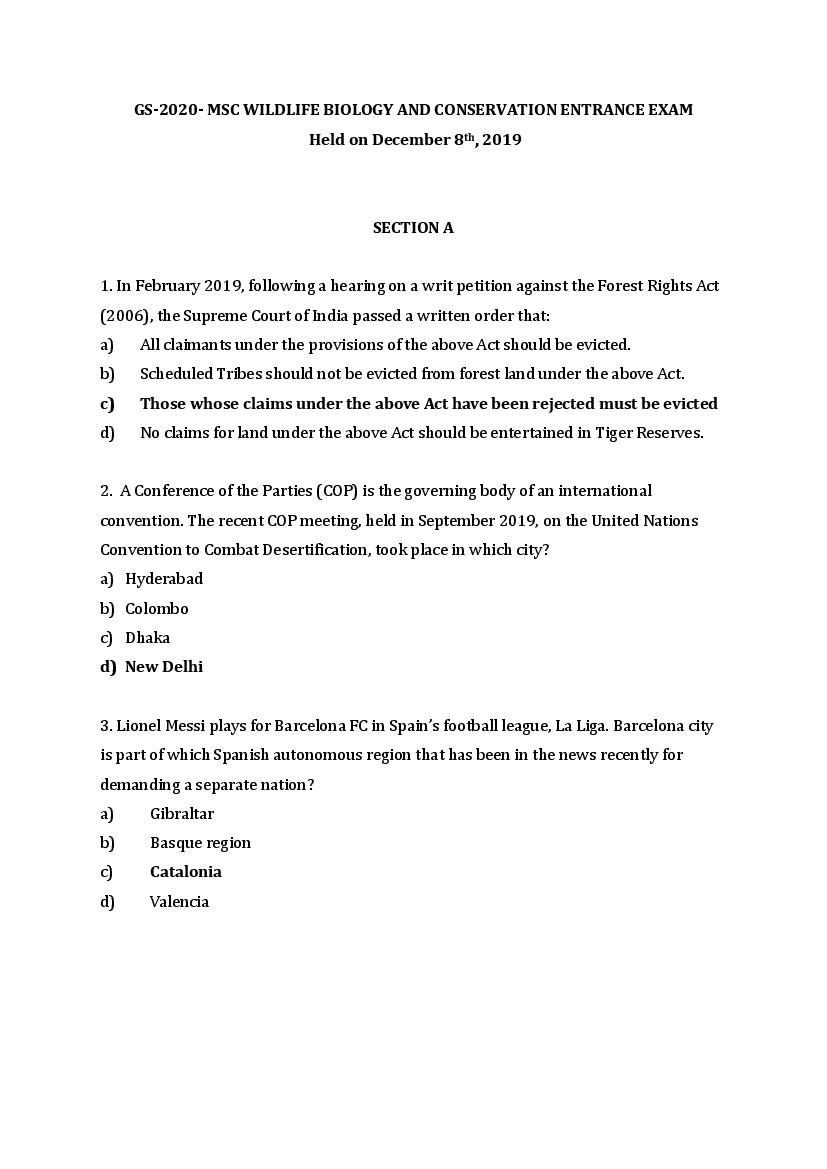
Held on December 8th, 2019
SECTION A
1. In February 2019, following a hearing on a writ petition against the Forest Rights Act
(2006), the Supreme Court of India passed a written order that:
a) All claimants under the provisions of the above Act should be evicted.
b) Scheduled Tribes should not be evicted from forest land under the above Act.
c) Those whose claims under the above Act have been rejected must be evicted
d) No claims for land under the above Act should be entertained in Tiger Reserves.
2. A Conference of the Parties (COP) is the governing body of an international
convention. The recent COP meeting, held in September 2019, on the United Nations
Convention to Combat Desertification, took place in which city?
a) Hyderabad
b) Colombo
c) Dhaka
d) New Delhi
3. Lionel Messi plays for Barcelona FC in Spain’s football league, La Liga. Barcelona city
is part of which Spanish autonomous region that has been in the news recently for
demanding a separate nation?
a) Gibraltar
b) Basque region
c) Catalonia
d) Valencia
Page 2
It is now familiar to all of us and a matter of great concern for the future functioning of
our planet and the fate of our species. Which of the following is the closest to the
estimated increase in global mean surface air temperature since 1880?
a) 0.85 oC
b) 2.02 oC
c) 0.53 oC
d) 0.37 oC
5. Which Indian state lends its name to the latest geological age in the Quaternary
period?
a) Nagaland
b) Manipur
c) Meghalaya
d) Mizoram
6. On 2nd September 2018, a devastating fire destroyed large parts of the scientific and
cultural artifacts of the National Museum in which city?
a. New Delhi
b. Los Angeles
c. Paris
d. Rio de Janeiro
Page 3
for:
1. Greta Thunberg A. National Campaign for People's Right to Information
2. Sunita Narain B. Girl’s education and human rights
3. Malala Yousafzai C. Global climate strikes
4. Aruna Roy D. Delhi Clean Air Challenge
a) 1:A, 2:D, 3:B, 4:C
b) 1:B, 2:A, 3:C, 4:D
c) 1:C, 2:D, 3:B, 4:A
d) 1:C, 2:B, 3:D, 4:A
8. You are given 9 weighing stones of weights 1, 2, 3, 4, 5, 6, 7, 8 and 9 kilos respectively.
How many unique combinations of stones can you use to weigh a quantity of 10 kilos,
with the condition that the 4 kilo stone has to be included?
a) 1
b) 2
c) 3
d) 4
9. Two parallel pillars A1 and A2 with heights ‘x’ and ‘y’ respectively, are ‘z’ meters
apart, where z is a positive number. Under what conditions can height ‘x’ exceed the
distance between the top of pillar A1 and the base of pillar A2?
a) Always
b) Never
c) All z >= x2 + y2
d) All x < 2y / z
Page 4
something”. Which of the following is the best example of a quid pro quo?
a) A charity accepts funds from a donor to provide flood relief to a coastal community
b) A gang member found guilty of a crime is given a reduced sentence in
exchange for providing information on other gang members
c) Vietnam imported seafood from India and then exported meat to Cambodia
d) A doctor provides consulting services to help a poor community overcome an
outbreak of viral fever
11. Shown below is the graph of the time taken to run men’s 100 m since 1900. Bio-
mechanists fit a curve to the data from 1900 to 2000, but Usain Bolt’s run has proved to
be an outlier on this curve. In 2009, Usain Bolt ran 100 m in 9.58 seconds, a world-
record that still holds. Based on this curve (red line shown below), approximately how
much ahead of his time was Usain Bolt?
a) 0 years
b) 15 years
c) 50 years
d) 80 years
Page 5
for a plant the Cerrado red plum. He observes that the Cerrado red plum is only found in
areas where the Cerrado fruiteater is also found. Which of the following is consistent
with this statement?
a) The presence of the Cerrado fruiteater is necessary but not sufficient for
occurrence of the Cerrado red plum.
b) The presence of the Cerrado fruiteater is sufficient but not necessary for the
occurrence of the Cerrado red plum.
c) The presence of the Cerrado fruiteater is necessary and sufficient for the occurrence
of the Cerrado red plum.
d) The presence of the Cerrado fruiteater is neither necessary nor sufficient for the
occurrence of the Cerrado red plum.
13. Nushi drives due North from his house traveling at a speed to 30km per hour. After
traveling for 20 minutes, he turns due West and travels for another 6 minutes at 60km
per hour. He then turns due South and travels at 45 km per hour for 24 minutes and
then stops at a petrol station. He fills up the tank and then turns and heads directly
home as the crow flies (that is, in a straight line), traveling at a speed of 30 km per hour.
How long will it take him to reach home after he leaves the petrol station and
approximately what direction will he be traveling in?
a) 18 minutes, traveling north-east
b) 22 minutes, traveling north-west
c) 20 minutes, traveling north-east
d) 24 minutes, traveling north-west
Page 6
region. The triangle represents a dry deciduous forest (DDF), the square a moist
deciduous forest (MDF), and the circle a wet evergreen forest (WEF). Which of the
following statements is NOT CONSISTENT with this figure?
a) Among these three forests, the WEF has the plant community with the highest
proportion of unique species.
b) The unique species in DDF is equal to the number of species that that is common
between DDF and MDF.
c) The unique species in MDF is greater that the number of species that it shares
with other forests.
d) The WEF has a greater number of species in common with MDF than with DDF.
15. Which of the following sentences is grammatically the most appropriate?
a) Now that it’s raining, there are fewer people out on the streets.
b) Now that its raining, there are fewer people out on the streets.
c) Now that it’s raining, there are less people out on the streets.
d) Now that its raining, there are less people out on the streets.
Page 7
children, who will be asleep at that time of the night, cannot be left alone in the house.
So she calls her friend Uma and asks if she can help out with baby-sitting. Which of the
following is the most correct use of words for her request?
a) Will you see the children while I am away?
b) Will you watch the children while I am away?
c) Will you look at the children while I am away?
d) Will you watch over the children while I am away?
17. Talking to his wife over the telephone after their home was burgled, the husband
said “Niether of the dogs ------- hurt, nor ------ any of the jewels stolen.’’ Which of the
following options is technically the most correct choice of verbs for the above blanks, in
the order they would appear in the sentence above?
a) was, was
b) was, were
c) were, was
d) were, were
18. When Edmund complained that he was getting cold feet about the expedition, his
friends responded as below:
Hilary said, “Put your feet in a hot bath- that should take care of it.”
Tenzing said, “That is perfectly normal- You just need to get started.’’
Norgay said, “Are you worried about frost-bite? Perhaps you need a new pair of shoes.’’
Sherpa said, “I am rather surprised. It is usually the ears that get cold.”
Which of his friends had understood Edmund correctly?
a) Hilary
b) Tenzing
c) Norgay
d) Sherpa
Page 8
sentence is FALSE only if?
a) It is raining and the shop is not open
b) It is not raining and the shop is open
c) It is raining and the shop is open
d) It is not raining and the shop is not open
20. As of December 1, 2019, the number of states in the Indian republic is:
a) 26
b) 27
c) 28
d) 29
Page 9
1. In mathematics, n! , where n is a positive integer, is
a) A very large number
b)
c)
d) n × (n-1) × (n-2) ×.... x1
2. What is the next number is the series 100, 199, 296, 391,…
a) 488
b) 480
c) 484
d) 485
3. If the probability of a day being cool is 0.3 and the probability of rain falling on the
same day is 0.6, then the probability that the day will be both hot and dry is:
a) 0.10
b) 0.18
c) 0.28
d) 0.82
4. If ax = by
a) log(a) + log(b) = x/y
b) log(a) - log(b) = x/y
c) log(a/b) = x/y
d) log(a)/log(b) = x/y
Page 10
concentration of 20microgram/L. If the elephant has 500L of blood, and the
concentration of the drug I have is 5milligram/mL, then how many mL of the drug do I
need to inject?
a) 5microL
b) 2mL
c) 5mL
d) 2000mL
6. You carry out a study to estimate the abundance of the Malabar spiny dormouse
Platacanthomys lasiurus using live trap and release, in an isolated rainforest patch in the
Anamalais. The first day you capture 30 different individuals and tag each one by
painting their abdomens with indelible, insoluble ink. The next day, you capture X
different individuals and find that 60% of the individuals captured on Day 2 are marked
(i.e. they were also captured on Day 1). Assuming that over the 2-day duration of the
study, there are no births, no deaths, no immigration, and no emigration; all individuals
have the same probability of being captured; and being captured on day 1 does not
affect the probability of being recaptured on day 2 in any way, what is the best estimate
for the number of spiny dormice in the rainforest patch?
a) 40
b) 50
c) 1.6 X
d) 2.4 X
7. During a single mist-netting session, Meghna and Sachin captured birds belonging to
three species: A, B and C. Of the birds captured, the sum of individuals of species A and B
was 24, of species A and C was 32, and of B and C was 22. How many birds in total did
they capture?
a) 44
b) 30
c) 39
d) 64
Page 11
population is monogamous and all individuals form pairs. In the 2018 breeding season,
each pair of birds successfully raised one young. All youngsters survived until 2019, but
half the parents died between 2018 and 2019. In 2019, the population of this species is:
a) Equal to that in 2018
b) Higher than that in 2018
c) Lower than that in 2018
d) Unpredictable
9. On a very hot day, tired after working all day in the field, the farmer goes to the
canteen and orders a pint of mineral water. He next orders 2/3rd pint, and then 4/9th,
8/27th pints etc. If he kept on doing this for infinitely long, how many pints would the
man have ultimately had?
a) 3 pints
b) 2.2 pints
c) Infinite pints
d) 2 pints
10. An ecologist estimates the mean height of a tree species in 30 different sites
distributed across a wide rainfall gradient. Which of the following is the most
appropriate statistical procedure to examine whether mean height (measured in
metres) is related to rainfall (measured in mm)?
a) one-way ANOVA
b) chi-square test
c) linear regression
d) t-test
Page 12
population is described well by the function where P is per capita predation
rate, D is prey density and a and b are constants that are greater than 0. According to
this model, at extremely high prey densities, P will approach:
a) a
b) a/b
c) b
d) D
12. In a particular bird population in which individuals forage in groups, group size
represents a balance between the foraging time that individuals gain from reducing
their individual vigilance because of the vigilance shown by other group members and
the foraging time that they lose in negative interactions with other individuals. In this
population, I estimate that feeding time F (number of minutes in an hour) shows the
following relationship with group size G:
F = 3 + 10G – G2
According to this relationship, the optimal group size (the group size when feeding time
is maximum), all else being equal, is:
a) 1
b) 3
c) 5
d) 10
Page 13
measured the number of matings obtained by males of different sizes and the equation
that best explained these data was .
Which of the graphs below represents this relationship?
a) A
b) B
c) C
d) D
Page 14
minimum piece(s) of information do I need to find the height?
a) Ɵ1 and AB
b) Ɵ1 and Ɵ2
c) Ɵ2 alone
d) AB alone
Page 15
infected by rabies) in a dog population follows a binomial distribution, and estimates
the probability that an individual is infected to be 0.6. For such a population, you are
planning to test 20 individuals. Which of the following graphs best represents the
expected probability distribution (relative frequency of different possible outcomes) of
the number of infected dogs you might find?
A) B)
C) D)
a) A
b) B
c) C
d) D
Page 16
colour, one on the thorax and one on the abdomen. If you have 8 colours available to
you, how many bees can you mark with a unique pattern, so that you can identify each
unique individual later?
a) 64
b) 16
c) 256
d) 8
17. There are four species of hornbills that are found in the Western Ghats, but all of
them do not occur everywhere. The set of specific hornbill species that occur at any one
place is called the hornbill community of that place. How many such possible different
hornbills communities are theoretically possible (from no hornbills to all four)?
a) 20
b) 4
c) 24
d) 16
18. Amaltash (Cassia fistula), with it’s famous suspended yellow inflorescences,
normally flowers in March/April. However a few trees flower in October. Suppose the
probability of a tree flowering in October is 0.1. You go out in October and survey 10
trees at random. What is the probability that none of your 10 trees are flowering at that
time?
a) 0.9^10
b) 0.1^10
c) 10^0.9
d) 10^0.1
Page 17
female chital's three offspring are two sons and one daughter?
a) 3/8
b) 1/2
c) 2/3
d) 1/3
20. What is the relationship between the surface area (A) and the volume (V) of a cube?
a) A = 6V^2/3
b) A = 6 + V.2/3
c) A = 6V^3/2
d) A = 6 + V^2/3
21. Standard deviation (s) is a measure of the variation or dispersion in a sample of
measurements where n is the total number of measurements. The relationship between
standard deviation and the number of measurements is:
a) Standard deviation does not change in a predictable way with the number of
measurements
b) Standard deviation increases linearly with the number of measurements
c) Standard deviation decreases linearly with the number of measurements
d) Standard deviation decreases exponentially with the number of measurements
Page 18
population started with a number of individuals N0, and then grew at a rate of lambda
each year.
Nt = N0.lambda^t
Suppose we wanted to know, for any given value of lambda, how many years (t) would
need to pass until the population doubled in size (ie when Nt/N0 = 2). Which equation
below would we use to solve for t?
a) t = log10(2)/ log10(lambda)
b) t = log10(2)- log10(lambda)
c) t = log10(2)* log10(lambda)
d) t = log10(2) + log10(lambda)
23. The Forest Department wants to plant 200 trees in a hectare of land such that the
distance between neighouring trees is maximised. What do you think this distance will
be, on average?
a) 1m
b) 2m
c) 5m
d) 7m
24. You are studying the population densities of chital in different sanctuaries across
India, and so far the frequency distribution appears to follow a normal (also called
Gaussian) distribution. The last sanctuary you sample has a much higher density than
any of the others. What does the inclusion of this population do to the mean and median
densities?
a) Mean increases; median largely unchanged
b) Mean increases; median increases
c) Mean largely unchanged; median largely unchanged
d) Mean largely unchanged; median increases
Page 19
insects and other invertebrates that babblers catch. Drongos also regularly give reliable
alarm calls to predators, and sometimes even attack predators that are approaching
babbler groups. In addition to the protection that the drongo provides, babblers also
gain protection from predators through their own sentinel individuals, who perch on
elevated positions and keep a look out for danger. A study examined how the
proportion of time a babbler group invested in sentinel behaviour changed, both, with
babbler group size, and in relation to whether a drongo was present or not. Which of the
following interpretations or speculations DO NOT follow logically from the result shown
in the figure?
Figure from Ridley & Raihani 2007; Behavioral Ecology 18: 324-330
a. The behavioural response of babblers to the presence of drongos is contingent on
group size
b. In the absence of drongos, babblers in large groups are likely to have more time for
activities other than being a sentinel as compared to drongos in small groups.
c. Babblers in smaller groups are less likely to pay attention to drongo alarm calls
compared to babblers in larger groups.
d. Babblers in smaller groups are likely to have more time for activities other than being
a sentinel when a drongo is present as compared to when a drongo is absent.
Page 20
1. Which of these global biodiversity hotspots is NOT partly located within India?
a. Himalayas
b. Indo-Burma
c. Madagascar and the Indian Ocean Islands
d. Sundaland
2. Sudan, who died recently, was the last male individual of which critically endangered
mammal?
a. Nubian Giraffe
b. Northern White Rhinoceros
c. Somali Wild Ass
d. Sudan Cheetah
3. Recently, the Australian government released a document detailing eight sightings of
an animal presumed extinct since the mid 1900s. Which species were the purported
sightings of?
a) Tasmanian devil
b) Tasmanian pademelon
c) Tasmanian pygmy possum
d) Tasmanian tiger
4. The chicks of which bird were recently hatched in a captive breeding program for the
first time in India?
a) Bengal Florican
b) Great Indian Bustard
c) Houbara Bustard
d) Lesser Florican
Page 21
archaeological heritage sites, might be a representation of which real animal?
a) Bharal
b) Gaur
c) Ibex
d) Rhinoceros
6. According to life history theory, if an individual is assumed to have a fixed amount of
resources that it can allocate to the production of offspring, the fecundity of individuals
in a fish species should be inversely related to which of the following traits?
a) Mortality of eggs
b) Number of eggs
c) Size of eggs
d) Maternal body size
7. The Wallace Line divides which two biogeographic realms?
a) Indomalaya and Australasia
b) Neotropic and Paleartic
c) Palearctic and Australasia
d) Palearctic and Indomalaya
8. Tropical rainforests are known for their highly diverse insect communities. Which of
the following statements are possible explanations for why one or few insect species do
not out-compete the other insect species?
i. The most dominant insect species face high predation relative to rare species
ii. Different insect species adjust their reproductive rates in order that all species
can persist
iii. Different insect species require different micro-environments to survive
iv. Most insect species in the tropics reproduce at very low rates
a) i and ii
b) i and iii
c) ii and iii
d) ii and iv
Page 22
Endangered species: Elephant, tiger, rhino, hoolock gibbon, lion-tailed macaque, swamp
deer, Great Indian Bustard, Bengal Florican and clouded leopard.
Protected areas: Kanha National Park, Ranthambore Tiger Reserve, Corbett National
Park, Kaziranga National Park, Silent Valley National Park, Jaisalmer Desert National
Park, Panna Tiger Reserve, Eaglenest Wildlife Sanctuary
If you are asked to select the least number of protected areas which would give
protection to all the 10 endangered species, which combination below would you
select?
a) Corbett National Park, Silent Valley National Park, Eaglenest Wildlife Sanctuary,
Panna Tiger Reserve
b) Corbett National Park, Silent Valley National Park, Jaisalmer Desert National Park
c) Kaziranga National Park, Silent Valley National Park, Panna Tiger Reserve
d) Kaziranga National Park, Jaisalmer Desert National Park, Silent Valley National
Park
Page 23
the following statements are NOT true?
a) All cold-blooded organisms have lower metabolic rates than warm-blooded
organisms
b) For a given mass, unicellular organisms typically have lower metabolic rates than
cold-blooded organisms
c) The rate at which metabolic rate changes with body mass appears to be similar for
different groups of organisms
d) Typically, the bigger you are, the greater your metabolic rate
11. In which of the following are you most likely to find chemoautotrophic organisms
a) tropical shallow-water coral reef.
b) deep-sea hydrothermal vents.
c) tidal pools.
d) tropical estuary.
Page 24
a) analogous traits.
b) homologous traits.
c) vestigial traits.
d) atavistic traits.
13. The typical temperature tolerance curves of temperate, subtropical and tropical
ectotherms is shown below (solid line) with the temperatures of optimal performance
(dashed line). Tropical ectotherms are adapted to warmer temperatures than temperate
ectotherms. However, tropical ectotherms have a narrow range of temperatures that
they can tolerate , while subtropical ectotherms have the broadest tolerance ranges. The
temperature of optimal metabolic performance is closely related to the mean
temperatures in these regions. What is the expected vulnerability of metabolic
performance of these ectotherms in future climates with global warming, given an equal
increase in mean temperatures in these regions.
Page 25
b) Temperate > subtropical > tropical
c) Tropical > temperate > subtropical
d) Tropical > subtropical > temperate
14. Pineapple is an example of a plant that has CAM photosynthetic pathways. CAM
plants
a) keep stomates open in the day and closed during the night.
b) keep stomates open in the night and closed during the day.
c) keep stomates open both in the day and in the night.
d) do not have stomates in their photosynthetic tissues.
15. In a hypothetical rainforest ecosystem with species X, Y, and Z: Z is the most drought
tolerant, followed by X and then Y; Y is the most shade tolerant, followed by X and then
Z; in terms of growth rates, Y is equivalent to Z, and both are slower-growing than X.
Going from the interior to the edge of the forest, all else being equal, in what order
would each species reach its greatest abundance?
a) Y, X, Z
b) X, Y, Z
c) X, Z, Y
d) Z, Y, X
Page 26
studying cannot withstand the harsh environment in altitudes greater than 4000m in
the Trans-Himalayan rangelands of Ladakh when the plant is grown on its own.
However, she finds that this plant is commonly found in these rangelands up to altitudes
of 5000m IF a dwarf shrub is also present. Which of the following statements is
consistent with the observed increase in altitudinal range when the annual plant occurs
with the dwarf shrub?
a) The fundamental niche of the annual is the same as its realized niche.
b) The fundamental niche of the annual is narrower than its realized niche.
c) The fundamental niche of the annual is wider than its realized niche.
d) The fundamental niche of the annual plant changes in the presence of the dwarf
shrub.
17. A student wants to carry out a comparative analysis of nest architecture in birds. To
do this, she has to prepare a list of bird species for which she will collect information on
nest shape, materials used to build nests and the morphological, life history and
behavioural traits of the bird species. From the following, pick out the species that she
cannot include in her analysis.
a) Asian Koel
b) Black Kite
c) House Crow
d) Purple Sunbird
18. You are trudging along a mountain trail at dawn. It is early September and warm
rain is falling steadily. You huddle into your rain-jacket and turn towards the north-east
so that your back is to the wind. As the mist clears, you see that you are in a landscape
with grassy meadows that stretch out on all sides to the mountain-tops, with patches of
stunted forests in pockets in the mountain-sides. You are most probably walking in the:
a) Southern Western Ghats
b) Northern Western Ghats
c) Southern Eastern Ghats
d) Northern Eastern Ghats
Page 27
statements is true?
a) Birds, crocodiles and lizards evolved from turtles.
b) Birds are more closely related to crocodiles than to lizards.
c) Turtles are more closely related to lizards than to crocodiles.
d) Lizards are more closely related to crocodiles than to birds
20. The Globe Skimmer, which is known to migrate trans-oceanically between India and
Africa, is a species of:
a. Butterfly
b. Dragonfly
c. Moth
d. Locust
21. Camera traps are, today, a widely-used method in wildlife and conservation
research. Which of the following is NOT a purpose for which camera traps are
employed?
a. Estimating population densities
b. Studying behaviour of animals
c. Surveying occurrence of rare and endangered species
d. Trapping of animals to fit them with radiocollars
Page 28
J) The Book of Indian Animals i) Vandana Shiva
K) Indica: A Deep Natural History of the Indian ii) Madhav Gadgil &
Subcontinent Ramachandra Guha
L) Ecology & Equity: The Use and Abuse of Nature in iii) SH Prater
Contemporary India
M) Monocultures of the Mind: Perspectives on iv) Pranay Lal
Biodiversity and Biotechnology
a) J-i, K-iii, L-ii, M-iv
b) J-iii, K-iv, L-ii, M-i
c) J-i, K-iii, L-iv, M-ii
d) J-iv, K-iii, L-i, M-ii
23. While studying for this exam, you developed an ability to quickly turn the pages of
large textbooks to arrive at the correct page. Your friend tells you that now, if and when
you have a child, he or she will also be good at quickly flipping through textbooks. Your
friend’s comments reflect the ideas of:
a.Charles Darwin
b.Gregor Mendel
c. Jean-Baptiste Lamarck
d. James Watson
Page 29
sympatric speciation?
a) A new, isolated population of finches is founded by a small group of colonists arriving
at an oceanic island
b) Following deforestation of a region for agriculture, the only bird disperser of a
tropical tree now does not move across the deforested region between remnant
forested areas.
c) The formation of the Grand Canyon forms a barrier preventing interbreeding of
squirrels on the canyon’s northern and southern rim
d) An individual of a hermaphroditic plant species following meiotic failure,
produces gametes which grow into fertile tetraploid plants.
25. Which of the following mammal species is not endemic to India?
a. Brown Mongoose (Herpestes fuscus)
b. Brown Palm Civet (Paradoxurus jerdoni)
c. Lion-tailed Macaque (Macaca silenus)
d. Nilgiri Tahr (Nilgiritragus hylocrius)
26. A study found that a terrestrial plant species growing around ponds that had fish
received more pollination than those growing around ponds without fish. The causal
chain of links that the study proposed was that the fish fed on the aquatic larvae of a
carnivorous insect that fed on pollinators of the plant. What is this insect likely to be?
a. Grasshopper
b. Dragonfly
c. Praying Mantis
d. Wasp
27. The first sentence of which famous book about the environment is “The battle to
feed all of humanity is over.”?
a. A Sand County Almanac by Aldo Leopold
b. Guns, Germs, and Steel by Jared Diamond
c. Silent Spring by Rachel Carson
d. The Population Bomb by Paul Ehrlich & Anne Ehrlich
Page 30
contributed by different age classes) for India in the year 2019. The y-axis shows age
classes in years, and the x-axis shows the percentage of total population. Bars to the left
of the 0% mark are males, and bars to the right are females. In which age class does the
median age of the Indian population fall? (Figure from PopulationPyramid.net)
a. 15-19
b. 20-24
c. 24-29
d. 30-34
Page 31
end of the year you have recorded one nectar feeder, two wood peckers, two frugivores,
three seed-eaters and one carnivore. The term that best describes the categories you
have used is:
a. Family
b. Guild
c. Habitat
d. Taxon
30. Which of these is not one of four fundamental processes is least likely to cause
changes in allele frequencies in a population?
a. Hybridisation
b. Migration
c. Mutation
d. Natural selection
Page 32
Write an essay on one of the following topics (maximum word limit – 750 words)
TOPIC ONE
The Forest Rights Act (FRA) of India, or as it is technically called, the Scheduled Tribes
and Other Traditional Forest Dwellers (Recognition of Forest Rights) Act, 2006, isan
important piece of forest legislation passed in India in December 2006. This act was
aimed at enabling forest-dwelling communities that have historically lived in and
depended on forest areas to legally have the right to continue to live there. For this, it
provides them security of tenure over the land for cultivation and habitation through
individual rights and access to a variety of forest resources through community rights. It
also recommends some provisions for communities to protect the forests that they have
depended upon, as well as provisions for protecting critical wildlife areas within the
framework of the act.
This act has been fiercely debated in the conservation circles in India. While proponents
argue that it is socially just and can serve to help conservation, opponents have fiercely
criticised it as a means for land redistribution and are concerned that it will lead to
massive forest destruction. Based on your understanding of the pressing wildlife and
conservation issues in India, the larger landscape of conservation efforts in this
country, write an essay in which you analyse this act, the reasoning behind it and the
potential positive and negative effects for wildlife and forest conservation in India.
OR
TOPIC TWO
The era that we currently live in, The Anthropocene, is marked by one of the most rapid
mass extinctions in the known history of our planet. As the human footprint continues
to expand, and earth’s climate warms, it is clear that urgent actions will be needed if we
are to save life as we know it. Prominent biologist Edward O. Wilson, in a call to arms,
proposes in his book, “Half-Earth: Our Planet’s Fight for Life,” that setting aside half the
world, on both land and in the oceans, to conserve nature, would help save the majority
of species. While some researchers have backed the “Nature Needs Half” theme saying it
Page 33
this idea, saying that it raises many questions and needs careful examination.
Given what you know and understand about the current extinction crisis, and the
challenges faced in the conservation of wildlife and biodiversity globally, write an essay
that carefully analyzes this idea: Will saving half-earth actually prevent extinctions and
save most of earth’s species as claimed by it proponents? Is it logistically possible?
Under what conditions might it work? Is there a socially just way to achieve the goals of
half-earth? What might it mean for human societies in the future if it can be achieved?
Document Details
| Board / Org | Default |
| Exam | TIFR GS |
| Type | Question Paper |
| Pages | 33 |
| Updated | 22 Jul 2026 |