KUET 2025 Question Paper Botany
Finished viewing? Save it for later —
Download KUET 2025 Question Paper Botany (PDF · 15 pages)About KUET 2025 Question Paper Botany
KUET 2025 Question Paper Botany is available here for free download. Published by University of Kashmir for KUET, this question paper can be viewed online or downloaded as a PDF (15 pages). Candidates preparing for KUET can use KUET 2025 Question Paper Botany to understand the exam pattern, the type of questions asked, and the overall difficulty level.
Frequently Asked Questions
How can I download KUET 2025 Question Paper Botany?
Open this page and click the Download button to save KUET 2025 Question Paper Botany as a PDF. It is completely free on AglaSem Docs.
Is KUET 2025 Question Paper Botany free to download?
Yes. KUET 2025 Question Paper Botany can be viewed online and downloaded as a PDF free of cost on AglaSem Docs.
How many pages does KUET 2025 Question Paper Botany have?
KUET 2025 Question Paper Botany contains 15 pages, which you can read online or download together as a single PDF.
Where can I find more KUET study material?
You can find more KUET question papers, sample papers, syllabus, and answer keys on AglaSem Docs.
KUET 2025 Question Paper Botany – Text
Read the full text of this question paper below — useful to quickly search, copy and reference the content online without downloading the PDF.
📄 View text version (16 pages)
Page 1
KUET 2025 Question
Paper Botany
EXAM YEAR TYPE
KUET 2025 Question Paper
Notes · Sample Papers · Previous Year Papers · Mock Tests
Page 2
m .co
c. o
e m
em l a s
s a g
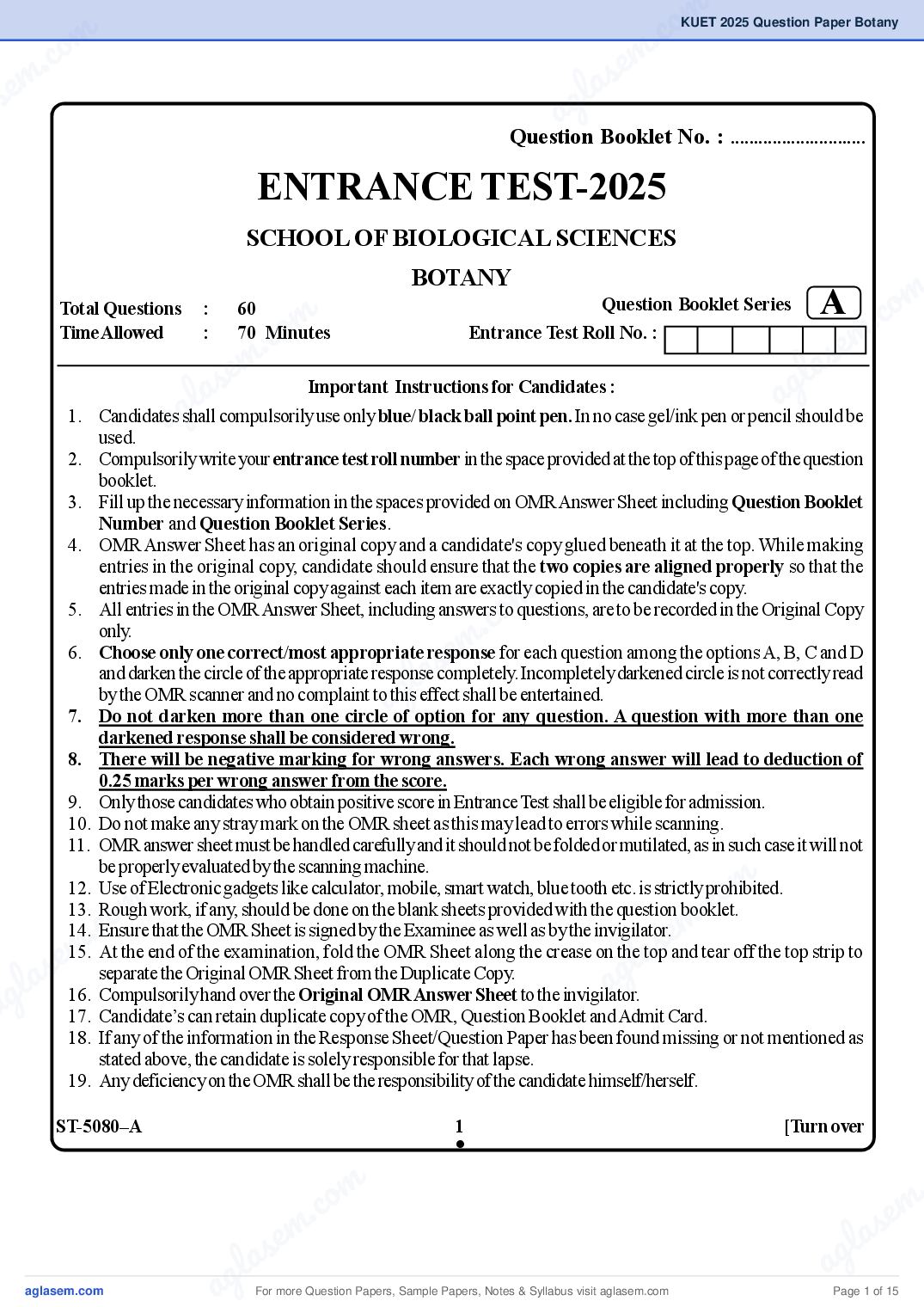
Question Booklet No. : .............................
ENTRANCE TEST-2025
SCHOOL OF BIOLOGICAL SCIENCES
A .com
BOTANY
m
co
Total Questions : 60 Question Booklet Series
. e m
as
Time Allowed : 70 Minutes Entrance Test Roll No. :
e m l
a s g
l compulsorily use only blue/ black ball point pen. In no case gel/ink pen or pencila should be
g
Important Instructions for Candidates :
used.
a
1. Candidates shall
2. Compulsorily write your entrance test roll number in the space provided at the top of this page of the question
booklet.
3. Fill up the necessary information in the spaces provided on OMR Answer Sheet including Question Booklet
Number and Question Booklet Series.
4. OMR Answer Sheet has an original copy and a candidate's copy glued beneath it at the top. While making
entries in the original copy, candidate should ensure that the two copies are aligned properly so that the
m
co
entries made in the original copy against each item are exactly copied in the candidate's copy.
.
5. All entries in the OMR Answer Sheet, including answers to questions, are to be recorded in the Original Copy
em
only.
a s
6. Choose only one correct/most appropriate response for each question among the options A, B, C and D
l
g
and darken the circle of the appropriate response completely. Incompletely darkened circle is not correctly read
a
by the OMR scanner and no complaint to this effect shall be entertained.
7. Do not darken more than one circle of option for any question. A question with more than one
darkened response shall be considered wrong.
8. There will be negative marking for wrong answers. Each wrong answer will lead to deduction of
0.25 marks per wrong answer from the score.
9. Only those candidates who obtain positive score in Entrance Test shall be eligible for admission.
10. Do not make any stray mark on the OMR sheet as this may lead to errors while scanning.
11. OMR answer sheet must be handled carefully and it should not be folded or mutilated, as in such case it will not
m
co
be properly evaluated by the scanning machine.
m .
12. Use of Electronic gadgets like calculator, mobile, smart watch, blue tooth etc. is strictly prohibited.
c. o se
m
13. Rough work, if any, should be done on the blank sheets provided with the question booklet.
em la
14. Ensure that the OMR Sheet is signed by the Examinee as well as by the invigilator.
las g
15. At the end of the examination, fold the OMR Sheet along the crease on the top and tear off the top strip to
g
separate the Original OMR Sheet from the Duplicate Copy.
a
a 16. Compulsorily hand over the Original OMR Answer Sheet to the invigilator.
17. Candidate’s can retain duplicate copy of the OMR, Question Booklet and Admit Card.
18. If any of the information in the Response Sheet/Question Paper has been found missing or not mentioned as
stated above, the candidate is solely responsible for that lapse.
19. Any deficiency on the OMR shall be the responsibility of the candidate himself/herself.
ST-5080–A 1 [Turn over
m .
.co s e m
e m l a
l a s a g
ag For more Question Papers, Sample Papers, Notes & Syllabus visit Page 1 of 15
Page 3
“Contagium vivum fludium” ? the ground, as immature :
(A) W.M .Stanly (A) Spilocaea-type conidia
(B) D.J. Ivanovsky (B) Pseudothecia
(C) M.W.Beijerinck (C) Conidia
(D) Schlesinger (D) Ascogonium
2. A rod-shaped virus having a central core of RNA
8. Paddy blast is caused by :
surrounded by protein coat (capsid) is :
(A) Pyricularia oryzae
(A) Adenovirus
(B) Heliminthosporium oryzae
(B) Tabacco mosaic virus
(C) Erysiphe graminis
(C) Herpes virus
(D) Pox virus (D) Erysiphe polygoni
3. When the DNA of dead bacteria get mixed up with 9. Gametophytic plants of Ectocarpus bears :
the DNA of living bacteria and produce a new strain, (A) Plurilocular sporangia
this method of reproduction is known as : (B) Plurilocular gametangia
(A) Transformation (C) Unilocular sporangia
(B) Transduction (D) Tetrasporangia
(C) Conjugation 10. The life cycle in Batrachospermum is :
(D) Binary fission (A) Haplobiontic
4. Nitrifying bacteria convert :
(B) Haplontic
(A) Nitrogen into nitrates
(C) Diplontic
(B) Ammonia or ammonium compounds into nitrites
(D) Diplobiontic
(C) Nitrate to nitrogen
11. In case of Oedogonium, the antheridia when
(D) Nitrogen to ammonia
produced on normal filament are known as :
5. The basidiocarps are composed of the :
(A) Nannandrous
(A) Primary mycelium
(B) Macrandrous
(B) Secondary mycelium
(C) Tertiary mycelium (C) Polyandrous
(D) Quaternary mycelium (D) Monoandrous
6. Harting net is a term associated with : 12. The thallus in Vaucheria is :
(A) Mycorrhiza (A) Filamentous
(B) Lichens (B) Heterotrichous
(C) Cyanobacteria (C) Siphonaceous
(D) Viruses (D) Dendroid
ST-5080–A 2
For more Question Papers, Sample Papers, Notes & Syllabus visit Page 2 of 15
Page 4
m .co
c. o
e m
em l a s
s a g
13. The dominant and independent phase of life cycle in 18. Which of the following is a fossil ?
Bryophytes is : (A) Equistem
(A) Zygote (B) Dryopteris
(B) Embryo (C) Rhynia
(D) Psilotum
(C) Sporophyte
m
19. The pollination in Cycas is :
c. o
(D) Gametophyte
m
(A) Hydrophilous
co m
14. Which one of the following is not correct ?
. e
(B) Anemophyllous
em
(A) In apospory, gametophyte develops directly
la s
s
(C) Malacophily
l a
from the vegetative cells of the sporophyte
a g
ag
(D) Ophiophily
(B) Apospory takes place without the occurrence 20. Chilghoza nuts are obtained from :
of meiosis or spore formation (A) Pinus gerardiana
(C) Apospory takes place with the occurrence of (B) Picea smithiana
meiosis and spore formation (C) Abies balsamea
(D) Apospory is commonly seen in Anthoceros (D) Cryptomeria japonica
15. As per the theory of regressive evolution of 21. The system of classification of plants into Herbs,
m
Shrubs, Under shrubs and Trees by Theophrastus
c. o(A) Natural system
sporophyte in Bryophytes, the most advanced type
is :
em
of sporophyte is present in :
(A) Riccia
l a s
g
(B) Artificial system
a
(B) Funaria
(C) Evolutionary system
(C) Polytrichum
(D) Modern system
(D) Pellia 22. George Bentham and J.D Hooker gave a
16. Vegetative reproduction in Funaria occurs by : comprehensive system of classification of seed plants
(A) Secondary protonema in their book :
(B) Gemmae (A) Historia Plantarum
m
(B) Species Plantarum
c o
(C) Apospory
o m (D) Systema Naturae m.
(C) Genera Plantarum
c
17. .In Equisetum, the stele is : e
(D) All the three
23. Secondary meristemaissderived from :
s em (A) Haplostele g l
gla (B) Actinostele a
(A) Primary meristem
a (B) Primary permanent tissue
(C) Amphiphloic siphonostele (C) Promeristem
(D) Ectophloic siphonostele (D) Primordial meristem
ST-5080–A 3 [Turn over
m .
.co s e m
e m l a
l a s a g
ag For more Question Papers, Sample Papers, Notes & Syllabus visit Page 3 of 15
Page 5
(A) Hofmeister(1859) fertilization, is known as :
(B) Nageli(1878) (A) Amphimixis
(C) Hanstein(1868)
(B) Apomixis
(D) Schmidt(1924)
(C) Endomixis
25. One of the following is not a complex tissue :
(A) Sclerenchyma (D) Hemimixis
(B) Xylem 31. The nutrient which is part of middle lamella(helps
(C) Wood parenchyma cement cell walls together), necessary for spindle
(D) Phloem formation in mitosis and meiosis, is :
26. Vascular bundles are conjoint, collateral, open and (A) Calcium
endarch in :
(B) Magnesium
(A) Monocot stem
(C) Potassium
(B) Dicot stem
(C) Dicot root (D) Phosphorus
(D) Dicot leaf 32. Water potential is increased by :
27. Which of the following has haploid chromosome (A) Addition of solutes
number ?
(B) Increase in temperature
(A) Nucellus
(C) Decrease in turgor pressure
(B) Microspore mother cell
(C) Endosperm (D) Decrease in temperature
(D) Functional megaspore 33. The rate of transpiration depends upon :
28. Transfer of pollen grains from anther to stigma of (A) Light
another flower of the same plant is called as : (B) Temperature
(A) Autogamy
(C) Humidity of air
(B) Geitonogamy
(D) All the three
(C) Xanogamy
(D) Polygamy 34. Pollen germination, flowering, fruiting, cell division and
29. The central cell of the embryo sac after triple fusion hormone movement in plants is affected by :
becomes the : (A) Iron
(A) Primary endosperm cell (B) Boron
(B) Zygote
(C) Zinc
(C) Embryo
(D) Copper
(D) Synergid
ST-5080–A 4
For more Question Papers, Sample Papers, Notes & Syllabus visit Page 4 of 15
Page 6
m .co
c. o
e m
em l a s
s a g
35. The water splitting complex associated with PS II, is 41. Conversion of nitrate and ammonia into atmospheric
physically located : free nitrogen is called :
(A) On inner side of the membrane of the thylakoid
(A) Nitrification
(B) In the lumen of the thylakoid
(B) Denitrification
(C) In the stroma of the thylakoid
(D) On the outer side of the membrane of the (C) Nitrogen fixation
m
c. o
thylakoid (D) Ammonification
m
co m
36. The first stable product of carbon di-oxide fixation in 42. The hormone, responsible for the closure of stomata
sugar-cane is :
m . s e
e la
and increases the tolerance of plants to various kinds
a s g
(A) 3-phosphoglyceric acid
l a
of stresses, is :
ag
(B) Oxaloacetic acid
(A) Ethylene
(C) Phosphoenol pyruvate
(D) Ribulose-1, 5 bisphosphate (B) Gibberellin
37. In glycolysis, ATP is utilized at : (C) Abscisic acid
(A) One step (D) Cytokinin
(B) Ten steps 43. In incomplete dominance, the phenotypic ratio is :
(C) Two steps
m 3:1
(A) 1 : 2 : 1
c. o(B)
(D) Three steps
em (C) 9 : 3 : 3 : 1
38. The first member of the tricarboxylic acid cycle is :
a s
(A) Citric acid
g l (D) None of the above
a
(B) Succinic acid
(C) Malic acid 44. The genes which are tightly linked show :
(D) Oxaloacetic acid (A) High recombination
39. The plant growth regulator, used to overcome apical
(B) Low recombination
dominance, is :
(A) Auxin (C) Very high recombination
(B) Gibberellin (D) Both (A) and (C)
m
co
(C) Cytokinin 45. Two or more genes localized on different
m .
c. o m
(D) Abscisic acid chromosomes showing the same phenotypic action
em (A) Long day plant se
40. A plant that requires a long period of darkness for
la
are called :
s g
flowering, is known as :
la (B) Short day plant (B) Inhibitoryagenes
(A) Duplicate genes
ag
(C) Day neutral plant (C) Supplementary genes
(D) Normal day plant (D) Complementary genes
ST-5080–A 5 [Turn over
m .
.co s e m
e m l a
l a s a g
ag For more Question Papers, Sample Papers, Notes & Syllabus visit Page 5 of 15
Page 7
because of : cell is/are :
(A) Glycocalyx (A) m RNA
(B) Plasma membrane (B) t RNA
(C) Plasmids (C) r RNA
(D) Mesosome (D) All the three
47. Transport of ions across the membrane against their
52. In lac operon, the i gene codes for :
concentration gradient is known as :
(A) Repressor of the lac operon
(A) Osmosis
(B) Beta-galactosidase
(B) Active transport
(C) Permease
(C) Passive transport
(D) Transacetylase
(D) Diffusion
53. The start/ initiator codon of the genetic code is :
48. The enzymes capable to transform fat store of the
seeds into carbohydrates, are synthesized in : (A) UAA
(A) Lysosomes (B) UAG
(B) Mitochondria (C) UGA
(C) Glyoxysomes (D) AUG
(D) Golgi bodies 54. Dissimilarity between taxa is often represented/ defined
49. The four chromatids of each bivalent chromosomes as :
becomes distinct and appears as tetrads, during : (A) 1-similarity
(A) Zygotene (B) 0-1
(B) Pachytene (C) 0
(C) Diplotene (D) 1
(D) Diakinesis 55. In APG-IV system of classification, the number of
50. The number of the base pairs per turn of the helix in angiosperm orders is :
Z-DNA, are :
(A) 416
(A) 12
(B) 64
(B) 11
(C) 59
(C) 10
(D) 54
(D) 8
ST-5080–A 6
For more Question Papers, Sample Papers, Notes & Syllabus visit Page 6 of 15
Page 8
m .co
c. o
e m
em l a s
s 56. The material on which the description of a new species 59. a g
Failure of cytokinesis after telophase stage of cell
or subspecies is based, is referred as :
(A) Type culture division results in an increase in whole set of
(B) Type species chromosomes, is known as :
(C) Type material
(A) Aneuploidy
(D) Type genus
m
57. On the basis of embryological characters, the genus (B) Hyperploidy
m
which has been separated from the family Onagraceae
c. o
co
(C) Polyploidy
.
by Hutchinson (1955), is :
e m
(A) Trapa
em
(D) Haploidy
la s
(B) Epilobium
l a s a g
ag
60. Body-punched cards are used in :
(C) Ludwigia
(D) Fuchsia (A) Indented key
58. Royal Botanical garden is located in : (B) Bracketed key
(A) USA
(C) Numbered key
(B) United Kingdom
(C) Italy (D) Multi-access key
(D) India
m
. co
s em
g l a
a
m
m .co
c. o se
m
s em g la
gla a
a
ST-5080–A 7
m .
.co s e m
e m l a
l a s a g
ag For more Question Papers, Sample Papers, Notes & Syllabus visit Page 7 of 15
Page 9
ST-5080–A 8 165
For more Question Papers, Sample Papers, Notes & Syllabus visit Page 8 of 15
Page 10
c. o se
m
em la
as a g
m
co
m m .co
m . s e
se l a
l a ag
ag
m
. co
s em
g l a
a
m
m c. o
c. o s e m
s em la
gla ag
a
m . c
.co s e m
e m l a
as
For more Question Papers, Sample Papers, Notes & Syllabus visit
a g Page 9 of 15
Page 11
Page 12
c. o s e m
em
l a
as a g
m
co
m m.co
m . s e
se l a
l a ag
ag
m
. co
s em
g l a
a
m
m c. o
c. o s e m
s em l a
gla ag
a
m . c
c. o s e m
sem g l a
a
For more Question Papers, Sample Papers, Notes & Syllabus visit
aPage 11 of 15
Page 13
Page 14
c. o se
m
em la
as a g
m
co
m m.co
m . s e
se l a
l a ag
ag
m
. co
s em
g l a
a
m
m c. o
c. o s e m
s em la
gla ag
a
m . c
.co s e m
e m l a
as
For more Question Papers, Sample Papers, Notes & Syllabus visit
a g
Page 13 of 15
Page 15
Page 16
c. o se
m
em la
as a g
m
co
m m .co
m . s e
a s e g la
l a
ag
m
. co
s em
g l a
a
m
m c. o
c. o s e m
s em l a
gla ag
a
m . c
c. o s e m
sem g l a
a
For more Question Papers, Sample Papers, Notes & Syllabus visit
a Page 15 of 15
Document Details
| Board / Org | University of Kashmir |
| Exam | KUET |
| Type | Question Paper |
| Pages | 15 |
| Updated | 29 Oct 2026 |