KUET 2025 Question Paper Chemistry
Finished viewing? Save it for later —
Download KUET 2025 Question Paper Chemistry (PDF · 20 pages)About KUET 2025 Question Paper Chemistry
KUET 2025 Question Paper Chemistry is available here for free download. Published by University of Kashmir for KUET, this question paper can be viewed online or downloaded as a PDF (20 pages). Candidates preparing for KUET can use KUET 2025 Question Paper Chemistry to understand the exam pattern, the type of questions asked, and the overall difficulty level.
Frequently Asked Questions
How can I download KUET 2025 Question Paper Chemistry?
Open this page and click the Download button to save KUET 2025 Question Paper Chemistry as a PDF. It is completely free on AglaSem Docs.
Is KUET 2025 Question Paper Chemistry free to download?
Yes. KUET 2025 Question Paper Chemistry can be viewed online and downloaded as a PDF free of cost on AglaSem Docs.
How many pages does KUET 2025 Question Paper Chemistry have?
KUET 2025 Question Paper Chemistry contains 20 pages, which you can read online or download together as a single PDF.
Where can I find more KUET study material?
You can find more KUET question papers, sample papers, syllabus, and answer keys on AglaSem Docs.
KUET 2025 Question Paper Chemistry – Text
Read the full text of this question paper below — useful to quickly search, copy and reference the content online without downloading the PDF.
📄 View text version (21 pages)
Page 1
KUET 2025 Question
Paper Chemistry
EXAM YEAR TYPE
KUET 2025 Question Paper
Notes · Sample Papers · Previous Year Papers · Mock Tests
Page 2
m .co
c. o
e m
em l a s
s a g
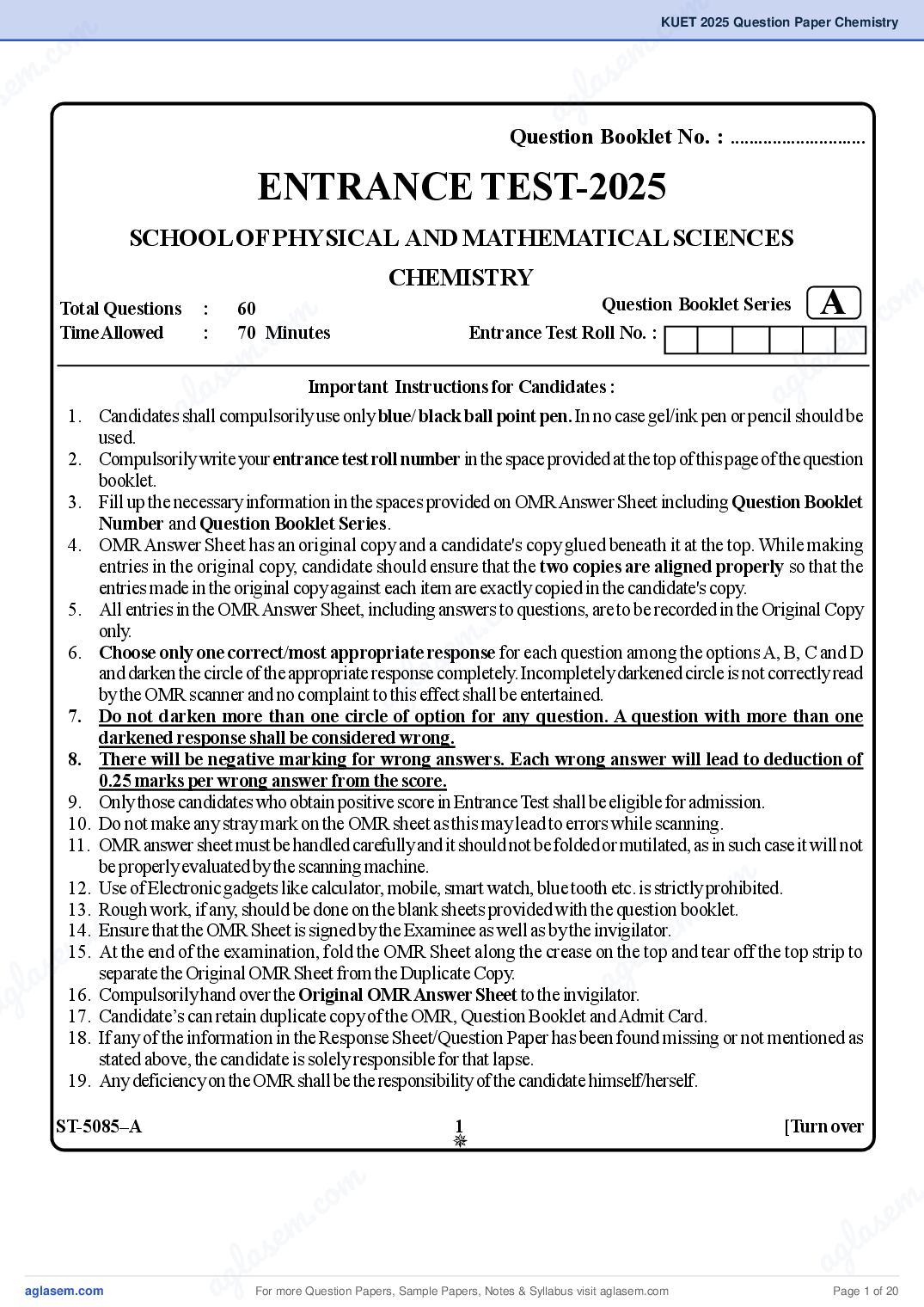
Question Booklet No. : .............................
ENTRANCE TEST-2025
SCHOOL OF PHYSICAL AND MATHEMATICAL SCIENCES
A .com
CHEMISTRY
m
co
Total Questions : 60 Question Booklet Series
. e m
as
Time Allowed : 70 Minutes Entrance Test Roll No. :
e m l
a s g
l compulsorily use only blue/ black ball point pen. In no case gel/ink pen or pencila should be
g
Important Instructions for Candidates :
used.
a
1. Candidates shall
2. Compulsorily write your entrance test roll number in the space provided at the top of this page of the question
booklet.
3. Fill up the necessary information in the spaces provided on OMR Answer Sheet including Question Booklet
Number and Question Booklet Series.
4. OMR Answer Sheet has an original copy and a candidate's copy glued beneath it at the top. While making
entries in the original copy, candidate should ensure that the two copies are aligned properly so that the
m
co
entries made in the original copy against each item are exactly copied in the candidate's copy.
.
5. All entries in the OMR Answer Sheet, including answers to questions, are to be recorded in the Original Copy
em
only.
a s
6. Choose only one correct/most appropriate response for each question among the options A, B, C and D
l
g
and darken the circle of the appropriate response completely. Incompletely darkened circle is not correctly read
a
by the OMR scanner and no complaint to this effect shall be entertained.
7. Do not darken more than one circle of option for any question. A question with more than one
darkened response shall be considered wrong.
8. There will be negative marking for wrong answers. Each wrong answer will lead to deduction of
0.25 marks per wrong answer from the score.
9. Only those candidates who obtain positive score in Entrance Test shall be eligible for admission.
10. Do not make any stray mark on the OMR sheet as this may lead to errors while scanning.
11. OMR answer sheet must be handled carefully and it should not be folded or mutilated, as in such case it will not
m
co
be properly evaluated by the scanning machine.
m .
12. Use of Electronic gadgets like calculator, mobile, smart watch, blue tooth etc. is strictly prohibited.
c. o se
m
13. Rough work, if any, should be done on the blank sheets provided with the question booklet.
em la
14. Ensure that the OMR Sheet is signed by the Examinee as well as by the invigilator.
las g
15. At the end of the examination, fold the OMR Sheet along the crease on the top and tear off the top strip to
g
separate the Original OMR Sheet from the Duplicate Copy.
a
a 16. Compulsorily hand over the Original OMR Answer Sheet to the invigilator.
17. Candidate’s can retain duplicate copy of the OMR, Question Booklet and Admit Card.
18. If any of the information in the Response Sheet/Question Paper has been found missing or not mentioned as
stated above, the candidate is solely responsible for that lapse.
19. Any deficiency on the OMR shall be the responsibility of the candidate himself/herself.
ST-5085–A 1 [Turn over
m .
.co s e m
e m l a
l a s a g
ag For more Question Papers, Sample Papers, Notes & Syllabus visit Page 1 of 20
Page 3
the intermediate is a trigonal planar AB3E unit, which NH3 and BF3?
of the following shall undergo fastest reaction as per (A) Both have a C3 axis
VSEPR theory? (B) Both have v planes
(A) NH3 (C) BF3 has a C2 axis
(B) PH3 (D) NH3 has a h plane
(C) PF3 6. The topology of the Borane’s A and B produced in
(D) NF 3 the sequence will be:
B6 H6
2
2. Predict energy of 4s electron in element with atomic 4H 2 BH
A B
2e, BH 2H
number 19, given the shielding constant calculated
(A) closo, nido
using Slater rules to be 16.8.
(B) closo, arachno
(A) 4.1 KJ
(C) arachno, nido
(B) –4.1 KJ
(D) nido, arachano
(C) –4.1 eV
7. What is incorrect for the cyclic silicate anion
(D) 4.1K cal
[Si3O9]n– ?
3. Which of the following F NMR describes the
19
(A) It has a six membered ring with three
VSEPR predicted structure for ClF3 molecule?
Si—O—Si linkages
(A) A singlet for three Fluorine
(B) It has an overall charge of –9
(B) Two signals of unequal intensity
(C) Each Si center has a tetrahedral environment
(C) A down field doublet and up field triplet
(D) It has all oxygen in formal -2 oxidation state
(D) Two equivalent environments in 2:1 intensity with overall charge of –6
ratio
8. The interhalogen IF3 (1.84 g) reacts with the 0.93 g
4. For X2 molecules X = B, C, N, O and F, which of tetramethylammonium fluoride forming the
experimental evidence predicts σ-π energy crossover product X, what is incorrect about this reaction ?
of molecular orbital’s? (A) It forms the quaternary ammonium salt
(A) F2 is diamagnetic (B) It forms the cationic interhalogen compound
(B) N2 is diamagnetic (C) The changes involve from T shape to square
(C) O2 is paramagnetic planar
(D) B2 is paramagnetic (D) The changes involves from planar shape to
tetrahedral
ST-5085–A 2
For more Question Papers, Sample Papers, Notes & Syllabus visit Page 2 of 20
Page 4
m .co
c. o
e m
em l a s
s a g
9. Identify the complex with larger CFSE among the 11. The linkage isomers possible for the complex
following pairs : Trans-bis(ethylenediamine)dithiocyanatocopper
2 (II) will be:
(I) (i) Cr OH 2 6 or
(A) None
2
(ii) Mn OH 2 6 (B) one
m
(C) two
o
2
Mn OH 2 6
c
(II) (iii) or
m .
co
(D) three
. e m
s
3
Fe OH 2 6
m
(iv) 12. Which of these transition metal compounds can be
s e g l a
a
studied with ESR spectroscopy?
l a
3
(III) (v) Fe OH 2 6 or
g
(vi) a Fe CN
3
(A) VOSO
(B) K2Cr2O7
4
6
(C) KMnO4
(IV) (vii) tetrahedral FeCl4
2
or
2
(D) Ferrocene
(viii) Co Cl 4
13. The number of radial nodes possessed by a 4f atomic
(A) i, iii, v, vii orbital is :
m3
(B) ii, iii, v, vii (A) 4
(C) i, iv, vi, viii
c. o(B)
(D) ii, iii, vi, vii
s em (C) 2
10. An uncharged tetradentate macrocyclic ligand
g l a (D) 0
develops a square planar red complex with a d8 metal 14.a What is incorrect for the inner transition metal complex
ion which is of diamagnetic nature when treated with [Ce(NO3)6]2– ?
perchlorate ions no change is observed in magnetism (A) It involves stabilization of unusual Ce4+ oxidation
however on adding coordinating SCN– ions its color state
changes to violet and it becomes two electron
(B) NO 3 ion acts as a bidentate ligand in it
paramagnetic this can be due to:
m
(C) It has icosahedron geometry with coordination
o
(A) Substitution of macrocyclic ligand by added
m c
c. o Change from square planar to tetrahedral (D) All of the abovesem.
number 12
SCN– ions
m geometry a
(B)
e
s (C) Change from low spin to high spin complex g l
15. [Xe] 4f configuration of Eu corresponds to: 6 3+
l a a
ag
(A) F 3
0
(D) Change from coordination number 4 to (B) F 7
0
coordination number 6 with octahedral (C) 3
F6
geometry (D) 4
F0
ST-5085–A 3 [Turn over
m .
.co s e m
e m l a
l a s ag
ag For more Question Papers, Sample Papers, Notes & Syllabus visit Page 3 of 20
Page 5
cytochromes P-450? enzyme is ……. reduction.
(A) Cytochromes P-450 act as dioxygenases (A) 2 electron
(B) Cytochromes P-450 act as monooxygenases (B) 4 electron
and catalyse the insertion of O into a C–H bond (C) 6 electron
(C) Cytochromes P-450 couple to cytochrome c (D) 8 electron
in the mitochondrial electron-transfer chain 21. The least stable canonical structure among the
(D) Cytochromes P-450 contain high-spin Fe(III); following is:
this directly binds O2 and acts as an O2 carrier
O O O
17. Match these items for their biological role:
A. As ferritin I. Iron Storage
N N N
B. As haemoglobin II. Dioxygen transport
H H H
C. As a siderophore III. Iron transport
D. As transferrin IV. Mobilization and (I) (II) (III)
sequester (A) I
(A) A-III, B-II, C-I, D-IV (B) II
(B) A-I, B-II, C-III, D-IV (C) III
(C) A-I, B-II, C-IV D-III (D) All are equally stable
(D) A-III, B-II, C-I, D-IV 22. Which among the following is the most stable
18. The presence of solvent in a crystalline sample of a carbocation?
compound could be detected and quantified using:
(A) UV-VIS (A)
(B) TGA
(C) ESI-MS
(B)
(D) AAS
19. In a transition metal alkyl compound, which
-bonded R group could undergo -hydrogen (C)
elimination reaction?
(A) Ethyl
(B) Methyl
(D)
(C) Benzyl
(D) Neopentyl
ST-5085–A 4
For more Question Papers, Sample Papers, Notes & Syllabus visit Page 4 of 20
Page 6
m .co
c. o
e m
em l a s
s a g
23. Which among the following statements is incorrect? 26. Identify the major product formed in the below given
reaction :
(A) CF2 is more stable than CCl2
CH3
(B) CCl2 is more stable than CBr2
Anhy. AlCl3
+ Cl
(C) Singlet CH2 is more stable than triplet CH2
m
(D) Singlet CH2 has planar geometry
m c. o
co
CH3
. e m
m
24. Among the below given vicinal diols only three are
e la s
l a s
cleaved by HIO4. The diol which is NOT cleaved by (A)
a g
HIO4 is : ag
OH CH3
(A) (B)
t-Bu OH
OH CH3
m
co
(B)
.
t-Bu OH (C)
s em
OH
g l a CH3
(C)
t-Bu OH a
(D)
OH
(D)
t-Bu OH 27. Which one of the following is not a metal catalyst for
25. Which of the following alkenes gives only acetic acid the hydrogenation of an alkene?
m
co
on oxidation with hot concentrated KMnO4?
m .
(A) Pd
c. o (A) Ethylene
se
m
em (B) 1-Butene
(B) Pt
s g la
la (C) Propene a
(C) Na
ag (D) Ni
(D) 2-Butene
ST-5085–A 5 [Turn over
m .
.co s e m
e m l a
l a s a g
ag For more Question Papers, Sample Papers, Notes & Syllabus visit Page 5 of 20
Page 7
show in 1H NMR Spectroscopy?
reaction :
Cl
H3C CH3 Peroxide
+ HBr
H H Light
(A) 3
(B) 4
(A)
(C) 5 Br
(D) 6
29. Predict the order of the C=O stretch in IR
(B) Br
spectroscopy for the following compounds :
O O O
Br
(C)
Br
(i) (ii) (iii) (D) None of these
(A) i > ii > iii 33. Which of the following reactions can be used to
(B) ii > iii > i prepare alkanes?
(C) ii > i > iii (A) Wurtz reaction
(D) i = ii = iii
(B) Wolf-Kishner reduction
30. Which among the following is an atom un-economic
process? (C) Kolbe’s electrolysis
(A) Substitution reactions (D) All of these
(B) Addition reactions 34. The hydroboration-oxidation reaction can be
(C) Rearrangement reactions characterized as the _________ to an alkene.
(D) Diels-Alder reaction
(A) anti-Markovnikov syn addition of water
31. Which among the following molecules will not
produce heat upon microwave irradiation? (B) anti-Markovnikov anti addition of water
(A) Ethanol (C) Markovnikov syn addition of water
(B) Hexane (D) Markovnikov anti addition of water
(C) Benzaldehyde
(D) Water
ST-5085–A 6
For more Question Papers, Sample Papers, Notes & Syllabus visit Page 6 of 20
Page 8
m .co
c. o
e m
em l a s
s a g
35. Predict the number of stereoisomers possible for the 38. Identify the product formed in the below given
below given cholesterol molecule : reaction :
(i) Na, NH3
C 3H 7 (CH2)7OH
(ii) NH4Cl
C 3H7 (CH2)7OH
m
(A)
c. o
H H H
m
.co e m
H H C 3H 7 H
e m
(B)
la s
s
HO
g
H (CH2)7OH
l a a
Cholesterol
ag
(A) 158
O
(B) 8
C 3H 7 (CH2)6CH
(C) 256 (C)
(D) 81 H H
36. Which of the following factors has no effect on the
H H
rate of SN1 reactions? C3 H 7
(D) H
(A) The nature of the alkyl halide H (CH2)7OH
(B) The nature of the leaving group
m
c. o
(C) The concentration of the alkyl halide 39. Identify the major product formed in the below given
em Cl
(D) The concentration of the nucleophile reaction :
37. Identify the major product formed in the below given
l a s
a g
reaction : KOCEt3
OMe
Cl NaNH2
NH3(liq.)
(A)
OMe
NH2
(A)
(B)
m
co
OMe
m .
Cl
c. o OMeNH m
(B)
em la se
2
(C)
s
la (C) a g
ag NH 2
NH2 (D)
Cl
(D)
ST-5085–A 7 [Turn over
m .
.co s e m
e m l a
l a s a g
ag For more Question Papers, Sample Papers, Notes & Syllabus visit Page 7 of 20
Page 9
(A) The most probable kinetic energy of the for :
constituents of an ideal gas is more than their (A) Hexagonal Crystal Systems
average kinetic energy (B) Tetragonal Crystal Systems
(B) The most probable kinetic energy of the (C) Orthorhombic Crystal Systems
constituents of an ideal gas is less than their (D) Cubic Crystal Systems
average kinetic energy 44. In the kinetic investigations over a chemical reaction
(C) The most probable kinetic energy of the with balanced stoichiometry of 2A B yields
2C ,
constituents of an ideal gas is equal to their the rate of reaction doubles when the concentration
average kinetic energy of A is doubled but increases by a factor of 8 if both
(D) Depending upon the temperature, the most the concentrations are doubled. This implies that the
probable kinetic energy of the constituents of reaction follows a rate law of :
an ideal gas can be higher or lower than their (A) Rate k A B , with an overall order of 2
average kinetic energy
Rate k A B , with an overall order of 3
2
(B)
41. According to van der Waals equation of state, the (C) Rate k A B , with an overall order of 3
2
actual volume (Vactual) and the excluded volume
(D) Rate k A B , with an overall order of 4
2 2
(Vexcluded) per molecule of gas with radius “r” is
45. The half-life of a reaction was observed to reduce to
given as :
one half when the initial concentration of the reactant
4 3 4 3 was doubled, then the order of the reaction is :
(A) Vactual r , Vexcluded r
3 3
(A) Zero
4 3 8 3 (B) One
(B) Vactual r , Vexcluded r
3 3 (C) Two
4 3 16 (D) Cannot be predicted
(C) Vactual r , Vexcluded r 3
3 3 46. In the catalysis of a reversible reaction, the use of
4 3 32 catalyst results in :
(D) Vactual r , Vexcluded r 3
3 3 (A) Increase in the rate constant of forward reaction
42. For a crystal with a six-fold axes of symmetry, a only
rotation by how much angle along this axes will lead (B) Increase in the rate constant of forward as well
to similar appearance ? as backward reaction
(A) 60o (C) Increase in the rate constant of forward reaction
with a shift in equilibrium to favor products
(B) 120o
(D) Increase in the rate constant of forward reaction
(C) 180o
and a decrease in the rate constant ofbackward
(D) All the three reaction
ST-5085–A 8
For more Question Papers, Sample Papers, Notes & Syllabus visit Page 8 of 20
Page 10
m .co
c. o
e m
em l a s
s 47. Photochemical internal conversion involves the 52. a g
The slope of the Clausius-Clapeyron plot
transition of electrons from : (ln P vs. 1/T) gives :
(A) Lower singlet states to higher singlet states (A) The enthalpy of vaporization
(B) Higher singlet state to lower singlet state
(B) The enthalpy of vaporization divided by R
(C) Singlet states to triplet states
(C) The negative of enthalpy of vaporization
(D) Triplet states to singlet states
(D) The negative of enthalpy of vaporization divided
m
48. In phosphorescence there is a change in electronic
c. o
by R
m
spin state from :
.co m
53. Which of the following hydrates is stable at room
e
(A) S1 to S0
(B) T1 to T0
em
temperature in FeCl3– H2O system?
la s
(C) T1 to S0
l a s (A) FeCl3.2H2O
a g
ag
(D) S0 to T1 (B) FeCl3.3H2O
49. Which of the following is not correct for heat capacity (C) FeCl3.5H2O
of ideal gases ?
(D) FeCl3.6H2O
(A) For monoatomic gases C p C v R
54. A solute with its dimer form as the only stable form in
(B) Heat capacity of diatomic gases is higher than benzene in contrast to its monomeric form in water
that of monoatomic gases
distributes between water and benzene.
(C) Heat capacity does not depend upon the The concentration of solute in water was observed to
m
molecular structure of gas
co
be 0.20 mol/L, while in benzene it was 0.10 mol/L.
.
(D) For a diatomic gas Cp C v 2R
em
The distribution coefficient KD(Benzene/water) of
s
50. In the isothermal expansion of an ideal gas : solute will be :
(A) H U 0
g l a (A) 0.20
(B) U 0, H PV a (B) 0.50
(C) U H PV (C) 1.00
(D) U H nRT (D) 1.58
51. Which among the following statements best describes 55. Which among the following statements correctly
the behaviour of an ideal vs. non-ideal gas during explains the reason for the increase in molar
adiabatic expansion ? conductance of a string electrolyte with dilution ?
o m
(A) Both ideal and non-ideal gases cool at the same (A) Increase in the number of ions with increase of
m c
.of dissociation of the
c. o
rate during adiabatic expansion dilution
m
e of dilution
em (C) A non-ideal gas may cool less than an ideal gas s
(B) An ideal gas cools more than a non-ideal gas (B) Increase in the degree
s
during adiabatic expansion
(C) Increase ing
l a
electrolyte with increase
gla a the mobility of ions with increase of
a during adiabatic expansion
(D) While ideal gas cools, the non-ideal gas always
dilution
(D) Decrease in the viscosity of solution with
heats up during adiabatic expansion increase of dilution
ST-5085–A 9 [Turn over
m .
.co s e m
e m l a
l a s a g
ag For more Question Papers, Sample Papers, Notes & Syllabus visit Page 9 of 20
Page 11
the conductance of electrolyte solutions ? voltage “V Volts” when it delivers a current
(A) At infinite dilution the transport number as well of I amperes for a total of “t” seconds will be :
as the ionic mobility of an ion is independent of (A) E I t V
its counter ions I t
(B) E
(B) At infinite dilution the transport number as well V
as the ionic mobility of an ion is dependent on iV
(C) E
the nature of its counter ions t
(C) At infinite dilution the transport number of an V t
(D) E
i
ion is independent of the nature of its counter
59. The correct statement about saturated calomel
ions but it’s ionic mobility is dependent on the
electrode is :
nature of its counter ions
(A) It is the most commonly used primary reference
(D) At infinite dilution the ionic mobility of an ion is
electrode
independent of the nature of its counter ions but
it’s transport number is dependent on the nature (B) Its potential does not depend upon the
of its counter ions temperature
57. For a sparingly soluble salt like BaSO4, the solubility (C) It is regarded as an electrode of first kind
(S) is related to its specific conductance (k) and molar (D) None of the above
conductance at infinite dilution 0m as : 60. Theoretically, for a Galvanic cell with a positive
temperature coefficient :
2
k
(A) S 0 (A) The electrical energy will be always equal to
m
the enthalpy of the cell reaction
1
k (B) The electrical energy will be less than the
(B) S 0
m enthalpy of the cell reaction
1/2 (C) The electrical energy will be more than the
k
(C) S 0 enthalpy of the cell reaction
m
(D) The emf of the cell decreases with an increase
k
2
of temperature
(D) S
0m
ST-5085–A 10
For more Question Papers, Sample Papers, Notes & Syllabus visit Page 10 of 20
Page 12
m .co
c. o
e m
em l a s
s ROUGH WORK a g
m
m c. o
.co s e m
em la
l a s a g
ag
m
. co
s em
g l a
a
m
m .co
c. o se
m
s em g la
gla a
a
ST-5085–A 11 93
m .
.co s e m
e m l a
l a s a g
ag For more Question Papers, Sample Papers, Notes & Syllabus visit Page 11 of 20
Page 13
Page 14
. e
em las
as ag
m
co
m m .co
m . s e
s e la
la ag
ag
m
. co
s em
g l a
a
m
m c. o
c. o s e m
s em l a
gla ag
a
m .
.co s e m
m a
se
For more Question Papers, Sample Papers, Notes & Syllabus visit
g l
Page 13 of 20
Page 15
Page 16
. e
em las
as ag
m
co
m m.co
m . s e
s e la
la ag
ag
m
. co
s em
g l a
a
m
m c. o
c. o s e m
s em l a
gla ag
a
m .
.co s e m
m a
se
For more Question Papers, Sample Papers, Notes & Syllabus visit
g l
Page 15 of 20
Page 17
Page 18
. e
em las
as ag
m
co
m m.co
m . s e
se l a
l a ag
ag
m
. co
s em
g l a
a
m
m c. o
c. o s e m
s em l a
gla ag
a
m .
.co s e m
m a
se
For more Question Papers, Sample Papers, Notes & Syllabus visit
g l
Page 17 of 20
Page 19
Page 20
. e
em las
s ag
m
co
m m.co
m . s e
se l a
l a ag
ag
m
. co
s em
g l a
a
m
m c. o
c. o s e m
s em l a
gla ag
a
m .
.co s e m
m a
se
For more Question Papers, Sample Papers, Notes & Syllabus visit
g l
Page 19 of 20
Page 21
Document Details
| Board / Org | University of Kashmir |
| Exam | KUET |
| Type | Question Paper |
| Pages | 20 |
| Updated | 29 Oct 2026 |