Rajasthan Board 12th English Literature Sample Paper 2021
Finished viewing? Save it for later —
Download Rajasthan Board 12th English Literature Sample Paper 2021 (PDF · 6 pages)About Rajasthan Board 12th English Literature Sample Paper 2021
Rajasthan Board 12th English Literature Sample Paper 2021 is available here for free download. Published by Rajasthan Board for Class 12, this sample paper can be viewed online or downloaded as a PDF (6 pages). Candidates preparing for Class 12 can use Rajasthan Board 12th English Literature Sample Paper 2021 to understand the exam pattern, the type of questions asked, and the overall difficulty level.
Frequently Asked Questions
How can I download Rajasthan Board 12th English Literature Sample Paper 2021?
Open this page and click the Download button to save Rajasthan Board 12th English Literature Sample Paper 2021 as a PDF. It is completely free on AglaSem Docs.
Is Rajasthan Board 12th English Literature Sample Paper 2021 free to download?
Yes. Rajasthan Board 12th English Literature Sample Paper 2021 can be viewed online and downloaded as a PDF free of cost on AglaSem Docs.
How many pages does Rajasthan Board 12th English Literature Sample Paper 2021 have?
Rajasthan Board 12th English Literature Sample Paper 2021 contains 6 pages, which you can read online or download together as a single PDF.
Where can I find more Class 12 study material?
You can find more Class 12 question papers, sample papers, syllabus, and answer keys on AglaSem Docs.
Rajasthan Board 12th English Literature Sample Paper 2021 – Text
Read the full text of this sample paper below — useful to quickly search, copy and reference the content online without downloading the PDF.
📄 View text version (6 pages)
Page 1
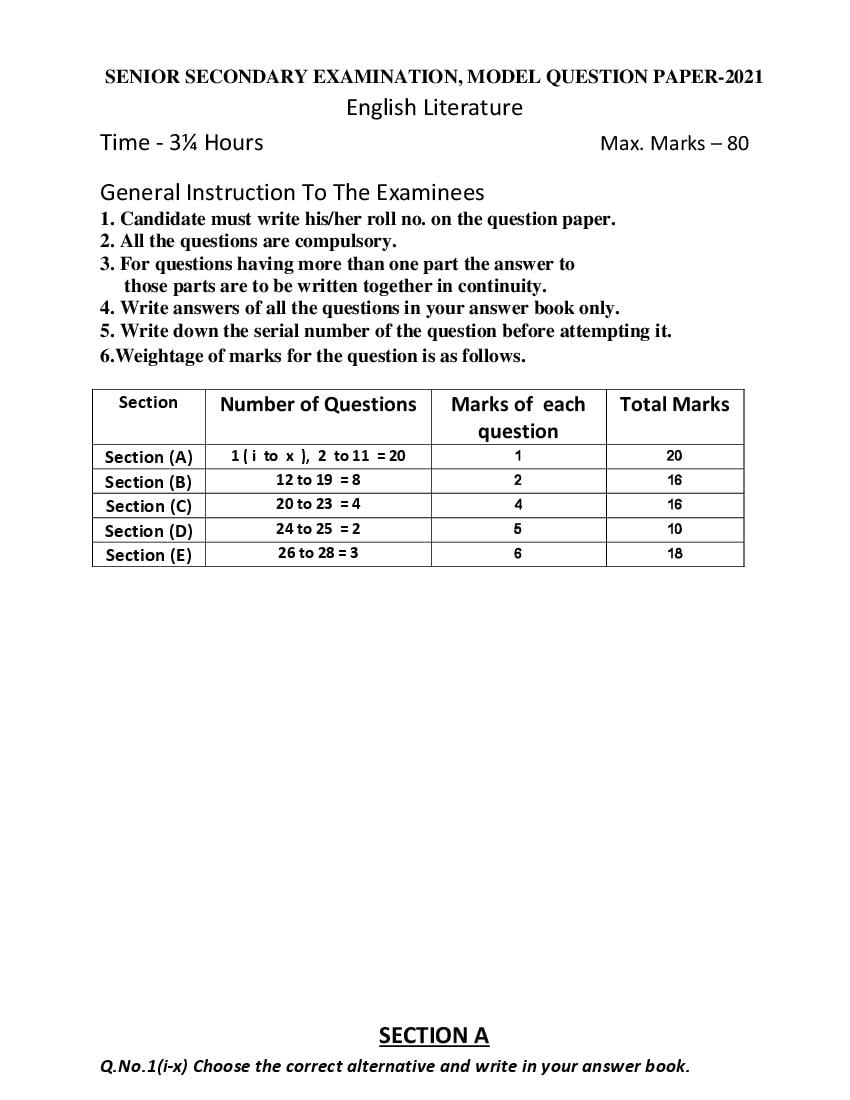
English Literature
Time - 3¼ Hours Max. Marks – 80
General Instruction To The Examinees
1. Candidate must write his/her roll no. on the question paper.
2. All the questions are compulsory.
3. For questions having more than one part the answer to
those parts are to be written together in continuity.
4. Write answers of all the questions in your answer book only.
5. Write down the serial number of the question before attempting it.
6.Weightage of marks for the question is as follows.
Section Number of Questions Marks of each Total Marks
question
Section (A) 1 ( i to x ), 2 to 11 = 20 1 20
Section (B) 12 to 19 = 8 2 16
Section (C) 20 to 23 = 4 4 16
Section (D) 24 to 25 = 2 5 10
Section (E) 26 to 28 = 3 6 18
SECTION A
Q.No.1(i-x) Choose the correct alternative and write in your answer book.
Page 2
(a) Calculate (b) California (c) Bensbrook (d) Colebrook
(ii) Who of the following went to Melbourne. (Eveline) [1]
(a) Frank (b) Ernest (c) The Priest (d) Eveline
(iii) The cost of that little enamel box was (A cup of tea) [1]
(a) Eight guineas (b) Twenty eight guineas (c) Twenty guineas
(d) None of the above
(iv) On hearing about the attack of the government, the work men –
(The cow of Barricades) [1]
(a) Erected a barricade (b) Secured houses and hoarded valuables
(b) Collected arms (d) All of the above
(v) “Stand still and I will read to thee………. “ Whom does “I” refer to?
(A Lecture upon the shadow) [1]
(a) The poet himself (b) Lover/beloved (c) God (d) None of these
(vi) What guided human souls towards divinity? (On Time) [1]
(a) Bad habits (b) Peace, Love and humanity
(b) (c) evils of heart (d) Selfishness
(vii) Precise means – (Time and time again) [1]
(a) different ways (b) inaccurate (c) clumsy (d) exact
(viii) “Faith makes one ……..” (Does culture matter) [1]
(a) Kind (b) Neutral (c) Indifferent (d) Unkind
(ix) What does the metaphor ‘the bottle of wine ‘represent? [1]
(Why the Novel matters)
(a) Body (b)Spirit (c) Soul (d) Body and Soul
(x) In which language does Manjula write? (Broken Images) [1]
(a) Kannada (b)Hindi (c) Tamil (d) Malyalam
Q. No. 2 – 6 : Transform the following sentences into indirect speech:
2. The Teacher said, “Work hard Raman.” [1]
3. Punit said to me, “Do you play Cricket?” [1]
4. The Hermit said, “Man is moral.” [1]
5. Reena said to Aloka, “I went to the market yesterday.” [1]
Page 3
Q. No. 7 - 11 : The following sentences have not been edited. There in an error
in each sentence. Identify the error and write it correctly in your
answer book :
Example :
Incorrect Correct
A apple a day keeps the doctor away. eg. ___A____ ___An___
7. He is far to young to drive a car. ________ ________ [1]
8. I went for a walk every day. ________ ________ [1]
9. Poonam is more beautiful then Pooja. ________ ________ [1]
10. The man which is honest always succeeds. ________ ________ [1]
11. Slow and Steady win the race. ________ ________ [1]
SECTION B- READING
Q 12-16 Read the following passage and answer the questions that follow:
Optimism is not a deep, complicated philosophy or a school of
thought. It is more a matter of our general attitude of life, of always taking a
positive and bright view of life. In some persons it is a born trait. They are born
that way by nature and temperament. But in most cases it is an acquired or a
carefully cultivated habit. So we find that some people always look at the bright
side of things while there are some others who always see the bad, dark side of
things. To an optimist, every cloud has a silver lining, A pessimist, on the other
hand, misses the silver lining and sees only the cloud. Fredrick Langbridge sums it
up “Two men look out through the same bars: one sees the mud, and one the
stars."
One Sunday morning, when William Dean Howells and Mark Twain
came out of the church, it started raining heavily, “Do You think it will stop? asked
Howells. “It always has," replied Twain. An optimist hopes for the best. Optimism
nurtures most,: hope and cheerfulness . Alexander regarded hope as the greatest
possession of mankind. He held that if you destroy 'hope', you destroy "future'.
Hope strengthens our will to survive calamities, so that we never give way to
despair. It helps us count our blessings , and hope persistently goads us 'to go on'.
It is rightly said that an optimist sees on opportunity in every calamity, a pessimist
sees a calamity in every opportunity.
A person who is optimistic , cheerful and full of hope gains easy
acceptance everywhere in society and succeeds in maintaining meaningful and
lasting relation with others. Most people feel dejected , even down and out, when
they do not succeed in achieving their aim. They allow themselves to reach a state
of hopelessness. Some even suffer sudden loss of energy and the will to persist.
Page 4
esteem can be so powerful in the case of some , they might even take the
extreme step of ending their lives.
An optimist reacts to situations differently. He thinks and acts in a
positive manner. Optimism aids his patience, increases his energy and steels his
will to see his objective. Optimism is, in fact, an unending source of positive
energy. There is nothing negative about it. Unlike the pessimist who gives up
when he finds one door locked, the optimist believes in looking for other doors
which are wide open. Instead of giving way to despair, he tries to find alternatives
– Asar Ducknacr, a well- known poet wrote – when I do not succeed in achieving
my aim, I think of attaining it through a different approach and so I try again.
A pessimist is a perpetual loser, an optimist is a winner despite an
occasional failure. Unlike the pessimist, an optimist does not allow himself or
herself to sink into a state of morbidity or depression because of a positive frame
of mind, an optimist is never without solace and never suffers from poverty of
spirit.
Q12. What do you understand by ‘Optimism’? [2]
Q13. Which two things does optimism nurture ? [2]
Q14. Why is a pessimist a perpetual loser? Give two reasons. [2]
Q15. How does an optimist react to failure ? [2]
Q16. Find words from the passage which mean the same as: [2]
(i)disaster (ii) peace
Q17-19. Read the following poem and answer the questions that follow :
Break, break, break
On thy cold grey stones, O Sea !
And I would that my tongue could
utter the thoughts that arise in me.
O for the fisherman's boy,
That he shouts with his sister at play!
O well for the sailor lad,
That he sings in his boat on the bay !
And the stately ships go on
To their haven under the hill;
But O for the touch of a vanish' d hand,
And the sound of a voice that is still !
Break, break, break
At the foot of thy crags, O sea !
But the tender grace of a day
That is dead will never come back to me.
Q17. 'And I would.........in me’, What wish does the poet express? [2]
Q18. Which activities in the second stanza are in contrast with the poet's
mood? [2]
Page 5
(i) disappeared (ii) majestic [2]
SECTION C – TEXT
Q 20-23 Answer the following questions in 50 words each.
Q.20. ‘Captain Hagberd was an eccentric person’, Elaborate. (Tomorrow) [4]
OR
Write the central idea of the Poem ‘On Time’ (On Time)
Q. 21. The essay ‘Why the Novel matters’ establishes the superiority of the
Novel. Discuss [4]
OR
‘Rosemary is different from others.’ How? (A cup of tea)
Q. 22.Why does the poet say that triumph and disaster are two imposters?
(If) [4]
OR
Describe the happiest days of Manjula in the play ‘Broken Images’.
(Broken Images)
Q. 23. According to the poet what is the nature of true love?
(A Lecture upon the Shadow) [4]
OR
Discuss the topic of debate between Arjun and Krishna in the
Bhagwad Gita. (The Argumentative Indian)
SECTION D- (Writing)
Q. 24. Write an essay in about 150-200 words on any one of the following
topics: [5]
India – a Land of fairs and festivals
OR
Truth and Non- Violence – Need of the Hour
Q. 25. You are Vivek/Vinesh, student of class XII write a report in about 150-200
words on Career Day Celebration in your school. [5]
OR
You are Sachin/Sunita student of class XII write a speech in about 150-
200 words to be delivered in your school prayer assembly on ‘The
Importance of Books.’
SECTION-E
(Fiction and Literary Terms)
Page 6
Q.26. Write a note on ‘Pari.’ How does she come to Jeevan – Niwas ? [6]
(Inside the Haveli)
OR
Describe the personality and manners of Kanwarani sa
(Inside the Haveli)
OR
The Novel ‘Inside the Haveli’ revolves around Geeta. Comment on the
three phases of Geeta’s life – as a daughter, as a daughter in law and as a
Mother. (Inside the Haveli)
Q.27. Comment upon the theme of the Novel ‘Inside the Haveli’
(Inside the Haveli) [6]
OR
Critically analyze the Haveli as a symbol. (Inside the Haveli)
OR
Discuss ‘Inside the Haveli’ as a modern classic.
Q.28. Write notes on any two of the following literary terms in about 50 words
each : [2x3=6]
(i) Metaphysical poetry
(ii) Anglo- Indian Literature
(iii) Interior Monologue
(iv) Impressionism
Document Details
| Board / Org | Rajasthan Board |
| Exam | Class 12 |
| Type | Sample Paper |
| Pages | 6 |
| Updated | 22 Jul 2026 |