NCERT Solutions for Class 11 English (Woven Words) Short Stories 7 Glory at Twilight
Finished viewing? Save it for later —
Download NCERT Solutions for Class 11 English (Woven Words) Short Stories 7 Glory at Twilight (PDF · 4 pages)About NCERT Solutions for Class 11 English (Woven Words) Short Stories 7 Glory at Twilight
NCERT Solutions for Class 11 English (Woven Words) Short Stories 7 Glory at Twilight is available here for free download. Published by NCERT for Class 11, this solution can be viewed online or downloaded as a PDF (4 pages). Candidates preparing for Class 11 can use NCERT Solutions for Class 11 English (Woven Words) Short Stories 7 Glory at Twilight to understand the exam pattern, the type of questions asked, and the overall difficulty level.
Frequently Asked Questions
How can I download NCERT Solutions for Class 11 English (Woven Words) Short Stories 7 Glory at Twilight?
Open this page and click the Download button to save NCERT Solutions for Class 11 English (Woven Words) Short Stories 7 Glory at Twilight as a PDF. It is completely free on AglaSem Docs.
Is NCERT Solutions for Class 11 English (Woven Words) Short Stories 7 Glory at Twilight free to download?
Yes. NCERT Solutions for Class 11 English (Woven Words) Short Stories 7 Glory at Twilight can be viewed online and downloaded as a PDF free of cost on AglaSem Docs.
How many pages does NCERT Solutions for Class 11 English (Woven Words) Short Stories 7 Glory at Twilight have?
NCERT Solutions for Class 11 English (Woven Words) Short Stories 7 Glory at Twilight contains 4 pages, which you can read online or download together as a single PDF.
Where can I find more Class 11 study material?
You can find more Class 11 question papers, sample papers, syllabus, and answer keys on AglaSem Docs.
NCERT Solutions for Class 11 English (Woven Words) Short Stories 7 Glory at Twilight – Text
Read the full text of this solution below — useful to quickly search, copy and reference the content online without downloading the PDF.
📄 View text version (4 pages)
Page 1
Subject : English
Chapter : 7
Chapter Name : Glory at Twilight
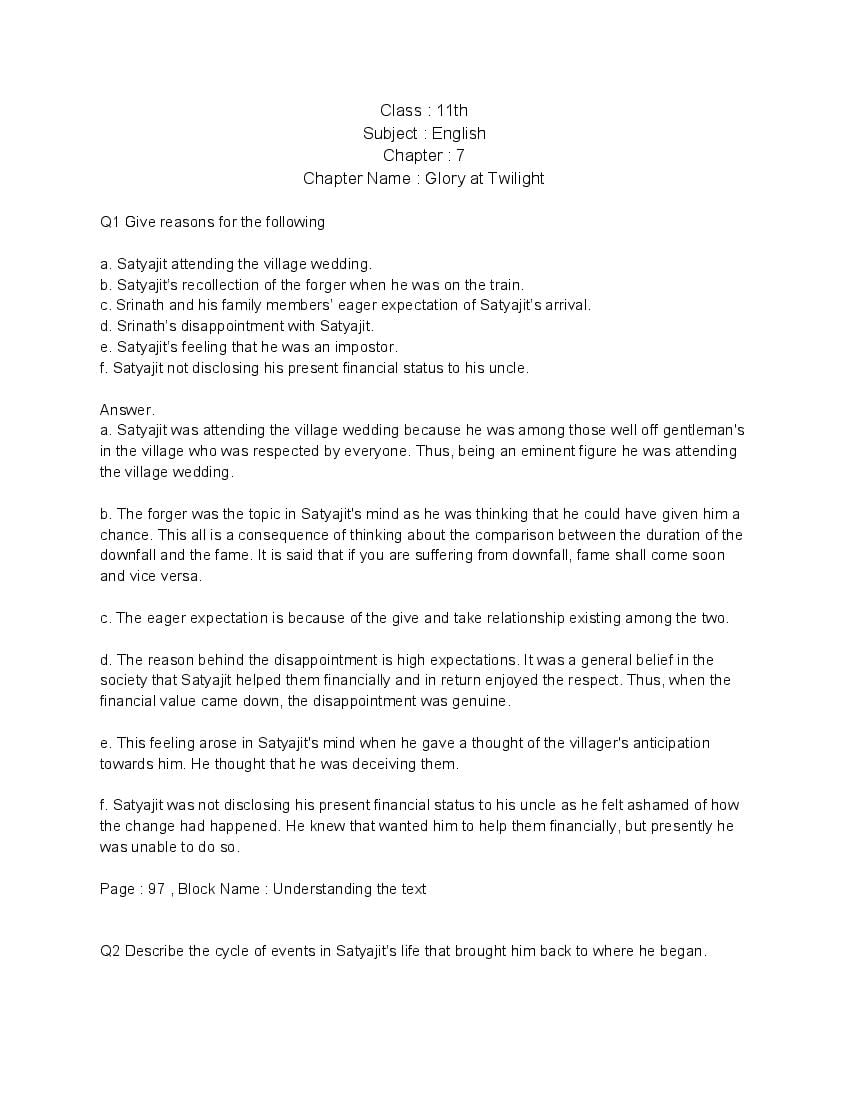
Q1 Give reasons for the following
a. Satyajit attending the village wedding.
b. Satyajit’s recollection of the forger when he was on the train.
c. Srinath and his family members’ eager expectation of Satyajit’s arrival.
d. Srinath’s disappointment with Satyajit.
e. Satyajit’s feeling that he was an impostor.
f. Satyajit not disclosing his present financial status to his uncle.
Answer.
a. Satyajit was attending the village wedding because he was among those well off gentleman's
in the village who was respected by everyone. Thus, being an eminent figure he was attending
the village wedding.
b. The forger was the topic in Satyajit's mind as he was thinking that he could have given him a
chance. This all is a consequence of thinking about the comparison between the duration of the
downfall and the fame. It is said that if you are suffering from downfall, fame shall come soon
and vice versa.
c. The eager expectation is because of the give and take relationship existing among the two.
d. The reason behind the disappointment is high expectations. It was a general belief in the
society that Satyajit helped them financially and in return enjoyed the respect. Thus, when the
financial value came down, the disappointment was genuine.
e. This feeling arose in Satyajit's mind when he gave a thought of the villager's anticipation
towards him. He thought that he was deceiving them.
f. Satyajit was not disclosing his present financial status to his uncle as he felt ashamed of how
the change had happened. He knew that wanted him to help them financially, but presently he
was unable to do so.
Q2 Describe the cycle of events in Satyajit’s life that brought him back to where he began.
Page 2
important feature in the uprising. He started his job as a clerical figure in a bank. It was only
after that he caught a forgery, he was promoted to the post of managing director. This was
when he realized that the post that he acquired was just by chance and not by his hard work.
This is the realisation that stuck him when the thought that fame and downfall go hand in hand.
Thus, when the wheel of fortune turned, his destiny changed completely. Now he became
ashamed of discussing his financial conditions.
Q1 It is difficult to adjust to a fall from glory.
Answer. This statement is completely justified and there are clear evidence provided in the
chapter how Satyajit fell from being an influential figure to the time when he was even ashamed
to discuss anything about his financial conditions. Falling from a great height and recollecting
yourself is not an easy task. It is usually observed that when a person experiences a downfall,
along with the financial status, moreover the pride is collapsed. It's easier to build a fortune than
recollecting the individual's pride. Everyone around you knows you because of the positives,
thus the chances are high that no one understands the downfall and thus it becomes difficult to
cope with the same.
Q2 ‘Failure had a tempo faster than success.’
Answer. It is a universal rule that the tempo of failure is faster than that of success. A person
can achieve success easily but then it's in no time that failure will knock your way. Also, that
human destiny plays a key role in the life cycle. Achieving success can be either a result of the
hard work or a mere chance of luck. But the destined failure shall come to an individual as per
the rules that are written in the books. When failure arrives, it's nothing can an individual do, just
accepting the fate and making adjustments alongside is the option left to the humans under the
scope of destiny.
Q3 Satyajit should have revealed his predicament to his uncle.
Answer. Predicament is the unpleasant difficulty or an unexpected problem that a person has to
deal with. Here in this chapter, the predicament that Satyajit was facing that he was in a fix
between his own financial status and the villagers. As the ongoing tradition, Satyajit was
considered as the Godly figure who enjoyed the status and respect as he helped the villagers
financially. Yes, it is true that he should have revealed this problem to his uncle as without the
disclosure he was simply fooling them. He enjoyed the status and the respect and in return, he
Page 3
been easier for him to deal with the social circumstances that otherwise grew problematic for
him.
Q4 The author’s comment on crime and punishment.
Answer. The author's thoughts on crime and punishment changed drastically while fate played a
game on him. He was of the opinion that if he had not caught the forgery, he would have not
been promoted and thus all the process of fame and fall would have been normally. Had he
gained the success by his efforts and hardworking nature, the fruits of the same would have
been long-lived and riper. Now he just wishes to go back and live life from the normal
perspective. He was punished for the hurry that resulted in the downfall.
He feels that what you receive merely out of luck is short-lived.
Q1 How is Satyajit’s financial crash introduced to the reader?
Answer. The financial crisis that the protagonist was facing is introduced to the readers in
various ways in which he had started rationing the expenses. Various instances show that
Satyajit was trying to reduce his expenditure. He thought twice while picking a cigarette from the
packet and kept it back as he was controlling to reduce the expenses.
Q2 Comment on the way in which the story is narrated from Satyajit’s perspective.
Answer. The narration of the story from Satyajit's perspective is more like an explanation of
what happens with him step by step. He keeps on justifying by giving a reason to his every
action, which is something that is discouraged while reading because it minimises the power of
the reader to formulate decisions. The imaginative capacity of the reader is turned to zero as
anything and everything comes with a reason of how and why it happened. Thus the story
would have been more interesting and would have gathered more attention by the readers if
they have something to be thought about.
Q3 How has the author used the episode of the bank theft to comment on Satyajit’s success in
his career?
Page 4
about the career line that the protagonist had. It was a miracle that changed the position of the
mere client to the managing director. This all happened because he had caught a thief and as a
consequence of the same, he was rewarded with that position. It was not something that he had
earned, thus the narrator uses this to explain the concept that the tempo of failure is faster than
the success. As this position was a result of a mere lucky activity, so was that short-lived. Thus,
the narrator has succeeded in establishing the fact that the tempo of failure is faster than the
success.
Q4 How do these lines capture the essence of the story: ‘Glory was all overlaid with dark
shame. Glory was dead.’‘… let him be wrapped a while in the lingering twilight splendour of
departed glory’.
Answer. These lines perfectly sum up the story as this was exactly what happened with Satyajit.
He was unable to accept the fact that now the things weren't the same as earlier. He was no
longer the man who enjoyed the respect and praise in the village. He was no longer able to help
them financially. Thus, the glory was overlaid with shame is the statement that is used for his
condition when he sat and thought about the predicament that he suffered from. Glory was
dead- he was no longer the same man now. But it was difficult for him to accept the defeat. It
would be right to say that pride had a great fall in his case.
Document Details
| Board / Org | NCERT |
| Exam | Class 11 |
| Type | Solution |
| Pages | 4 |
| Updated | 30 Apr 2026 |