HP Board Class 11 Syllabus 2025
Finished viewing? Save it for later —
Download HP Board Class 11 Syllabus 2025 (PDF · 63 pages)About HP Board Class 11 Syllabus 2025
HP Board Class 11 Syllabus 2025 is available here for free download. Published by Himachal Pradesh Board for Class 12, this syllabus can be viewed online or downloaded as a PDF (63 pages). Candidates preparing for Class 12 can use HP Board Class 11 Syllabus 2025 to understand the exam pattern, the type of questions asked, and the overall difficulty level.
Frequently Asked Questions
How can I download HP Board Class 11 Syllabus 2025?
Open this page and click the Download button to save HP Board Class 11 Syllabus 2025 as a PDF. It is completely free on AglaSem Docs.
Is HP Board Class 11 Syllabus 2025 free to download?
Yes. HP Board Class 11 Syllabus 2025 can be viewed online and downloaded as a PDF free of cost on AglaSem Docs.
How many pages does HP Board Class 11 Syllabus 2025 have?
HP Board Class 11 Syllabus 2025 contains 63 pages, which you can read online or download together as a single PDF.
Where can I find more Class 12 study material?
You can find more Class 12 question papers, sample papers, syllabus, and answer keys on AglaSem Docs.
HP Board Class 11 Syllabus 2025 – Text
Read the full text of this syllabus below — useful to quickly search, copy and reference the content online without downloading the PDF.
📄 View text version (55 pages)
Page 1
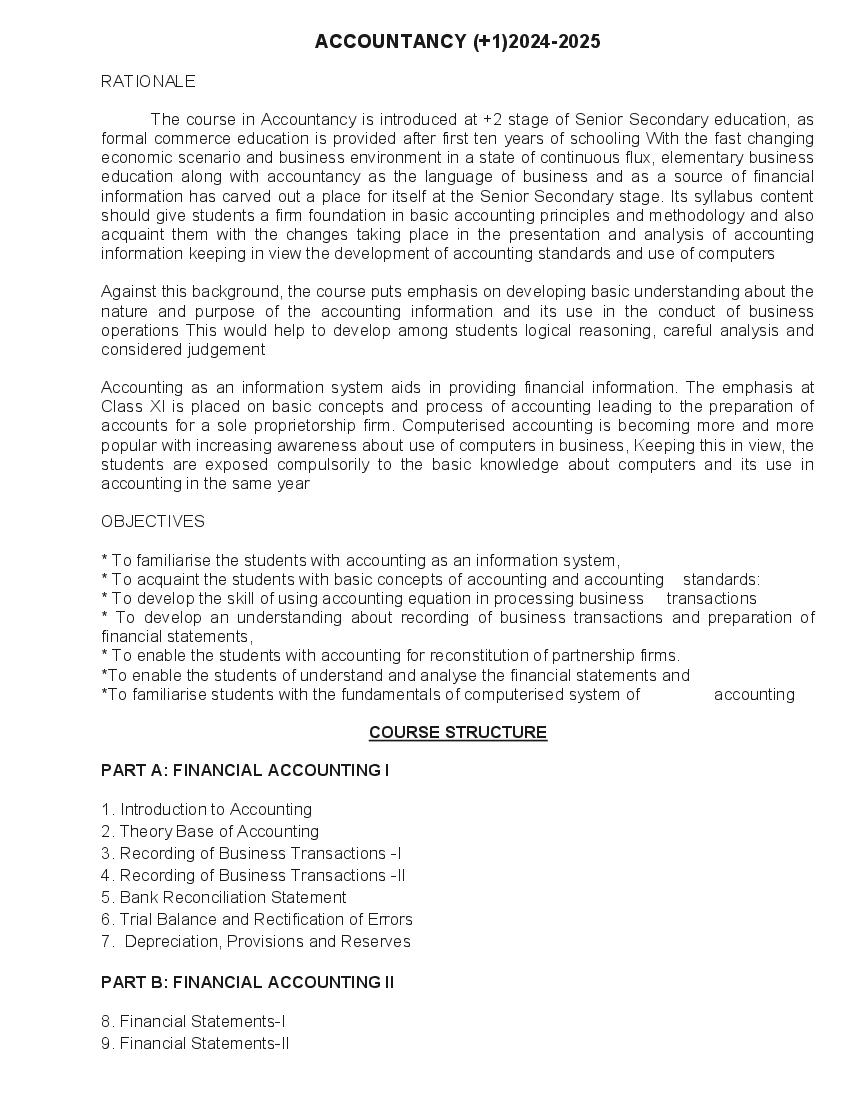
RATIONALE
The course in Accountancy is introduced at +2 stage of Senior Secondary education, as
formal commerce education is provided after first ten years of schooling With the fast changing
economic scenario and business environment in a state of continuous flux, elementary business
education along with accountancy as the language of business and as a source of financial
information has carved out a place for itself at the Senior Secondary stage. Its syllabus content
should give students a firm foundation in basic accounting principles and methodology and also
acquaint them with the changes taking place in the presentation and analysis of accounting
information keeping in view the development of accounting standards and use of computers
Against this background, the course puts emphasis on developing basic understanding about the
nature and purpose of the accounting information and its use in the conduct of business
operations This would help to develop among students logical reasoning, careful analysis and
considered judgement
Accounting as an information system aids in providing financial information. The emphasis at
Class XI is placed on basic concepts and process of accounting leading to the preparation of
accounts for a sole proprietorship firm. Computerised accounting is becoming more and more
popular with increasing awareness about use of computers in business, Keeping this in view, the
students are exposed compulsorily to the basic knowledge about computers and its use in
accounting in the same year
OBJECTIVES
* To familiarise the students with accounting as an information system,
* To acquaint the students with basic concepts of accounting and accounting standards:
* To develop the skill of using accounting equation in processing business transactions
* To develop an understanding about recording of business transactions and preparation of
financial statements,
* To enable the students with accounting for reconstitution of partnership firms.
*To enable the students of understand and analyse the financial statements and
*To familiarise students with the fundamentals of computerised system of accounting
COURSE STRUCTURE
PART A: FINANCIAL ACCOUNTING I
1. Introduction to Accounting
2. Theory Base of Accounting
3. Recording of Business Transactions -I
4. Recording of Business Transactions -II
5. Bank Reconciliation Statement
6. Trial Balance and Rectification of Errors
7. Depreciation, Provisions and Reserves
PART B: FINANCIAL ACCOUNTING II
8. Financial Statements-I
9. Financial Statements-II
Page 2
Himachal Pradesh Board of School Education Dharamshala Distt.Kangra (HP) 176213
Part-A: Financial Accounting-I
Unit-I Introduction to Accounting:
Concept, features, objectives, advantages and limitations of accounting system, users of accounting information,
internal and external users, features of qualitative accounting information, role of accounting system in business.
basic accounting terms, transactions, capital, drawings, assets, liabilities, revenue, expenditure, stock, debtors,
creditors, voucher, discount.
Unit-II Theory Base of Accounting:
Accounting assumptions, concepts, principles and conventions of accounting system, business entity concept,
money measurement concept, going concern concept, cost concept, revenue concept, matching concept, principle
of full disclosure, principle of consistency, principle of conservation and materiality, accounting standards,
applicability of accounting standards, features and importance of accounting standards, Indian accounting
standards.
Unit-III Recording of Business Transactions-I:
Accounting process, books of original entries, double entry system, voucher, source of transactions, accounting
equation, meaning and preparation of accounting equation, rules of debit and credit, journal, meaning, features
and importance of journal, meaning and utility of ledger, posting from journal to ledger
Unit-IV Recording of Business Transactions-II:
Special purpose books, cashbook, meaning and its types, petty cashbook, purchases book, sales book, purchases
return book, sales return book, ledger, meaning and other subsidiary books, journal proper.
Unit-V Bank Reconciliation Statement:
Bank reconciliation statement, meaning, need and preparation of bank reconciliation statement causes of
difference between cashbook and passbook.
Unit-VI Trial Balance and Rectification of Errors:
Meaning, objectives and preparation of trial balance, methods of preparing trial balance, balance method, total
amount method, balance and total method, errors, concept and types of errors, errors affecting trial balance and
errors not affecting trial balance, detection and rectification of errors, one-sided errors and two-sided errors,
suspense account, meaning and preparation of suspense account.
Unit-VII Depreciation, Provisions and Reserves:
Meaning, concept and need of depreciation, causes of depreciation, methods of depreciation, straight line
method, written down value method (excluding change in method), charging depreciation to assets accounts,
creating provisions for depreciation/ accumulated depreciation account, treatment of disposal of assets, concept,
features and importance of reserves, types of reserves, revenue reserves, capital re4serves, general reserves,
specific reserves and secret reserves, meaning and need of provisions, difference between reserves and
provisions, provision for doubtful debts, provision for discount on debtors and creditors, provision for depreciation
and taxation.
Page 3
Part-B: Financial Accounting-II
Unit-VIII Financial Statements-I:
Concept, types and uses of financial statements, trading account, profit and loss account, balance sheet, meaning
and difference between capital expenditure and revenue expenditure, presentation of financial statements,
operating profit (EBIT) vertical and horizontal forms of financial statements preparation of financial statements
without adjustments.
Unit-IX Financial Statements-II:
Meaning and need of different adjustments in preparing of financial statements, financial statements with
adjustments, closing stock, outstanding expenses, prepaid expenses and accrued income, income received in
advance, depreciation and bad debts, provision for doubtful debts, provision for discount on debtors and
creditors, commission to manager, interest on capital, preparation of trading account, profit and loss account and
balance sheet.
Page 4
RATIONALE
The courses in Business Studies and Accountancy are introduced at + 2 stage of Higher
Secondary Education as formal commerce education in provided after first ten years of
schooling. Therefore, it becomes necessary that instructions in these subjects are given in
such a manner that students have a good understanding of the principles and practices
bearing in business (trade and industry) as well as their relationship with the society
Business is a dynamic process that brings together technology, natural resources and human
initiative in a constantly changing global environment To understand the framework in
which a business operates, a detailed study of the organisation and management of
business processes and its interaction with the environment is required Information
Technology is becoming a part of business operations in more and more organisations
Computerised systems are fast replacing other systems. E-business and other related
concepts are picking up fast which need to be emphasized in the curriculum
The Course in Business Studies will prepare students to analyse, manage, evaluate and
respond to changes which affect business. It provides a way of looking at and interacting
with the business environment. It recognizes the fact that business influences and is
influenced by social, political, legal and economic forces. It allows students to appreciate
that business is an integral component of society and develops an understanding of many
social and ethical issues.
Therefore, to acquire basic knowledge of the business world, a course in Business Studies
would be useful. It also informs students of a range of study and work options and bridges
the gap between school and work
OBJECTIVES
* To develop in students an understanding of the processes of business and its
environment:
* To acquaint students with the dynamic nature and inter-dependent aspects of
business
* To develop an interest in the theory and practice of business, trade and industry
* To familiarize candidates with theoretical foundations of organizing managing and
handling operations of a business firm,
* To help students appreciate the economic and social significance of business
activity and the social costs and benefits arising therefrom
* To acquaint students with the practice of managing the operations and resources of
business.
* To prepare students to function more effectively and responsibly as consumers,
employers, employees and citizens;
* To help students in making the transition from school to higher education on to the
world of work including self-employment
* To develop in students a business attitude and skills to be precise and articulate
Page 5
PART A: FOUNDATIONS OF BUSINESS
Chapter 1 : Business, Trade and Commerce
Chapter 2 : Forms of Business Organisation
Chapter 3 : Private, Public and Global Enterprises
Chapter 4 : Business Services
Chapter 5 : Emerging Modes of Business
Chapter 6 : Social Responsibilities
PART B: CORPORATE ORGANIZATION, FINANCE AND TRADE
Chapter 7: Formation of a Company
Chapter 8: Sources of Business Finance
Chapter 9: MSME and Business Entrepreneurship 1
Chapter 10: Internal Trade
Chapter 11: International Business
PART C: PROJECT WORK (PRACTICAL)
12. Record of Project and Viva
PARTA:FOUNDATIONS OF BUSINESS
Unit1: Business, Trade and Commerce
* Concept and characteristics of business
* Business, profession and employment-distinctive features
* Objectives of business-economic and social role of profit in business
* Classification of business activities Industry and Commerce
* Industry-types primary, secondary, tertiary.
* Commerce. Trade and Auxiliaries.
* Business risk-nature and causes.
UNIT2: FORMS OF BUSINESS ORGANISATIONS
* SoleProprietorshipJointHinduFamilyBusiness-meaning,features,meritsandlimitations
* Partnership-meaning, types, registration, merits, limitations, types of partners.
* Cooperative Societies-types, merits and limitations.
* Company: Private Ltd. Public Ltd.-merits, limitations;
* Choice of form of business organizations
* Starting a business-Basic factors
Unit3: Private, Public & Global Enterprises
* Private Sector and Public Sector.
* Forms of organizing public sector enterprises
* Departmental Undertaking
* Statutory Corporation
* Government Company
* Changing role of public sector
* Global Enterprises (Multinational Companies) meaning and features,
Unit4: Business Services
* Nature and types of Business services-Banking Insurance Transportation, Warehousing,
Communication
* Banking-types of Banks, Functions of Commercial banks, E-banking
* Insurance-principles, types life, fire and marine
* Postal and Telecom services
Page 6
* E-Business-Meaning, scope and benefits. Resources required for successful e-
business implementation, On-line transactions, payment mechanism, security
and safety of business transactions
Unit6: Social Responsibility
* Concept of social responsibility
* Case for Social responsibility
* Responsibility towards owners, investors) employees, consumers, government,
community and public in general
* Business and environmental protection
* Business ethics concept and elements
Part-B: CORPORATE ORGANISATION, FINANCEANDTRADE
Unit7: Formation of a Company
* Stages in the formation of a company
* Promotion
* Incorporation, and
* Commencement of business
Unit8: Sources of Business Finance
* Nature and significance
* Owner's funds and borrowed funds
* Sources of raising Finance
- Equity and Preference shares
- Debentures and Bonds
- Retained Profits
- Public deposits
- Loan from Financial Institutions
- Loans from commercial Banks
- Trade Credit
Unit9: MSME and Business Entrepreneurship
* Small Scale Industry: Tiny Sector, cottage and rural industry:
* Problems of small business in India
* Government Assistance and Special Schemes for Industries in rural, backward and hilly
areas
Unit10: Internal Trade.
* Meaning and types of internal trade whole sale and retail:
* Services of a wholesaler and a retailer,
* Types of Retail Trade:
- Itinerant retailers and fixed shops.
- Departmentalstore,supermarketmalls,chainstore,mailorderbusiness,consumer'scooperat
ivestore
- Automatic Vending Machine.
* Role of Chamber of Commerce and Industry in promotion of internal.
Unit11: International Business.
* Nature, Importance
* Ways of entering into international Business Export-Import Procedures and
documentation
Page 7
Unit-12: Project Work (Practical)
SUGGESTIVE/ILLUSTRATIVEPROJECTS
Any one of the following:
(i) Find out from local sample business unit(s) the various objectives they pursue
(ii) Problems of setting up and running business units.
(iii) Enquiry into the ethics of running business through questionnaires
(iv) Survey of quality of bank services in the local branch office
(v) Study of postal and courier mail services.
(vi) Availability and use of agency services, advertising, packaging. Investments in savings
schemes, etc.
(vi)Survey of the popularity of credit ards issued by different banks.
(viii) Study the profile of a sole trader/partnership commenting on the nature and working
of business.
(ix) Study of a Joint Hindu family business
(x) Study of the working of any cooperative society.
(xi) Study of a small business unit regarding source of finance
(xii) Nature of different traders (like hawkers and peddlers in a specific locality) in
issue of goods, capital investment, turnover.
(xii)Study of weekly bazaar in a locality
(xiv) Study of franchise retail store.
(xv) Study of export/import of any article
(xvi) Problems of women entrepreneurs in business.
(xvii) Waste/garbage disposal.
(xviii) Study of pavement trade.
(xix) Prepare a scrap book and collect articles on the changing role of public sector and any
other topics related to the
PRESCRIBED BOOKS
1 यवसा यक अ ययन एन. सी. ई. आर.ट . वारा का शत
2. Business studies NCERT Publication
Page 8
The present syllabus reinforces the ideas introduced in the lower classes while the
students learn new concepts besides getting an exposure to contemporary areas of
the subject. The syllabus also aims at emphasizing the underlying principles that are
common to both animals and plants as well as highlighting the relationships of
biology with other areas of knowledge The format of the syllabus allows a simple,
clear, consequential flow of concepts without any jarring jumps. The syllabus also
stresses the connection of the study of Biology to real life problems, use of biological
discoveries/innovations in everyday life-in environment, nature, medicine, health and
agriculture. The updated syllabus also focuses on reducing the curriculum load while
ensuring that ample opportunities and scope for learning and appreciating basic
concepts of the subject continues to be available within its framework.
The prescribed syllabus is expected to
Promote understanding of basic principles of biology
Learning of emerging knowledge and its relevance to individual and society.
Encourage rational/specific attitude to issues related to population, environment and
development.
Enhance awareness about environmental issues and problems and the appropriate
solutions.
Create awareness amongst the learners about variations amongst the living and
developing respect for the diversities and to appreciate that the most complex
biological phenomenon are also built on essentially simple processes
It is expected that the students would get an exposure to various branches of Biology
in the syllabus in a more contextual and friendly manner as they study its various
units.
COURSE STRUCTURE
Time : 3 Hrs (THEORY) Max. Marks : 60
UNIT I :- DIVERSITY IN THE LIVING WORLD
Chapter 1 : The Living World
Chapter 2 : Biological Classification
Chapter 3 : Plant Kingdom
Chapter 4 : Animal Kingdom
UNIT II :- STRUCTURAL ORGANISATION IN PLANTS AND ANIMALS
Chapter 5 : Morphology of Flowering Plants
Chapter 6 : Anatomy of Flowering Plants
Chapter 7 : Structural Organisation in Animals
UNIT III :- CELL : STRUCTURE AND FUNCTIONS
Chapter 8 : Cell : The Unit of Life
Chapter 9 : Biomolecules
Chapter 10 : Cell Cycle and Cell Division
UNIT IV :- PLANT PHYSIOLOGY
Chapter 11 : Photosynthesis in Higher Plants
Chapter 12 : Respiration in Plants
Chapter 13 : Plant Growth and Development
UNIT V :- HUMAN PHYSIOLOGY
Chapter 14 : Breathing and Exchange of Gases
Chapter 15 : Body Fluids and Circulation
Chapter 16 : Excretory Products and their Elimination
Chapter 17 : Locomotion and Movement
Chapter 18 : Neural Control and Coordination
Chapter 19 : Chemical Coordination and Integration
Page 9
Time : 3 Hours Marks : 20
1. Experiments and spotting
2. Record of one investigatory project and Viva based on the project
3. Class record and Viva based on experiments
A. LIST OF EXPERIMENTS
1. Study and describe three common flowering plants (solanaceae Fabaceae and
Liliaceae)
2. Preparation and study of T.S. of dicot and monocot roots and stems (normal)
3. Study of osmosis by potato osmometer
4. Study of plasmolysis in epidermal peels (eg Rhoeo leaves) 5. Study of distribution
of stomata in the upper and lower surface of leaves
6. Comparative study of the rates of transpiration in the upper and lower surface of
leaves
7. Test for the presence of sugar starch proteins and fats. To detect them is suitable
plant and animal materials
8. Separate plant pigments through paper chromatography.
9. To study the rate of respiration in flower buds/leaf tissue and germinating seeds
10. To study effect of different temperatures on the activity of salivary analyse on
starch
11. To test the presence of urea in urine.
12. To detect the presence of sugar in urine/blood sample
13. To detect the presence of albumin in urine
14. To detect the presence of bile salts in urine,
B. STUDY I OBSERVATION OF THE FOLLOWING SPOTTING
1. Study parts of a compound microscope.
2. Study of the specimens and identification with reasons-Bacteria, Oscillatoria,
Spirogyra, Rhizopus, mushroom, Yeast, liverwort, moss, fern, Pinus, one
monocotyledon and one Cotyledon and one lichen.
3. Study of specimens and identification with reasons-Amoeba Hydra, Liverfluke,
Ascaris, leech, earthworm, prawn, silkworm, honeybee, snail. starfish, shark, Rohu,
frog, ligard, pigeon and rabbit
4. Study of tissues, and diversity in shapes and sizes of plant and animal cells (e g
plisade cells. guard cells parenchyma, collenchyma, sclerenchyma Xylem. Phloem
Squamous epithelium, muscle fibers and mammalian blood smear) through
temporary/permanent slides.
5. Study of mitosis in onion root tip cells and animals cells (grasshopper) from
permanent slides.
6. Study of different modifications in root stem and leaves
7. Study and identify different types of inflorescences
8. Study of imbibition in seeds/ raisins
9. Observation and comments on the experimental set up on:
(a) Anaerobic respiration
(b) Phototropism
(c) Apical bud removal
(d) Suction due to transpiration
10. To study human skeleton and different types of joints
11. Study of external morphology of earthworm cockroach and frog through models
Page 10
RATIONALE
Higher Secondary is the most crucial stage of school education because at this juncture
specialized discipline based content - oriented courses are introduced . Students reach this
stage after 10 years of general education and opt for Chemistry with a purpose of pursuing their
career in basic sciences or professional courses like medicine , engineering , technology and
study courses in applied areas of science and technology at tertiary level . Therefore , there is a
need to provide learners with sufficient conceptual background of Chemistry , which will make
them competent to meet the challenges of academic and professional courses after the higher
secondary stage .
The new and updated curriculum is based on disciplinary approach with rigour and depth
taking care that the syllabus is not heavy and at the same time it is comparable to the
international level . The knowledge related to the subject of Chemistry has undergone
tremendous changes during the past one decade . Many new areas like synthetic materials , bio
- molecules , natural resources , industrial chemistry are coming in a big way and deserve to be
an integral part of chemistry syllabus at senior secondary stage At international level , new
formulations and nomenclature of elements and compounds , symbols and units of physical
quantities floated by scientific bodies like IUPAC and CGPM are of immense importance and
need to be incorporated in the updated syllabus . The revised syllabus takes care of all these
aspects . Greater emphasis has been laid on use of new nomenclature , symbols and
formulations , teaching of fundamental concepts , applications of concepts in chemistry to
industry / technology , logical sequencing of units , removal of obsolete content and repetition
etc.
OBJECTIVES
The broad objectives of teaching Chemistry at Senior Secondary Stage are to help the learners
To promote understanding of basic facts and concepts in chemistry while retaining the
excitement of chemistry
To make students capable of studying chemistry in academic and professional courses (
such as medicine technology ) at tertiary level .
To expose the students to various emerging new areas of chemistry and apprise
them with their relevance in their future studies and their application in various
spheres of chemical sciences and technology
To equip students to face various changes related to health , nutrition ,
environment , population , weather , industries and agriculture .
To develop problem solving skills in students .
To expose the students to different processes used in industries and their
technological applications .
To apprise students with interface of chemistry with other disciplines of science
such as physics , biology , geology , engineering etc.
To acquaint students with different aspects of chemistry used in daily life ,
To develop an interest in students to study chemistry as a discipline .
Page 11
THEORY
One Paper Time : 3 Hours 60 Marks
Unit No. Title Marks
Unit I Some basic Concepts of Chemistry
Unit II Structure of Atom
Unit III Classification of Elements and Periodicity in Properties
Unit IV Chemical Bonding and Molecular Structure
Unit V Thermodynamics
Unit VI Equilibrium
Unit VII Redox Reactions
Unit VIII Organic Chemistry - some basic Principles and Techniques
Unit IX Hydrocarbons
PRACTICALS
EVALUATION SCHEME FOR EXAMINATION MARKS
Volumetric Analysis Marks
Salt Analysis Marks
Content Based Experiment Marks
Class Record and Viva Marks
Investigatory Project Marks
Total 20 Marks
PRACTICALS SYLLABUS
A. Basic Laboratory Techniques
(a) Cutting a glass tube and glass rod .
(b) Bending of a glass tube
(C) Draw out , a glass jet .
(d) Boring a Cork .
B. Characterization and Purification of chemical substance
1 . Determination of melting point of organic compound
2 . Determination of boiling point of organic compound
3 . Crystallization involving impure sample of anyone of the following Alum , copper sulphate ,
Benzoic acid .
C. Experiments related of pH change
(a) Anyone of the following experiments : Determination of pH of some solutions obtained from
fruit juices , solutions of known and varied concentrations of acids . bases and salts using pH
paper or universal indicator Comparing the pH of solutions of strong and weak acid of same
concentration . Study the pH change in the titration of a strong base using universal indicator
(b) Study of pH change by common - ion effect in case of weak acids and weak bases .
D. Chemical equilibrium
One of the following experiments :
Page 12
decreasing the concentration of either ions .
(b) Study the shift in equilibrium between [ Co ( H20 ) 612+ and chloride ions by changing the
concentration of either of the ions.
E. Quantitative estimation
using a chemical balance .
Preparation of standard solution of oxalic acid .
Determination of strength of a given solution of sodium hydroxide by titrating it against
standard solution of oxalic acid .
Preparation of standard solution of sodium carbonate .
Determination of strength of a given solution of hydrochloric acid by titrating it against
standard sodium carbonate solution .
F. Qualitative analysis
Determination of one anion and one cation in a given salt
Cations - Pb2+ , Cu2+ , As3+, Al3+, Fe3+ Mn2+ , Zn2+ , Co2+ , Ca2+ Sr2+ , Ba2+ , Mg2+ NH4+
Anions - CO32- , S2- , SO32- . HO21- , NO3-1, Cl-, Br- ,I- PO43- , C2O42, CH3 COO-
( Note : Insoluble salts excluded )
( G ) Detection of nitrogen , sulphur , Chlorine
Bromine and iodine in an organic compound
PROJECT :
Scientific investigations involving laboratory testing and collecting information from other
sources ,
A Few suggested Projects
Checking the bacterial contamination in drinking water by testing sulphide ion
Study of the methods of purification of water .
Testing the hardness , presence of iron , fluoride , chloride etc. depending upon the regional
variation in drinking water and the study of causes of presences of these ions above permissible
limit ( if any ) .
Investigation of the foaming capacity of different washing soaps and the effect of addition of
sodium carbonate on them .
Study of the acidity of different samples of the tea leaves
Determination of the rate of evaporation of different liquids
Study of the effect of acids and bases on the tensile strength of fibers . Analysis of fruit and
vegetable juices for their acidity
Note : Any other investigatory project , which involves about 10 period of work , can be chosen
with the approval of the teacher .
Page 13
Syllabus
Subject: Computer Science Class: 10+1
UNIT - I MARKS
Fundamentals of Computer (10 Theory)
Computer and its applications, Block Diagram of Computer, Generations of
Computer, Concept of Memory (Primary and Secondary memory), Input &
Output Devices, Concept of Software (System and Application software),
Number System (Binary, Decimal), Conversion between binary and decimal
number system.
UNIT - II
Digital Network Essentials (08 Theory)
Internet Fundamentals, Information Technology and the Internet, Web
Browsing, Multimedia on the Web, Web Search Engines, E-mail, Internet
Security, Need of computer network, Data communication fundamentals-
Analog and Digital signal transmission, Transmission Medias- Guided Media:
Twisted pairs, Coaxial Cable, Optical fibers, Unguided transmission media:
Radiowave, Microwave, Satellite, Wi-Fi. Network Classification- LAN, MAN,
WAN, PAN.
UNIT-III
Desk Top Publishing (Elementary) (07 Theory & 02 Practical)
Concept of Desk Top Publishing, Application of DTP, Comparison of DTP with
Word Processing, Introduction to Page maker, creating a new publication using
Page maker, saving a file in Page maker, Various tools in PageMaker for
designing pages, Master pages, headers, footers etc, and various printing
options for a publication, Hands on with Page maker.
UNIT-IV
Digital Image Editing (07 Theory & 02 Practical)
Understanding Photoshop – Classification of Images (Bitmap, Vector Images),
Image types, Image Size and Resolution, Creating a Digital College, Working
with Files, Rulers and Guides, Changing Print Size of an Image, Tool box,
Working with Colours, Selections, Shapes and Painting - Softening and
Refining Selections, Saving, Loading, Deleting, Moving, Copying Pasting and
Extracting Selections, Drawing with Pen Tool, Creating Brush-Filling and
Stroking Selection and Layers. Transforming and Typing, Rotating, Cropping,
and Flipping Images.
Page 14
HTML Fundamentals (10 Theory & 05 Practical)
Introduction to web page Designing using HTML, creating saving an HTML
document, Elements in HTML container and Empty elements, Designing web
pages using the following elements : HTML,HEAD, TITLE, BODY (Attributes
BACK GROUND, BGCOLOUR, TEXT, LINK, ALINK, VLINK, LEFTMARGIN,
TOPMARGIN), FONT (Attributes : COLOUR, SIZE FACE), BASEFONT
(ATTRIBUTES : COLOUR, SIZE, FACE), CENTER, BR (Break, HR (Horizontal
Rule Attributes, SIZE, WIDTH, ALIGN, NOSHADE, COLOUR),Comments, For
commentsH1.H6 (Heading), P (Paragraph) B (Bold), I (Italics), U (Underling),
UL&OL (Unordered List & Ordered List), Attributes: Type, Start, L1 (List Item),
Insertion of images using the element IMG Attributes :(SRC, WIDTH, HEIGHT,
ALT, ALIGN).Internal and External Linking between Web pages; Significance of
linking, A-Anchor element)attributes:(NAME, HREF, TITLE, ALT), Inserting
Table in HTML (TD, TH, TR).
UNIT-VI
Advanced Web Publishing (JavaScript) (12 Theory & 06 Practical)
Networking Fundamentals- Introduction to Networking, Internetworking
Servers, Need of Web Publishing, Web Languages, JavaScript Introduction,
JavaScript Fundamentals-features of the JavaScript Language to design client-
side, Variables, Data Types, Operators , Write JavaScript Programs, Control
program flow (Conditional Statements and Looping Statements), Developing
Interactive Forms and validation, the most popular applications of JavaScript,
Cookies and JavaScript Security.
UNIT-VII (06 Theory & 02 Practical)
Multimedia Applications (Sound & Video Editing)
Sound editing - The nature of sound; Microphones and its types, their
characteristics and application in film and television production, the sound
track and sound editing, the sound mixing console, sound editing and
languages dubbing, Video Editing, Editing types: linear and non-linear editing,
Role of the editor and his relationship with the director, Video Cassette
Recorder, Digital - Computer as a tool of editing using software - Windows
Movie maker.
UNIT-VIII (Project Work) (04 Practical)
Page 15
RATIONALE
Economics is one of the social sciences, which has great influence on every
human being. As economic life and the economy go through change the need to ground
education in children's own experience becomes essential. While doing so, it is imperative to
provide them opportunities to acquire analytical skills to observe the understand the economic
realities
At senior secondary stage, the learners are in a position to understand abstract
ideas, exercise the power of thinking and to develop their own perception. It is at this stage, the
learners are exposed to the rigor of the discipline of economics in a systematic way.
The economics courses are introduced in such a way that in the initial stage, the
learners are introduced to the economic realities that the nation is facing today along with some
basic statistical tools to understand these broader economic realities. In the later stage, the
learners are introduced to economics as a theory of abstraction.
The economics courses also contain many projects and activities. These will
provide opportunities for the learners to explore various economic issues both from their day-to-
day life and also from issues, which are broader and invisible in nature. The academic skills that
they learn in these courses would help to develop the projects and activities. The syllabus is
also expected to provide opportunities to use information and communication technologies to
facilitate their learning process.
OBJECTIVES
1. Understanding of some basic economic concepts and development of economic reasoning
which the learners can apply in their day-to-day life as citizens, workers and consumers.
2. Realisation of learners' role in nation building and sensitivity to the economic issues that the
nation is facing today
3. Equipment with basic tools of economics and statistics to analyse economic issues This is
pertinent for even those who may not pursue this course beyond senior secondary stage.
4. Development of understanding that there can be more than one views on any economic issue
and necessary skills to argue logically with reasoning.
Page 16
PART A : STATISTICS FOR ECONOMICS
Chapter-1 : Introduction
Chapter-2 : Collection of data
Chapter-3 : Organization of Data
Chapter-4 : Presentation of Data
Chapter-5 : Measures of Central Tendency
Chapter-6 : Correlation
Chapter-7 : Index Number
Chapter-8 : Use of Statistical Tools
PART-B: INDIAN ECONOMIC DEVELOPMENT
Chapter-1 : Indian Economy on the Eve of Independence
Chapter-2 : Indian Economy 1950-1990
Chapter-3 : Liberalisation, Privatisation and Globalisation: An Appraisal
Chapter-4 : Human Capital Formation in India
Chapter-5 : Rural Development
Chapter-6 : Employment : Growth, Informalisation and Other Issues
Chapter-7 : Environment And Sustainable Development
Chapter-8 : Comparative Development Experiences of India and Its Neighbours
Page 17
1.ENGLISH CORE
BACKGROUND
Students are expected to have acquired a reasonable degree of language proficiency in
English by the time they come to class XI, and the course will aim, essentially, at promoting the
higher-order language skills.
For a large number of students, the senior secondary stage will be a preparation for the
university, where a fairly high degree of proficiency in English may be required. But for another
large group, the senior secondary stage may be a preparation for entry into the world of work.
The Core Courses should cater to both groups by promoting the language skills required for
academic study as well as the language skills required for the workplace.
OBJECTIVE
The general objective at this stage are :
- to listen to and comprehend live as well as recorded oral presentations on a variety of
topics.
- to develop greater confidence and proficiency in the use of language skills necessary for
social and academic purposes.
- to participate in group discussion/interviews, making short oral presentation of given
topics.
- to perceive the overall meaning and organization of the text (i.e., the relationships of
the different ‘’chunks’’ in the text to the each other).
- to identify the central/main point and supporting details etc.
- to build communicative competence in various registers of English.
- to promote advance language skills with an aim to develop the skills of reasoning,
drawing inferences etc. through meaningful activities.
- to develop ability and knowledge required in order to engage in independent reflection
and enquiry.
- to develop the capacity to appreciate literary use of English and also use English
creatively and imaginatively.
At the end of this stage learners will be able to do the following :
- read and comprehend extended texts (prescribed and non-prescribed) in the following
genres : fiction, science fiction, drama, poetry, biography, autobiography, travel and
sports literature, etc.
Page 18
unseen texts)
- understand and respond to lectures, speeches, etc.
- write expository/argumentative essays of 250-500 words, explaining or developing a
topic, arguing a case, etc.
- write formal/informal letters and applications for different purposes.
- write items related to the workplace (minutes, memoranda, notices, summaries,
reports; filling up of forms, preparing CVs, e-mail messages etc.)
- taking/making notes from reference materials, recorded talks etc.
LANGUAGE ITEMS
The Core Course should draw upon the language items suggested for classes IX-X and
develop deeper into their usage and functions. Particular attention may, however, be given to
the following areas of grammar:
- The uses of different tense forms for different kinds of narration (e.g. media, commentaries,
reports, programmer, etc)
- The use of passive forms in scientific and innovative writings.
- Converting one kind of sentence/clause into a different kind of structure of well as other items
to exemplify stylistic variations in different discourses
- Modal auxiliaries – used based on semantic considerations.
METHODS AND TECHNIQUES
The techniques used for teaching should promote habits of self-learning and reduce
dependence on the teacher. In general, we recommend a multi-skill, learner-centred, activity based
approach, of which there can be many variations. The core classroom activity is likely to be that of silent
reading of prescribed/selected texts for comprehension, which can lead to other forms of language
learning activities such as role play, dramatization, group discussion, writing, etc. although many such
activities could be carried out without the preliminary use of textual material. It is important that
students be trained to read independently and intelligently, interacting actively with texts, with the use
of reference materials (dictionaries, thesauruses, etc.) where necessary. Some pre-reading activity will
generally be required, and the course books should suggest suitable activities, leaving teachers free to
devise other activities when desired. So also, the reading of texts should be followed by post reading
activities. It is important to remember that every text can generate different readings. Students should
be encouraged to interpret texts in different ways.
Group and pair activities can be resorted to when desired, but many useful language activities
can be carried out individually.
In general, teachers should encourage students to interact actively with texts and with each
other. Oral activity (group discussion, etc.) should be encouraged.
Page 19
1. The Portrait of a Lady
Khushwant Singh
A Photograph
Shirley Toulson
2. We’re Not Afraid to Die…
If we can all be Together
Gordan Cook and Alan East
3. Discovering Tut: the Saga Continues
A.R. Williams
The Laburnum Top
Ted Hughes
The Voice of The Rain
Walt Whitman
4. The Ailing Planet: the Green Movement’s Role
Nani Palkhivala
Childhood
Markus Natten
5. The Adventure
Jayant Narlikar
6. Silk Road
Nick Middleton
Father to Son
Elizabeth Jennings
Writing Skills
1. Note Making
2. Summarising
3. Sub-titling
4. Essay writing
5. Letter-writing
6. Creative writing
Snapshots (Supplementary Reader)
1. The Summer of the Beautiful (White Horse, Willian Saroyan)
2. The Address (Marga Minco)
3. Mother’s Day (J.B. Priestley)
4. The Ghat of the the Only World (Amitav Ghosh)
5. Birth (A.J. Cronin)
6. The Tale of Melon City (Vikram Seth)
Page 20
+1 2024-2025
RATIONALE
Geography is introduced as an elective subject at the senior secondary stage.
After ten years of general education, students branch out at the beginning of this stage and are
exposed to the rigors of the discipline for the first time. Being an entry point for the higher
education, students choose geography for pursuing their academic interest and, therefore, need
a broader and deeper understanding of the subject For others, geographical knowledge is
useful in daily lives because it is a valuable medium for the education of young people. Its
contributions lie in the content, cognitive processes, skills and values that geography promotes
and thus helps the students explore, understand and evaluate the environmental and social
dimensions of the world in a better manner.
Since geography explores the relationship between people and their
environment, it includes studies of physical and human environments and their interactions at
different scales local, state/region, nation and the world The fundamental principles responsible
for the varieties in the distributional pattern of physical and human features and phenomena
over the earth's surface need to be understood properly. Application of these principles would
be taken up through selected case studies from the world and India. Thus the physical and
human environment of India and study of some issues from a geographical point of view will be
covered in greater detail. Students will be exposed to different methods used in geographical
investigations
OBJECTIVES
The course in geography will help learners
Familiarize themselves with the terms, key concepts and basic principles of geography.
Search for, recognize and understand the processes and patterns of the spatial
arrangement of the natural as well as human features and phenomena on the earth's
surface:
Understand and analyses the inter-relationship between physical and human
environments and their impact
Apply geographical knowledge and methods of inquiry to new situations or problems at
different levels-local, regional, national and global;
Develop geographical skills, relating to collection, processing and analysis of data.
information and preparation of report including maps and graphs and use of computers
wherever possible; and
Utilize geographical knowledge in understanding issues concerning the community such
as environmental issues, socio-economic concerns, gender and become responsible
and effective member of community.
Page 21
A. FUNDAMENTALS OF PHYSICAL GEOGRAPHY
Unit-1. Geography as a discipline
Unit-2. The Earth
Unit-3. Landforms
Unit-4. Climate
Unit-5. Water (Oceans)
Unit-6. Life on the Earth
Unit-7 Map Work.
B. INDIA-PHYSICAL ENVIRONMENT
Unit-8. Introduction
Unit-9. Physiography
Unit-10. Climate and Vegetation
Unit-11. Natural Vegetation
Unit-12. Natural Hazards and Disaster : Causes, Consequences and Management
Map Work
PRACTICAL WORK
Unit-1. Fundamentals of Maps
Unit-2. Topographic and weather Maps
Page 22
Rational
Through a focus on a series of critical historical issues and debates, the students would
be introduced to a set of important historical events and processes. A discussion of these
themes, it is hoped, would allow students not only to know about these events and processes,
but also to discover the RATIONALE excitement of doing history.
OBJECTIVES
Effort in these senior secondary classes would be to emphasize to students that history
is a critical discipline, a process of enquiry, a way of knowing about the past, rather than
just a collection of facts. The syllabus would help them understand the process through
which historians write history, by choosing and assembling different types of evidence,
and by reading their sources critically. They will appreciate how historians follow the
trails that lead to the past, and how historical knowledge develops.
The syllabus would also enable students to relate/compare developments in different
situations, analyze connection between similar processes located in different time
periods, and discover the relationship between different methods of social enquiry
within different social sciences
The syllabus in class XI is organized around some major themes in world history. The
themes have been selected so as to (i) focus on some important developments in
different spheres-political, social, cultural and economic, (ii) study not only the grand
narratives of development urbanization, industrialization and modernization-but also to
know about the processes of displacements and marginalization. Through the study of
these themes students will acquire a sense of the wider historical processes as well as
an idea of the specific debates around them.
The treatment of each theme in class XI would include (a) a road picture of the theme
under discussion,(b) a more detailed focus on one region of study, (c) an introduction to
a critical debate associated with the issue.
Page 23
PART-1 (Section -A) : Early Societies
Introduction
Timeline I – (6MYA to 1 BCE)
Chapter-1 : Writing and City Life
PART-II (Section -B) : Empires
Introduction
Timeline II : (c.100 BCE to 1300 CE)
Chapter-2 : An Empire Across Three Continents
Chapter-3 : Nomadic Empires
PART-III (Section -C) : Changing Traditions
Introduction
Timeline III : (c. 1300 to 1700)
Chapter-4: The Three Orders
Chapter-5: Changing Culture Traditions
PART-IV (Section -D) : Towards Modernisation
Introduction
Timeline IV : (c. 1700 to 2000)
Chapter-6 : Displacing Indigenous People
Chapter-7 : Paths to Modernisation
Map Work
Prescribed Books:-
1. fo'o bfrgkl ds dqN fo"k; % fg- iz- Ldwy f'k{kk cksMZ }kjk izdkf'kr
2. Themes in World History : NCERT Publication.
Page 24
mPprj ek/;fed Lrj esa izos'k ysus okyk fo|kFkhZ igyh ckj lkekU; f'k{kk ls fo'ks"k vuq'kklu
dh f'k{kk dh vksj mUeq[k gksrk gSA nl o"kksZa esa fo|kFkhZ Hkk"kk ds dkS'kyksa ls ifjfpr gks tkrk gSA Hkk"kk
vkSj lkfgR; ds Lrj ij mldk nk;jk vc o"kksaZ esa fo|kFkhZ Hkk"kk ds dkS"kyksa ls ifjfpr gks tkrk gSA Hkk"kk
vkSj lfgR; ds Lrj ij mldk nk;jk vc ?kj vkl&iM+kl s ] Ldwy] izkra vkSj ns'k ls gksrk gqvk /khjs&/khjs
fo'o rd QSy tkrk gSA og bl mez esa igq¡p pqdk gS fd ns'k dh lkaLd`frd] lkekftd] jktuhfrd
vkSj vkfFkZd leL;kvksa ij fopkj&foe'kZ dj lds] ,d ft+Eesnkj ukxfjd dks rjg viuh ftEesnkfj;ksa
dks le> lds rFkk ns'k vkSj [kqn ds lgh fn'kk ns ldus esa Hkk"kk dh rkdr dks igpku ldsA ,sls n`<+
Hkkf"kd vkSj oSpkfjd vk/kkj ds lkFk tc fo|kFkhZ vkrk gS rks mls foe'kZ dh Hkk"kk ds :i esa fganh dh
O;kid le>k vkSj iz;ksx esa n{k cukuk lcls igyk mn~ns'; gksxkA fd'kksjkoLFkk ls ;qokoLFkk ds bl
uktqd eksM+ ij fdlh Hkh fo"k; dk pquko djrs le; cPps vkSj muds vfHkHkkod bl ckr dks ysdj
lcls vf/kd fpafrf jgrs gSa fd p;fur fo"k; muds Hkkoh dSfj;j vkSj thfodk ds voljksa esa enn djsxk
fd ughaA bl mez ds fo|kfFkZ;ksa esa fparu vkSj fu.kZ; djus dh izo`fÙk Hkh izcy gksrh gSA blh vk/kkj ij
os vius ekufld] lkekftd] ckSf)d vkSj Hkf"kd fodkl ds izfr Hkh lpsr gsrs gSa vkSj vius Hkkoh
v/;;u dh fn'kk r; djrs gSa bl Lrj ij ,fPNd fganh dk v/;;u ,d l`tukRed] lkfgfR;d]
laLd`frd vkSj fofHkUu iz;qfDr;ksa dh Hk"kk ds :i esa gksxkA bl ckr ij Hkh cy fn;k tk,xk fd fuarj
fodflr gksrh fganh ds vf[ky Hkkjrh; Lo:i ls cPps dk fj'rk cu ldsA
bl Lrj ij fo|kfFkZ;ksa esa Hk"kk ds fyf[kr iz;ksx ds lkFk&lkFk mlds ekSf[kd iz;ksx dh
dq'kyrk vkSj n}krk dk fodkl Hkh t+:jh gSA iz;kl ;g Hkh gksxk fd fo|kFkhZ vius fc[kjs gq, fopkjksa
vkSj Hkkoksa dh lgt vkSj ekSfyd vfHkO;fDr dh {kerk gkfly dj ldsA
bl ikB~;Øe ds v/;;u ls ¼1½ fo|kFkhZ viuh :fp vkSj vko';drk ds vuq:i lkfgR; dk
xgu vkSj fo'ks"k v/;;u tkjh j[k ldax s sA ¼2½ fo'ofo|ky; Lrj ij fu/kkZfjr fganh lkfgR; ls lacaf/kr
ikB~;Øe ds lkFk lgt lac/a k LFkkfir dj ldsaxsA ¼3½ ys[ku dkS'ky ds O;kogkfjd vkSj l`tukRed
:iksa dh vfHkO;fDr esa l{ke gks ldsx
a sA ¼4½ jkstxkj ds fdlh Hkh {ks= esa tkus ij Hkk"kk dk iz;ksx izHkkoh
<ax ls dj ldsx a As vkSj ¼5½ ;g ikB~;Øe fo|kFkhZ dks lapkj rFkk izdk'ku tSls fofHkUu {ks=ksa esa viuh
{kerk vktekus ds volj iznku dj ldrk gSA
mn~ns';
l`tukRed lkfgR; dh ljkguk] mldk vkuan mBkuk vkSj mlds izfr l`tukRed vkSj vkykspukRed
n`f"V dk fodklA
lkfgR; dh fofo/k fo/kkvkas ¼dfork] dgkuh] fuca/k vkfn½ egÙoiw.kZ dfo;ksa vkSj jpukdkjksa] izeq[k
/kkjkvksa vkSj 'kSfy;ksa dk ifjp; djkukA
Hkk"kk dh l`tukRed ckjhfd;ksa vkSj O;kogkfjd iz;ksx dk cks/k rFkk mldk lanHkZ vkSj le; ds
vuqlkj izHkko'kkyh <ax ls ekSf[kd vkSj fyf[kr vfHkO;fDr dj ldukA
fofHkUu Kkukuq'kkluksa ds foe'kZ dh Hkk"kk ds :i esa fganh dh fof'k"V izd`fr ,oa {kerk dk cks/k
djkukA
lkfgR; dh izHkkodkjh {kerk dk mi;ksx djrs gq, lHkh izdkj dh fofo/knkvksa ¼/keZ] tkfr] fyax] oxZ]
Hkk"kk vkfn½ ,oa varjksa ds izfr ldkjkRed vkSj laons u'khy joS;s dk fodkl djkukA
ns'k&fons'k esa izpfyr fganh ds :iksa ls ifjfpr djkukA
Page 25
ds iz;ksx dh {kerk dk fodkl djukA
lkfgR; dh O;kid /kkjk ds chp j[kdj jpukvksa dk fo'ys"k.k vkSj foospu djus dh {kerk gkfly
djukA
foijhr ifjfLFkr;ksa esa Hkh Hkk"kk dk bLrseky 'kkafr ds lkFk djukA
vewrZ fo"k;ksa ij iz;qDr Hkk"kk dk fodkl rFkk dYiuk'khyrk vkS ekSfyd fparu ds fy, iz;ksx djukA
ikB~; lkexzh vkSj ikB~; fcanq
1- dkO; vkSj x| laxzkg Hkkx&1 esa izeq[k jpukdkjksa }kjk fyf[kr fofo/k fo/kkvksa ls lac) dkO; vkSj
x| jpuk,¡ gksxhA ;s jpukdkjksa vkSj fo/kkvksa dh fofHkUu 'kSfy;ksa ls fo|kFkhZ dh ifjfpr djk,¡xhA
jpukvksa esa ys[ku&ifjp; esa mudh lkfgfR;d i`"BHkwfe] lkfgfR;d izo`fÙk la{ksi esa nh tk ldrh gSA
iz'u& vH;klksa esa ,sls iz'u gksaxs tks fo|kFkhZ dks l`tukRedrk vkSj ekSfydrk dk fodkl dj ldsA
jpukvksa dh izLrqfr bl izdkj gksxh fd fo|kFkhZ esa lkfgR; ds fodklkRed Lo:Ik gh le> cu ldsA
2- X;kjgoha ds ,sfPNd ikB~;Øe ds fy, iwjd iBu dk izko/kku&lkfgR; dh fofo/k fo/kkvksa dh jpukvksa
dk ,d ladyu ¼Hkkx&1½
3- jpukRed vkSj O;kogkfjd ys[ku ij vk/kkfjr ,d iqLrd ¼d{kk tek ,d vkSj tek nks nksuksa ds
fy,½ bl iqLrd esa fuEu fo"k; lfEefyr gksaxAs
l`tukRed ys[ku&dfork] ukVd] Mk;jh] dgkuh
lwpuk ra= ds fy, ys[ku&
¼d½ fizVa ek/;e ¼lekpkj i= vkSj if=dk½
o`Ùk ys[ku] iqLrd&leh{kk] lk{kkRdkj] lkekftd fo"k;ksa ij ys[ku
¼[k½ bysDVªkWfud ek/;e&
jsfM;ks&nwjn'kZu ds fy, ys[ku] lekpkj ys[ku
O;kogkfjd ys[ku&
izfrosnu] dk;Zlwph] dk;Zo`Rr
f'k{k.k& ;qfDr;k¡
bu d{kkvksa esa v/;kidksa dh Hkwfedk mfpr okrkoj.k fuekZ.k esa lgk;d dh gksuh pkfg,A mudks
Hkk"kk vkSj lkfgR; dh i<+kbZ esa bl ckr ij /;ku nsus dh t:jr gksxh fd&
d{kk dk okrkoj.k laoknkRed dh rkfd v/;kid fo|kFkhZ vkSj iqLrd rhuksa ds chp ,d fj'rk cu
ldsA
xyr ls lgh dh vksj igqqpus dk iz;kl gksA ;kuh cPpksa dks Lora= :i ls cksyus] fy[kus vkSj i<+us
fn;k tk, vkSj fQj muds gksus okyh Hkwyksa dh igpkudj v/;kid viuh i<+kus dh 'kSyh esa ifjorZu
djsA
,sls f'k{k.k&fcanqvksa dh igpku dh tk, ftlls d{kk esa fo|kFkhZ dh lfØ; Hkkxhnkjh jgs vkSj
v/;kid Hkh mudk lkFkh gksA
'kkjhfjd ck/kkxzLFr fo|kfFkZ;ksa ds fy, mi;qDr f'k{k.k lkexzh dk bLrseky fd;k tk, rFkk fdlh Hkh
izdkj ls mUgs vU; fo|kfFkZ;ksa ls derj ;k vyx u le>k tk,A
d{kk esa v/;kid dh gj izdkj dh fofHkUurkvksa ¼fyax] /keZ] tkfr oxZ vkfn½ ds izfr lkdkjkRed
vkSj laosnu'khy okrkoj.k fufeZr djuk pkfg,A
l`tukRed ds vH;kl ds fy, fo|kFkhZ ls lky esa de ls de nks jpuk,a fy[kokbZ tk,A
Page 26
x|&[kaM
1- izsepan ¼bZnxkg½
2- vejdkar ¼nksigj dk Hkkstu½
3- gfj”kadj ijlkbZ ¼VkpZ cspusokys½
4- jkax;
s jk?ko ¼xw¡xs½
5- lq/kk vjksMk+ ¼T;ksfrck Qqy½s
6- vkseizdk”k okYehfd ¼[kkukcnks”k½
7- ikaMs; cspu “kekZ ^mxz* ¼mldh ek¡½
8- Hkkjrsna q gfj”panz ¼Hkkjro’kZ dh mUufr dSls gks ldrh gS\½
dkO;&[k.M
dchj %& vjs bu nksgqu jkg u ikbZ
ckye] vkoks gekjs xsg js
lwjnkl %& [ksyu esa dks dkdksa xqlS;k¡¡
eqjyh rÅ xqikyfga Hkkofr
nos %& g¡lh dh pksV
liuk
njckj
lqfe=kuanu iar %& la/;k ds ckn
egknsoh oekZ %& tkx rq>dks nwj tkuk
ukxktZuq %& ckny dks f?kjrs ns[kk gS
Jhdkar oekZ %& gLr{ksi
/kwfey %& ?kj esa okilh
varjky Hkkx&1
gqlSu dh dgkuh viuh t+ckuh
cM+kSnk dk cksfMZa Ldwy
jkuhiqj ckTk+kj
edcwy fQ+nk gqluS
vkokjk elhgk
fn”kkgkjk
fo’.kq izHkkdj
Page 27
¼[k½ jpukRed rFkk O;kogkfjd ys[ku
¼x½ varjk] Hkkx&1 ¼dkO; Hkkx½
¼x|& Hkkx½
iwjd iqLrd] Hkkx&1
d- vifBr cks/k ¼x|ka'k vkSj dkO;ka'k cks/k½
1- x|ka'k ij vk/kkfjr pkj y?kwrjkRed iz'u rFkk 'kh"kZd dk pquko
2- dkO;ka'k ij vk/kkfjr ikap y?kwrjkRed iz'u
[k- jpukRed rFkk O;kogkfjd ys[ku
fu/kkZfjr iqLrd ds vk/kkj ij l`tukRed ys[ku ls lacaf/kr iz'u
fuca/k
i=
O;kogkfjd ys[ku ij iz'u
izfrosnu] dk;Zlpw h] dk;Zo`Ùk bR;kfn
x- varjk] Hkkx&1 ¼dkO; Hkkx½
lizlx a O;k[;k
dfork ds dF; vkSj dkO;&lkSan;Z ij iz'u
dkO; ij iz'u
dkO; ij&lkSUn;Z ij
fdlh ,d dfo dk ifjp;
thou ifjp;
jpuk&ifjp;
dkO;&f'kYi dh fo'ks"krk
x| Hkkx
lizlx a O;k[;k
ikBksa dh fo"k; oLrq ij vk/kkfjr ls iz'u
iwNs x;s ys[kdksa esa ls fdlh ,d dk ifjp;
¼thou&ifjp;] jpuk&ifjp;] Hkk"kk&f'kYi dh fo'ks"krk,a½
iwjd iqLrd] Hkkx&1
fo"k; oLrq ij vk/kkfjr iz'u
fofo/k fo/kkvksa ij vk/kkfjr cks/kkRed iz'u
fu/kkZfjr iqLrdsa %&
¼1½ varjk Hkkx&1 ¼fg0 iz0 Ldwy f'k{kk cksMZ }kjk izdkf'kr½
¼2½ varjky ¼fg0 iz0 Ldwy f'k{kk cksMZ }kjk izdkf'kr½
¼3½ vfHkO;fDr vkSj ek/;e ¼fg0 iz0 Ldwy f'k{kk cksMZ }kjk izdkf'kr½
Page 28
The syllabus in the subject of Mathematics has undergone changes from time to time in
accordance with growth of the subject and emerging needs of society. Senior Secondary stage is a
launching stage from where the students go either for higher academic education in Mathematics or
for professional courses like engineering, physical and Bioscience, commerce or computer
applications. The present revised syllabus has been designed in accordance with National
Curriculum Frame Work 2005 and as per guidelines given in Focus Group on Teaching of
Mathematics 2005 which is to meet the emerging needs of all categories of students. Motivating the
topics from real life situations and other subject areas, greater emphasis has been laid on application
of various concepts.
OBJECTIVES
The broad objectives of teaching Mathematics at senior school stage intend to help the pupil
to acquire knowledge and critical understanding particularly by way of motivation of visualization of
basic facts, concepts, terms, principles and
symbols and mastery of underlying processes and skills
to feel the flow of reasons while proving a result or solving a problem
to apply the knowledge and skills acquired to solve problems and wherever possible, by more than
one method
to develop positive attitude to think analyze and articulate logically
to develop interest in the subject by participating in related competitions. to acquaint students with
different aspects of mathematics used in daily life
to develop awareness of the for national integration, protection of environment observance of small
family norms, removal of social barriers, elimination of sex biases
to develop reverence and respect towards great Mathematicians for their contribution to the field of
Mathematics
COURSE STRUCTURE
1. Sets
2. Relations and Functions
3. Trigonometric Functions
4. Complex Numbers and Quadratic Equations
5. Linear Inequalities
6. Permutations and Combinations
7. Binomial Theorem
8. Sequences and Series
9. Straight Lines
10. Conic Sections
11. Introduction to Three Dimensional Geometry
12. Limits and Derivatives
13. Statistics
14. Probability
PRESCRIBED BOOKS
Mathematics Published by HPBoSE Dharmshala
Page 29
1: Sets
Introduction, Sets and their representations. Empty set Finite and infinite sets,
Equal sets, Subsets, Subsets of the set of real numbers especially intervals (with
notations). Universal set, Venn diagrams, operations on sets Union and intersection
of sets. Difference of sets: Complement of a set.
2: Relations and Functions
Introduction, Cartesian product of sets, Ordered pairs, Relation, Domain, Co
Domain, Range, Function, Real Valued Function, Some Function and their graphs,
Identity function, Constant Function, Polynomial Functions, Rational Functions,
Modulus Functions, Signum Function, Greatest Integer Functions, Algebra of real
Function.
3. Trigonometric Functions:
Introduction, Angles, Degree Measure, Radian Measure and their conversion,
Notational Convention, Trigonometric Function and Sign of Trigonometric Functions,
Domain and range of Trigonometric Functions, Trigonometric Functions of sum and
difference of two angels.
Unit -II : Algebra
1. Complex Numbers
Introduction, complex numbers, Algebra of Complex Numbers, Power of i, the
Square root of a negative real number, Complex number identities, the modulus and
the conjugate of complex numbers, Argand Plane and Polar Representation
(definition and its representation only)
2. Linear Inequalities :
Introduction and definition of inequalities, Algebraic solutions of linear inequalities in
one variable and their graphical representation.
3. Permutations & Combinations :
Fundamental principle of counting. Permutations, Factorial notation, derivation of
formulae, combinations and their Practical Problems.
4. Binomial Theorem
Introduction, statement and proof of the binomial theorem for positive integral indices
Pascal’s triangle, simple applications,
5. Sequence and Series:
Introduction, Sequence and Series. Geometric progression (GP) general term of a
GP., sum of n terms of a GP , geometric mean (GM) relation between A.M. and
G.M.
Page 30
1. Straight Lines :
Brief recall of 2D from earlier classes, Slope of a line , angle between two lines.
Various forms of the equations of a line, point slope form, slope-intercept form,
intercepts form. Distance of a point from a line and Distance between two parallel
line.
2. Conic Sections :
Sections of cone, circles, ellipse, parabola, hyperbola, a point, a straight line and pair
of intersecting lines as a degenerated case of a conic section, Standard equations
and simple properties of parabola, ellipse and hyperbola, Standard equation of a
circle.
3. Introduction to Three-dimensional Geometry
Coordinate axes and coordinate planes in three dimensions, Coordinates of a point
in space, Distance between two points.
UNIT-IV: CALCULUS
1. Limits and Derivatives :
Institutive idea of Derivative, Introduced as rate of change, Algebra of limits, limits of
polynomials rational Function, limits of trigonometric Function, Derivatives, First
Principle of Derivative, Algebra of Derivative of Functions, Derivatives of Polynomial
and trigonometric functions, Limit involving exponential and logarithmic function.
UNIT-V: STATISTICS & PROBABILITY
1. Statistics :
Introduction, Measures of dispersion, Mean deviation of grouped/ungrouped data,
about mean, and about median, Shortcut method for calculating for mean deviation
about mean and about median, variance and standard deviation.
2. Probability:
Event, occurrence of events and its types, algebra of events mutually exclusive
events, exhaustive event, Axiomatic approach to probability.
Page 39
The curriculum in Human Ecology and family Science (HEFS). formerly
known Home Science, has been framed keeping in view the principles of the
National Curriculum Framework-200s of the NCERT. Traditionally, the field of Home
Science encompassed el. areas, namely, food and nutrition, Human development
and family studies, Fabric and apparel, resource management and communication
and extension, all these domains have their specific all these domains have their
space content and focus that contribute to the study of the individual and the family
in Indian socio cultural context:
A Special effort has been made to communicate respect for every student's
life at home and in society by making the curriculum appropriate for both boys and
girls, living in different context, including those who are homeless.
The Course adopts a developmental framework in class XI using the life-span
approach, stating with adolescence, the stage of development being experienced by
the students. Beginning with one's own stage of development would instill interest
and enable identification with the physical and emotional changes that the student is
undergoing. Following this is the study of child hood and adulthood.
For Class-XI the 'self and family and the Home' are focal points for
understanding the dynamics of individual lives and social interaction. The rationale
for using this approach is that it will enable the adolescent student to understand
herself himself in the context of the family, which in turn is nested within the wider
Indian socio-cultural milieu.
Objectives
The Human Ecology and Family Sciences curriculum has been fraud to enable the
learners to
1. develop an understanding of the self in relation to family and society.
2. understand one's role and responsibilities as a productive individual and as a
member of one's family, community and society.
3. integrate learning across diverse domains and form linkages with other academic
subjects
4. develop sensitivity and undertake a critical analysis of issues and concerns of
equity and diversity
5. appreciate the discipline of HEFS for professional careers.
Page 40
Part-1
Chapter 1:- Introduction
HEFS: Evolution of the Discipline and its Relevance to Quality of life
Unit I:- Understanding oneself Adolescence
Chapter 2:- Understanding the self
A. What makes me ‘I’
B. Development and Characteristics of the self
C. Influences on Identity
How do we Develop a Sense of self?
Chapter 3:- Food, Nutrition, Health and Fitness
Chapter 4:- Management of Resources
Chapter 5:- Fabric Around us
Chapter 6:- Media and Communication Technology
Unit II:- Understanding Family, Community And Society
Chapter 7:- Concerns and Needs in Diverse Contexts
A. Nutrition, Health and Hygiene
B. Resource Availability and Management
C. Textile Traditions in India
Part-II
Unit III:- Childhood
Chapter 8:- Nutrition, Health and Well-being
Chapter 9:- Our Apparel
Unit IV:- Adulthood
Chapter 10:- Financial Management and Planning
Chapter 11:- Care and Maintenance of Fabrics
Page 41
1. Study of Physical Self with reference to
a) Age, height, weight, hip size, round chest/breat, round waist
b) Age at menarche: girls
c) Growth of beard, change in voice: boys
d) Colour of hair and eyes
2. Understanding oneself with reference to:
a) Developmental norms
b) Peers, both male and female
c) Health Status
d) Garment sizing
3. a) Record own diet for a day
b) Evaluate qualitatively for adequacy
4. a) Record the fabrics and apparel used in a day
b) Categorise them according to functionality
5. a) Record one day's activities relating to time use and work
b) Prepare a time plan for oneself
6. a) Record own emotions for a day in different contexts
b) Reflect on the "why" of these emotions and ways of handling them
7. List and discuss five messages from print and electronic media which have
influence own self.
8. Collection of information from different regions in India and critical discussion on
a) Food practices including food taboos, fasting and festivity preparations
b) Clothing practices related to rites, ritual and occupation
c) Childcare practices in early year. gender similarities and difference
d) Traditional forms of communication including festive and special occasions
9. List and discuss 4-5 areas of agreement and disagreement with
a) Mother
b) Father
c) Siblings
d) Friends
e) Teachers
How would you resolve the disagreements to reach a state of harmony and mutual
acceptance?
10. Documentation of a traditional textile art craft of neighbouring area
11. Visit to any one programme/institution(Govt./NGO) for children:
Observation of activities in the programme and report writing.
OR
Observation of any two children of different ages in the neighbourhood and reporting
on their activities and behaviour.
Page 42
13. Relationship of fibre properties to their usage:
a) Thermal property and flammability
b) Moisture absorbency and comfort
14. Study one female adult and one male adult in the age range of 35 to 60 years
with reference to:
a) Health and illness
b) Physical activity and time arrangement
c) Diet behaviour
d) Coping with challenges
e) Media availability and preferences
15. Calculation of nutritive value of foods to identify rich sources of nutrients.
16. Preparation of different healthy snacks for an adolescent suitable in her/his
context.
17. Study of labels on:
a) Food
b) Drugs and cosmetics
c) Fabrics and apparel
d) Consumer durables
18. Observation and recording of group dynamics in different locations/situations
such as:
a) Home
b) Eateries
c) Playfield d) School
e) Recreation areas
19. Analysis of own communication styles and skills.
20. Plan a budget for self for a given situation/purpose.
21. List five problems faced by self or family as consumer. Suggest solutions to
overcome the same.
Page 43
psychology is introduced as an elective subject at the higher secondary the of
school education. As a discipline. Psychology specializes in the study of experiences,
behaviors and mental processes of human beings within a socio - cultural and socio -
historical context. This course purports to introduce learners to the basic ideas,
principles and methods in psychology so as to enable them to understand themselves
and their social world better. The emphasis is put on creating interest and exposure
needed by learners develop their own knowledge base and understanding.
The course deals with psychological knowledge and practices which are
contextually rooted. It emphasizes the complexity of behavioral processes and
discourages simplistic cause - effect thinking. This is pursued by encouraging critical
reasoning, allowing students to appreciate the role of cultural factors in behavior, and
illustrating how biology and experience shape behavior. The course while developing
an appreciation of subjectivity, also focuses on multiplicity of worldviews.
It is suggested that the teaching - learning processes should involve students in
evolving their own understanding. Therefore, Teaching of Psychology should be based
on the use of case studies, narratives, experiential exercises, analysis of common
everyday experiences, etc.
The present effort at reforming and updating the syllabus is based on the
feedback received from the teachers and students as well as some new educational
and curricular concerns such as, the curriculum load, interdisciplinary approach, issues
related to gender parity, concerns of special marginalized groups . peace and
environmental concerns, and inculcating citizenship values.
Objectives
1. To develop appreciation about human behavior and human mind in the context of
learners' immediate society and environment.
2 . To develop in learners an appreciation of multidisciplinary nature of psychological
knowledge and its application in various aspects of life.
3. To enable learners to become perceptive, socially aware and self reflective.
4. To facilitate students' quest for personal growth and effectiveness, and to enable
them to become responsive and responsible citizens.
Page 44
UNITS
Foundations of Psychology
i. What is psychology ?
ii. Methods of Enquiry in Psychology
iii. Human Development
iv. Sensory . Attentional and Perceptual Processes
v. Learning
vi. Human Memory
vii. Thinking
viii. Motivation and Emotion
Practicals ( Projects , experiments , small studies )
Practical ( Projects , experiments , small studies , etc . )
The students shall be required to undertake one project and conduct three practical . The
project would involve the use of different methods of enquiry and related skills . Practical would
involve undertaking experiments and conducting small studies , exercises , related to the topics
covered in the course ( Human Thinking ) development , Learning . Memory . Motivation .
Perception . Attention
I. Reporting file including Project work ;
II. Viva Cove :
III. Two experiments :
Page 45
RATIONALE
Sociology is introduced as an elective subject at the higher secondary stage. The
syllabus is designed to help learners to reflect on what they hear see in the course of
everyday life and develop a constructive attitude towards society in change, to equip a
learner with concepts and theoretical skills for the purpose. The Curriculum of Sociology
at this stage should enable the learner to understand dynamics of human behavior in all
its com complexities and manifestations. The learners of today need answers and
explanations to satisfy the questions that arise in their minds while trying to understand
social world. Therefore, there is a need to develop an analytical approach towards the
social structure so that they can meaningfully participate in the process of social
change. There is scope in the syllabus not only for interactive learning, based on
exercises and project work but also for teachers and students to jointly innovate new
ways of learning
Sociology studies society. The child's familiarity with the society in which she/he
lives in makes the study of sociology a double edged experience. At one level
sociology studies institutions such as family and kinship, class, caste and tribe
religion and region-contexts with which children are familiar of even if
differentially For India is a society which is varied both horizontally and vertically,
the effort in the books will be to grapple overtly with this both as a source of
strength and as a site for interrogation
Significantly the intellectual legacy of sociology equips the discipline with a plural
perspective that overtly engages with the need for defamiliarization, to unlearn
and question the given. This interrogative and critical character of sociology also
makes it possible to understand both other cultures as well as relearn about
one's own culture This plural perspective makes for an inbuilt richness and
openness that not too many other disciplines in practice share. From its very
Inception sociology has had mutually enriching and contesting traditions of an
interpretative method that openly takes into account
"subjectivity' and causal explanations that pays due importance to establishing
causal correspondences with considerable sophistication. Not surprisingly its
field work tradition also entails large scale survey methods as well as a rich
ethnographic tradition Indeed Indian sociology, in particular has bridged this
distinction between what has often been seen as distinct approaches of
Sociology and social anthropology The syllabus provides ample opportunity to
make the child familiar with the excitement of field work as well as its theoretical
significance for the very discipline or the very discipline of sociology
The plural legacy of sociology also enables a bird's eye view and a worm's eye
view of the society the child lives in This is particularly true today when the local
is inextricably defined and shaped by macro global processes
The syllabus proceeds with the assumption that gender as an organizing
principle of society cannot be treated as an add on topic but is fundamental to the
manner that all chapters shall be dealt with.
Page 46
possible to connect the lived reality of children with social structures and social
processes that sociology studies
A conscious effort will be made to build into the chapters for exploration of
society that makes learning a process discovery. A way towards this is to deal
with sociological concepts not as givens but a product of societal actions
humanly constructer and therefore open to questioning
OBJECTIVES
1. To enable learners to relate classroom teaching to their outside environment.
2. To introduce them to the basic concepts of sociology that would enable them to
observe and interpret social life.
3. To be aware of the complexity of social processes.
4. To appreciate diversity in society in India and the world at large
5. To build the capacity of students to understand and analyze the change in
contemporary Indian society
Courses of Study
INTRODUCING SOCIOLOGY
I. Sociology and Society
II. Terms, Concepts and their use in Sociology
III. Understanding Social Institutions
IV. Culture and Socialisation
V. Doing Sociology : Research Methods
UNDERSTANDING SOCIETY
VI. Social, Structure, Stratification and Social Processes in Society
VII. Social Change and Social Order in Rural and Urban Society
VII. Environment and Society
IX. Introducing Western Sociologists
X. India Sociologists
Page 47
RATIONALE
At the senior secondary level students who opt Political Science are given an opportunity to get
introduced to the diverse concerns of a Political Scientist At this level there is a need to enable students to
engage with political processes that surround them and provide them with understanding of the historical context
that has shaped the present The different courses introduce the students to the various streams of the discipline
of political science : political theory, Indian politics and international politics. Concerns of the other two streams-
comparative politics and public administration- are accommodated at different places in these courses. In
introducing these streams, special care has been taken not to burden the students with the current jargon of the
discipline. The basic idea here is to lay the foundations for a serious engagement with the discipline at the under
graduation stage.
OBJECTIVES
Indian Constitution At Work:
Enable students to understand historical processes and circumstances in which the Constitution was
drafted.
Provide opportunity for students to be familiar with the diverse visions that guided the makers of the
Indian Constitution.
Enable students to identify the certain key features of the Constitution and compare these to other
constitutions in the world.
Analyses the ways in which the provisions of the Constitution have worked in real political life.
POLITICAL THEORY
Develop the skills for logical reasoning and abstraction.
Inculcate attention to and respect for viewpoints other than one's own.
Introduce students to the different political thinkers in relation to a concept and in everyday social life.
Enable students to meaningfully participate in a concern of current political life that surrounds them.
Encourage the students to analyses any unexamined prejudices that one may have inherited
POLITICS IN INDIA AFTER INDEPENDENCE
Enable students to be familiar with some of the key political events and figures in the post-independence
period.
Develop skills of political analysis through events and processes of recent history.
Develop their capacity to link macro processes with micro situations and their own life
Encourage the students to take a historical perspective of making sense of the contemporary India.
CONTEMPORARY WORLD POLITICS
Enable the students to expand their horizon beyond India and make sense of the political map of
contemporary world.
Familiarize the students with some of the key political events and processes in the post cold war era.
Equip student to be conscious of the way in which global events and processes shape our everyday lives.
Strengthen their capacity for political analysis by thinking of contemporary developments in a historical
perspective.
Page 48
PART A : INDIAN CONSTITUTION AT WORK
1. CONSTITUTION: WHY AND HOW?
2. RIGHTS IN THE INDIAN CONSTITUTION
3. ELECTION AND REPRESENTATION
4. EXECUTIVE
5. LEGISLATURE
6. JUDICIARY
7. FEDERALISM
8. LOCAL GOVERNMENTS
9. CONSTITUTION AS A LIVING DOCUMENT
10. THE PHILOSOPHY OF THE CONSTITUTION
PART B POLITICAL THEORY
11. POLITICAL THEORY: AN INTRODUCTION
12. FREEDOM
13. EQUALITY
14. SOCIAL JUSTICE
15. RIGHTS
16. CITIZENSHIP
17. NATIONALISM
18. SECULARISM
COURSE CONTENT
PART A : INDIAN CONSTITUTION AT WORK
1. CONSTITUTION: WHY AND HOW?
Why do we need a constitution ? What does a constitution do ? Who made our constitution ? How did the
country's partition affect the working of the Constituent Assembly ? What were the sources of the constitution?
2. RIGHTS IN THE INDIAN CONSTITUTION
Why do we need bill of rights in a constitution? What are the fundamental rights provided by the constitution?
Why was the right to property removed from fundamental rights? interpretations by the courts influenced
fundamental rights? How has provision of fundamental rights provided the basis for civil liberties movement in
India? What are the fundamental duties? How have the
3. ELECTION AND REPRESENTATION
What are the different methods of representations? How do these methods affect parties and politics? Why was
the first past the post system chosen in India ? What have been the effects of this system ? Why is there a
system of reserved seats ? What are the provisions to ensure free and fair elections ? What does the Election
Commission do ?
4. EXECUTIVE
Why was the parliamentary system chosen over other forms o governmentWhy does the parliamentary system
need a constitutional head? How are the prime minister and the chief ministers elected What are the powers of
the President of India ? What are the powers of the Prime Minister or the Chief Minister and the council of
ministers? What are the powers of the governor ?
5. LEGISLATURE
Why does the parliament of India have two Houses ? How are the Parliament and the state assemblies
constituted ? What are the powers of the Rajya Sabha and Lok Sabha ? How are the laws passed? How is the
executive made accountable ? What are the constitutional means to prevent defection?
Page 49
What is Rule of law ? Why do we need an independent judiciary? What are the provisions that ensure the
independence of judiciary in India? How are judges appointed ? What are the powers of the Supreme and the
High courts? How do they use their jurisdiction for public interest.
7. FEDERALISM
What is federalism? How does federalism ensure accommodation of diversities ? In which ways is the Indian
constitution federal ? In which ways does the constitution strengthen the centre ? Why are there special
provisions for some states and areas?
8. LOCAL GOVERNMENTS
Why do we need decentralization of power? What has been the status of local government in the constitution?
What are the basic features of rural and urban local governments? What has been the effect of giving
constitutional status to local governments?
9. CONSTITUTION AS A LIVING DOCUMENT
How has the constitution changed since its inception? Why further changes are being debated? How has the
working of democracy affected the constitution?
10. THE PHILOSOPHY OF THE CONSTITUTION
What are the core provisions of the constitution ? What is the vision underlying these core provisions? How is this
vision shaped by modern Indian political thought?
PART-B POLITICAL THEORY
11. POLITICAL THEORY: AN INTRODUCTION
What is politics? Do we find politics in seemingly non- political domains? Can political arguments be resolved
through reasoning? Why do we need poetical theory?
12. FREEDOM
What is freedom ? What are reasonable constraints on individual liberty? How are the limits defined?
13. EQUALITY
Do all differences involve inequality? Does equality imply sameness? What are the major forms of inequality ?
How can equality be realized
14. SOCIAL JUSTICE
Is justice all about fairness? What is the relationship between justice and equality ? What are the different forms
of injustice ? In which ways can justice be secured ?
15. RIGHTS
How is a right different from any claim? VWhat are the major kinds of right claims ? How do we resolve a conflict
between individual and community rights? How does the state enable and obstruct rights ?
16. CITIZENSHIP
Who is a citizen? What are relevant grounds for inclusion and exclusion? How are new claims to citizenship
negotiated? Can we have a global citizenship ?
17. NATIONALISM
How are the boundaries of a nation defined? Must every nation have a state ? What demands can a nation make
on its citizens? What is the basis of the right to self determination?
18. SECULARISM
What is secularism ? Which domains of life does it relate to? What is a secular state ? Why do we need secular
state in modern times secularism suitable for India ?
Page 50
PHYSICAL EDUCATION
PHYSICAL FITNESS TEST
(For admission)
NORMS FOR PHYSICAL FITNESS TEST
(Boys)
Point 100 mts. 12 min. Run/walk Long Jump Cricket Ball Shuttle Run
Marks (sec.) (Mts.) (Mts.) Throw (Mts). (4X10mts.) (Sec.)
10 12.0 2000 5.50 70 8.5
9 12.5 1900 5.25 65 9.0
8 13.0 1800 5.00 60 9.4
7 13.5 1700 4.80 55 9.7
6 13.8 1650 4.65 50 10.0
5 14.0 1600 4.50 45 10.3
4 14.5 1550 4.35 40 10.6
3 14.8 1450 4.10 35 11.0
2 15.3 1350 3.85 30 11.5
1 15.8 1250 3.60 25 12.0
NORMS FOR PHYSICAL FITNESS TEST
(Girls):
Point 100 mts. 12 min. Run/walk Long Jump Cricket Ball Shuttle Run
Marks (sec.) (Mts.) (Mts.) Throw (Mts). (4X10mts.) (Sec.)
10 14.0 1700 5.0 50 9.5
9 14.5 1600 4.75 46 10.0
8 15.0 1500 4.50 42 10.5
7 15.5 1400 4.25 38 11.0
6 16.0 1300 4.00 34 11.5
5 16.5 1200 3.75 30 12.0
4 17.0 1100 3.50 26 12.5
3 17.5 1000 3.25 22 13.0
2 18.0 900 3.00 18 13.5
1 18.5 800 2.75 14 14.0
Page 51
PHYSICAL EDUCATION
ONE PAPER 3 HOURS 60 MARKS
PART – A 24 MARKS
1. CONCEPT OF PHYSICAL EDUCATION
1.1 Meaning and definition of Physical Education and its aims and objectives.
1.2.Need and importance of Physical Education.
1.3.Modern concept and scope of Physical Education.
1.4.Misconception about Physical Education.
1.5.Place of Physical Education in the total education process.
2. PHYSIOLOGICAL EFFECTS OF PHYSICAL EDUCATION
2.(i) Meaning of Muscular system - types of muscles.
(ii) Effects of exercise on the muscular system
2.2(i) Meaning of circulatory System
(ii) Effects of exercise on circulatory System.
2.3(i) Meaning and types of respiratory system.
(ii) Effects of exercise on respiratory system.
2.4(i) Meaning of Digestive System.
(ii) Effects of exercise on digestive System.
3. PHYSIOLOGICAL ASPECT OF PHYSICAL EDUCATION
3.(1). Definition of Psychology and sports Psychology.
3.2. Psychological factor affecting the performance in games and sports.
3.3. Achievement and motivation in sports.
3.3.(i) Types of Motivation and methods to motivate Players
3.4. Sportsmanship and Sports Ethics.
3.5. Methods of development of Sportsman and sports Ethics.
Page 52
1. History of the game/sport.
2. Latest general rules of the game/sport.
3. Latest Measurement of the games/sports.
4. Fundamental skills of the game/sport
5. Related sports/Games terminologies.
6. Important tournaments and venues.
7. Latest Sports personalities.
8. Sports Awards.
PART-C 24 Marks
1. HEALTHFUL LIVING
1.1.(i) Meaning and Concept of Health Education.
1.1.(iI) Aims and Objective of Health Education
1.1.(iii) Scope of Health Education
1.1.(iv) Importance of Health Education
1.1.(v) Principles of Health Education
1.1.(vi) Factors influencing Health Education
1.1.(vi) Importance of community participation for the Health promotion and welfare of
individual family and community - W.H.O., Indian Red Cross Society. T.B. Association of
India, Indian council for child welfare, family planning association of India, Hindu Kusht
Nivaran sangh.
2. COMMUNICABLE DISEASES
2.1. Meaning of communicable diseases and mode of transmission.
2.2. Essential conditions for communication diseases to occur and diseases process.
2.3. Cause of Communicable diseases.
2.4. Common alert signals indicating on set of communication diseases.
2.5. Mode of transmission, common symptoms and prevention of spread of- AIDS,
Rebies, Tetanus, Malaria, Hepatitis 'B' and 'C' , Tuberculosis.
3. CONTEMPORARY HEALTH PROBLEMS
3.1. Abuse of Alcohol, tobacco and drugs and the effects of abuse on individual,
family and community.
3.2. Effects of Alcohol, tobacco and drugs on sportsperson.
3.3. Eating habits that cause obesity and its effects on health.
3.4. Prevention of obesity.
Page 53
The activity syllabus has been divided into following four parts. The marks of each part
are as follows:
Part-A Track and Field (Two events) -
Part-B Games and Sports (One Game) -
Part-C Achievement in Sports -
Part-D Practical Note Book (Class Record) -
PART- A TRACK AND FIELD
Any two events may be opted. Each event will carry 4 marks out of which 2 marks are
for viva concerning athletics event selected by the candidate.
1. Sprints 100 meters or 200 meters or 400 meters.
2. Middle and Long distance running 800 meters or 1500* meters or 3000* meters
3. Broad Jump.
4. Triple Jump*
5. High Jump.
6. Shot Put.
7. Discuss throw.
8. Javelin Throw.
*denotes ‘for boys only’
PART- B TEAM GAMES
Any one game from Group A and B may be opted. The game will carry 4 marks out of
which 2 marks will be proficiency in the game and skills of the game.
Group A Group B
Hockey Badminton
Football* Wrestling*
Volley Ball Table Tennis
Basket Ball Boxing*
Kabaddi Rhythmic (Folk Dance, Drill & Marching)
Kho-Kho
Hand Ball
*denotes ‘for boys only’
Page 54
(Breakup of 10 marks shall be as follows)
1. School level participation
2. Zonal level participation
3. District level participation
4. State level participation
5. National level participation
PART D PRACTICAL NOTE BOOK
Practical Record (activities)
BOOKS RECOMMENDED:
Published by HPBOSE Dharamshala
Page 55
Senior Secondary stage of school education is a stage of transition from General
education to discipline - based focus on curriculum . The present updated syllabus keeps in
view the rigour and depth of disciplinary approach as well as the comprehension level of
learners . Due care has also been taken that the syllabus is not heavy and is at the same time ,
comparable to the international standards . Salient features of the syllabus include :
Emphasis on basic conceptual understanding of the content.
Emphasis , on use of Sl units , symbols , nomenclature of physical quantities and
formulations as per international standards .
Providing logical sequencing of the units of the subject matter and proper placement of
concepts with their linkage for better learning .
Reducing the curriculum load by eliminating overlapping of concepts / content within the
discipline and other disciplines .
Promoting process - skills , problems - solving abilities and applications of Physics
concepts .
Besides , the syllabus also attempts to
Strengthen the concepts developed at the secondary stage to provide firm foundation for
further learning in the subject .
Expose the learners to different processes used in Physics - related industrial and
technological applications
Develop process - skills and experimental observational , manipulative , decision making
and investigatory skills in the learners
Promote problem solving abilities and creative thinking in learners .
Develop conceptual competence in the learners and make them realize and appreciate
the interface of Physics with other disciplines .
COURSE STRUCTURE ( THEORY )
ONE PAPER THREE HOURS M . M . 60
Class - XI Weightage
Unit - I UNITS AND MEASUREMENTS
Unit - II MOTION IN A STRAIGHT LINE
Unit - III MOTION IN A PLANE
Unit - IV LAWS OF MOTION
Unit - V WORK, ENERGY AND POWER
Unit - VI SYSTEM OF PARTICLES AND ROTATIONAL MOTION
Unit - VII GRAVITATION
Unit - VIII MECHANICAL PROPERTIES OF SOLIDS
Unit - IX MECHANICAL PROPERTIES OF FLUIDS
Unit - X THERMAL PROPERTIES OF MATTER
Unit – XI THERMODYNAMICS
Unit – XII KINETIC THEORY
Unit – XIII OSCILLATIONS
Unit – XIV WAVES
Page 56
Introduction, System of units, Significant figures, Dimensions of Physical Quantities,
Dimensional analysis and its applications.
Unit - II : MOTION IN A STRAIGHT LINE
Introduction, Instantaneous velocity and speed, Acceleration, Kinematic Equations for uniformly
accelerated motion.
Unit - III : MOTION IN A PLANE
Introduction, Scalars and vectors, (position and displacement vectors, equality of vectors)
Multiplication of a vector by real number, addition and subtraction of vectors, Resolution of vectors,
Vector Addition-Analytical Method, Motion in Plane, motion in plane with constant acceleration,
Projectile motion, uniform circular motion, centripetal acceleration.
Unit – IV : LAWS OF MOTION
Introduction, Aristotle’s Fallacy, The laws of inertia, Newton’s First Law of Motion, Newton’s
Second Law of Motion, Momentum; Impulse, Newton’s Third Law of Motion, Conservation of
Momentum and its applications, Equilibrium of Particle, common Forces in Mechanics,: Friction, Static
Centripetal Force, Circular Motion (Motion of a car on le3vel road and Banked Road), Solving Problem in
Mechanics.
Unit – V: WORK, ENERGY AND POWER
Introduction, Scalar Project, work done by constant and variable force, kinetic energy, work-
Energy Theorem, The concept of potential energy, the conservation of Mechanical energy, P.E of a
spring, conservation Forces: Non-conservative Forces, Power, collisions (Elastic and Inelastic collisions),
collision in one dimension collision in two dimension.
Unit – VI: SYSTEM OF PARTICLES AND ROTATIONAL MOTION
Introduction, centre of Mass, Motion of centre of Mass, linear Momentum of system of
particles, vector product of two vectors, angular velocity and its relation with linear velocity, angular
acceleration Torque and angular momentum, conservation of angular momentum with examples,
equilibrium of rigid body, centre of gravity, moment of inertia, radius of gyration, kinematics of
rotational motion about a fixed axis, angular momentum in case of rotation, about fixed axis,
conservation of angular momentum.
Unit – VII: GRAVITATION
Introduction, Kepler’s laws, universal law of gravitation, gravitational constant, acceleration due
to gravity acceleration due to gravity below and above the surface of earth, gravitational potential
energy, escape speed, orbital velocity of Earth’s satellites, energy of orbiting.
Unit – VIII: MECHANICAL PROPERTIES OF SOLIDS
Introduction, Stress and strain, Hooke’s Law, Stress-Strain curve, Elastic moduli (Young’s
Modulus, Shear Modulus, Bulk Modulus), Poisson’s Ration, Elastic P.E in a stratched wire, applications of
Elastic behavior of Materials.
Page 57
Introduction, Pressure due to liquid column, Pascal’s law and its application, (Hydraulic lift and
hydraulic brakes), streamline flow, equation of continuity, Bernoulli’s principle (speed of efflux,
Dynamics lift), Viscosity, stroke’s Terminal velocity surface tension, surface energy and surface tension
(relation), Angle of contact, excess pressure in drops and bubbles, capillary rise, .
Unit – X: THERMAL PROPERTIES OF MATTER
Introduction, Temperature and heat, measurement of temperature, ideal gas equation and
absolute temperature, Thermal expansion (linear, orea and volume), Relation between coefficients of
linear, area and volume expansion, specific heat capacity and molar specific heat capacity, calorimetry,
change of state, latent heat, heat transfer ( conduction, conversion and radiation) Blackbody radiation
(Wien’s Displacement and Stefan Boltzmann Law), Newton’s law of cooling
Unit – XI: THERMODYNAMICS
Introduction, Thermal equilibrium, zeroth’s law of thermodynamics, heat; internal energy and
work, First law of thermodynamics, specific heat capacity, Thermodynamics state variables and equation
of state, thermodynamics Processes (Quasi-static, isothermal adiabatic, isochoric process, isobaric and
cyclic process)
Unit – XII: KINETIC THEORY
Introduction, molecular nature of matter, behavior of gases, kinetic theory of ideal gas, pressure
of an ideal gas, kinetic interpretation of temperature, law of equipartition of energy, specific heat
capacity (mono atomic, diatomic and poly atomic gases).
Unit – XIII: OSCILLATIONS
Introduction, Periodic and oscillatory motion; period and frequency; displacement, simple
harmonic motion, simple harmonic motion and circular motion, velocity and acceleration in simple
harmonic motion, force laws of simple harmonic motion, energy in simple harmonic motion, oscillation
due to spring; simple pendulum
Unit – XIV: WAVES
Introduction, transverse and longitudinal waves, Displacement relation in progressive waves;
amplitude and phase; wavelength and angular wave number; period, angular frequency and frequency,
speed of travelling waves (transverse wave and longitudinal wave) principle of superposition of waves,
reflection of waves, standing waves normal modes in strings and organ pipes, beats.
PRACTICALS
Note : Every student will perform 10 experiments ( 5 from each section) and 8 activities
( 4 from each section ) during the academic vear.
Two demonstration experiments must be performed by the teacher with participation of
students. The students will maintain a record of these demonstration experiments.
EVALUATION SCHEME FOR PRACTICAL EXAMINATION
- One experiment from any one section
- Two activities ( one from each section )
- Practical Record ( experiments & activities )
- Record of demonstration experiments & Viva Based on these experiments
- Viva on experiments & activities
Page 58
Experiments
1. Use of Vernier Callipers
(i) To measure diameter of a small spherical / cylindrical body .
(ii) To measure dimensions of agiven regular body of known mass and hence find its
density .
(iii) To measure internal diameter and depth of a given beakers calorimentre and hence
find its volume .
2. Use of screw gauge
(1) To measure diameter of a given wire ,
(ii) To measure thickness of a given sheet
(iii) To measure volume of an irregular lamina .
3. To determine radius of curvature of a given spherical surface by a spherometer .
4. To find the weight of given body using parallelogram law of vectors.
5. Using a simple pendulum, plot L-T and L-T2 graphs. Hence find the effective length of
second's Pendulum using appropriate graph.
6. To study the relationship between force of limiting frication and normal reaction and to
find co-efficient of frication between a block and a horizontal surface.
7. To find the downward force, along an inclined plane, actiong on a roller due to
gravitational pull of the earth and study its relationship with the angle of inclination by the
plotting graph between force and sinθ.
Activites
1. To make a paper scale of given least count , e . g . 0 . 2cm . 0.5cm
2. To determine mass of a given body using a meter scale by princiate moments .
3 To plot a graph for a given set of data , with proper choice of scales and error bars .
4 To measure the force of limiting friction for rolling of a roller on a horizontal plane .
5. To study the variation in range of a jet of water with angle of projection .
6. To study the conservation of energy of a ball rolling down on inclined plane ( using a
double inclined plane ) . . .
7. To study dissipation of energy of a simple pendulum by plotting a graph between square
of amplitude and time . .
SECTION - B
Experiments
1. To determine Young ' s modulus of elasticity of the material of a given wire .
2. To find the force constant of a helical spring by plotting graph between load and
extension .
3. To study the variation in volume with pressure for a sample of air at constant
temperature by plotting graphs between P and v , and between P and \ / V .
4. determine the surface tension of water by capillary rise method .
5. To determine the coefficient of viscosity of measuring terminal velocity of a given
spherical body.
6. To study the relationship between the te time by plotting a cooling curve .
Page 59
tension using sonometer .
( ii ) To study the relation between the length of given wire and tension for constant
frequency using sonometer .
8. To find the speed of sound in air at room temperature tube by two - resonance positions.
9. To determine specific heat of a given ( i ) solid ( ii ) liquid by method of mixtures
Activities
1. To observe change of state and plot a cooling curve for molten way
2. To observe and explain the effect of heating on a bi - metallic strip .
3. To note the change in level of liquid in a container on heating and interpret the
observations .
4. To study the effect of detergent on surface tension by observing capillary rise .
5. To study the factors affecting the rate of loss of heat of a liquid .
6. To study the effect of load on depression of a suitably clamped meter scale loaded ( i )
at its end ( ii ) in the middle . ,
PRESCRIBED BOOKS
Physics Published by HPBOSE Dharamshala
Page 60
fo"k;kuqØef.kdk
izFke% ikB% osnke`re
f}rh;% ikB% ijksidkjk; lrka foHkwr;%
r`rh;% ikB% ekuks fg egrka /ue~
prqFkZ% ikB% lkSo.kZ'kdfVdk
iPpe% ikB% vkgkjfopkj%
"k"B% ikB% lUrfrizcks/ue~
lIre% ikB% foKkuukSdk
v"Ve% ikB% dUFkkekf.kD;e~
uoe% ikB% bZ'k% oqQ=kkfLr
n'ke% ikB% lÙoekgks jtLre%
,dkn'k% ikB% uonzO;kf.k
ifjf'k’V
1- Nun
2- vyïkj
3- vuq”kaflr xzUFk
पा य मः पर ा नदशा च
एकम ्` नप म ् अव ध: होरा यम ् पूणा का :
अि मन ् नप े च वार : ख डाः भ व यि त
ख ड: (क) अप ठतांश-अवबोधनम ्
(ख) रचना मककायम ्
(ग) अनु यु त याकरणम ्
(घ) (अ) प ठत अवबोधनम ्
(आ) सं कृतसा ह ये तहास य प रचयः
तख डं व तत
ृ ववरणम ्।
Page 61
80-100 श दप र मतः एकः सरल: अप ठत ग यांशः। सं कृतसा ह यप रचायकं वषयव तु यात ्।
नवै व यम ्
(1) एकपदे न उ रम ्
(2) पण
ू वा येन उ रम ्
(3) सवमान थाने सं ा योगः
(4) कता- या-अि व तः
(5) वशेषण- वशे य / पयाय वलोमा दचयनम ्
(6) समु चतशीषक दानम ्
(7) dr`Z - या-पदचयनम ्
ख डः 'ख' (रचना मककायम ्)
सं कृतेन रचना मकं ल खतकायम ्
1. क य च थ य वै श यम धकृ य ( द संके ाधा रतम ्)
अनौपचा रक प म ् / औपचा रकं प म ्
2. संकेताधा रतम ् अनु छे दलेखनम ्
द त यसाहा येन (कम प क वम ् का यम ् अ धकृ य).
ख ड- 'ग' (अनु यु त याकरणम ्)
1. वणानाम ् उ चारण थाना न
2. सि धः
सि धकरणम ् सि धछे दः च
वा येषु एवं अधो ल खतसि ध नयमान ् आधार कृ य- वरसि धः द घः, गुणः, व ृ ध, यण, अया द,
पूव पम ्
य जनसि धः चु वम ्, टु वम ्, ण व वधानम ्, ष व वधानम ्, चवम ् , आगमः, मोऽनु वारः,
परसवणः वसगसि धः स वम ्, उ वम ्, रकारः, लोप:
Page 62
अज ताः सव, पव
ू , थम, वतीय, स ख, प त, दात, न, गो, वस ्, अ
हल ता : प थन ्, म त, ता श ्, अदस ् , दश ् वाच ् गर् ध नन ् पयस ् प चन ्, ष स तन ्, अ टन, नवन ्
दशन ्
4. वा येषु या योगः (अधो ल खतधातून ् अ धकृ य)
धातवः
भू (भव ्) प ,हस ्, नम ् , गम ् (ग ) अस ् हन ् ु ध ्, नश ् नत
ृ ् , आप ् शक् , इष ् , कृ, ा, भ ,
च त ् , तेषाम ् समानाथका च
आ मनेप दन: सेन ्, लभ, च, मु , याच ् ,
उभयप दनः नी, ह, भज ्, पच ्,
5. पा यांशष
े ु अधो ल खत यययु ता न पदा न अ धकृ य नाः
अ कृद ता न त, त, तवत,ु शत, शानच, वा, यप, तुमुन ् यत ्, त यत ्, अनीयर, तच
ृ ् वुल,
ि तन, ण न, अच ्
आ. त धता ता न- इन, ठक, अण, व, मयट, ईयसन
ु , इ ठन ्
इ. ी ययाः - टाप, डीप ्
6. अ यय योगा:
प ठतपा यांशष
े ु अधो ल खत-अ ययपदै ः र त थानपू त :
पqनः उ चैः, नीचैः, शनैः अ य, ऋते. युगपत, अ य, व: हयः, सायम, चरम, ईषत ् तू णीम ्, सहसा,
म या, पुरा, ाय: नूनम ्, भूयः, खल, कल, प ठतांशष
े ु यु ता न अ या न अ ययपदा न च।
7. वभि त योगाः
प ठतपा यांशष
े ु यु त-उपपदकारक वभ ती: अ धकृ य नाः
08. प ठत पा यांशष
े ु सरलसम तपदानां व हाः
Page 63
भाग : 'अ (प ठतांश-अवयोधनम ्)
1. =यः अंशाः
1. ग यांश:
2. प यांश:
3. ना यांश:
नवै व यम ्
एकपदे न उ रम ्
पूणवा येन उ रम ्
वशेषण- वशे य अि व तः / पयाय: / वलोमचयनम ् कत-ृ या पदचयनम ् सवनाम थाने
सं ा योगः / क: कम ् कथय त
2. कथना न आ य न नमाणम ्
3. अ वयलेखनम ् / र त थानपू तमा यमेन अ वय:
4. द पंि तषु चा र कवै श टय तनम ्/ भावाथलेखनम ्
5. cgqfodYih; iz”uk% ¼ikBk/kkfjr iz”uk%] iz”ufuekZ.ka vUo;a p½
ख ड-'घ'
भाग : 'आ' (सं कृतसा ह य य इ तहासः)
अ तलघूनर / लघू र नमा यमेन सं कृतना यसा ह य य प रचयपर णम ्
1. पा यपु तके संक लत-अंशानां मुखलेखकानां सं तप रचयः
vFkok
सं कृतसा ह य य मुख का यानां प रचयः
3. ना य वषयकश दावल प रचयः
ना द , नेप यम ्, तावना, आ मगतम ्, काशम ्, वेशक: जनाि तकम ् भरत वा य ( द प रभाषासु
र त थानपू तमा यमेन / द ना यांशं प ठ वा अ भ ानमा यमेन।)
Document Details
| Board / Org | Himachal Pradesh Board |
| Exam | Class 12 |
| Type | Syllabus |
| Pages | 63 |
| Updated | 09 Jun 2026 |