NCERT Solutions for Class 11 English (Woven Words) Poetry 2 Let Me Not to the Marriage of True Minds
Finished viewing? Save it for later —
Download NCERT Solutions for Class 11 English (Woven Words) Poetry 2 Let Me Not to the Marriage of True Minds (PDF · 3 pages)About NCERT Solutions for Class 11 English (Woven Words) Poetry 2 Let Me Not to the Marriage of True Minds
NCERT Solutions for Class 11 English (Woven Words) Poetry 2 Let Me Not to the Marriage of True Minds is available here for free download. Published by NCERT for Class 11, this solution can be viewed online or downloaded as a PDF (3 pages). Candidates preparing for Class 11 can use NCERT Solutions for Class 11 English (Woven Words) Poetry 2 Let Me Not to the Marriage of True Minds to understand the exam pattern, the type of questions asked, and the overall difficulty level.
Frequently Asked Questions
How can I download NCERT Solutions for Class 11 English (Woven Words) Poetry 2 Let Me Not to the Marriage of True Minds?
Open this page and click the Download button to save NCERT Solutions for Class 11 English (Woven Words) Poetry 2 Let Me Not to the Marriage of True Minds as a PDF. It is completely free on AglaSem Docs.
Is NCERT Solutions for Class 11 English (Woven Words) Poetry 2 Let Me Not to the Marriage of True Minds free to download?
Yes. NCERT Solutions for Class 11 English (Woven Words) Poetry 2 Let Me Not to the Marriage of True Minds can be viewed online and downloaded as a PDF free of cost on AglaSem Docs.
How many pages does NCERT Solutions for Class 11 English (Woven Words) Poetry 2 Let Me Not to the Marriage of True Minds have?
NCERT Solutions for Class 11 English (Woven Words) Poetry 2 Let Me Not to the Marriage of True Minds contains 3 pages, which you can read online or download together as a single PDF.
Where can I find more Class 11 study material?
You can find more Class 11 question papers, sample papers, syllabus, and answer keys on AglaSem Docs.
NCERT Solutions for Class 11 English (Woven Words) Poetry 2 Let Me Not to the Marriage of True Minds – Text
Read the full text of this solution below — useful to quickly search, copy and reference the content online without downloading the PDF.
📄 View text version (3 pages)
Page 1
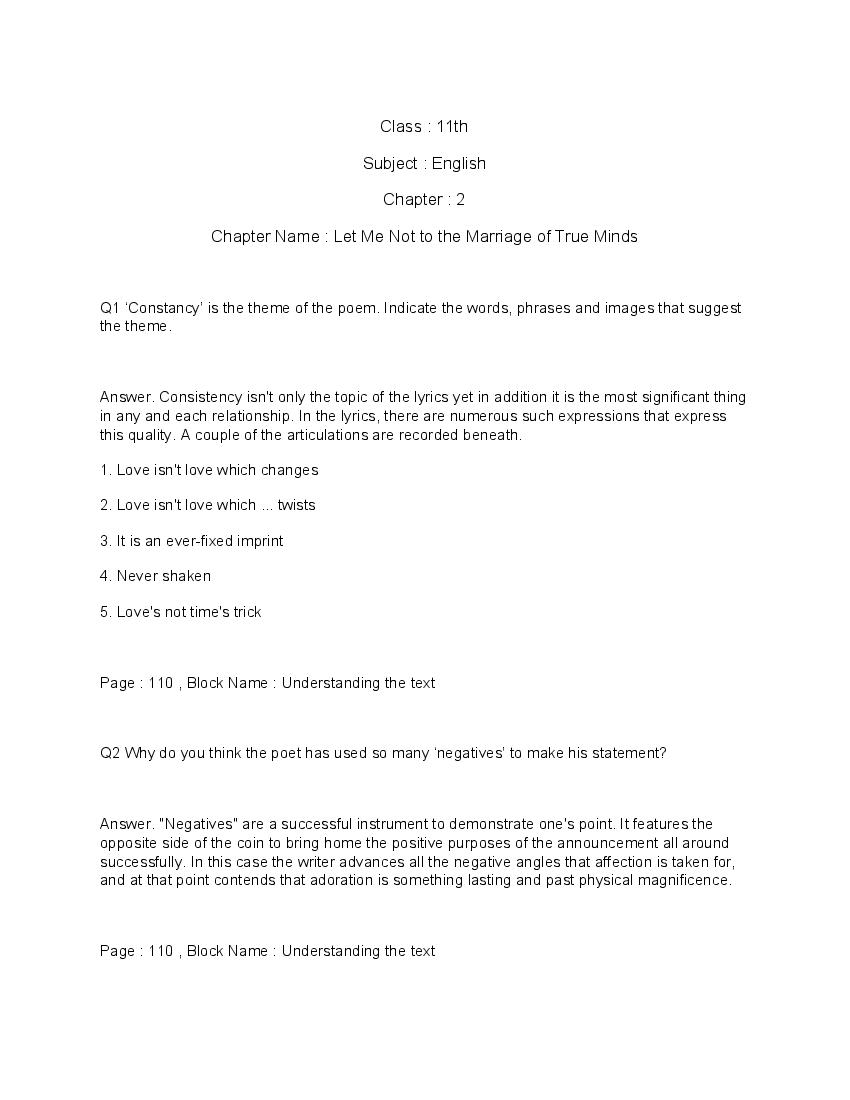
Subject : English
Chapter : 2
Chapter Name : Let Me Not to the Marriage of True Minds
Q1 ‘Constancy’ is the theme of the poem. Indicate the words, phrases and images that suggest
the theme.
Answer. Consistency isn't only the topic of the lyrics yet in addition it is the most significant thing
in any and each relationship. In the lyrics, there are numerous such expressions that express
this quality. A couple of the articulations are recorded beneath.
1. Love isn't love which changes
2. Love isn't love which ... twists
3. It is an ever-fixed imprint
4. Never shaken
5. Love's not time's trick
Q2 Why do you think the poet has used so many ‘negatives’ to make his statement?
Answer. "Negatives" are a successful instrument to demonstrate one's point. It features the
opposite side of the coin to bring home the positive purposes of the announcement all around
successfully. In this case the writer advances all the negative angles that affection is taken for,
and at that point contends that adoration is something lasting and past physical magnificence.
Page 2
Answer. It infers that on the off chance that the writer is refuted about these musings on
adoration, at that point he will retract all that he has composed, and no man has ever cherished.
Q4 Love is presented as the subject or doer of actions in the poem. Why do you think the poet
has used this form rather than involving human agents?
Answer. It isn't astonishing that Shakespeare has picked love as the subject and has not
included human specialists. The purpose behind his decision is clear and it the basic subject of
the ballad, the flighty idea of people. In any case, the affection, and everlasting being, is
consistent. Subsequently, the writer when discussed every one of the characteristics that
affection typifies and ought to be sans of, he picked love itself and not a human, whose feelings
and slants experience continuous changes. Shakespeare ought to be acknowledged for his
comprehension of human instinct and consequently an insightful choice made by him in his
organization.
Q5 Explain the phrases a. his bending sickle’s compass b. Time’s fool
Answer. (a) Compass is considered as an image of forever. In any case, in the ballad, it speaks
to the change that a relationship experiences as it develops, old and less extreme. How a man's
affection for his young darling becomes less as he offered an incentive to magnificence over the
profound love. Despite the fact that the affection never bites the dust, the physical excellence of
a darling may blur and shrinks as it tumbles to time's compass' sickle.
(b) Shakespeare says that adoration isn't helpless before time. Genuine affection is
ever-enduring. No matter how old a human develops, with it adore develops; however the
Page 3
relationship together.
Document Details
| Board / Org | NCERT |
| Exam | Class 11 |
| Type | Solution |
| Pages | 3 |
| Updated | 30 Apr 2026 |